
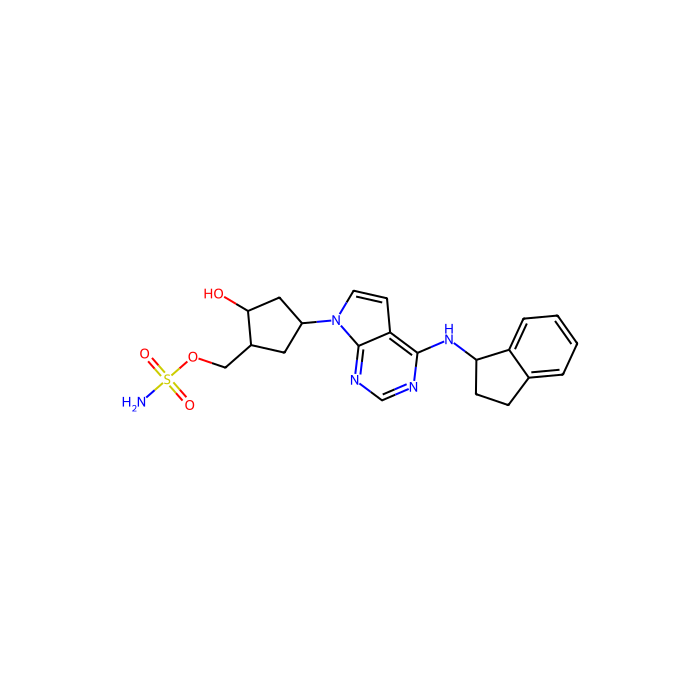
计算溶液所需的质量、体积或浓度。
| 活性类型 | 活性值-log(M) | 作用机制 | 期刊 | 参考文献(PubMed IDs) |
|---|
Moligand™ 级 ,适用于对基线干扰要求严格的色谱和分析工作流程。
-80℃储存。特低温运输 。请查阅批次 COA 获取详细规格。
SDS、COA、产品数据表及规格说明书均可下载。可通过批号查询获取批次 COA。
在色谱分析、有机合成和交叉偶联反应领域已被 1 篇同行评审文献引用。
MLN4924是一种有效的和选择性的NEDD8激活酶(NAE)抑制剂,IC50值为4 nM。
MLN4924与AMP竞争结合NAE的核苷酸结合位点。与密切相关的酶UAE、SAE、UBA6和ATG7(IC50值分别为1.5、8.2、1.8和10 μM)相比,MLN4924对NAE具有高选择性。MLN4924对其它利用ATP的酶没有作用。在HCT-116细胞中,MLN4924导致Ubc12-NEDD8硫酯和NEDD8-滞蛋白(cullin)缀合物的减少,从而抑制CRL-泛素化介导的蛋白降解(比如CDT1蛋白),CDT1蛋白的积累会引起细胞周期缺陷。在HCT-116异种移植小鼠中,MLN4924以30 mg/kg和60 mg/kg的剂量显著抑制肿瘤生长,这些剂量的耐受性良好。在H522和Calu-6肺癌异种移植小鼠中,MLN4924也具有抗肿瘤活性。
Pevonedistat (MLN4924)是Nedd8激活酶(NAE)的小分子抑制剂,IC50为4 nM。
Information
Pevonedistat (MLN4924) MLN4924 is a small molecule inhibitor of Nedd8 activating enzyme ( NAE ) with IC50 of 4 nM.
In vitro
MLN4924 is structurally related to adenosine 59-monophosphate (AMP)—a tight binding product of the NAE reaction. MLN4924 (3 μM) selectively inhibits NAE in HCT-116 cell lysates. MLN4924 (3 μM) inhibits overall protein turnover by <9% in HCT-116 cells. MLN4924 results in a dose-dependent decrease of Ubc12–NEDD8 thioester and NEDD8–cullin conjugates with an IC50 < 0.1 μM in HCT-116 cells, resulting in a reciprocal increase in the abundance of the known CRL substrates CDT1, p27 and NRF2, but not non-CRL substrates. MLN4924 (3 μM) leads cells to accumulate in S-phase as early as 8 hours and results in a significant fraction of cells contained 4N DNA content by 24 hours in HCT-116 cells. MLN4924 (3 μM) results in rapid accumulation of pIkappaBalpha, decrease in nuclear p65 content, reduction of nuclear factor-kappaB (NF-kappaB) transcriptional activity, and G(1) arrest, ultimately resulting in apoptosis induction, events consistent with potent NF-kappaB pathway inhibition in ABC DLBCL cells. MLN4924 (1 μM) triggers DNA replication and inhibit cell proliferation by stabilizing the DNA replication factor Cdt1, a substrate of cullins 1 and 4. MLN4924 (1 μM) , which is sufficient to elevate Cdt1 for 4-5 hours, is found to be sufficient to induce DNA replication and to activate apoptosis and senescence pathways. MLN4924 treatment induces the characteristics of senescence phenotypes as evidenced by enlarged and flattened cellular morphology and positive staining of senescence-associated β-Gal. MLN4924-induced senescence is associated with cellular response to DNA damage, triggered by accumulation of DNA-licensing proteins CDT1 and ORC1, as a result of inactivation of CRL/SCF E3s. MLN4924-induced senescence is irreversible and coupled with persistent accumulation of p21 and sustained activation of DNA damage response.
In vivo
MLN4924 (60 mg/kg) results in a dose- and time-dependent decrease of NEDD8–cullin levels as early as 30 min after administration in HCT-116 tumour-bearing mice, with maximal effect 1–2 hours post-dose. MLN4924 (60 mg/kg) also leads to a dose- and time-dependent increase in the steady state levels of NRF2 and CDT1 in HCT-116 tumour-bearing mice. MLN4924 (60 mg/kg) leads to DNA damage in the tumour indicated by the increased levels of phosphorylated CHK1 in HCT-116 tumour-bearing mice. MLN4924 administered on a BID schedule at 30 mg/kg and 60 mg/kg inhibits tumour growth with T/C values of 0.36 and 0.15, respectively, in mice bearing HCT-116 xenografts. MLN4924 (60 mg/kg) blocks NAE pathway biomarkers and results in complete tumor growth inhibition in mice bearing human xenograft tumors of ABC- and GCB-DLBCL. MLN4924 (60 mg/kg) results in NF-kappaB pathway inhibition accompanied by tumor regressions in primary human tumor mice models of ABC-DLBCL.
Cell Data
cell lines:
Concentrations:3 μM
Incubation Time:72 hours
Powder Purity:≥97%
| ALogP | 1.7 |
|---|


 危险品化学品经营许可证(带存储)