Measured by its ability to inhibit IL-1 alpha -induced IL-8 secretion in HepG2 human hepatocellular carcinoma cells. The ED50 for this effect is 0.8‑4 µg/mL in the presence of 1 μg/mL of recombinant human (rh) IL-1 R2 Fc Chimera and 50 pg/mL rhIL-1 alpha.
Coreceptor with IL1R1. Associates with IL1R1 bound to IL1B to form the high affinity interleukin-1 receptor complex which mediates interleukin-1-dependent activation of NF-kappa-B and other pathways. Signaling involves the recruitment of adapter molecules such as TOLLIP, MYD88, and IRAK1 or IRAK2 via the respective TIR domains of the receptor/coreceptor subunits. Recruits TOLLIP to the signaling complex. Does not bind to interleukin-1 alone; binding of IL1RN to IL1R1, prevents its association with IL1R1 to form a signaling complex. The cellular response is modulated through a non-signaling association with the membrane IL1R2 decoy receptor. Secreted forms (isoforms 2 and 3) associate with secreted ligand-bound IL1R2 and increase the affinity of secreted IL1R2 for IL1B; this complex formation may be the dominant mechanism for neutralization of IL1B by secreted/soluble receptors.
生物活性
Measured by its ability to inhibit IL-1 alpha -induced IL-8 secretion in HepG2 human hepatocellular carcinoma cells. The ED50 for this effect is 0.8‑4 µg/mL in the presence of 1 μg/mL of recombinant human (rh) IL-1 R2 Fc Chimera and 50 pg/mL rhIL-1 alpha.
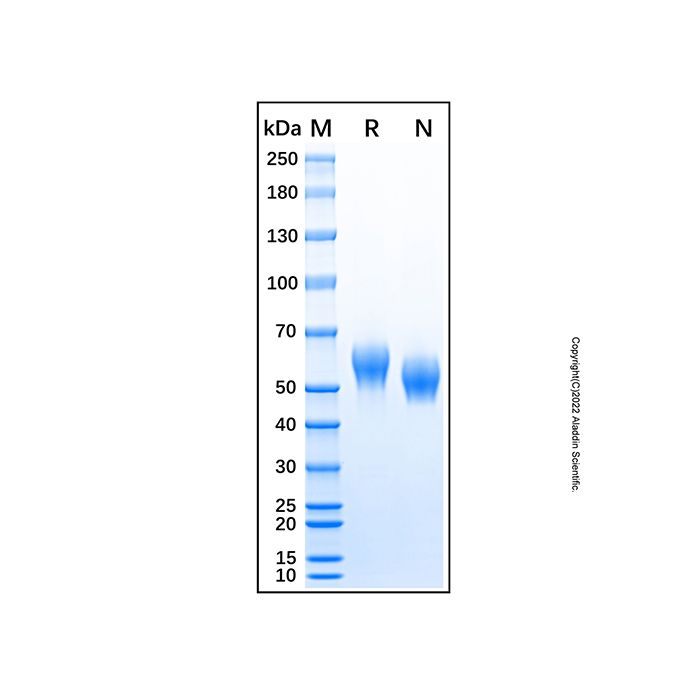
Recombinant Human IL-1 RAcP/IL-1 R3 Protein (rp147471) - SDS-PAGE
2 μg/lane of Recombinant Human IL-1 RAcP/IL-1 R3 Protein was resolved with SDS-PAGE under reducing (R) and non-reducing (N) conditions and visualized by Coomassie® Blue staining, showing the band at 57 kDa under reducing conditions and 53 kDa under non-reducing conditions.

 ZJ25F1129753


 危险品化学品经营许可证(带存储)