Function Transforming growth factor beta-2 proprotein Precursor of the Latency-associated peptide (LAP) and Transforming growth factor beta-2 (TGF-beta-2) chains, which constitute the regulatory and active subunit of TGF-beta-2, respectively. Latency-associated peptide Required to maintain the Transforming growth factor beta-2 (TGF-beta-2) chain in a latent state during storage in extracellular matrix. Associates non-covalently with TGF-beta-2 and regulates its activation via interaction with 'milieu molecules', such as LTBP1 and LRRC32/GARP, that control activation of TGF-beta-2. Transforming growth factor beta-2 Multifunctional protein that regulates various processes such as angiogenesis and heart development. Activation into mature form follows different steps: following cleavage of the proprotein in the Golgi apparatus, Latency-associated peptide (LAP) and Transforming growth factor beta-2 (TGF-beta-2) chains remain non-covalently linked rendering TGF-beta-2 inactive during storage in extracellular matrix. At the same time, LAP chain interacts with 'milieu molecules', such as LTBP1 and LRRC32/GARP, that control activation of TGF-beta-2 and maintain it in a latent state during storage in extracellular milieus. Once activated following release of LAP, TGF-beta-2 acts by binding to TGF-beta receptors (TGFBR1 and TGFBR2), which transduce signal.
Lyophilized from 10mM PBS, 5% Trehalose, 5% Mannitol, pH7.4.
复溶
Reconstitute in sterile water to a concentration of 0.1-0.5 mg/ml.
储存条件
-20°C储存,避免反复冻融
运输条件
超低温运输
稳定性与储存
在 -20~-80℃ 下可保存 1 年以上。复溶后建议分装。避免冷冻/解冻循环。
图片
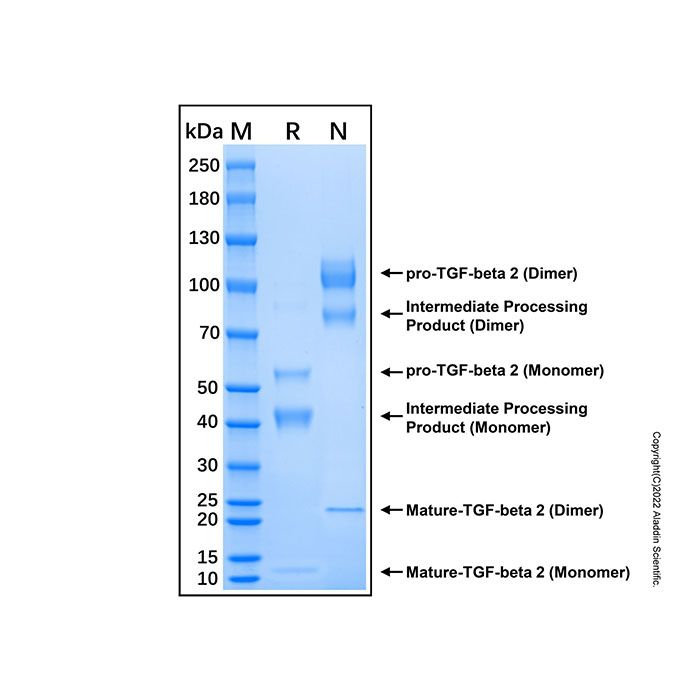
Recombinant Mouse TGF-beta 2 Protein (rp168042) - SDS-PAGE 2 μg/lane of Recombinant Mouse TGF-beta 2 Protein was resolved with SDS-PAGE under reducing (R) and non-reducing (N) conditions and visualized by Coomassie® Blue staining, showing the band at 12, 42, 55 kDa under reducing condition and 23, 82, 110 kDa under non-reducing condition.

 ZJ25F0724429


 危险品化学品经营许可证(带存储)