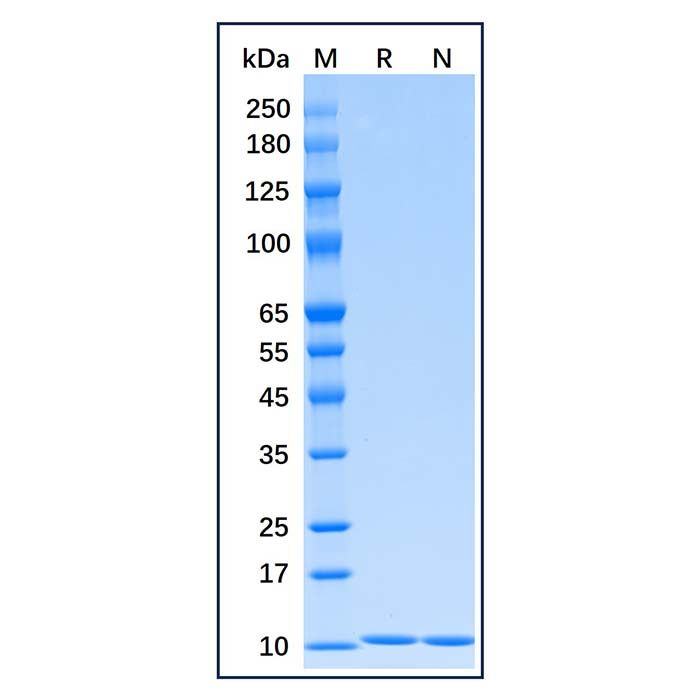
Purity:>95%, by SDS-PAGE visualized with Coomassie® Blue Staining. Description: Ubiquitin is a 76 amino acid (aa) protein that is ubiquitously expressed in all eukaryotic organisms. Ubiquitin is highly conserved with 96% aa sequence identity shared between human and yeast Ubiquitin, and 100% aa sequence identity shared between human and mouse Ubiquitin (1). In mammals, four Ubiquitin genes encode for two Ubiquitin-ribosomal fusion proteins and two poly-Ubiquitin proteins. Cleavage of the Ubiquitin precursors by deubiquitinating enzymes gives rise to identical Ubiquitin monomers each with a predicted molecular weight of 8.6 kDa. Conjugation of Ubiquitin to target proteins involves the formation of an isopeptide bond between the C-terminal glycine residue of Ubiquitin and a lysine residue in the target protein. This process of conjugation, referred to as ubiquitination or ubiquitylation, is a multi-step process that requires three enzymes: a Ubiquitin-activating (E1) enzyme, a Ubiquitin-conjugating (E2) enzyme, and a Ubiquitin ligase (E3). Ubiquitination is classically recognized as a mechanism to target proteins for degradation and as a result, Ubiquitin was originally named ATP-dependent Proteolysis Factor 1 (APF-1). In addition to protein degradation, ubiquitination has been shown to mediate a variety of biological processes such as signal transduction, endocytosis, and post-endocytic sorting.
We recommend that this vial be briefly centrifuged prior to opening to bring the contents to the bottom. Reconstitute at 0.5 mg/mL in sterile distilled water. Stock solutions should be apportioned into working aliquots and stored at ≤ -20 °C. Further dilutions should be made in appropriate buffered solutions.
储存条件
-20°C储存,避免反复冻融
运输条件
超低温运输
稳定性与储存
在 -20°C 下可保存 1 年。避免冷冻/解冻循环。
图片
Recombinant Human HA-Ubiquitin Protein (rp170435) - SDS-PAGE Recombinant Human HA-Ubiquitin Protein was resolved with SDS-PAGE under reducing (R) and non-reducing (N) conditions and visualized by Coomassie® Blue staining, showing a band at 10.4 kDa.

 ZJ23F1101779


 危险品化学品经营许可证(带存储)