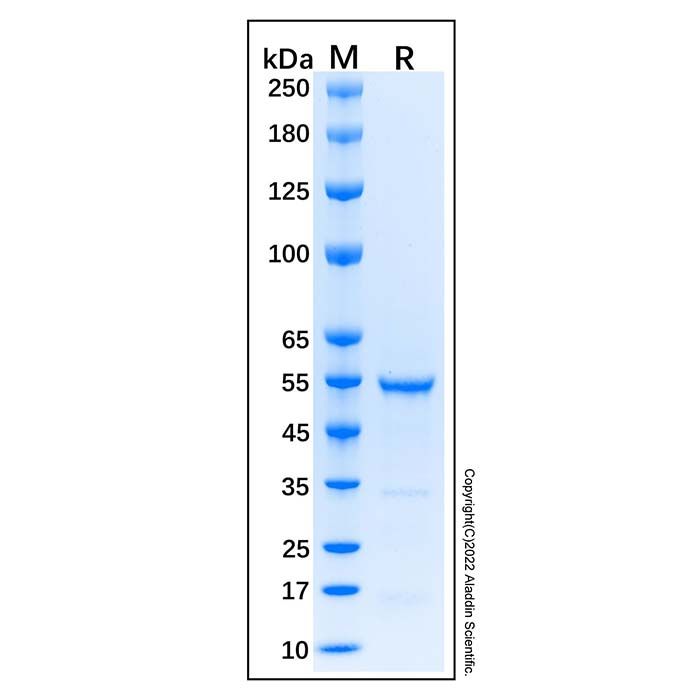
Purity:>90%, by SDS-PAGE visualized with Coomassie® Blue Staining. Description: Receptor-regulated SMAD (R-SMAD) that is an intracellular signal transducer and transcriptional modulator activated by TGF-beta (transforming growth factor) and activin type 1 receptor kinases. Binds the TRE element in the promoter region of many genes that are regulated by TGF-beta and, on formation of the SMAD3/SMAD4 complex, activates transcription. Also can form a SMAD3/SMAD4/JUN/FOS complex at the AP-1/SMAD site to regulate TGF-beta-mediated transcription. Has an inhibitory effect on wound healing probably by modulating both growth and migration of primary keratinocytes and by altering the TGF-mediated chemotaxis of monocytes. This effect on wound healing appears to be hormone-sensitive. Regulator of chondrogenesis and osteogenesis and inhibits early healing of bone fractures. Positively regulates PDPK1 kinase activity by stimulating its dissociation from the 14-3-3 protein YWHAQ which acts as a negative regulator.
We recommend that this vial be briefly centrifuged prior to opening to bring the contents to the bottom. Reconstitute at 1.0 mg/mL in sterile distilled water. Stock solutions should be apportioned into working aliquots and stored at ≤ -20 °C. Further dilutions should be made in appropriate buffered solutions.
储存条件
-20°C储存,避免反复冻融
运输条件
超低温运输
稳定性与储存
在 -20°C 下可保存 1 年,在 2-8°C 下可保存 1 个月。避免冷冻/解冻循环。
图片
Recombinant Human Smad3 Protein (rp184657) - SDS-PAGE 2 μg/lane of Recombinant Human Smad3 Protein was resolved with SDS-PAGE under reducing (R) and visualized by Coomassie® Blue staining, showing a band at 53.5 kDa under reducing conditions.

 ZJ24F0404082


 危险品化学品经营许可证(带存储)