
计算溶液所需的质量、体积或浓度。
为什么选择此级别
,适用于对基线干扰要求严格的色谱和分析工作流程。
储存与运输
避光,室温。常规运输 。请查阅批次 COA 获取详细规格。
质量文档
SDS、COA、产品数据表及规格说明书均可下载。可通过批号查询获取批次 COA。
文献证明
在色谱分析、有机合成和交叉偶联反应领域已被 1678 篇同行评审文献引用。
规格
别名
三氧化二铝
英文别名
CL3430 | GK (Oxide) | LMI26O6933 | A1-3438 T 1/8'' | beta-Aluminum oxide | G 0 (Oxide) | Hypalox II | Aluminum oxide (2:3) | ALUMINUM OXIDE, ANHYDROUS [EP IMPURITY] | Quinolin-2-ol, 6-methoxy-4-methyl- | Abramax | ALUMINUM OXIDE, ANHYDROUS (EP IMPURITY) |
规格或纯度
Phosphotungstic acid modified alumina
英文名称
Aluminum oxide
储存条件
避光,室温
运输条件
常规运输
名称和识别符
EC号
215-691-6
分子类型
小分子
IUPAC Name
dialuminum;oxygen(2-)
INCHI
1S/2Al.3O/q2*+3;3*-2
InChi Key
PNEYBMLMFCGWSK-UHFFFAOYSA-N
Smiles
O=[Al]O[Al]=O
Isomeric SMILES
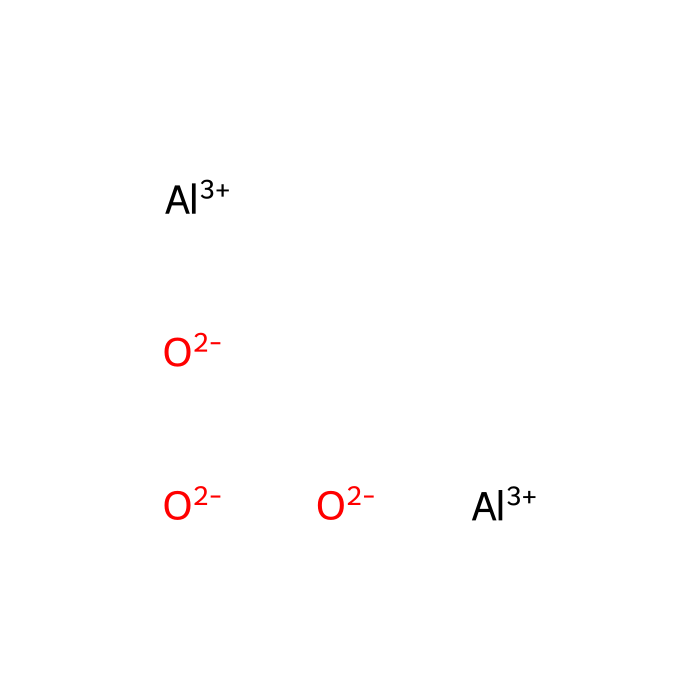
[O-2].[O-2].[O-2].[Al+3].[Al+3]
分子量
101.96
Reaxy-Rn
11323344
Reaxys-RN link address
https://www.reaxys.com/reaxys/secured/hopinto.do?context=S&query=IDE.XRN=11323344&ln=
技术文档
高级数据
系统学分类
分类树(Taxonomy Tree)
-
界(kingdom)
无机化合物
-
超类(Superclass)
混合金属/非金属化合物
- 类(Class) 后过渡金属盐
-
超类(Superclass)
混合金属/非金属化合物
| 界(kingdom) | 无机化合物 |
|---|---|
| 超类(Superclass) | 混合金属/非金属化合物 |
| 类(Class) | 后过渡金属盐 |
| 亚类(Subclass) | 暂无 |
| 中间层级节点(Intermediate Tree Nodes) | 暂无 |
| 直接上位类(Direct Parent) | 后过渡金属盐 |
| 其他上位类(Alternative Parents) | 杂项混合金属/非金属 无机盐 |
| 分子骨架(Molecular Framework) | 暂无 |
| 取代基(Substituents) | 无机过渡金属盐 - 无机盐 - 甲基吡啶 |
| 描述(Description) | 该化合物属于无机化合物中的后过渡金属盐类。这类无机卤化物中,最重的金属原子为后过渡金属。 |
| 外部描述符(External Descriptors) | 暂无 |
三维结构
交互式化学结构模型
化学和物理性质
密度
3.968
敏感性
对湿度敏感
折光率
1.768
沸点
2977°C
熔点
2000°C
分子量
101.961 g/mol
XLogP3
氢键供体数Hydrogen Bond Donor Count
0
氢键受体数Hydrogen Bond Acceptor Count
3
可旋转键计数Rotatable Bond Count
0
精确质量Exact Mass
101.948 Da
单同位素质量Monoisotopic Mass
101.948 Da
拓扑极表面积Topological Polar Surface Area
3.000 Ų
重原子数Heavy Atom Count
5
形式电荷Formal Charge
0
复杂度Complexity
0.000
同位素原子数Isotope Atom Count
0
定义的原子立体中心计数Defined Atom Stereocenter Count
0
未定义的原子立体中心计数Undefined Atom Stereocenter Count
0
定义的键立体中心计数Defined Bond Stereocenter Count
0
未定义的键立体中心计数Undefined Bond Stereocenter Count
0
所有立体化学键的总数The total count of all stereochemical bonds
0
共价键合单元计数Covalently-Bonded Unit Count
5
安全和危险性(GHS)
RTECS
BD1200000
质检证书(CoA,COO,BSE/TSE 和分析图谱)
C of A & Other Certificates(BSE/TSE, COO):
输入批号以搜索分析图谱:
技术文档和文章
钼:读懂这枚关键元素
目录: 技术文章
How to Choose Alumina Products? — A Practical Guide from Fundamental Concepts to Application Categories
目录: 技术文章
Nanowires: Properties, Preparation Routes, and Process Selection (Comprehensive Analysis of Top-Down and Bottom-Up Approaches with Recommended Aladdin Reagents)
目录: 技术文章
Cobalt Catalysts—From Fundamentals to Practice: Mechanistic Insights, Selection Logic, and a One-Stop Aladdin Selection List
目录: 技术文章
Minute-Scale Construction of Fluorinated Nitrogen-Bridged Bicycles: Pd(II)/Pd(IV) Cascade Chemistry and a Pd(IV) “Dyotropic (Paired-Migration)” Rearrangement Driving Strain-Release Ring Expansion
目录: 技术文章
High-Refractive-Index vs Low-Refractive-Index Coating Materials: From AR/Waveguide Principles to a Formulation & Material-Selection Map (Including Product Category Tables A/B/C)
目录: 技术文章
SOFC Solid Oxide Fuel Cells: From “What It Is and How It Generates Power” to a Key Materials Map, Application Scenarios, and Selection Navigation (Electrolytes / Electrodes / Interconnects / Sealing)
目录: 技术文章
Panorama Guide to Lithium-Ion Battery Electrode Materials: Working Principles, Materials Map, and Selection Navigation (incl. Tables 1–4)
目录: 技术文章
Post-Transition Metals and Their Salts: A Classification Guide from Definitions to Value-Chain Applications (Including Product Lists in Tables 1–4)
目录: 技术文章
Optical & Optoelectronic Materials Selection Guide:Positioning materials, key metrics, and validation paths along “Generation → Guiding → Control → Readout” (with product navigation and Tables 1–4)
目录: 技术文章
Ceramic Materials Guide: Basic Definitions, Classification Framework, and Research-Task-Oriented Selection (with Product Navigation and Tables 1–4)
目录: 技术文章
Why Metal Nanocatalysts Can “Save Energy Yet Lose Performance Easily”: Durability Logic from Active Sites to Support/Interface Engineering (Including Selection Guide and Product Tables A–D)
目录: 技术文章
Applications of Self-Assembled Monolayers (SAMs), Microcontact Printing, and Soft Lithography in Surface Functionalization and Micro/Nanopatterning
目录: 技术文章
Self-Assembled Nanodielectrics (SANDs): Self-Assembled Nanodielectric Layers for Low-Voltage Thin-Film Transistors (with Product Selection Guide)
目录: 技术文章
Research Value of Polyelectrolyte Multilayers: Layer-by-Layer Design of Interfacial Composition, Mass Transport, and Function
目录: 技术文章
Polyetherimide (PEI): Structural Features, Main Properties, and Typical Application Directions
目录: 技术文章
Experimental Selection and Outcome Assessment of Heterogeneous Metal Catalysts in Organic Synthesis
目录: 技术文章
What Is Silica Sol: Mechanism of Action, Application Scenarios, and Selection Criteria for Nanosilica Dispersions
目录: 技术文章
Limitations and Future Development of Epoxy Resins: Safety, Environmental Protection, Recycling, Bio-Based Materials, and High-Performance Trends
目录: 技术文章
Four Core Applications of Epoxy Resins: Bonding, Protection, Load-Bearing, and Insulation Protection
目录: 技术文章
Guide to Epoxy Resin Performance Design: System Composition, Key Properties, Process Control, and Application Selection
目录: 技术文章
Guide to Selecting Polyurethane Coating Systems: Application Analysis for Wood, Flooring, Plastics, Automotive, and Industrial Protection
目录: 技术文章
Comprehensive Performance Analysis of Polyurethane Coating Films: Soft/Hard Segment Structure, Microphase Separation, Crosslinking and Curing, and Selection of Representative Chemicals
目录: 技术文章
Structure–Property Relationship of Silicone Resins: Mechanisms of Heat Resistance, Weatherability, Hydrophobicity, and Coating Performance Analysis
目录: 技术文章
Silicone Resin Coating Formulation Design: From Application Conditions to Matching Resins, Pigments and Fillers, Curing, and Substrates
目录: 技术文章
How Should Montmorillonite Be Rationally Modified? Organic Modification, Inorganic Modification, and Application-Oriented Selection and Validation
目录: 技术文章
Structural Design Logic of Common Resin Modification Technologies: Molecular Chain Structure, Functional Groups, Phase Structure, Crosslinked Networks, and Hybrid/Functional Design
目录: 技术文章
Resin Polarity in Coating Formulations: From Molecular Structure to Dissolution, Compatibility, Interfacial Interactions, and Formulation Design
目录: 技术文章
Signal Transduction Mechanism of Graphene Biosensors: From Molecular Recognition to Electrical/Optical Signal Readout and Materials Selection
目录: 技术文章
Color-Development Mechanisms, Formulation Forms, and Selection/Application Logic of Colorants in Personal Care Products
目录: 技术文章
Vanadium-Aluminum Master Alloy: Vanadium Source Control and Quality Essentials in High-End Titanium Alloy Melting
目录: 技术文章
此产品的引用文献
溶液计算器
常见问题
本产品应如何储存?
请于室温、避光条件下保存。本品对光敏感,请保存在原始的避光或棕色容器中。
本产品如何运输?
本产品按常温标准条件运输,无需温控包装。
本产品的 CAS 号、分子式和分子量是多少?
本产品的 CAS 号为 1344-28-1,分子式为 Al2O3,分子量为 101.96 g/mol。InChIKey PNEYBMLMFCGWSK-UHFFFAOYSA-N。
如何获取批次专用COA?
每个订单都会随附分析证书(COA),您也可以从账户订单历史中下载。如需订购前的COA,请联系您的客户代表,或使用PDP上的"申请COA"按钮——我们将提供代表性批次的COA。
产品仅提供给经过验证的企业、机构和合格的专业人员用于研发。不适用于人类、动物、诊断或治疗。
Copyright © 2023至今 上海阿拉丁生化科技股份有限公司 保留所有权利。


 危险品化学品经营许可证(带存储)