Acts as an E3 ubiquitin-protein ligase which accepts ubiquitin from an E2 ubiquitin-conjugating enzyme in the form of a thioester and then directly transfers the ubiquitin to targeted substrates. It catalyzes 'Lys-29'-, 'Lys-48'- and 'Lys-63'-linked ubiquitin conjugation. It is involved in the control of inflammatory signaling pathways. Is an essential component of a ubiquitin-editing protein complex, comprising also TNFAIP3, TAX1BP1 and RNF11, that ensures the transient nature of inflammatory signaling pathways. Promotes the association of the complex after TNF stimulation. Once the complex is formed, TNFAIP3 deubiquitinates 'Lys-63' polyubiquitin chains on RIPK1 and catalyzes the formation of 'Lys-48'-polyubiquitin chains. This leads to RIPK1 proteosomal degradation and consequently termination of the TNF- or LPS-mediated activation of NFKB1. Ubiquitinates RIPK2 by 'Lys-63'-linked conjugation and influences NOD2-dependent signal transduction pathways. Regulates the transcriptional activity of several transcription factors, and probably plays an important role in the regulation of immune response. Ubiquitinates NFE2 by 'Lys-63' linkages and is implicated in the control of the development of hematopoietic lineages. Critical regulator of T helper (TH2) cytokine development through its ability to induce JUNB ubiquitination and degradation (By similarity). Ubiquitinates SNX9. Ubiquitinates CXCR4 and HGS/HRS and regulates sorting of CXCR4 to the degradative pathway. It is involved in the negative regulation of MAVS-dependent cellular antiviral responses. Ubiquitinates MAVS through 'Lys-48'-linked conjugation resulting in MAVS proteosomal degradation. Involved in the regulation of apoptosis and reactive oxygen species levels through the ubiquitination and proteosomal degradation of TXNIP. Mediates the antiapoptotic activity of epidermal growth factor through the ubiquitination and proteosomal degradation of p15 BID. Targets DTX1 for lysosomal degradation and controls NOTCH1 degradation, in the absence of ligand, through 'Lys-29'-linked polyubiquitination.
Post-translational: "On T-cell activation, phosphorylation by the JNK cascade on serine and threonine residues surrounding the PRR domain accelerates the ubiquitination and degradation of JUN and JUNB. The increased ITCH catalytic activity due to phosphorylation by JNK1 may occur due to a conformational change disrupting the interaction between the PRR/WW motifs domain and the HECT domain and, thus exposing the HECT domain (By similarity). Phosphorylation by FYN reduces interaction with JUNB and negatively controls JUN ubiquitination and degradation. Ubiquitinated; autopolyubiquitination with 'Lys-63' linkages which does not lead to protein degradation.
宿主种属
兔(Rabbit)
特异性
ITCH
种属反应性
人(Human),小鼠(Mouse)
免疫原
A synthetic peptide derived from human ITCH/AIP4 (AA 27-40)
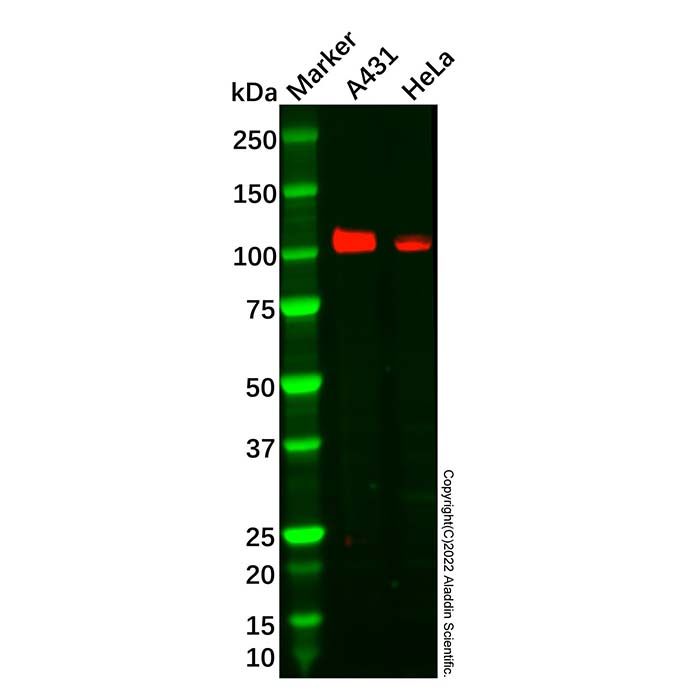
Recombinant ITCH/AIP4 Antibody (Ab111347) - Western Blot All lanes: Recombinant ITCH/AIP4 Antibody (Ab111347) at 1/1000 dilution Samples: Lysates at 20 µg per lane Secondary: Goat Anti-Rabbit IgG H&L (HRP) (Ab170144) at 1/30000 dilution
Predicted band size: 103 kDa Observed band size: 107 kDa Exposure time: 30.0 s
Recombinant ITCH/AIP4 Antibody (Ab111347) - Western Blot All lanes: Recombinant ITCH/AIP4 Antibody (Ab111347) at 1/1000 dilution Samples: Lysates at 20 µg per lane Secondary: Goat Anti-Rabbit IgG H&L (HRP) (Ab170144) at 1/30000 dilution
Predicted band size: 103 kDa Observed band size: 107 kDa Exposure time: 100.0 s

 ZJ26F0737769


 危险品化学品经营许可证(带存储)