
计算溶液所需的质量、体积或浓度。
| 活性类型 | 活性值-log(M) | 作用机制 | 期刊 | 参考文献(PubMed IDs) |
|---|
Moligand™ 级 ,适用于对基线干扰要求严格的色谱和分析工作流程。
-80℃储存。特低温运输 。请查阅批次 COA 获取详细规格。
SDS、COA、产品数据表及规格说明书均可下载。可通过批号查询获取批次 COA。
在色谱分析、有机合成和交叉偶联反应领域已被 58 篇同行评审文献引用。
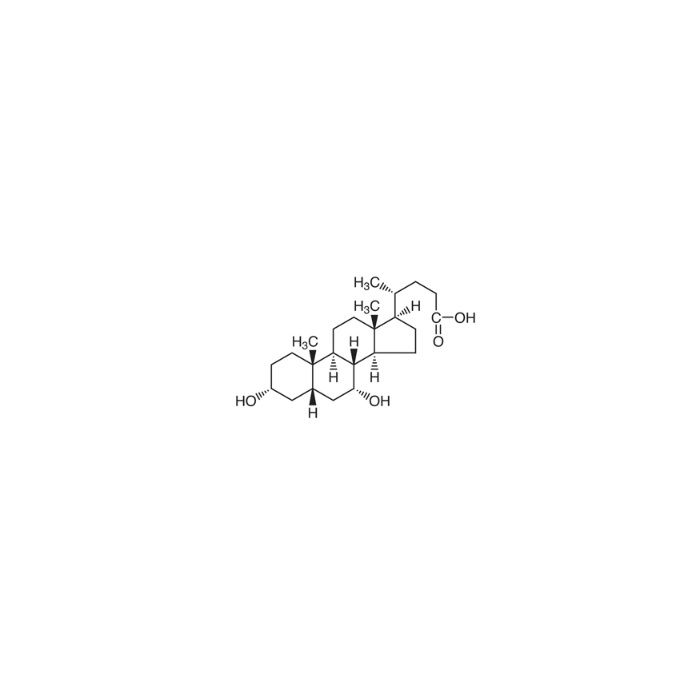
Chenodeoxycholic Acid, Free Acid and its 7β-isomer ursodeoxycholic acid are potent (nanomolar affinity) selective inhibitors of DD2 (AKR1C2). These compounds were non-competitive inhibitors of AKR1D1 yielding Ki values of 3.2 μM for chenodeoxycholic acid. This chemical is a hydrophobic primary bile acid, which increases intracellular Ca2+ in rat hepatocyte couplets. Studies indicate that Chenodeoxycholic Acid induces apoptosis throμgh a PKC dependent pathway. It is known that Chenodeoxycholic Acid is essential in the metabolism of cholesterol via activation of nuclear receptors. This bile acid can also bind to BABP with a stoichiometery of 1:2. Alternate studies indicate that chenodeoxycholic acid can inhibit the expression of IL-6 and cell viability in QBC939 cells.An apoptosis inducer via PKC-dependent signalling pathway.
Information
Chenodeoxycholic Acid Chenodeoxycholic Acid (Chenodiol) is a naturally occurring human bile acid, and inhibits production of cholesterol in the liver and absorption in the intestines. Chenodeoxycholic Acid is a hydrophobic primary bile acid that activat
In vitro
Chenodeoxycholic acid (CDCA) and Deoxycholic acid (DCA) both inhibits 11 beta HSD2 with IC(50) values of 22 mM and 38 mM, respectively and causes cortisol-dependent nuclear translocation and increases transcriptionalactivity of mineralocorticoid receptor (MR). Chenodeoxycholic acid is able to stimulate Ishikawa cell growth by inducing a significant increase in Cyclin D1 protein and mRNA expression through the activation of the membrane G protein-coupled receptor (TGR5)-dependent pathway. Chenodeoxycholic acid (CDCA) induces LDL receptor mRNA levels approximately 4 fold and mRNA levels for HMG-CoA reductase and HMG-CoA synthase two fold in a cultured human hepatoblastoma cell line, Hep G2. Chenodeoxycholic acid-induced Isc is inhibited (≥67%) by Bumetanide, BaCl2, and the cystic fibrosis transmembrane conductance regulator (CFTR) inhibitor CFTRinh-172. Chenodeoxycholic acid-stimulated Isc is decreased 43% by the adenylate cyclase inhibitor MDL12330A and Chenodeoxycholic acid increases intracellular cAMP concentration. Chenodeoxycholic acid treatment activates C/EBPβ, as shown by increases in its phosphorylation, nuclear accumulation, and expression in HepG2 cells. Chenodeoxycholic acid enhances luciferase gene transcription from the construct containing -1.65-kb GSTA2 promoter, which contains C/EBP response element (pGL-1651). Chenodeoxycholic acid treatment activates AMP-activated protein kinase (AMPK), which leads to extracellular signal-regulated kinase 1/2 (ERK1/2) activation, as evidenced by the results of experiments using a dominant-negative mutant of AMPKα and chemical inhibitor.
In vivo
Cell Data
cell lines:
Concentrations:
Incubation Time:
Powder Purity:≥99%
| ALogP | 4.9 |
|---|


 危险品化学品经营许可证(带存储)