谷氨酸(Glu)广泛存在于动物、植物、微生物和培养细胞中,不仅是组成蛋白质的20种氨基酸 之一,还可以通过转氨基作用参与多种氨基酸合成,是生物体内主要氨基来源之一。谷氨酸脱氢酶 (GDH)和谷氨酸合成酶(GOGAT)共同参与谷氨酸的合成,在氨同化和转化成有机氮化合物的代 谢中起重要作用。
检测原理:GDH催化NH₄⁺、NADH 和α-酮戊二酸,生成谷氨酸和 NAD⁺,引起340nm吸光度下降,通过测定340nm吸光度的下降速率,计算GDH活性。
G1505936
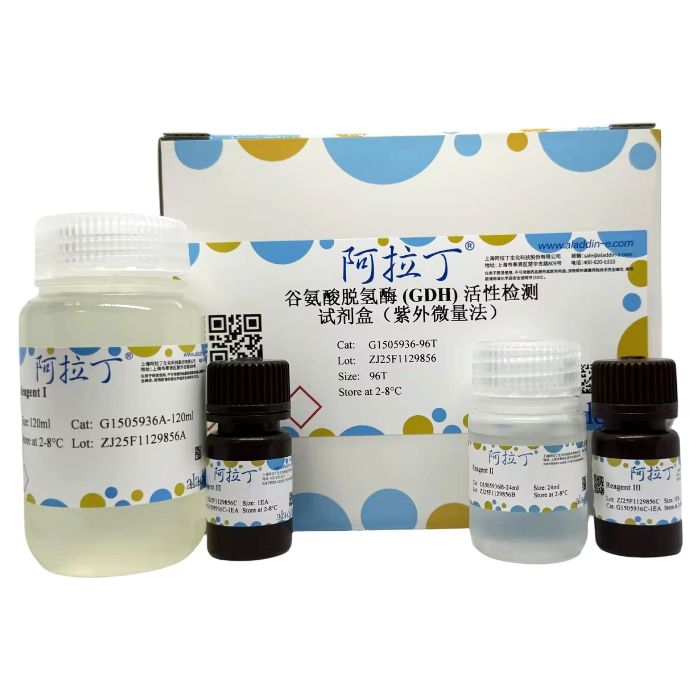
| Component
| 48T
| 96T
| Storage
|
G1505936A
| Reagent Ⅰ
| 60 mL
| 120 mL
| 2-8℃
|
G1505936B
| Reagent Ⅱ
| 12 mL | 24 mL | 2-8℃
|
G1505936C
| Reagent Ⅲ
| 1EA | 2EA
| 2-8℃. Store in the dark. |
注意:正式检测前,建议选择2-3个预期差异较大的样本进行预实验。
自备仪器和试剂
1、酶标仪或紫外分光光度计(能测340nm处的吸光度)
2、96孔UV板或微量石英比色皿、可调节式移液枪及枪头
3、制冰机、低温离心机
4、去离子水
5、匀浆器(如果是组织样本)
实验流程
1、试剂准备
| 试剂名称 | 试剂准备 | 注意事项 |
Reagent Ⅰ
| 即用型;使用前平衡到室温
| 4℃保存 |
Working Solution
| 临用前配制,每瓶Reagent Ⅲ中加入11.7mL Reagent Ⅱ,充分混匀待用,现配现用
| 4℃避光保存 |
2、样本制备
注意:
(1) 推荐使用新鲜样本。测定过程中,样本和所有试剂在冰上放置,以免变性和失活。
(2) 如需测定蛋白浓度,推荐使用阿拉丁B665595 BCA蛋白定量试剂盒或R1491648 即用型BCA蛋白定量试剂盒。
2.1 组织
称取约0.1g样本,加入1mL Reagent Ⅰ,冰浴匀浆,8,000g,4℃离心10min,取上清液,置冰上待测。
2.2 细胞(菌)
收集500万细胞(菌)到离心管内,用冷PBS清洗,离心后弃上清,加入1mL Reagent Ⅰ,冰浴超声波破碎5min(功率20%或200W,超声3s,间隔7s,重复30次),然后8,000g,4℃离心10min,取上清液,置冰上待测。
2.3 血清(浆)样本
直接检测。
3、实验步骤
3.1 酶标仪或紫外分光光度计预热30min以上,调节波长到340nm。紫外分光光度计用去离子水调零。
3.2 Working Solution于37℃(哺乳动物)或25℃(其他物种)孵育30min。
3.3 操作表(下述操作在96孔UV板或微量石英比色皿中操作)
试剂
| 测定孔(μL)
|
样本
| 10
|
Working Solution
| 190
|
3.4 迅速混匀后,于340nm检测,记录20s和5min 20s的吸光值,分别记为A1和A2,计算ΔA测=A1-A2。
注意:实验之前建议选择2-3个预期差异大的样本做预实验。如果ΔA测小于0.005,可适当加大样本量。如果ΔA测大于0.5,样本可用Reagent Ⅰ进一步稀释,计算结果乘以稀释倍数。因通过单位时间内吸光值的变化计算酶活,不推荐同时测多个样本。
4、结果计算
注意:我们为您提供的计算公式,包括推导过程计算公式和简洁计算公式。两者完全相等。建议以加粗的简洁计算公式为最终计算公式。
4.1 使用96孔UV板测定的计算公式
(1) 血清(浆)GDH活力的计算
单位的定义:每毫升血清(浆)每分钟消耗1nmol的NADH定义为一个酶活力单位。
GDH (U/mL)=[ΔA测×V反总÷(ε×d)×109]÷V样本÷T=1286×ΔA测
(2) 组织中GDH活力的计算
A. 按样本蛋白浓度计算
单位的定义:每mg组织蛋白每分钟消耗1nmol的NADH定义为一个酶活力单位。
GDH (U/mg prot)=[ΔA测×V反总÷(ε×d)×109]÷(V样本×Cpr)÷T=1286×ΔA测÷Cpr
B. 按样本鲜重计算
单位的定义:每g组织每分钟消耗1nmol的NADH定义为一个酶活力单位。
GDH (U/g 鲜重)=[ΔA测×V反总÷(ε×d)×109]÷(W÷VReagent Ⅰ×V样本)÷T=1286×ΔA测÷W
C. 按细胞(菌)密度计算
单位的定义:每1万个细胞(菌)每分钟消耗1nmol的NADH定义为一个酶活力单位。
GDH (U/104)=[ΔA测×V反总÷(ε×d)×109]÷(V样本÷VReagent Ⅰ×500)÷T=2.572×ΔA测
参数说明:
V反总:反应体系总体积,0.2mL=2×10⁻⁴L;
VReagent Ⅰ:加入Reagent Ⅰ体积,1mL;
V样本:加入样本体积,0.02mL;
ε:NADH摩尔消光系数,6.22×103L/mol/cm;
d:96孔UV板直径,0.5cm;
Cpr:蛋白浓度(mg/mL);
T:反应时间,5min;
W:样本质量,g;
500:细胞(菌)总数,500万;
109:单位换算系数,1mol=109nmol。
4.2 使用微量石英比色皿测定的计算公式
将上述计算公式中的光径d: 0.5cm调整为d: 1cm进行计算即可。
注意事项
1、正式检测前,建议选择2-3个预期差异较大的样本进行预实验。
2、本产品仅供科学研究使用,不适用于临床诊断。为了您的安全和健康,请穿实验服并戴一次性手套操作。
Glutamate (Glu) is widely found in animals, plants, microorganisms, and cultured cells. It is not only one of the 20 amino acids that make up proteins but also participates in the synthesis of various amino acids through transamination, serving as a major source of amino groups in organisms. Glutamate Dehydrogenase (GDH) and Glutamate Synthase (GOGAT) jointly participate in the synthesis of glutamate, playing important roles in the metabolism of ammonia assimilation and conversion into organic nitrogen compounds.
Detection Principle: GDH catalyzes the reaction of NH₄⁺, NADH, and α-ketoglutarate to produce glutamate and NAD⁺, leading to a decrease in absorbance at 340 nm. The GDH activity is calculated by measuring the rate of decrease in absorbance at 340 nm.
G1505936
| Component
| 48T
| 96T
| Storage
|
G1505936A
| Reagent Ⅰ
| 60 mL
| 120 mL
| 2-8℃
|
G1505936B
| Reagent Ⅱ
| 12 mL | 24 mL | 2-8℃
|
G1505936C
| Reagent Ⅲ
| 1EA | 2EA
| 2-8℃. Store in the dark. |
Note: Before formal testing, it is recommended to perform a preliminary experiment using 2-3 samples expected to have significant differences.
Required Instruments and Reagents
1. Microplate reader or UV spectrophotometer (capable of measuring absorbance at 340 nm)
2. 96-well UV plate or micro quartz cuvettes, adjustable pipettes and tips
3. Ice maker, refrigerated centrifuge
4. Deionized water
5. Homogenizer (for tissue samples)
Experimental Procedure
1. Reagent Preparation
Reagent Name
| Reagent Preparation
| Notes
|
Reagent Ⅰ
| Ready-to-use; Equilibrate to room temperature before use.
| Store at 4℃
|
Working Solution
| Prepare immediately before use: Add 11.7 mL of Reagent Ⅱ to each bottle of Reagent Ⅲ and mix thoroughly.
| Prepare fresh before use; store at 4℃ protected from light. |
2. Sample Preparation
Notes:
(1) Fresh samples are recommended. During the assay, keep samples and all reagents on ice to prevent denaturation and inactivation.
(2) If protein concentration measurement is required, the use of Aladdin's B665595 BCA Protein Quantification Kit or R1491648 Ready-to-Use BCA Protein Quantification Kit is recommended.
2.1 Tissue
Weigh approximately 0.1 g of sample, add 1 mL of Reagent Ⅰ, and homogenize on ice. Centrifuge at 8,000 g, 4°C for 10 min. Collect the supernatant and keep it on ice for testing.
2.2 Cells (Bacteria)
Collect 5 million cells (bacteria) into a centrifuge tube. Wash with cold PBS, centrifuge, and discard the supernatant. Add 1 mL of Reagent Ⅰ. Disrupt the cells using ice-bath ultrasonication for 5 minutes (power 20% or 200 W, ultrasonic for 3 s, interval 7 s, repeat 30 times). Then centrifuge at 8,000 g, 4°C for 10 min. Collect the supernatant and keep it on ice for testing.
2.3 Serum (Plasma) samples
Can be detected directly.
3. Experimental Steps
3.1 Preheat the microplate reader or UV spectrophotometer for at least 30 minutes. Set the wavelength to 340 nm. For the UV spectrophotometer, zero it with deionized water.
3.2 Incubate the Working Solution at 37°C (for mammals) or 25°C (for other species) for 30 minutes.
3.3 Operation Table (Perform the following steps in a 96-well UV plate or micro quartz cuvette)
Reagent
| Test Well (μL)
|
Sample
| 10
|
Working Solution
| 190
|
3.4 Mix quickly and measure the absorbance at 340 nm immediately. Record the absorbance values at 20 seconds and 5 minutes 20 seconds, denoted as A1 and A2 respectively. Calculate ΔATest = A1 - A2.
Note: It is recommended to perform a preliminary experiment with 2-3 samples expected to have large differences before the formal experiment. If ΔATest is less than 0.005, consider appropriately increasing the sample volume. If ΔATest is greater than 0.5, the sample can be further diluted with Reagent Ⅰ, and the calculated result should be multiplied by the dilution factor. Since enzyme activity is calculated based on the absorbance change per unit time, it is not recommended to measure multiple samples simultaneously.
4. Calculation of Results
Note: We provide two types of calculation formulas: the derived process formula and the simplified formula. They are completely equivalent. It is recommended to use the simplified formula in bold as the final calculation formula.
4.1 Calculation Formulas for using 96-well UV Plate
(1) Calculation of GDH Activity in Serum (Plasma)
Unit Definition: One unit of enzyme activity is defined as the amount of enzyme that consumes 1 nmol of NADH per minute per milliliter of serum (plasma).
GDH (U/mL) = [ΔATest × VReaction Total ÷ (ε × d) × 109] ÷ VSample ÷ T = 1286 × ΔATest
(2) Calculation of GDH Activity in Tissue
A. Calculation based on sample protein concentration
Unit Definition: One unit of enzyme activity is defined as the amount of enzyme that consumes 1 nmol of NADH per minute per milligram of tissue protein.
GDH (U/mg prot) = [ΔATest × VReaction Total ÷ (ε × d) × 109] ÷ (VSample × Cpr) ÷ T = 1286 × ΔATest ÷ Cpr
B. Calculation based on sample fresh weight
Unit Definition: One unit of enzyme activity is defined as the amount of enzyme that consumes 1 nmol of NADH per minute per gram of tissue.
GDH (U/g fresh weight) = [ΔATest × VReaction Total ÷ (ε × d) × 109] ÷ (W ÷ VReagent Ⅰ × VSample) ÷ T = 1286 × ΔATest ÷ W
C. Calculation based on cell (bacterial) density
Unit Definition: One unit of enzyme activity is defined as the amount of enzyme that consumes 1 nmol of NADH per minute per 10⁴ cells (bacteria).
GDH (U/10⁴) = [ΔATest × VReaction Total ÷ (ε × d) × 109] ÷ (VSample ÷ VReagent Ⅰ × 500) ÷ T = 2.572 × ΔATest
Parameter Description:
VReaction Total: Total reaction system volume, 0.2 mL = 2 × 10⁻⁴ L;
VReagent Ⅰ: Volume of Reagent Ⅰ added, 1 mL;
VSample: Volume of sample added, 0.01 mL;
ε: Molar extinction coefficient of NADH, 6.22 × 10³ L/mol/cm;
d: Light path for 96-well UV plate, 0.5 cm;
Cpr: Protein concentration (mg/mL);
T: Reaction time, 5 min;
W: Sample mass, g;
500: Total number of cells (bacteria), 5 million;
109: Unit conversion factor, 1 mol = 10⁹ nmol.
4.2 Calculation Formulas for using Micro Quartz Cuvette
Adjust the light path d from 0.5 cm to 1 cm in the formulas above for calculation.
Precautions
1. Before formal testing, it is recommended to perform a preliminary experiment using 2-3 samples expected to have significant differences.
2. This product is for scientific research use only. It is not intended for clinical diagnosis. For your safety and health, please wear lab coats and disposable gloves during operation.

 ZJ25F1129856

 危险品化学品经营许可证(带存储)