Permeabilizer Pluronic F-127,10 % in H₂O是一种即用型、低毒高分子非离子表面活性剂。其两亲性PEG-PPG-PEG嵌段结构可在水相中形成胶束,瞬时包裹并增溶疏水AM酯 (Fluo-3 AM、Fluo-4 AM、Fluo-8 AM、Fluo-20 AM、Fura-2AM、Indo-1 AM、Rhod-2 AM、Calcein AM、CFDA-SE、SBFI AM、PBFI AM、Quest Fluor-8 AM、Quest Rhod-4 AM等)或其他脂溶性探针 (Di-4-ANEPPS、Di-8-ANEPPS、DiOC2(3)、DiOC6(3)、RH421 等),使这些染料在无需有机共溶剂的情况下快速、均匀地穿透活细胞膜,显著提高加载效率并降低细胞毒性。产品10%水溶液可直接稀释使用,兼容荧光显微、流式及高通量平台,广泛适用于钙离子成像、膜电位检测、药物递送等实验。
活细胞离子指示剂与疏水探针的细胞加载效率一直是细胞功能研究的关键瓶颈。传统DMSO加载法易造成细胞膜损伤、染料聚集及批次差异。Pluronic F-127通过温和增溶与瞬时膜扰动机制,在不破坏膜完整性的前提下实现染料均匀分布,已成为神经科学、肿瘤学及药物筛选领域的标准渗透增强剂。其低免疫原性、可逆作用及与多种荧光探针的广谱兼容性,使其成为构建高保真“实时-原位”细胞功能图谱的核心工具。
注:别名Poloxamer 407、泊洛沙姆407、聚醚或聚氧乙烯聚氧丙烯。
注:本文中Pluronic 为BASF的商标及注册商标。
应用范围:非离子型表面活性剂;药物控释载体;染料水溶性增强剂;AM 酯指示剂加载辅助;膜电位与膜通透性探针载体;
产品特点:
1、进口原料,稳定可靠:产品选用细胞培养级进口原料,每批次纯度>99%,实验结果一致性强;
2、即用型配方,操作轻松:开瓶即用,无需繁琐前处理;
3、低毒高效,细胞友好:细胞存活率>95%,染料加载效率提升3-5倍;
4、平台通用,应用广泛:兼容主流成像与检测设备,支持钙成像、膜电位检测、药物递送等场景;
5、温敏凝胶特性,拓展应用场景:支持构建药物缓释系统,适用于科研与工业开发。
产品参数:
1、分子式: H(C₂H₄O)ₓ(C₃H₆O)ᵧ(C₂H₄O)zOH ;
2、分子量:约12500;
3、CAS 号:9003-11-6;
4、颜色和性状:无色液体;
5、浓度 (M/V):10%;
产品组分:
| 组分 | 250 T |
| Permeabilizer Pluronic F-127, 10% in H₂O | 1 mL |
注:使用次数以每次使用500 μL 0.08%的Pluronic F-127溶液,工作浓度0.04%终体积1 mL计算。
注意事项:
1、产品室温保存,请勿冷藏,低温条件下产品容易形成凝胶,如出现类似情况可将产品于50-65 ℃水浴锅中加入5-10 min,并漩涡混匀至无色液体即可,不影响产品使用。
2、产品使用时的浓度不宜过高,与Fluo-8等荧光强度较高的荧光染料一起使用时工作浓度建议在0.1%以下,与荧光强度较弱的荧光染料 (如Indo-1 AM、5-CFDA AM、Fura Red AM)一起使用时可适当提高工作浓度。
3、本产品仅限于科研用途并且不得存放于普通住宅内。
4、为了您的安全和健康,请遵循您所在常规实验室安全规定。
使用说明:
一、 实验前准备
1. 试剂准备:
(1) 将试剂从储存条件 (如4 °C)取出,平衡至室温 (15-25 °C)。
(2) 准备细胞培养基、缓冲液 (如Hanks或20 mM Hepes缓冲液)、荧光染料 (如AM酯类离子指示剂)。
2. 对照组设置:
(1) 阴性对照组:未加染料或Pluronic F-127的细胞;
(2) 阳性对照组:已知能正常摄取染料的细胞;
(3) 溶剂对照组:仅加溶剂 (如DMSO或缓冲液)的细胞,用于排除溶剂干扰。
二、 操作步骤
方案一:以将离子指示剂的AM 酯类物质以5 μM的浓度装载至细胞内为例,不同细胞或染料条件会有差异
1. 配制Pluronic F-127工作液母液:
使用细胞培养级或者缓冲液 (如Hanks或20 mM Hepes缓冲液)将10% Pluronic F-127按1: 125的比例进行稀释,获得0.08%的Pluronic F-127溶液。
2. 配制染料工作液母液:
使用细胞培养级或者缓冲液 (如Hanks或20 mM Hepes缓冲液)将5 mM的AM酯染料按1: 500的比例进行稀释,获得10 μM AM酯染料溶液。
注:染料工作液配制说明:染料工作液母液应按照最终目标工作浓度的2倍浓度进行配制。推荐最终工作浓度为0.01%-0.1%,具体浓度需根据细胞类型和染料种类进行优化。例如,对于大多数AM 酯类染料 (如 Fluo-4 AM),0.04%的Pluronic F-127通常能获得良好的细胞加载效果。
3. 配制染色工作液:
将0.08%的Pluronic F-127溶液和10 μM AM酯染料溶液进行等体积 (体积比1: 1)混合,获得Pluronic F-127工作浓度为0.04%,AM酯染料工作浓度为5 μM的混合溶液。
4. 标记细胞:
将待标记细胞除去培养基后,加入适量上述混合溶液,放置室温孵育10 min至1 h。
注:标记时间可根据染料类型及细胞特性进行适当调整。Pluronic F-127适用于大多数哺乳动物细胞,包括悬浮细胞与贴壁细胞。然而,对于某些特殊细胞类型 (如原代细胞或敏感细胞系),建议通过预实验优化Pluronic F-127的使用浓度及孵育时间,以最大限度降低潜在的细胞毒性风险。
5. 清洗细胞:
(1) 标记完成后,使用缓冲液或新鲜细胞培养基洗涤细胞2-3次,离心去上清。
(2) 重悬于缓冲液中,准备上机检测。
三、 结果判读
1. 定性分析 (荧光显微镜)观察细胞内荧光信号的分布与强度:
(1) 正常摄取:细胞内可见均匀或特异性荧光信号;
(2) 摄取不良:荧光信号弱或分布不均,提示Pluronic F-127浓度或孵育时间需优化;
(3) 背景干扰:若细胞外或背景荧光强,提示洗涤不充分或染料浓度过高;
2. 定量分析 (流式细胞仪)使用流式细胞仪采集细胞荧光强度数据:
(1) 分析指标:平均荧光强度 (MFI):反映细胞内染料摄取量;阳性细胞比例:标记成功的细胞占比;
(2) 数据解读:MFI显著高于阴性对照组,则染料成功加载;阳性率低或MFI偏低,建议优化Pluronic F-127浓度或孵育时间;
常见疑问与解答:
1、问:相比Pluronic F-127,DMSO劣势有哪些?Pluronic F-127如何带来改变?
答:DMSO (二甲基亚砜)是一种常用的有机溶剂,能溶解许多疏水性化合物,但它也带来了不少问题:
a.细胞毒性大:浓度超过0.1%就可能损伤细胞,影响实验结果;
b.干扰信号:DMSO本身可能影响细胞膜电位、离子通道或信号通路,导致数据偏差;
c.溶解能力有限:对于某些强疏水性染料或药物,DMSO的溶解能力不够,容易产生沉淀;
d.操作不便:DMSO易吸湿、易挥发,对某些塑料有腐蚀性,实验条件要求高;
Pluronic F-127是一种非离子型表面活性剂,广泛应用于生物实验中,最大优势就是安全、高效、稳定:
a.低毒、生物相容性好:Pluronic F-127对细胞几乎没有毒性,即使在高浓度下使用,也不会显著影响细胞活力和功能,非常适合长时间或高灵敏度的实验;
b.显著提升疏水性分子的水溶性:它能在水中形成胶束结构,包裹疏水性分子 (如荧光染料、药物、AM酯类探针),大幅提升其溶解度,避免沉淀,确保实验顺利进行;
c.减少或替代DMSO:在许多实验中,Pluronic F-127可以部分甚至完全替代DMSO,从根本上降低溶剂毒性,减少干扰,提高数据的可靠性和重复性;
d.提升加载效率与信号稳定性:在离子指示剂 (如 Fluo-3 AM、Fura-2 AM)的细胞加载过程中,Pluronic F-127能促进染料进入细胞,减少泄漏和聚集,让信号更强、更稳定。
2、问:为什么我的Pluronic F-127在4 °C变成了凝胶?还能用吗?
答:这是正常现象。Pluronic F-127在低温下会形成凝胶,但不会影响其性能。使用前只需将其置于室温 (15-25 °C)下静置,待其完全溶解并澄清透明后即可正常使用。
3、问:如何判断Pluronic F-127是否失效?
答:若产品出现浑浊、沉淀、异味或溶解后无法恢复澄清透明,可能已变质或污染,建议停止使用。此外,若实验中染料加载效果显著下降,也可能是产品活性降低,建议更换新批次。
4、问:Pluronic F-127是否可以与其他试剂混合使用?
答:可以。Pluronic F-127与大多数缓冲液、培养基和荧光染料兼容。但需避免与高浓度离子溶液 (如>100 mM Ca²⁺或Mg²⁺)或强酸强碱混合,以免影响其胶束形成和增溶效果。
5、问:如何优化Pluronic F-127的实验条件?
答:建议通过以下步骤优化:
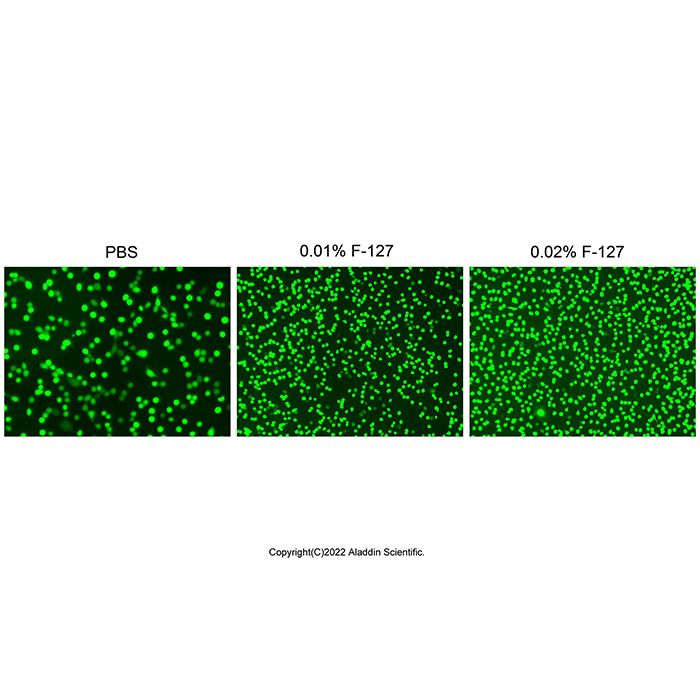
a.浓度梯度实验:测试0.01%、0.02%、0.05%、0.1%等不同浓度对细胞活性和染料加载效果的影响;
b.孵育时间优化:通常10-60 min,根据染料和细胞类型调整;
c.温度优化:室温或37 °C均可,但37 °C可能加速染料摄取;
6、问:Pluronic F-127是否会影响荧光信号?
答:在推荐浓度下,Pluronic F-127不会显著影响荧光信号。相反,它能提升染料的溶解度和细胞加载效率,从而增强信号强度和稳定性。但高浓度可能导致背景荧光增加,需注意优化。
Product Introduction
Permeabilizer Pluronic F-127, 10% in H₂O is a ready-to-use, low-toxicity polymeric nonionic surfactant. Its amphiphilic PEG-PPG-PEG block structure enables micelle formation in aqueous phase, which instantaneously encapsulates and solubilizes hydrophobic AM esters (e.g., Fluo-3 AM, Fluo-4 AM, Fluo-8 AM, Fluo-20 AM, Fura-2 AM, Indo-1 AM, Rhod-2 AM, Calcein AM, CFDA-SE, SBFI AM, PBFI AM, Quest Fluor-8 AM, Quest Rhod-4 AM) or other lipophilic probes (e.g., Di-4-ANEPPS, Di-8-ANEPPS, DiOC₂(3), DiOC₆(3), RH421). This allows these dyes to rapidly and uniformly penetrate live cell membranes without the need for organic co-solvents, significantly improving loading efficiency and reducing cytotoxicity. The 10% aqueous solution can be directly diluted for use, compatible with fluorescence microscopy, flow cytometry, and high-throughput platforms, and is widely applied in experiments such as calcium imaging, membrane potential detection, and drug delivery.
The efficiency of loading live-cell ion indicators and hydrophobic probes into cells has long been a critical bottleneck in cell function research. Traditional DMSO loading methods are prone to causing cell membrane damage, dye aggregation, and batch-to-batch variability. Pluronic F-127 achieves uniform dye distribution through mild solubilization and transient membrane perturbation mechanisms without compromising membrane integrity, and has become a standard permeabilization enhancer in neuroscience, oncology, and drug screening. Its low immunogenicity, reversible action, and broad compatibility with various fluorescent probes make it a core tool for constructing high-fidelity "real-time in situ" cell function maps.
Note: Aliases include Poloxamer 407, poloxamer 407, polyether, or polyoxyethylene polyoxypropylene.
Note: Pluronic is a trademark and registered trademark of BASF.
Application Scope
Nonionic surfactant; controlled-release drug carrier; dye water solubility enhancer; AM ester indicator loading aid; membrane potential and membrane permeability probe carrier;
Product Features
1. Imported raw materials, stable and reliable: The product uses cell-culture-grade imported raw materials, with purity >99% per batch, ensuring strong consistency in experimental results;
2. Ready-to-use formulation, easy operation: Ready to use upon opening, no tedious pre-treatment required;
3. Low toxicity and high efficiency, cell-friendly: Cell viability >95%, dye loading efficiency increased by 3-5 times;
4. Universal platform, wide application: Compatible with mainstream imaging and detection equipment, supporting scenarios such as calcium imaging, membrane potential detection, and drug delivery;
5. Thermogelation property, expanding application scenarios: Supports the construction of sustained-release drug systems, suitable for scientific research and industrial development.
Product Parameters
1. Molecular formula: H(C₂H₄O)ₓ(C₃H₆O)ᵧ(C₂H₄O)zOH;
2. Molecular weight: ~12,500;
3. CAS number: 9003-11-6;
4. Color and appearance: Colorless liquid;
5. Concentration (M/V): 10%;
Product Components
Component
| 250 T |
| Permeabilizer Pluronic F-127, 10% in H₂O | 1 mL |
Note: Usage count is calculated based on 500 μL of 0.08% Pluronic F-127 solution per use, with a final working concentration of 0.04% in a total volume of 1 mL.
Precautions
1. Store the product at room temperature; do not refrigerate. The product tends to form a gel under low-temperature conditions. If this occurs, place the product in a water bath at 50-65 °C for 5-10 minutes and vortex until it becomes a colorless liquid, which does not affect product performance.
2. The working concentration of the product should not be too high. When used with high-intensity fluorescent dyes such as Fluo-8, the recommended working concentration is below 0.1%; when used with low-intensity fluorescent dyes (e.g., Indo-1 AM, 5-CFDA AM, Fura Red AM), the working concentration can be appropriately increased.
3. This product is for research use only and must not be stored in ordinary residential premises.
4. For your safety and health, please follow the standard laboratory safety regulations in your institution.
Instructions for Use
I. Pre-Experiment Preparation
1. Reagent Preparation:
(1) Remove reagents from storage conditions (e.g., 4 °C) and equilibrate to room temperature (15-25 °C).
(2) Prepare cell culture medium, buffer (e.g., Hanks or 20 mM Hepes buffer), and fluorescent dye (e.g., AM ester ion indicators).
2. Control Setup:
(1) Negative control: Cells without dye or Pluronic F-127;
(2) Positive control: Cells known to normally take up the dye;
(3) Solvent control: Cells with only solvent (e.g., DMSO or buffer), used to exclude solvent interference.
II. Operational Steps
Protocol 1: Loading AM ester ion indicators into cells at 5 μM (conditions may vary for different cells or dyes)
1. Prepare Pluronic F-127 working stock solution:
Dilute the 10% Pluronic F-127 at a ratio of 1:125 using cell-culture-grade water or buffer (e.g., Hanks or 20 mM Hepes buffer) to obtain a 0.08% Pluronic F-127 solution.
2. Prepare dye working stock solution:
Dilute the 5 mM AM ester dye at a ratio of 1:500 using cell-culture-grade water or buffer (e.g., Hanks or 20 mM Hepes buffer) to obtain a 10 μM AM ester dye solution.
Note: Dye working solution preparation instructions: The dye working stock solution should be prepared at twice the final target working concentration. The recommended final working concentration is 0.01%-0.1%, and the specific concentration needs to be optimized based on cell type and dye type. For example, for most AM ester dyes (e.g., Fluo-4 AM), 0.04% Pluronic F-127 usually provides good cell loading results.
3. Prepare staining working solution:
Mix the 0.08% Pluronic F-127 solution and 10 μM AM ester dye solution in equal volumes (1:1 by volume) to obtain a mixed solution with a Pluronic F-127 working concentration of 0.04% and an AM ester dye working concentration of 5 μM.
4. Label cells:
After removing the medium from the cells to be labeled, add an appropriate amount of the above mixed solution and incubate at room temperature for 10 min to 1 h.
Note: The labeling time can be appropriately adjusted according to the dye type and cell characteristics. Pluronic F-127 is suitable for most mammalian cells, including suspension and adherent cells. However, for certain special cell types (e.g., primary cells or sensitive cell lines), it is recommended to optimize the Pluronic F-127 concentration and incubation time through pre-experiments to minimize potential cytotoxicity risks.
5. Wash cells:
(1) After labeling, wash the cells 2-3 times with buffer or fresh cell culture medium, and centrifuge to remove the supernatant.
(2) Resuspend in buffer and prepare for detection.
III. Result Interpretation
1. Qualitative analysis (fluorescence microscopy): Observe the distribution and intensity of intracellular fluorescence signals:
(1) Normal uptake: Uniform or specific fluorescence signals visible inside cells;
(2) Poor uptake: Weak or unevenly distributed fluorescence signals, indicating the need to optimize Pluronic F-127 concentration or incubation time;
(3) Background interference: Strong extracellular or background fluorescence indicates insufficient washing or excessively high dye concentration;
2. Quantitative analysis (flow cytometry): Collect cell fluorescence intensity data using a flow cytometer:
(1) Analysis indicators: Mean fluorescence intensity (MFI): reflects intracellular dye uptake; positive cell ratio: proportion of successfully labeled cells;
(2) Data interpretation: If MFI is significantly higher than the negative control, the dye is successfully loaded; if the positive rate is low or MFI is low, it is recommended to optimize the Pluronic F-127 concentration or incubation time;
Frequently Asked Questions and Answers
1. Q: What are the disadvantages of DMSO compared to Pluronic F-127? How does Pluronic F-127 bring about changes?
A: DMSO (dimethyl sulfoxide) is a commonly used organic solvent that can dissolve many hydrophobic compounds, but it also causes several problems:
a. High cytotoxicity: Concentrations exceeding 0.1% may damage cells and affect experimental results;
b. Signal interference: DMSO itself may affect cell membrane potential, ion channels, or signaling pathways, leading to data bias;
c. Limited solubilization capacity: For some highly hydrophobic dyes or drugs, DMSO's solubilization capacity is insufficient, and precipitation is prone to occur;
d. Inconvenient operation: DMSO is hygroscopic, volatile, and corrosive to certain plastics, requiring strict experimental conditions;
Pluronic F-127 is a nonionic surfactant widely used in biological experiments, with the greatest advantages of safety, efficiency, and stability:
a. Low toxicity and good biocompatibility: Pluronic F-127 is almost non-toxic to cells and does not significantly affect cell viability and function even at high concentrations, making it ideal for long-term or high-sensitivity experiments;
b. Significantly improves water solubility of hydrophobic molecules: It can form micellar structures in water to encapsulate hydrophobic molecules (e.g., fluorescent dyes, drugs, AM ester probes), greatly improving their solubility, avoiding precipitation, and ensuring smooth experiments;
c. Reduces or replaces DMSO: In many experiments, Pluronic F-127 can partially or completely replace DMSO, fundamentally reducing solvent toxicity, minimizing interference, and improving data reliability and reproducibility;
d. Enhances loading efficiency and signal stability: During cell loading of ion indicators (e.g., Fluo-3 AM, Fura-2 AM), Pluronic F-127 promotes dye entry into cells, reduces leakage and aggregation, resulting in stronger and more stable signals.
2. Q: Why did my Pluronic F-127 turn into a gel at 4 °C? Can it still be used?
A: This is a normal phenomenon. Pluronic F-127 forms a gel at low temperatures, but this does not affect its performance. Before use, simply place it at room temperature (15-25 °C) and let it stand until it is completely dissolved and clear, then it can be used normally.
3. Q: How to determine if Pluronic F-127 has expired?
A: If the product appears cloudy, precipitated, has an odor, or cannot return to a clear state after dissolution, it may have deteriorated or been contaminated, and use is recommended to be discontinued. In addition, if dye loading efficiency decreases significantly in experiments, it may indicate reduced product activity, and a new batch is recommended for replacement.
4. Q: Can Pluronic F-127 be mixed with other reagents?
A: Yes. Pluronic F-127 is compatible with most buffers, media, and fluorescent dyes. However, avoid mixing with high-concentration ionic solutions (e.g., >100 mM Ca²⁺ or Mg²⁺) or strong acids/bases, as this may affect micelle formation and solubilization.
5. Q: How to optimize experimental conditions for Pluronic F-127?
A: Optimization is recommended through the following steps:a. Concentration gradient experiment: Test the effects of different concentrations (e.g., 0.01%, 0.02%, 0.05%, 0.1%) on cell viability and dye loading efficiency;b. Incubation time optimization: Typically 10-60 min, adjusted according to dye and cell type;c. Temperature optimization: Room temperature or 37 °C is acceptable, but 37 °C may accelerate dye uptake;
6. Q: Does Pluronic F-127 affect fluorescence signals?
A: At recommended concentrations, Pluronic F-127 does not significantly affect fluorescence signals. On the contrary, it improves dye solubility and cell loading efficiency, thereby enhancing signal intensity and stability. However, high concentrations may increase background fluorescence, requiring optimization.

 ZJ26F1039692


 危险品化学品经营许可证(带存储)