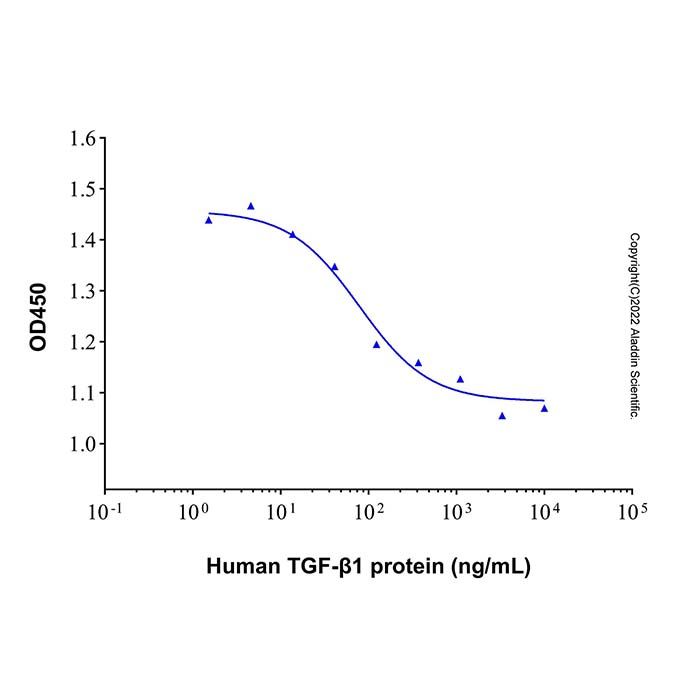
Measured by its ability to inhibit the IL-4-dependent proliferation of TF-1 cells. The ED50 for this effect is 78.66 ng/mL in the presence of 500 ng/mL IL-4 (rp156008).
TGF-beta 1 is a member of the transforming growth factor beta (TGF-beta) family. The transforming growth factor-beta family of polypeptides are involved in the regulation of cellular processes, including cell division, differentiation, motility, adhesion and death. TGF-beta 1 positively and negatively regulates many other growth factors. It inhibits the secretion and activity of many other cytokines including interferon-γ, tumor necrosis factor-alpha and various interleukins. It can also decrease the expression levels of cytokine receptors. Meanwhile, TGF-beta 1 also increases the expression of certain cytokines in T cells and promotes their proliferation, particularly if the cells are immature. TGF-beta 1 also inhibits proliferation and stimulates apoptosis of B cells, and plays a role in controlling the expression of antibody, transferrin and MHC class II proteins on immature and mature B cells. As for myeloid cells, TGF-beta 1can inhibit their proliferation and prevent their production of reactive oxygen and nitrogen intermediates. However, as with other cell types, TGF-beta 1 also has the opposite effect on cells of myeloid origin. TGF-beta 1 is a multifunctional protein that controls proliferation, differentiation and other functions in many cell types. It plays an important role in bone remodeling as it is a potent stimulator of osteoblastic bone formation, causing chemotaxis, proliferation and differentiation in committed osteoblasts. Once cells lose their sensitivity to TGF-beta1-mediated growth inhibition, autocrine TGF-beta signaling can promote tumorigenesis. Elevated levels of TGF-beta1 are often observed in advanced carcinomas, and have been correlated with increased tumor invasiveness and disease progression.
Post-translational: Transforming growth factor beta-1 proprotein: The precursor proprotein is cleaved in the Golgi apparatus by FURIN to form Transforming growth factor beta-1 (TGF-beta-1) and Latency-associated peptide (LAP) chains, which remain non-covalently linked, rendering TGF-beta-1 inactive. N-glycosylated (PubMed:2493139, PubMed:28117447, PubMed:3162913). Deglycosylation leads to activation of Transforming growth factor beta-1 (TGF-beta-1); mechanisms triggering deglycosylation-driven activation of TGF-beta-1 are however unclear (PubMed:2493139).
生物活性
Measured by its ability to inhibit the IL-4-dependent proliferation of TF-1 cells. The ED50 for this effect is 78.66 ng/mL in the presence of 500 ng/mL IL-4 (rp156008).
13.1 & 40.6 & 53.1 kDa, under reducing conditions; 105.2 kDa, under non-reducing conditions.
分子类型
蛋白质
产品线
生物产品
储存与运输
物理形态
冻干(Lyophilized)
储存缓冲液
Lyophilized from PBS, 8% Trehalose, 0.01% TWEEN 80, pH 7.4
浓度
见COA
复溶
We recommend that this vial be briefly centrifuged prior to opening to bring the contents to the bottom. Reconstitute at 1.0 mg/mL in sterile distilled water. Stock solutions should be apportioned into working aliquots and stored at ≤ -20 °C. Further dilutions should be made in appropriate buffered solutions.
储存条件
-20°C储存,避免反复冻融
运输条件
超低温运输
稳定性与储存
Store at -20℃ for 12 months. Upon reconstitution, it is recommended to aliquot. Avoid freeze/thaw cycle.
图片
Recombinant Human TGF-beta 1 Protein (rp156015) - Protein Bioactivity Measured by its ability to inhibit the IL-4-dependent proliferation of TF-1 cells. The ED₅₀ for this effect is 78.66 ng/mL in the presence of 500 ng/mL IL-4 (rp156008).
Recombinant Human TGF-beta 1 Protein (rp156015) - SDS-PAGE 3 μg/lane of Recombinant Human TGF-beta 1 Protein was resolved with SDS-PAGE under reducing (R) and non-reducing (N) conditions and visualized by Coomassie® Blue staining, showing a band at 13.1 & 40.6 & 53.1 kDa under reducing conditions and 105.2 kDa under non-reducing conditions. The recombinant human latent TGF-beta 1 consists of 370 amino acids and predicts a molecular mass of 42.1 kDa. In SDS-PAGE under reducing conditions, the apparent molecular mass of rh TGF-beta 1 is approximately 13.1, 40.6 and 53.1 kDa corresponding to mature TGF-beta 1, LAP protein and inacitve latent TGF-beta 1 respectively due to glycosylation. Under non-reducing conditions, it is the dimer form.

 ZJ26F0838293


 危险品化学品经营许可证(带存储)