计算溶液所需的质量、体积或浓度。
EnzymoPure™ 级 ,适用于对基线干扰要求严格的色谱和分析工作流程。
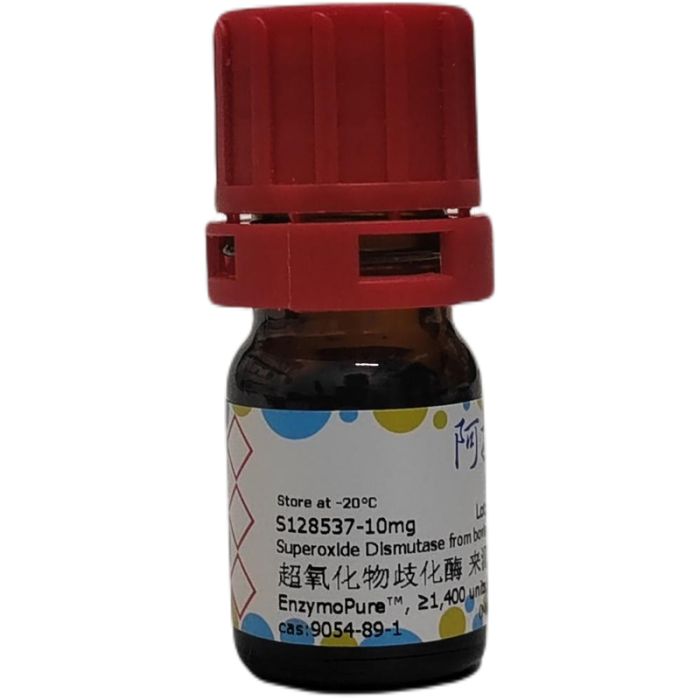
-20°C储存。超低温运输 。请查阅批次 COA 获取详细规格。
SDS、COA、产品数据表及规格说明书均可下载。可通过批号查询获取批次 COA。
在色谱分析、有机合成和交叉偶联反应领域已被 13 篇同行评审文献引用。
Superoxide dismutase (SOD) catalyzes the removal of the O2- free radical. The enzyme protects oxygen-metabolizing cells against harmful effects of superoxide free-radicals. Superoxide dismutase is inactivated by H2O2. It consists of two subunits of identical molecular weight joined by a disulfide bond. The molecular weight is 32,500 daltons, and there are two Cu(II) and two Zn(II) atoms per molecule. The isoelectric point of the enzyme is 4.95.Superoxide dismutase from bovine erythrocytes has been used in a study to assess a kinetic model of radiation-induced inactivation of superoxide dismutase in nitrous oxide-saturated solutions. Superoxide dismutase from bovine erythrocytes has also been used in a study to investigate the possible participation of superoxide anion in the intestinal tryptophan 2,3-dioxygenase reaction.

Superoxide dismutase (SOD) catalyzes the removal of the O2- free radical. The enzyme protects oxygen-metabolizing cells against harmful effects of superoxide free-radicals. Superoxide dismutase is inactivated by H2O2. It consists of two subunits of identical molecular weight joined by a disulfide bond. The molecular weight is 32,500 daltons, and there are two Cu(II) and two Zn(II) atoms per molecule. The isoelectric point of the enzyme is 4.95.
Superoxide dismutase from bovine erythrocytes has been used in a study to assess a kinetic model of radiation-induced inactivation of superoxide dismutase in nitrous oxide-saturated solutions. Superoxide dismutase from bovine erythrocytes has also been used in a study to investigate the possible participation of superoxide anion in the intestinal tryptophan 2,3-dioxygenase reaction.
| 1. Dong Zhicheng, Xu Yunyun, Wu Can, Chao Jin, Tian Chen, Lin Zhang. (2023) Efficient removal of natural organo-chromium(III) through self-circulating decomplex and immobilization with nanoscale zero-valent iron. Nano Research, [10.1007/s12274-023-6028-9] |
| 2. Jiayi Luo, Yunqiang Yi, Zhanqiang Fang. (2023) Nitrogen-rich magnetic biochar prepared by urea was used as an efficient catalyst to activate persulfate to degrade organic pollutants. CHEMOSPHERE, [PMID:37482309] [10.1016/j.chemosphere.2023.139614] |
| 3. Jiayi Luo, Yunqiang Yi, Zhanqiang Fang. (2023) Effect of Mn-based magnetic biochar /PS reaction system on oxidation of metronidazole. CHEMOSPHERE, [PMID:37119924] [10.1016/j.chemosphere.2023.138747] |
| 4. Gu Yurong, Zhang Yi, Jiang Chengchun, Dong Zijun, Bai Xue. (2023) Efficient metformin transformation in sulfite/UV process co-present with oxygen. Frontiers in Environmental Science, [10.3389/fenvs.2022.1071963] |
| 5. Xixi Chen, Wanyi Fu, Zhichao Yang, Yulong Yang, Yanjun Li, Hui Huang, Xihui Zhang, Bingcai Pan. (2023) Enhanced H2O2 utilization efficiency in Fenton-like system for degradation of emerging contaminants: Oxygen vacancy-mediated activation of O2. WATER RESEARCH, [PMID:36603306] [10.1016/j.watres.2022.119562] |
| 6. Xiang Li, Xianyi Gan. (2022) Photo-Fenton degradation of multiple pharmaceuticals at low concentrations via Cu-doped-graphitic carbon nitride (g-C3N4) under simulated solar irradiation at a wide pH range. Journal of Environmental Chemical Engineering, [10.1016/j.jece.2022.108290] |
| 7. Jiayi Luo, Yunqiang Yi, Guangguo Ying, Zhanqiang Fang, Yifeng Zhang. (2021) Activation of persulfate for highly efficient degradation of metronidazole using Fe(II)-rich potassium doped magnetic biochar. SCIENCE OF THE TOTAL ENVIRONMENT, [PMID:34856267] [10.1016/j.scitotenv.2021.152089] |
| 8. Zhenxiao Zheng, Kai Zhu, Zhiyuan Dai. (2021) Preparation of Antarctic Krill Oil Emulsion and Its Stability under Catalase Treatment. Foods, 10 (11): (2797). [PMID:34829078] [10.3390/foods10112797] |
| 9. Qian Peng, Xuekun Tang, Kun Liu, Xianping Luo, Dongsheng He, Ying Dai, Ganghong Huang. (2019) High-Efficiency Catalysis of Peroxymonosulfate by MgO for the Degradation of Organic Pollutants. Minerals, 10 (1): (2). [10.3390/min10010002] |
| 10. Shiyu Liu, Rongchang Wang, Cuixiang Ma, Dianhai Yang, Duanxin Li, Zbigniew Lewandowski. (2019) Improvement of electrochemical performance via enhanced reactive oxygen species adsorption at ZnO–NiO@rGO carbon felt cathodes in photosynthetic algal microbial fuel cells. CHEMICAL ENGINEERING JOURNAL, [10.1016/j.cej.2019.123627] |
| 11. Yunqiang Yi, Guoquan Tu, Pokeung Eric Tsang, Zhanqiang Fang. (2019) Insight into the influence of pyrolysis temperature on Fenton-like catalytic performance of magnetic biochar. CHEMICAL ENGINEERING JOURNAL, [10.1016/j.cej.2019.122518] |
| 12. Qing-Yuan Li, Xi-Wei Pang, Xing Xing, Xin-Xin Xu, Jun-Jun Jia, Ke-Jiang Zhao, Zhen-Bang Tian, Chao-Jun Wu, Zhong-Liang Zhang, Jing Wang. (2025) Facile synthesis of copper sulfide nanoflower decorated amine-grafted polyacrylonitrile fibers for rapid and long-lasting antimicrobial performance mediated by photothermal and photocatalytic effects. Materials Today Communications, [10.1016/j.mtcomm.2025.112201] |
| 13. Maochang Xu, Dan Ran, Jian Hu, Jingying Mao, Dehui Qiao, Zongquan Zhang, Xiaoya Liang, Li Zhang, Yu Nie, Hong Yang, Xiangyu Zhou, Chunhong Li. (2024) Multifunctional Prussian blue nanozymes alleviate atherosclerosis through inhibiting the inflammation feedback loop. Journal of Materials Chemistry B, [PMID:39692245] [10.1039/D4TB01926A] |