T7RNA聚合酶是一种来源于T7噬菌体的一种依赖于DNA的RNA聚合酶,具有高度特异性的5'→3'端的RNA聚合酶活性。T7RNA聚合酶对T7启动子具有较高的特异性,能够以T7启动子下游序列为模板合成大量的RNA。
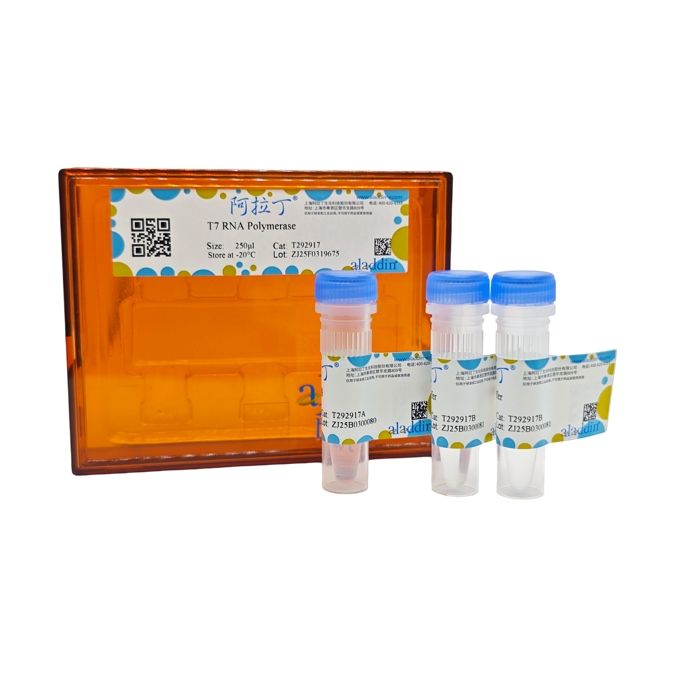
产品组分
| T292917 | Component | 50 μL | 250 μL | 1 mL | Storage | | T292917A | T7 RNA 聚合酶 | 50 μL | 250 μL | 1 mL | -20°C. Avoid freeze/thaw cycle | | T292917B | 10×HH T7 Buffer | 2×50 μL | 2×250 μL | 2×1 mL | -20°C. Avoid freeze/thaw cycle |
|
使用说明
体系配制(50μl)
| 组分 | 体积 |
Nuclease-free water/DEPC
| Up to 20 μL
|
10×HH T7 Buffer
| 2 μL
|
ATP/GTP/CTP/UTP (100mM each)
| 0.4 μL each (2mM each Final)
|
RNase inhibitor
| 1 μL (40 U)
|
Inorganic pyrophosphatase
| 0.5 μL (0.05 U)
|
T7 RNA Polymerase (50 U/μL)
| 1 μL
|
Linearized template DNA
| 1 μg
|
10×HH T7 Buffer: 400 mM Tris-HCl (25℃,pH 8.20), 60 mM MgCl2, 100mM DTT, 20mM spermidine.
按以上顺序添加反应组分*10xHH T7 Buffer 只适用于 2mM 终浓度的NTPS 投料量,如需7.5mM-10mM 投料量,请选用高产试剂盒系列产品。
反应时间:37℃℃孵育2 h。
反应终止:加入2 μL 0.2 M EDTA (pH = 8.0@ 25°℃)或者 75°℃ 加热 10 min。
DNA 模板去除:可用 DNasel(2 U) 37°C处理 15 min。
质量控制
1) 核酸内切酶残留检测:50μL反应体系中加入50U本酶和1μgλDNA在37°C下反应16小时,琼脂糖凝胶电泳DNA谱带不发生变化。
2) 核酸外切酶残留检测:50μL反应体系中加入50U本酶和1μgλ-HindIIIdigestDNA在37°C下孵育16小时,琼脂糖凝胶电泳DNA谱带不发生变化。
3) 核酸切口酶残留检测:50μL反应体系中加入50U本酶和1μgpBR322DNA在37°C下孵育16小时,琼脂糖凝胶电泳DNA谱带不发生变化。
4) RNase残留检测:50μL反应体系中加入50U本酶和1.6μgMS2RNA在37°C下孵育16小时,琼脂糖凝胶电泳RNA谱带不发生变化。
5) 热失活:75°C,10min
注意事项
1、转录反应配制应在无 RNase 污染的环境中完成,操作过程建议佩戴手套。使用无核酸酶的水、吸头和反应管进行体系配制。
2、可以通过提高 NTP 浓度(每个浓度可达 10mM),提高 RNA产量,同时需要适当增加Mg”浓度。
3、反应体系需要在室温下配制,避免在4℃时 DNA 与 10xHH T7 Buffer 发生反应产生沉淀。
4、模板 DNA 线性化不完全,可能降低转录产物产量和长度。
5、反应体系体积可根据实际需求按比例进行放大或缩小。
6、反应产物若出现下降,可向反应体系加入20 mM 新鲜 DTT。
7、转录片段≤500bp,建议延长转录时间为4-8 h.
8、10xHH T7 Buffer 冻存后容易产生沉淀在使用前请确认是否完全溶解,如果有沉淀产生,可于 37 ℃充分加热后摇晃复溶
9、10xHH T7 Buffer 只适用于 2mM 终浓度的 NTPS投料量,如器7.5mM-10mM 投料量,请选用高产试剂盒系列产品。
T7RNA polymerase is a DNA-dependent RNA polymerase derived from T7 phage with highly specific 5'→3' terminal RNA polymerase activity. T7RNA polymerase has high specificity to the T7 promoter and can synthesize a large amount of RNA using the downstream sequence of the T7 promoter as a template.
Product Content
| T292917 | Component | 50 μL | 250 μL | 1 mL | Storage | | T292917A | T7 RNA Polymerase | 50 μL | 250 μL | 1 mL | -20°C. Avoid freeze/thaw cycle | | T292917B | 10×HH T7 Buffer | 2×50 μL | 2×250 μL | 2×1 mL | -20°C. Avoid freeze/thaw cycle |
|
Activity unit definition
In a standard reaction system, the amount of enzyme required to catalyze NTP to produce a 1nmol PPi within 37°C1 hours is defined as one unit of activity (U).
Iinstructions
System configuration (50 μ l)
| 组分 | 体积 |
Nuclease-free water/DEPC
| Up to 20 μL
|
10×T7 RNA Polymerase Buffer
| 2 μL
|
ATP/GTP/CTP/UTP (100mM each)
| 0.4 μL each (2mM each Final)
|
RNase inhibitor
| 1 μL (40 U)
|
Inorganic pyrophosphatase
| 0.5 μL (0.05 U)
|
T7 RNA Polymerase (50 U/μL)
| 1 μL
|
Linearized template DNA
| 1 μg
|
10×HH T7 Buffer: 400 mM Tris-HCl (25℃,pH 8.20), 60 mM MgCl2, 100mM DTT, 20mM spermidine.
The addition of reaction components *10xHH T7 Buffer in the above order is only applicable to the dosage of NTPS with a final concentration of 2mM. If the dosage of 7.5mM to 10mM is required, please choose the high-yield kit series.
Reaction time: Incubation at 37℃ for 2 h.
Reaction termination: Add 2μL 0.2M EDTA (pH = 8.0@25 °C) or heat at 75° C for 10 min.
DNA template removal: DNasel(2 U) at 37°C for 15 min.
Quality Control
1) Endonucrenase residue detection: 50U benzyme and 1μg λDNA were added to the 50μL reaction system at 37°C for 16 hours, and the DNA bands of agarose gel electrophoresis did not change.
2) Exonuclide residue detection: 50U benzyme and 1μgλ-HindIIIdigestDNA were added to the 50μL reaction system and incubated at 37°C for 16 hours, and the DNA bands of agarose gel electrophoresis did not change.
3) Nucleic acid incision enzyme residue detection: 50U benzyme and 1μgpBR322DNA were added to the 50μL reaction system and incubated at 37°C for 16 hours, and the DNA bands of agarose gel electrophoresis did not change.
4) RNase residue detection: 50U benzyme and 1.6μgMS2RNA were added to the 50μL reaction system and incubated at 37°C for 16 hours, and the RNA bands of agarose gel electrophoresis did not change.
5) Thermal inactivation: 75°C, 10min.
Matters needing attention
1. The preparation of transcription reaction should be completed in an environment free of RNase pollution, and gloves are recommended during operation. The system was prepared using nuclease-free water, suction heads and reaction tubes.
2, you can increase the RNA production by increasing the NTP concentration (each concentration can reach 10mM), while the need to appropriately increase the Mg "concentration.
3, the reaction system needs to be prepared at room temperature to avoid DNA reaction with 10xHH T7 Buffer at 4 ℃ and precipitate.
4. Incomplete linearization of template DNA may reduce the yield and length of transcription products.
5, the volume of the reaction system can be scaled up or down according to actual needs.
6. If the reaction product decreases, 20 mM fresh DTT can be added to the reaction system.
7, transcription fragments ≤500bp, it is recommended to extend the transcription time to 4-8 h.
8. 10xHH T7 Buffer is prone to precipitate after freezing. Please confirm whether it is completely dissolved before use. If precipitate occurs, it can be shaken and redissolved after fully heating at 37 ℃
9, 10xHH T7 Buffer is only suitable for 2mM final concentration of NTPS feed, such as 7.5mM-10mM feed, please choose high yield kit series products.

 ZJ26F0333070


 危险品化学品经营许可证(带存储)