尿酸已用于:制备尿酸钠(MSU)结晶,以研究其对核定位富含亮氨酸重复序列1(NLRP1)基因表达的影响 还原剂,以测试其对正铁肌红蛋白形成的保护能力制备MSU,以研究其作为Clec12a特异性配体的用途。应用:
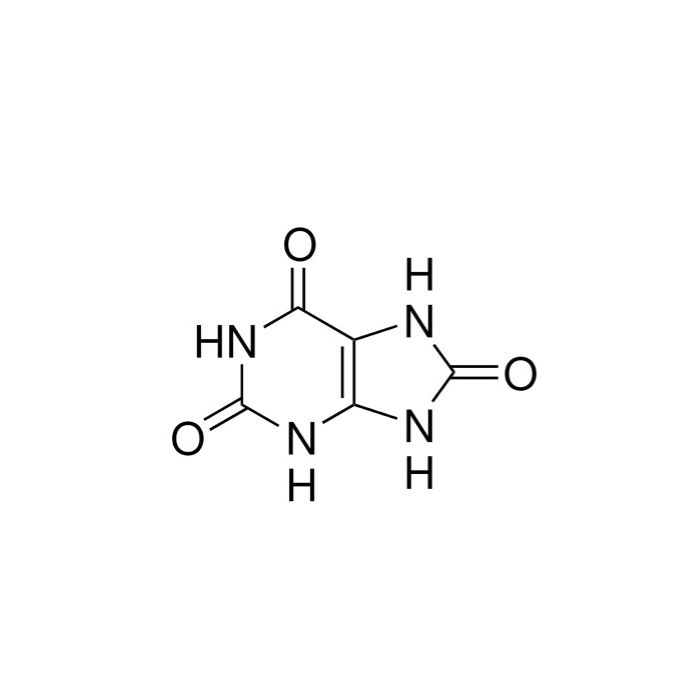
尿酸是人类嘌呤降解的最终产物。它是由黄嘌呤氧化酶对黄嘌呤的作用形成。尿酸水平升高在临床上表现为痛风。在除人类以外的物种中,尿酸可进一步代谢。在除灵长类动物以外的哺乳动物中,尿酸可转化为尿囊素。在硬骨鱼中,尿囊素可进一步转化为尿囊酸盐,然后水解成尿素和乙醛酸。尿酸还可用于嘌呤的生物合成。它已被研究用作过氧亚硝基等生物自由基的清除剂。已有相关文献发表了关于尿酸的高效液相色谱(HPLC)和气相色谱-质谱(GC-MS)法。尿酸可促进血管平滑肌细胞中单核细胞趋化蛋白-1(MCP-1)的表达。
Uric acid is the terminal product of purine degradation in humans. It is formed from the action of xanthine oxidase upon xanthine. Elevated levels of uric acid may clinically be manifested as gout. In species other than humans, uric acid can be further metabolized. In mammals other than primates, uric acid is converted to allantoin. In teleost fish, allantoin is further converted to allantoate, which is hydrolyzed to urea and glyoxylate. Uric acid may also be used in the biosynthesis of purines. It has been studied as a scavenger of biological free radicals like peroxynitrite. High-performance liquid chromatography (HPLC) and gas chromatography-mass spectrometry (GC-MS) methods for uric acid have been published. Uric acid promotes monocyte chemoattractant protein-1 (MCP-1) expression in vascular smooth muscle cells.
Application:
Uric acid has been used:
- to prepare monosodium urate (MSU) crystals to study its effect on nuclear localization leucine-rich-repeat protein 1 (NLRP1) gene expression
- as a reductant to test its protective potential against met-myoglobin formation
- to prepare MSU to study its use as specific ligand of Clec12a.

 G2621105


 危险品化学品经营许可证(带存储)