
 C2613463
计算溶液所需的质量、体积或浓度。
为什么选择此级别
,适用于对基线干扰要求严格的色谱和分析工作流程。
储存与运输
避光,-20°C储存。超低温运输 。请查阅批次 COA 获取详细规格。
质量文档
SDS、COA、产品数据表及规格说明书均可下载。可通过批号查询获取批次 COA。
文献证明
在色谱分析、有机合成和交叉偶联反应领域已被 277 篇同行评审文献引用。
概述
产品介绍:
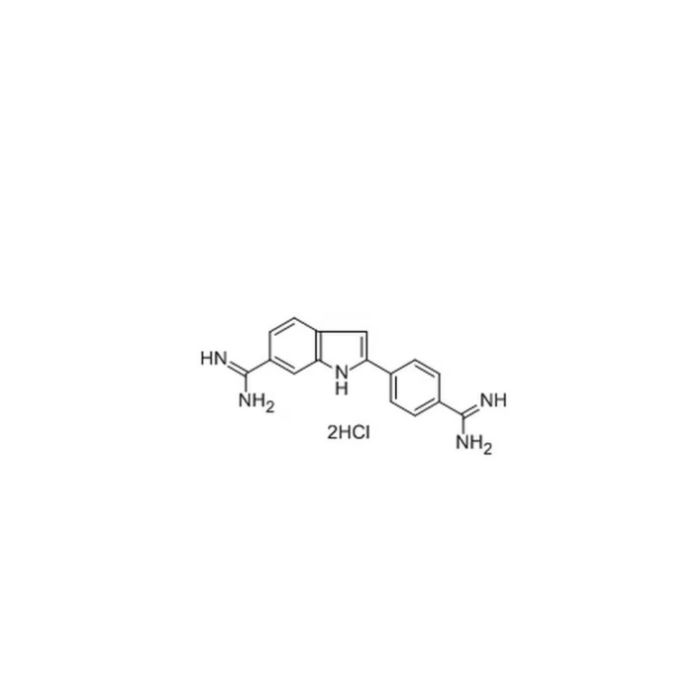
DAPI是一种可对DNA染色的细胞核染色试剂,它在嵌入双链DNA后释放蓝色荧光,亮度增强约20倍。DAPI常用于细胞凋亡检测,染色后用荧光显微镜观察或流式细胞仪检测。DAPI具有很高的光漂白承受水平,能用来检测酵母线粒体DNA、叶绿体DNA、病毒DNA以及染色DNA等。 以贴壁细胞(96孔板)举例,每孔100 μL染色工作液,10 mL可以用于100个孔的染色。
产品参数:
Ex/Em(结合DNA)=360/460 nm CAS号:28718-90-3 分子量:350.3 分子式:C16H17Cl2N5
注意事项:
1. 使用前请将产品瞬时离心至管底,再进行后续实验。 2. 本染色液的浓度经过优化的,可以满足各种常规染色的需要。如需调整使用浓度,请选择 D489987 或D106471,自行配置合适的工作液浓度。 3. DAPI对人体有害,请穿实验服并戴一次性手套操作,注意适当防护。 4. 荧光染料均存在淬灭问题,请尽量注意避光,以减缓淬灭。
应用范围:
细胞核染色
使用方法:
对于细胞或组织样品,固定后,适当洗涤去除固定剂。如果要进行免疫荧光染色,染色完成后再进行 DAPI 染色。如果不需要进行其他染色,则直接进行后续的 DAPI 染色。 1. 对于贴壁细胞(去除孔板中的培养基)或组织切片,加入少量 DAPI 染色液,覆盖住样品即可。对于悬浮细胞,至少加入待染色样品体积 3 倍的染色液,混匀。 2. 在室温培养细胞 10-20 min。 3. 用 PBS 或合适的缓冲液洗细胞两次,每次 3-5 min,洗涤完成后加入 50 μL PBS 防止细胞干掉。 4. 用带有 360 nm 激发波长,460 nm 发射波长的滤光片的荧光显微镜观察细胞。
Product introduction:
DAPI is a nuclear staining reagent that can stain DNA. It releases blfluorescence after embedding double stranded DNA, and the brightness is enhanced about 20 times. DAPI is often used for apoptosis detection, and it is observed by fluorescence microscope or detected by flow cytometry after staining. DAPI has a high photobleaching tolerance and can be used to detect yeast mitochondrial DNA, chloroplast DNA, viral DNA and stained DNA. Take adherent cells (96 well plate) as an example, 100 per well μ L staining working solution, 10 ml can be used for the staining of 100 wells.
Product parameters:
Ex/em (bound DNA) =360/460 nmcas No.: 28718-90-3 molecular weight: 350.3 molecular formula: c16h17cl2n5
Matters needing attention:
1. please centrifuge the product to the bottom of the tube immediately before use, and then conduct subsequent experiments. 2. the concentration of this dyeing solution is optimized to meet the needs of various conventional dyeing. If you need to adjust the concentration, please select D489987 or D106471 ,and configure the appropriate working fluid concentration by yourself. 3. DAPI is harmful to human body. Please wear experimental clothes and disposable gloves for operation, and pay attention to proper protection. 4. fluorescent dyes have quenching problems. Please try to avoid light to slow down quenching.
Scope of application:
Nuclear staining
Instruction:
For cell or tissue samples, after fixation, appropriate washing to remove the fixative. If immunofluorescence staining is performed, DAPI staining is performed after staining. If no other staining is required, subsequent DAPI staining is performed directly.
1.For adherent cells ( remove the medium in the orifice plate ) or tissue sections, add a small amount of DAPI staining solution and cover the sample. For suspension cells, at least 3 times the volume of the sample to be stained was added and mixed.
2.Cells were cultured at room temperature for 10-20 min.
3.The cells were washed twice with PBS or appropriate buffer, 3-5 min each time, and 50 μL PBS was added after washing to prevent the cells from drying out.
4.Cells were observed under a fluorescence microscope with a filter with 360 nm excitation wavelength and 460 nm emission wavelength.
规格
英文名称
DAPI staining solution (ready to use)
储存条件
避光,-20°C储存
运输条件
超低温运输
名称和识别符
PubChem SID
EC号
249-186-7
分子类型
小分子
IUPAC Name
2-(4-carbamimidoylphenyl)-1H-indole-6-carboximidamide;dihydrochloride
INCHI
1S/C16H15N5.2ClH/c17-15(18)10-3-1-9(2-4-10)13-7-11-5-6-12(16(19)20)8-14(11)21-13;;/h1-8,21H,(H3,17,18)(H3,19,20);2*1H
InChi Key
FPNZBYLXNYPRLR-UHFFFAOYSA-N
Smiles
C1=CC(=CC=C1C2=CC3=C(N2)C=C(C=C3)C(=N)N)C(=N)N.Cl.Cl
Isomeric SMILES
C1=CC(=CC=C1C2=CC3=C(N2)C=C(C=C3)C(=N)N)C(=N)N.Cl.Cl
PubChem CID
分子量
350.25
Beilstein号
4894417
Reaxy-Rn
4894417
技术文档
高级数据
系统学分类
分类树(Taxonomy Tree)
| 界(kingdom) | 有机化合物 |
|---|---|
| 超类(Superclass) | 有机杂环化合物 |
| 类(Class) | 吲哚及其衍生物 |
| 亚类(Subclass) | 吲哚 |
| 中间层级节点(Intermediate Tree Nodes) | 暂无 |
| 直接上位类(Direct Parent) | 2-苯基吲哚 |
| 其他上位类(Alternative Parents) | 苯基吡咯 苯及其取代衍生物 杂芳族化合物 甲脒类 甲脒类 氮杂环化合物 有机光子化合物 盐酸盐 碳氢化合物衍生物 |
| 分子骨架(Molecular Framework) | 芳香族杂多环化合物 |
| 取代基(Substituents) | 2-苯基吲哚 - 2-苯基吡咯 - 氨基脒 - 芳香族杂多环化合物 - 氮杂环 - 苯基化合物 - 羧酰亚胺 - 羧酰胺基 - 杂芳香族化合物 - 烃衍生物 - 氟氯烃 - 单环苯基基团 - 有机硝基化合物 - 有机氮化合物 - 有机氮化合物 - 吡咯 - 取代吡咯 |
| 描述(Description) | 该化合物属于有机化合物中的2-苯基吲哚类。这类吲哚在2位被苯基取代。 |
| 外部描述符(External Descriptors) | 暂无 |
三维结构
交互式化学结构模型
作用机制
| 作用机制 | Action Type | target ID | Target Name | Target Type | Target Organism | Binding Site Name | 参考文献 |
|---|
化学和物理性质
分子量
350.200 g/mol
XLogP3
氢键供体数Hydrogen Bond Donor Count
7
氢键受体数Hydrogen Bond Acceptor Count
2
可旋转键计数Rotatable Bond Count
3
精确质量Exact Mass
349.086 Da
单同位素质量Monoisotopic Mass
349.086 Da
拓扑极表面积Topological Polar Surface Area
116.000 Ų
重原子数Heavy Atom Count
23
形式电荷Formal Charge
0
复杂度Complexity
413.000
同位素原子数Isotope Atom Count
0
定义的原子立体中心计数Defined Atom Stereocenter Count
0
未定义的原子立体中心计数Undefined Atom Stereocenter Count
0
定义的键立体中心计数Defined Bond Stereocenter Count
0
未定义的键立体中心计数Undefined Bond Stereocenter Count
0
所有立体化学键的总数The total count of all stereochemical bonds
0
共价键合单元计数Covalently-Bonded Unit Count
3
安全和危险性(GHS)
象形图
信号词
警告
危险声明
H315: 引起皮肤刺激
H317: 可能引起皮肤过敏反应
H335: 可能引起呼吸道刺激
预防措施声明
P261: 避免吸入灰尘/烟雾/气体/雾/蒸汽/喷雾
P264: 处理后要彻底洗手。
P271: 仅在室外或通风良好的地方使用。
P272: 被污染的工作服不允许离开工作场所
P280: 戴防护手套/穿防护服/戴防护眼罩/戴防护面具。
P321: 特殊处理(请参阅此标签上的...)。
P302+P352: 如皮肤沾染:用水充分清洗。
P304+P340: 如误吸入:将人转移到空气新鲜处,保持呼吸舒适体位。
P333+P313: 如发生皮肤刺激或皮疹:求医/就诊。
P362+P364: 脱掉沾污的衣服,清洗后方可重新使用。
P405: 密闭存放
P403+P233: 存放在通风良好的地方。保持容器密闭。
P501: 将内容物/容器处理到。。。
P332+P317: 如果出现皮肤刺激:请寻求医疗帮助。
P319: 如果你感到不适,请寻求医疗帮助。
WGK Germany
3
个人防护装备
Eyeshields,Gloves,type N95 (US),type P1 (EN143) respirator filter
质检证书(CoA,COO,BSE/TSE 和分析图谱)
C of A & Other Certificates(BSE/TSE, COO):
输入批号以搜索分析图谱:
技术文档和文章
内质网及细胞器染色试剂
目录: 技术文章
A Comprehensive Overview of Zinc Ion Fluorescent Probes: From TSQ / Zinquin to ZnAF / Zinpyr-1 – Mechanistic Comparison and Aladdin Selection Guide
目录: 技术文章
Fluorescent Probes: A Complete Beginner’s Guide — Definitions & Emission Mechanisms, Signal Readouts, Classification Framework, Selection Roadmap, and Product Tables (Tables 1–4)
目录: 技术文章
EMSA PAGE Precast Gels: Principle Alignment, Performance Advantages, and Application Scenarios
目录: 技术文章
dsDNase-Mediated Hydrolysis of Double-Stranded DNA: Enzymatic Characteristics, Methodological Strategies, and Bioanalytical Applications
目录: 技术文章
常用荧光素的比较与选型指南
目录: 技术文章
Physicochemical Properties of Diphenylamine, Analytical Applications, and a Review of Its DNA Colorimetric Reaction
目录: 技术文章
Mechanisms of Action, Research Applications, and Cold-Induced Effects of Colchicine: An Overview
目录: 技术文章
Glutaraldehyde-mediated Microbial Inactivation: Chemical Mechanisms, Determinants, and Key Validation Considerations
目录: 技术文章
Tissue Dissociation for Single-Cell Preparation: Sample Handling and Quality Control Strategies
目录: 技术文章
Comparative Analysis and Selection Strategies for Mounting Media in Immunological Experiments
目录: 技术文章
Comparison of Common Mammalian Cell Antibiotic Selection Systems: Puromycin, G418, Hygromycin B, and Blasticidin
目录: 技术文章
Principles, Applicable Scenarios, and Result Interpretation of Common Lipid Staining Methods
目录: 技术文章
Morphological Basis, Method Workflow, and Result Interpretation of Urinary Sediment Microscopy
目录: 技术文章
Practical Guide to TSA Tyramide Signal Amplification: How to Select Reagents, Optimize the Workflow, and Reduce Background When Detection Signals Are Weak for Low-Abundance Targets
目录: 技术文章
What Is Synthetic Biology? The Industrialization Pathway from Upstream Reagent Toolchains to Biomanufacturing Applications
目录: 技术文章
Evaluation of Blood-Brain Barrier Permeability: Tracer Extravasation, TEER Measurement, and Interpretation of In Vitro Model Results
目录: 技术文章
细胞周期与DNA损伤应答机制研究
目录: 技术文章
How to Select Staining Methods for Root Tip Squash and Pollen Mother Cells? Comparison of Common Staining Systems for Chromosome Observation
目录: 技术文章
Applications of Cell Permeabilization Technology in Immunofluorescence and Flow Cytometry Detection
目录: 技术文章
细胞结构荧光染色与多通道成像
目录: 技术文章
此产品的引用文献
溶液计算器
相关产品
4',6-二脒基-2-苯基吲哚二盐酸盐-≥98%,用于4′,6-Diamidino-2-phenylindole dihydrochloride has been used in staining of various cells in immunocytochemistry and cytochemistry, human subcutaneous adipose tissues for fluorescence imaging, embryo sections for immunofluorescence.
DAPI is several times more sensitive than ethidium bromide for staining DNA in agarose gels. It may be used for photofootprinting of DNA, to detect annealed probes in blotting applications by specifically visualizing the double-stranded complex, and to study the changes in DNA and analyze DNA content during apoptosis using flow cytometry. DAPI staining has also been shown to be a sensitive and specific detection method for mycoplasma.各种应用,CAS:28718-90-3
4,’6-二脒基-2-苯基吲哚二盐酸盐-10mM in DMSO,CAS:28718-90-3
4',6-二脒基-2-苯基吲哚二盐酸盐-≥97%,CAS:28718-90-3
产品仅提供给经过验证的企业、机构和合格的专业人员用于研发。不适用于人类、动物、诊断或治疗。
Copyright © 2023至今 上海阿拉丁生化科技股份有限公司 保留所有权利。


 危险品化学品经营许可证(带存储)