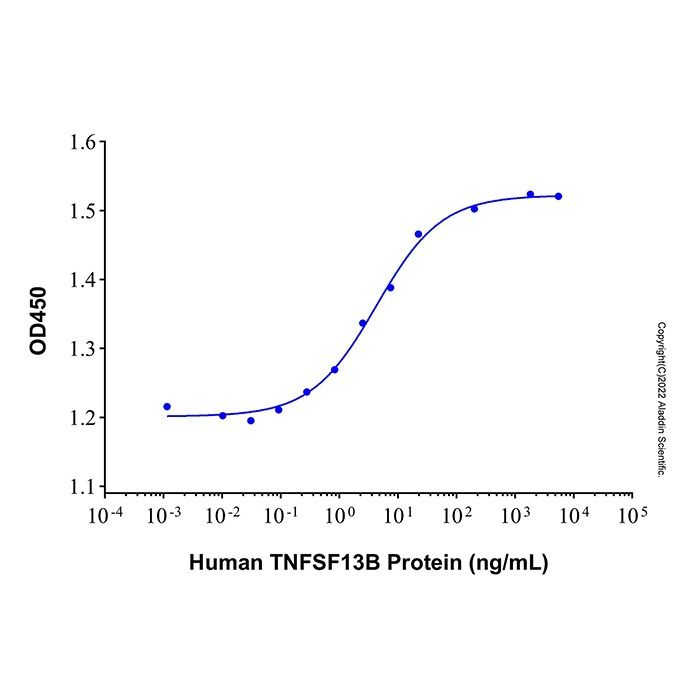
Measured in a cell proliferation assay using anti-IgM (115-006-020) stimulated mouse B cells. The ED50 for this effect is 0.78 ng/mL in the presence of 800 ng/mL anti-IgM. Immobilized Recombinant Human BAFF/BLyS/TNFSF13B Protein (rp169674) at 1.0 μg/mL can bind BAFF Antibody (Ab090522) with the EC50 of 346.4 ng/mL.
B-cell activating factor (BAFF), also known as BLyS, TALL-1, THANK, and TNFSF13B, is a 32 kDa transmembrane glycoprotein in the TNF ligand superfamily. It is involved in multiple aspects of immune system regulation, particularly towards B cells. Mature human BAFF consists of a 46 amino acid (aa) cytoplasmic domain, a 21 aa transmembrane segment, and a 218 aa extracellular domain (ECD) with a stalk region and one TNF-like domain. Within aa 134-285 of the ECD, human BAFF shares 72% aa sequence identity with mouse BAFF. It can be expressed as a homotrimer or as a heteromer in association with the related TNFSF member APRIL. A 18 kDa fragment containing the TNF-like domain can be released by proteolysis between Arg133 and Ala134. Soluble BAFF is stored intracellularly in neutrophils and released upon inflammatory stimulation. Alternative splicing generates an isoform termed deltaBAFF that lacks 19 aa between the proteolytic cleavage site and the TNF-like domain. deltaBAFF can form heteromers with BAFF and negatively regulates BAFF function. BAFF is produced by many hematopoietic cell types including by monocytes, macrophages, neutrophils, dendritic cells, and T cells and also by adipocytes. Both BAFF and APRIL are functional ligands for the TNF receptor superfamily members BCMA and TACI, and BAFF additionally binds and signals through BAFF R. All three receptors are primarily expressed by B cells. BAFF plays a critical role in the development and survival of B lineage cells. Mice that overexpress BAFF exhibit elevated B cell numbers, increased formation and size of germinal centers, and symptoms of autoimmunity. Soluble BAFF is elevated in B cell malignancies, autoimmunity, and other immune disorders. In addition, BAFF co-stimulates T cell activation, promotes a Th1 biased immune response, and promotes the expansion of Treg cells. BAFF also promotes monocyte survival, proinflammatory cytokine secretion, and differentiation to macrophages.
Post-translational: The soluble form derives from the membrane form by proteolytic processing. Isoform 2 is not efficiently shed from the membrane unlike isoform 1. N-glycosylated.
生物活性
Measured in a cell proliferation assay using anti-IgM (115-006-020) stimulated mouse B cells. The ED50 for this effect is 0.78 ng/mL in the presence of 800 ng/mL anti-IgM. Immobilized Recombinant Human BAFF/BLyS/TNFSF13B Protein (rp169674) at 1.0 μg/mL can bind BAFF Antibody (Ab090522) with the EC50 of 346.4 ng/mL.
16.1 kDa, under reducing conditions; 14.6 & 16.5 & 34.5 kDa, under non-reducing conditions.
分子类型
蛋白质
产品线
生物产品
储存与运输
物理形态
冻干(Lyophilized)
储存缓冲液
Lyophilized from PBS, pH 7.4
浓度
见COA
复溶
We recommend that this vial be briefly centrifuged prior to opening to bring the contents to the bottom. Reconstitute at 0.5 mg/mL in sterile distilled water. Stock solutions should be apportioned into working aliquots and stored at ≤ -20 °C. Further dilutions should be made in appropriate buffered solutions.
储存条件
-20°C储存,避免反复冻融
运输条件
超低温运输
稳定性与储存
Store at -20°C for 1 year. Avoid freeze/thaw cycle.
图片
Recombinant Human BAFF/BLyS/TNFSF13B Protein (rp169674) - Bioactivity Measured in a cell proliferation assay using anti-IgM (115-006-020) stimulated mouse B cells. The ED50 for this effect is 0.78 ng/mL in the presence of 800 ng/mL anti-IgM.
Recombinant Human BAFF/BLyS/TNFSF13B Protein (rp169674) - ELISA Immobilized Recombinant Human BAFF/BLyS/TNFSF13B Protein (rp169674) at 1.0 μg/mL can bind BAFF Antibody (Ab090522) with the EC50 of 346.4 ng/mL.
Recombinant Human BAFF/BLyS/TNFSF13B Protein (rp169674) - SDS-PAGE 3 μg/lane of Recombinant Human BAFF/BLyS/TNFSF13B Protein was resolved with SDS-PAGE under reducing (R) and non-reducing (N) conditions and visualized by Coomassie® Blue staining, showing a band at 16.1 kDa under reducing conditions and 14.6 & 16.5 & 34.5 kDa under non-reducing conditions. TNFSF13B is a member of the tumor necrosis factor (TNF) superfamily ligand family. Proteins of this superfamily generally exert their functions as multimers (PMID: 18555199).

 ZJ25F0318994


 危险品化学品经营许可证(带存储)