Cathepsin D is a lysosomal aspartic protease of the pepsin family. Human cathepsin D is synthesized as a precursor protein, consisting of a signal peptide (residues 1‑18), a propeptide (residues 19‑64), and a mature chain (residues 65‑412). The mature chain can be processed further to the light (residues 65‑161) and heavy (residues 169‑412) chains. It is expressed in most cells and overexpressed in breast cancer cells. It is a major enzyme in protein degradation in lysosomes, and also involved in the presentation of antigenic peptides. Mice deficient in this enzyme showed a progressive atrophy of the intestinal mucosa, a massive destruction of lymphoid organs, and a profound neuronal ceroid lipofucinosis, indicating that cathepsin D is essential for proteolysis of proteins regulating cell growth and tissue homeostasis. Cathepsin D secreted from human prostate carcinoma cells is responsible for the generation of angiostatin, a potent endogenous inhibitor of angiogenesis.
Post-translational: N- and O-glycosylated. Undergoes proteolytic cleavage and activation by ADAM30. As well as the major heavy chain which starts at Leu-169, 2 minor forms starting at Gly-170 and Gly-171 have been identified (PubMed:1426530). An additional form starting at Ala-168 has also been identified (PubMed:27333034).
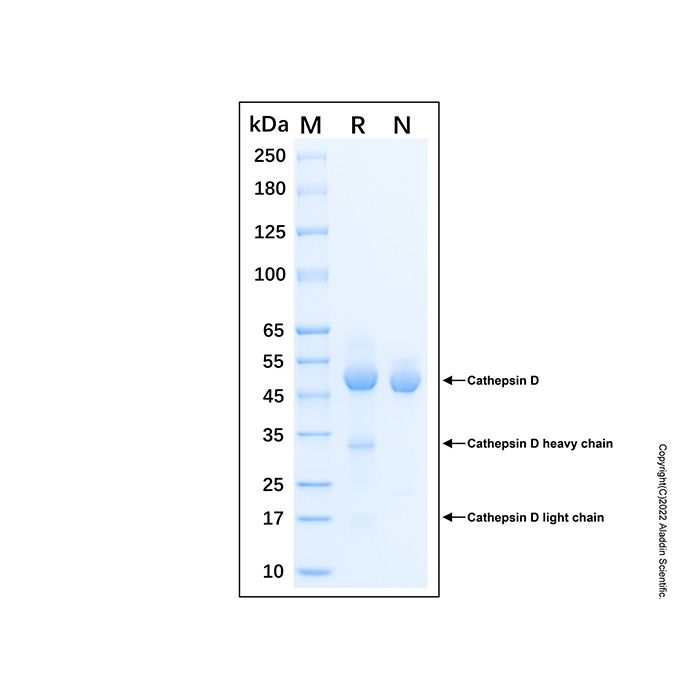
16.5 & 32.4 & 48.8 kDa, under reducing conditions; 48.1 kDa, under non-reducing conditions.
分子类型
蛋白质
产品线
生物产品
储存与运输
物理形态
冻干(Lyophilized)
储存缓冲液
Lyophilized from 20mM MES, 150mM NaCl, pH 6.5
复溶
We recommend that this vial be briefly centrifuged prior to opening to bring the contents to the bottom. Reconstitute at 1.0 mg/mL in sterile distilled water. Stock solutions should be apportioned into working aliquots and stored at ≤ -20 °C. Further dilutions should be made in appropriate buffered solutions.
储存条件
-20°C储存,避免反复冻融
运输条件
超低温运输
稳定性与储存
Store at -20°C for 1 year. Avoid freeze/thaw cycle.
图片
Recombinant Human Cathepsin D Protein (rp183610) - SDS-PAGE 3 μg/lane of Recombinant Human Cathepsin D Protein was resolved with SDS-PAGE under reducing (R) and non-reducing (N) conditions and visualized by Coomassie® Blue staining, showing a band at 16.5 & 32.4 & 48.8 kDa under reducing conditions and 48.1 kDa under non-reducing conditions.

 ZJ24F1215805


 危险品化学品经营许可证(带存储)