
计算溶液所需的质量、体积或浓度。
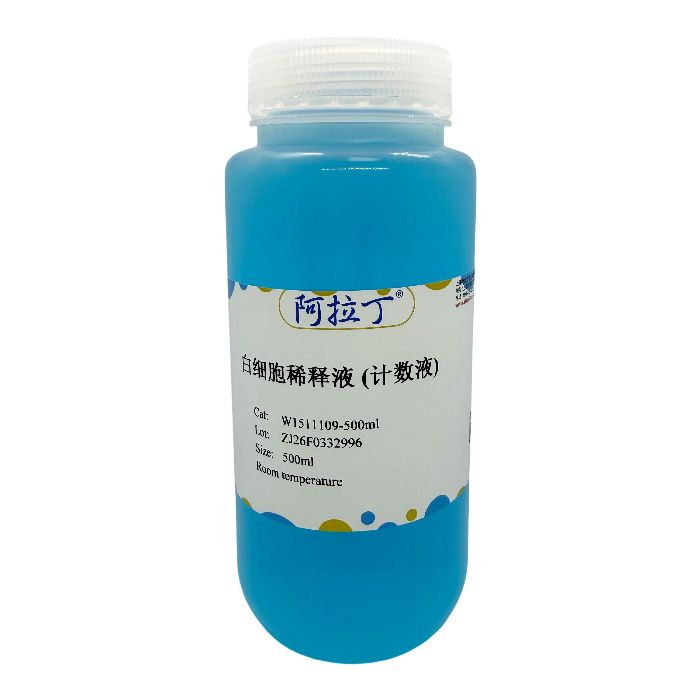
白细胞稀释液 (计数液)
有货
BioReagent,生物染色剂,用于显微镜 级 ,适用于对基线干扰要求严格的色谱和分析工作流程。
室温。常规运输 。请查阅批次 COA 获取详细规格。
SDS、COA、产品数据表及规格说明书均可下载。可通过批号查询获取批次 COA。
在色谱分析、有机合成和交叉偶联反应领域已被 0 篇同行评审文献引用。
白细胞 (White Blood Cell, WBC),旧称白血球。白细胞是人体与疾病斗争的"卫士",是人体血液中非常重要的一类免疫细胞。
生物白细胞稀释液 (WBC Dilution) 的作用原理是血液经由白细胞稀释液稀释后,导致成熟红细胞全部被溶解,充入计数池后显微镜下计算一定体积内白细胞数,换算求出每升血液中白细胞的数量。其作用是:1、稀释血液中白细胞,防止血液细胞的聚集和粘连;2、保持稳定的pH,电导率,渗透压等理化指标 (注:不同的仪器在用电阻法测量标本时,设定的脉冲信号阈值不尽相同)。该白细胞稀释液仅用于科研领域以方便进行白细胞的计数,不用于临床诊断。
操作步骤(仅供参考):
1、向小号试管中加入WBC Dilution 0.38 ml。
2、用洁净干燥的微量吸管吸取末梢血20 μl,擦去管外残余的血后加至WBC Dilution底部,轻轻将血放出,再轻轻吸上层清液清洗吸管2~3次,并立即混匀。稀释比例为1:20,也可以按照 1:10 或 1:40 的比例稀释。
3、待红细胞完全破坏后,液体呈现棕褐色,再次混匀,然后充池,避免产生气泡或外溢,室温静置2~3 min,待白细胞沉淀。
4、置于显微镜低倍镜下依次计数四角和4个大方格内的白细胞数。压线细胞按“数上不数下,数左不数右”的原则进行计数。
注意事项:
1、采血时不能过于挤压,针刺深度应适当。
2、小试管、计数板均应清洁,避免误认细胞。
3、在参考范围内,大方格间的细胞数不应相差8个以上,两次重复计数相差不能超出10%。
4、白细胞数量过多时,可以加大稀释倍数;白细胞数量过少时,可以计数8个大方格的白细胞数或大量取血。
5、为了您的安全和健康,请穿实验服并戴一次性手套操作。
计算:
白细胞数/L=(N÷4)×10×20×10⁶=(N÷20)×10⁹
| N | 4个大方格内白细胞总数 |
| ÷4 | 每个大方格(0.1 μl)内白细胞平均数 |
| ×10 | 1个大方格容积为 0.1 μl,换算成 1.0 μl |
| ×20 | 血液稀释倍数 |
| ×10⁶ | 由 1 μl 换算成 1 L |
White Blood Cells (WBC), formerly known as leucocytes, are the "guards" in the human body’s fight against diseases and a vitally important group of immune cells in human blood.
WBC dilution, all mature red blood cells are lysed. The mixture is then loaded into a hemocytometer, and the number of white blood cells in a defined volume is counted under a microscope. The white blood cell concentration per liter of blood is subsequently calculated via conversion.
Functions:
1. Dilute white blood cells in the blood to prevent the aggregation and adhesion of blood cells.
2. Maintain stable physicochemical parameters such as pH, conductivity and osmotic pressure.(Note: The set pulse signal thresholds vary among different instruments when measuring samples via the electrical resistance method.)
This WBC diluent is for research use only to facilitate white blood cell counting, and not intended for clinical diagnosis.
Operating Procedures (For Reference Only):
1. Add 0.38 mL of WBC Diluent to a small test tube.
2. Use a clean, dry micropipette to draw 20 μL of peripheral blood. Wipe off the residual blood on the outside of the pipette, insert the pipette to the bottom of the WBC Diluent, release the blood gently, then aspirate the supernatant to rinse the pipette 2–3 times and mix the solution thoroughly immediately. The standard dilution ratio is 1:20, and dilutions at 1:10 or 1:40 are also acceptable.
3. After complete red blood cell lysis (the solution turns brown), mix the solution again and load it into the hemocytometer, taking care to avoid bubble formation or overflow. Let it stand at room temperature for 2–3 minutes to allow white blood cells to settle.
4. Place the hemocytometer under the low-power microscope and count the number of white blood cells in the four large corner squares one by one. For cells overlapping the grid lines, follow the counting principle of "count cells touching the top and left lines, not the bottom and right lines".
Precautions:
1. Do not over-squeeze the puncture site during blood collection, and ensure the needle puncture depth is appropriate.
2. Keep the small test tubes and hemocytometers thoroughly clean to prevent misidentification of foreign particles as white blood cells.
3. Within the reference range, the difference in the number of cells between large squares should not exceed 8, and the difference between two replicate counts should not be more than 10%.
4. If the white blood cell count is excessively high, increase the dilution ratio; if the white blood cell count is extremely low, count the cells in 8 large squares or collect a larger volume of blood for testing.
5. For your safety and health, wear a lab coat and disposable gloves during all operations.
Calculation:
WBC count/L = (N÷4)×10×20×10⁶=(N÷20)×10⁹
| N | Total number of white blood cells in 4 large squares |
| ÷4 | Average number of white blood cells per large square (0.1 μL) |
| ×10 | Convert the volume of 1 large square (0.1 μL) to 1.0 μL |
| ×20 | Blood dilution ratio |
| ×10⁶ | Convert from 1 μL to 1 L |
通过匹配包装上的批号来查找并下载产品的 COA,每批产品都进行了严格的验证,您可放心使用!
| 批号(Lot Number) | 证书类型 | 货号 |
|---|---|---|
 ZJ26F0332996 |
分析证书 | W1511109 |
| ZJ26F0332997 |
分析证书 | W1511109 |
我们的级别选择指南涵盖了目录中所有的变体的纯度、稳定剂状态和应用适用性。
查看 BioReagent 级别指南 → 查看 Biological Stain 级别指南 → 查看 for Microscopy 级别指南 →

 危险品化学品经营许可证(带存储)