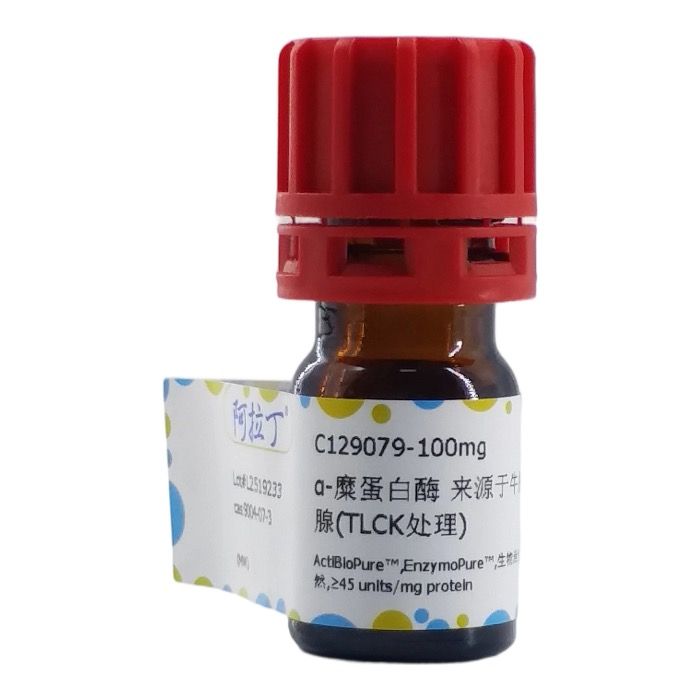
Chymotrypsin preferentially catalyzes the hydrolysis of peptide bonds involving L-isomers of tyrosine, phenylalanine and tryptophan. It also readily acts upon amides and esters of susceptible amino acids. Chymotrypsin catalyzes the hydrolysis of bonds of leucyl, methionyl, asparaginyl and glutamyl residues.
Stability/Storage: The enzyme is stable for days in solution at pH 3.0 and for years as a dry powder at 2-8°C. Protect from moisture.
Characteristics of Chymotrypsin
Architecture: Beta Barrel
Topology: Trypsin-like Serine Protease
Molecular Weight:25.6 kDa
Optimal pH:7.8-8.0
Isoelectric point:
8.52 (Chymotrypsinogen, Theoretical)
8.33 (Chymotrypsin, Theoretical)
Extinction Coefficient:
51,840 cm-1 M-1 (Theoretical)
E1%,280 = 20.19 (Chymotrypsinogen, Theoretical)
E1%,280 = 20.57 (Chymotrypsin, Theoretical)
Active Site Residues: Histidine (H57), Aspartate (D102), Serine (S195)
Activators: Cetyltributylammonium bromide, Dodecyltrimethylammonium bromide, Hexadecyltrimethylammonium bromide, Tetrabutylammonium bromide
Inhibitors: Hydroxymethylpyrroles, Boronic acids, Courmarin derivatives, Peptidyl aldehydes, Peptides from natural sources, Peptides containing an unnatural amino acid
Chymotrypsin Assay
Method
The reaction velocity is determined according to Hummel (1959) by measuring an increase in absorbance at 256 nm resulting from the hydrolysis of benzoyl-L-tyrosine ethyl ester. One unit hydrolyzes one micromole of benzoyl-L-tyrosine ethyl ester (BTEE) per minute at pH 7.8 and 25°C under the specified conditions.
Reagents
0.08 M Tris⋅HCl buffer, pH 7.8 containing 0.1 M calcium chloride
0.00107 M Benzoyl-L-tyrosine ethyl ester (BTEE) in 50% w/w methanol (63 ml absolute methanol added to 50 ml reagent grade water)
0.001 N HCl
Enzyme
Dissolve enzyme at one mg/ml in 0.001 N HCl. Dilute in 0.001 N HCl to 10-30 μg/ml for assay.
Procedure
Adjust the spectrophotometer to 256 nm and 25°C.
Pipette into cuvettes as follows:
0.08 M Tris⋅HCl buffer, pH 7.8 with 0.1 M CaCl2 1.5 ml
0.00107 M BTEE 1.4 ml
Incubate in spectrophotometer at 25°C for 4-5 minutes to achieve temperature equilibrium and record blank rate, if any. Add 0.1 ml of appropriately diluted enzyme and record increase in absorbance at 256 nm for 4-5 minutes. Calculate ΔA256/min from the initial linear portion of the curve.
Calculation
where 964 is the extinction coefficient of BTEE at 256 nm.


 A2119078


 危险品化学品经营许可证(带存储)