
计算溶液所需的质量、体积或浓度。
肌酐 (Cr) 含量检测试剂盒 (肌氨酸氧化酶, 比色法)
有货
BioReagent,比色法,适用于分析 级 ,适用于对基线干扰要求严格的色谱和分析工作流程。
2-8°C储存,避光。低温运输,禁止冷冻 。请查阅批次 COA 获取详细规格。
SDS、COA、产品数据表及规格说明书均可下载。可通过批号查询获取批次 COA。
在色谱分析、有机合成和交叉偶联反应领域已被 0 篇同行评审文献引用。
肌酐(Creatinine,CRE)是肌肉代谢的产物,主要通过肾小球滤过排出体外。在正常情况下,体内肌酐的含量基本稳定。血液中的肌酐浓度可作为检测肾小球滤过功能的指标之一。本试剂盒利用肌酐酶特异作用于肌酐生成肌酸,肌酸在肌酸酶和肌氨酸氧化酶的相继作用下生成过氧化氢,过氧化氢与显色剂反应呈现紫色,该有色物质在546 nm有最大吸收峰,进而计算得到肌酐含量。
组份表:
|
标准品的配制:
1. 临用前8000 g 4℃离心2 min使试剂落入管底;
2. 加1 mL蒸馏水溶解即浓度为2 mg/mL的标准品母液;
3. 再用蒸馏水稀释40倍(20 μl母液+780 μl水)成0.05 mg/mL,即442 μmol/L的肌酐标准品待检液。
实验器材:
研钵(匀浆机)、天平、冰盒(制冰机)、台式离心机、可调式移液枪、水浴锅(烘箱、培养箱、 金属浴)、96孔板、离心管、酶标仪、蒸馏水(去离子水、超纯水均可)。
指标测定:
建议先选取1-3个差异大的样本(例如不同类型或分组)进行预实验,熟悉操作流程,根据预实验结果确定或调整样本浓度,以防造成样本或试剂不必要的浪费!
1、样本提取:
① 组织样本:取约0.1 g组织样本,加1 mL的生理盐水或者常用PBS研磨,粗提液全部转移到EP管中,12000 rpm,常温离心10 min,上清液待测。
② 液体样品:澄清的液体可直接检测;若浑浊则离心后取上清液检测。
③ 细菌/细胞样本:先收集细菌或细胞到离心管内,离心后弃上清;取约500万细菌或细胞加入1 mL生理盐水或PBS, 超声波破碎细菌或细胞(冰浴,功率200 W,超声3 s,间隔10 s,重复30次);12000 rpm 4℃离心10 min,取上清,置冰上待测。
【注】:若增加样本量,可按照细菌/细胞数量(10⁴):无水乙醇(mL)为 500~1000:1的比例进行提取。
本实验亦可用裂解液裂解细胞样本进行后续实验检测,裂解方式以裂解液操作说明为准。
2、检测步骤:
① 打开酶标仪,设置温度 37℃(若仪器无法控温,则等待仪器过自检程序即可),设定波长到546 nm。
② 做实验前选取2个样本,找出适合本次检测样本的稀释倍数D。
③ 所有试剂解冻至室温,在96孔板中依次加入:
1. 测定管的ΔA大于0.5,须用蒸馏水对样本进行稀释,稀释倍数D代入计算公式。 2. 若ΔA的值小于0.005,可增加样本加样体积 V₁(如由6 μL增至10 μL或更多,则试剂二相应减少,空白管和标准管变化同测定管),或增加样本取样质量W;则改变后的 V₁和W需代入公式重新计算。 结果计算: 1、按照质量计算: 肌酐含量 (nmol/g)=(C标准 ×V₂)×(ΔA测定-ΔA空白)÷(ΔA标准 -ΔA空白)÷( V₁ ÷V×W)×D =442×(ΔA测定- ΔA空白)÷( ΔA标准 - ΔA空白)÷W×D 2、按照蛋白浓度计算: 肌酐含量 (nmol/mg prot)=( C标准 × V₂ )×(ΔA测定-ΔA空白)÷( ΔA标准) - ΔA空白))÷( V₁ ÷V× Cₚᵣ )×D =442×(ΔA测定- ΔA空白)÷( ΔA标准 - ΔA空白)÷ Cₚᵣ ×D 3、按照体积计算: 肌酐含量 (μmol/L)=( C标准 × V₂ )×(ΔA测定- ΔA空白)÷( ΔA标准 - ΔA空白)÷ V₁ ×D =442×(ΔA测定- ΔA空白)÷( ΔA标准 - ΔA空白)×D 4、按照细胞数量计算: 肌酐含量 (μmol/10⁴ cell)=( C标准 × V₂ )×(ΔA测定- ΔA空白)÷( ΔA标准 - ΔA空白)÷(500× V₁ ÷V)×D =0.884×(ΔA测定- ΔA空白)÷( ΔA标准 - ΔA空白)×D C标准:肌酐标品,0.05 mg/mL=442 μmol/L=442 nmol/mL; Mr:肌酐分子量,113; V₁ :加入样本体积,0.006 mL; V₂ :加入标准品体积,0.006 mL; V:提取液体积,1 mL; 500:细胞数量,万; W:质量,g; D:稀释倍数,未稀释即为 1; Cₚᵣ :样本蛋白质浓度,mg/mL;建议使用本公司的BCA蛋白含量检测试剂盒。 |
| Creatinine (CRE) is a metabolite produced by muscle metabolism, which is mainly excreted via glomerular filtration. Under normal physiological conditions, the internal creatinine level remains relatively stable. Serum creatinine concentration serves as one of the key indicators for evaluating glomerular filtration function. This assay kit adopts an enzymatic method: creatinine is specifically catalyzed by creatininase to generate creatine. Subsequently, creatine is sequentially acted upon by creatinase and sarcosine oxidase to produce hydrogen peroxide. Hydrogen peroxide reacts with chromogenic reagent to form purple-colored products with a maximum absorption peak at 546 nm, and the creatinine content is calculated accordingly. Components:
|
Standard sample preparation:
1. Before use, centrifuge 8000g at 4℃ for 2 minutes to ensure the reagents fall to the bottom of the tube;
2. Add 1 mL of distilled water to dissolve it to obtain a standard solution with a concentration of 2 mg/mL;
3. Dilute it 40 times with distilled water (20 μl of the standard solution + 780 μl of water) to obtain a 0.05 mg/mL solution, which is 442 μmol/L of creatinine standard solution for the test sample.
Experimental Instruments:
Mortar/homogenizer, analytical balance, ice box/ice maker, tabletop centrifuge, adjustable pipette, water bath incubator/drying oven/cell incubator/metal bath, 96-well plate, centrifuge tubes, microplate reader, distilled water (deionized water or ultrapure water is acceptable).
Index Determination:
It is recommended to select 1-3 representative samples with significant differences for pre-experiment to familiarize with operating procedures, and adjust sample concentration properly to avoid unnecessary waste of samples and reagents.
1. Sample Extraction
① Tissue samples: Weigh about 0.1 g tissue sample, add 1 mL normal saline or PBS buffer for homogenization. Transfer all crude extract into EP tube, centrifuge at 12000 rpm at room temperature for 10 min, and collect supernatant for detection.
② Liquid samples: Clear liquid samples can be detected directly; turbid samples need centrifugation before taking supernatant for assay.
③ Bacterial & cell samples: Collect bacteria or cells into centrifuge tubes and discard supernatant after centrifugation. Take approximately 5 million bacteria/cells and resuspend in 1 mL normal saline or PBS. Perform ultrasonic disruption in ice bath (power: 200 W, ultrasonic for 3 s, interval 10 s, repeat 30 times). Centrifuge at 12000 rpm, 4 °C for 10 min, collect supernatant and place on ice for later use.
Note: For increased sample dosage, extract samples at the ratio of cell number (10⁴ cells) : absolute ethanol (mL) = 500~1000 : 1.
Cell lysis buffer can also be used for sample treatment following the official protocol.
2. Detection Procedures
① Turn on the microplate reader, set temperature at 37 °C (skip temperature setting if unavailable), and adjust detection wavelength to 546 nm.
② Select 2 samples to confirm the optimal dilution factor (D) before formal detection.
③ Thaw all reagents to room temperature, and add reagents into 96-well plate in sequence.
|
Notes:
1.If the ΔA value of test well exceeds 0.5, dilute the sample with distilled water and bring dilution factor D into calculation formula.
2.If ΔA is lower than 0.005, increase sample loading volume V1 (e.g. from 6 μL to 10 μL or more, reduce Reagent 2 volume correspondingly; blank and standard wells shall be adjusted in the same way) or increase sample weight W. Recalculate results with revised parameters.
Result Calculation:
1. Calculated by sample weight
Creatinine content (nmol/g) = (Cₛₜₐₙdₐᵣd × V₂) × (ΔAₜₑₛₜ - ΔAbₗₐₙₖ) ÷ (ΔAₛₜₐₙdₐᵣd - Δ Abₗₐₙₖ ) ÷ ( V₁ ÷ V × W) × D = 442 × (Δ Aₜₑₛₜ - ΔAbₗₐₙₖ) ÷ (ΔAₛₜₐₙdₐᵣd - ΔAbₗₐₙₖ) ÷ W × D
2. Calculated by protein concentration
Creatinine content (nmol/mg prot) = (Cₛₜₐₙdₐᵣd × V₂) × (ΔAₜₑₛₜ - ΔAbₗₐₙₖ) ÷ (ΔAₛₜₐₙdₐᵣd - Δ Abₗₐₙₖ) ÷ (V₁ ÷ V × Cₚᵣ× D = 442 × (Δ Aₜₑₛₜ - ΔAbₗₐₙₖ) ÷ (ΔAₛₜₐₙdₐᵣd - ΔAbₗₐₙₖ) ÷ Cₚᵣ× D
3. Calculated by volume
Creatinine content (μmol/L) = ( Cₛₜₐₙdₐᵣd × V₂ ) × ( ΔAₜₑₛₜ - ΔAbₗₐₙₖ ) ÷ ( ΔAₛₜₐₙdₐᵣd - Δ Abₗₐₙₖ ) ÷ V₁ × D = 442 × ( Δ Aₜₑₛₜ - ΔAbₗₐₙₖ ) ÷ ( ΔAₛₜₐₙdₐᵣd - ΔAbₗₐₙₖ ) × D
4. Calculated by cell number
Creatinine content (μmol/10⁴ cells) = (Cₛₜₐₙdₐᵣd × V₂) × ( ΔAₜₑₛₜ - ΔAbₗₐₙₖ ) ÷ ( ΔAₛₜₐₙdₐᵣd - Δ Abₗₐₙₖ ) ÷ (500 × V₁ ÷ V) × D = 0.884 × ( Δ Aₜₑₛₜ - ΔAbₗₐₙₖ ) ÷ ( ΔAₛₜₐₙdₐᵣd - ΔAbₗₐₙₖ ) × D
Parameter Explanation:
Cstd: Creatinine standard concentration, 0.05 mg/mL = 442 μmol/L = 442 nmol/mL
Mr: Molecular weight of creatinine, 113
V₁ : Sample loading volume, 0.006 mL
V₂ : Standard solution loading volume, 0.006 mL
V: Total extraction solution volume, 1 mL
500: Ten thousand cell unit
W: Sample weight (g)
D: Dilution factor; set as 1 without dilution
Cₚᵣ: Sample protein concentration (mg/mL); BCA protein assay kit is recommended for determination.
| C1515993 | 组件 | 物理外观 | 48T | 储存 | 单次测试使用量 |
| C1515993A | 试剂一 | 黄色透明液体 | 17.5 mL | 2-8℃. 避光 | 每次反应需使用350 uL |
| C1515993B | 试剂二 | 粉色透明液体 | 6 mL | 2-8℃. 避光 | 每次反应需使用120 uL |
| C1515993C | 标准品 | 白色粉末 | 2 mg | 2-8℃. 避光 | 按照需求使用 |
通过匹配包装上的批号来查找并下载产品的 COA,每批产品都进行了严格的验证,您可放心使用!
| 批号(Lot Number) | 证书类型 | 货号 |
|---|---|---|
 ZJ26F0738040 ZJ26F0738040 |
分析证书 | C1515993 |
我们的级别选择指南涵盖了目录中所有的变体的纯度、稳定剂状态和应用适用性。
查看 BioReagent 级别指南 → 查看 Suitable for Analysis 级别指南 → 查看 Colorimetry 级别指南 →

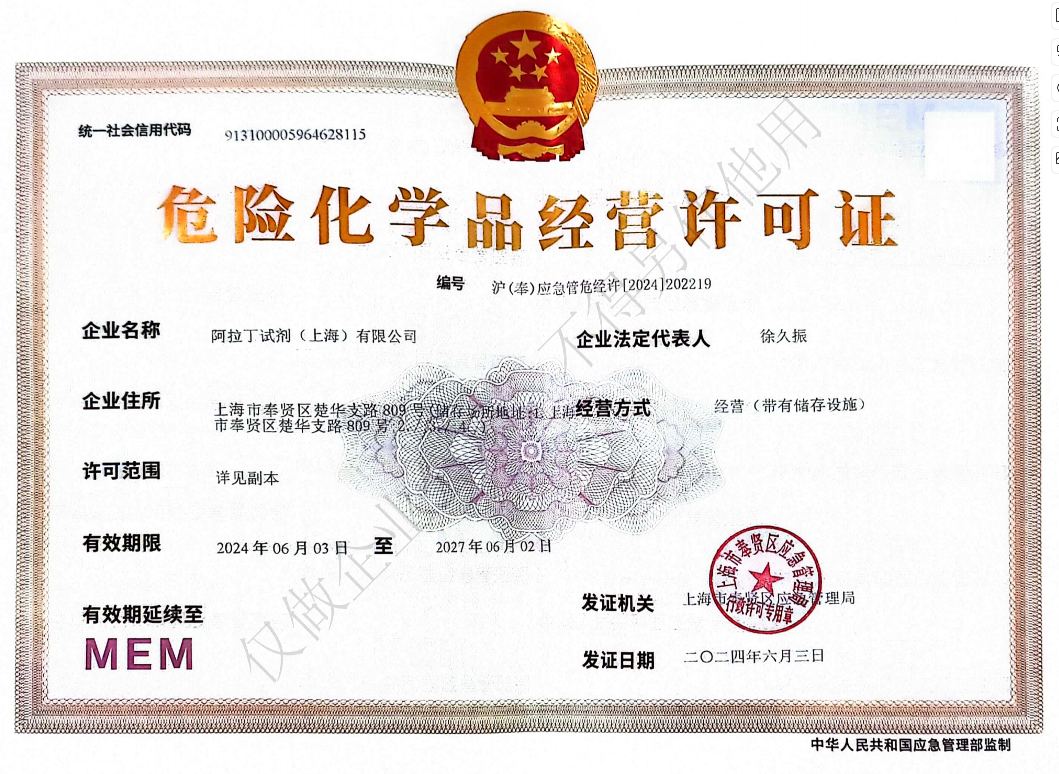 危险品化学品经营许可证(带存储)