葡萄糖 (Glucose,Dextrose, Glu) 又称玉米葡糖,简称葡糖,化学式C₆H₁₂O₆,分子量为180.16,是自然界分布最广、最重要的一种单糖,属于多羟基醛,用酶学方法测定葡萄糖是生化检测中的常用方法,最常用的有葡萄糖氧化酶法、己糖激酶法,上述酶学法特点是:
1、灵敏度、准确度、精密度均高;
2、使用温和的反应条件;
3、对葡萄糖有专一性,不受其他糖及还原物的干扰;
4、操作简便;
5、适用于自动分析仪。
检测原理:在葡萄糖氧化酶的催化下,葡萄糖被氧化成葡萄糖酸,同时消耗溶液中的氧,产生的过氧化氢与氧化色原物质反应生成红色的醌类化合物,初始反应中过氧化氢的生成量与葡萄糖浓度成正比,分光光度计505nm进行比色测定,专门用于人或动物的血清、血浆、脑脊液、细胞、组织等样本中的葡萄糖含量定量测定,但不宜直接检测尿液中的葡萄糖含量,其中Glu标准(5mmol/L)=90mg/dl。
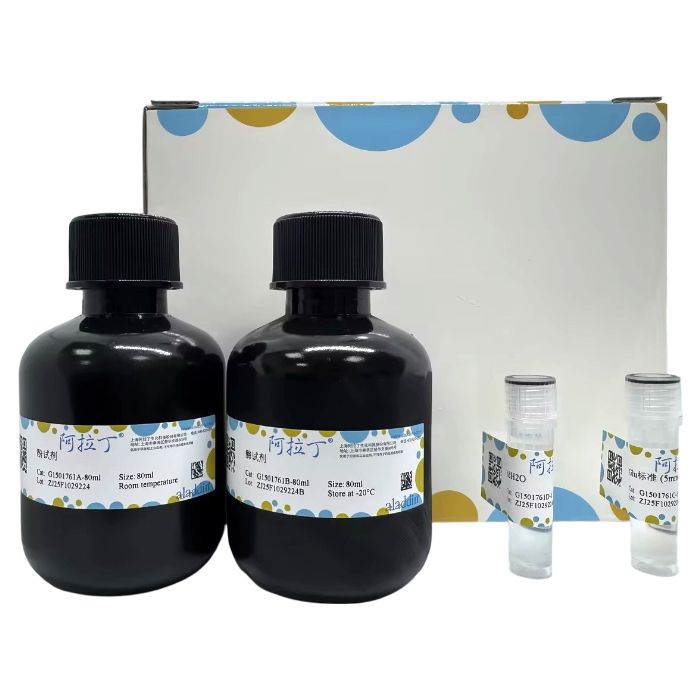
G1501761
| Component
| 200T | Storage
|
G1501761A
| 酚试剂 | 80 mL | RT. Store in the dark.
|
G1501761B
| 酶试剂 | 80 mL
| -20℃. Store in the dark.
|
G1501761C
| Glu标准 (5mmol/L) | 1.5 mL
| 2-8℃
|
G1501761D
| ddH₂O
| 1.5 mL
| RT |
自备仪器和试剂
生理盐水或PBS
离心管、匀浆机、离心机、水浴锅或恒温箱、分光光度计、1.0mL 比色皿
实验流程
1、试剂准备
临用前,酚试剂和酶试剂等比例混匀,即GOD-POD工作液,4℃保存。
2、样本处理
2.1 血清、血浆、脑脊液样品
从待测样品中分离出的血清或血浆不应有溶血,直接测定,如超过线性范围(30mmol/L),用生理盐水或PBS稀释后测定。
2.2 细胞样品
(1) 取适量的细胞(一般推荐> 10⁶ 以上),1000g离心10min,弃上清,留取沉淀。
(2) 用PBS或生理盐水清洗1~2次,1000g离心10min,弃上清,留取沉淀。
(3) 加入200~ 300μL的PBS或生理盐水匀浆,冰浴条件下超声破碎细胞,功率300W,每次3~5s,间隔30s,重复3~5次;亦可手动匀浆,制备好的匀浆液不可离心;亦可用1~2% Triton X-100冰浴30~ 60min,制备好的裂解液不可离心。
2.3 组织样品
准确称取适量组织样品,按质量(g):生理盐水或PBS(ml)=1: 9的比例,加入生理盐水或PBS,冰浴条件下手动或机械匀浆,2500~3000g离心10min,取上清。
3、加样
参考下表设置空白管、标准管、测定管,依次加入各种溶液,充分混匀,37℃水浴锅或45℃恒温箱中孵育15min。
| 试剂(mL) | 空白管 | 标准管 | 测定管 |
| ddH₂O | 0.008 | / | /
|
Glu标准 (5mmol/L)
| /
| 0.008
| /
|
| 待测样品 | /
| /
| 0.008
|
| GOD-POD工作液 | 0.8 | 0.8
| 0.8 |
4、测定
冷却后加入1.0ml比色皿中,测定505nm处吸光度,以空白管调零,读取标准管、测定管的吸光度,分别记为A 标准 、A 测定 。
5、结果计算
Glu (mmol/L)=A 测定 /A 标准 ×5
Glu (mg/L)=A 测定 /A 标准 ×900
参考区间
健康成年人空腹葡萄糖:3.9-6.1 mmol/L (70-110 mg/dl)
备注:Glu标准 (5mmol/L)=90 mg/dl=900 mg/L
注意事项
1、配制好的GOD-POD工作液,4℃避光保存,1周有效;低温试剂避免反复冻融,以免失效或效率下降。
2、测定标本用血清或以草酸钾-氟化钠抗凝的血浆(可抑制葡萄糖的分解),可直接用于检测脑脊液中的葡萄糖含量;待测样品如不能及时测定应置于2~8℃保存,3天内稳定。
3、尿葡萄糖目前多采用此法进行定量测定,但不能直接检测,需先用班氏法对尿液样品做半定量试验,按测出的大概含量,用蒸馏水稀释尿液使葡萄糖含量在3mg/mL以下,再进行检测,计算结果乘以稀释倍数即可,因为未经处理的尿液中尿酸等还原性物质的浓度较高,影响过氧化物酶反应,可能会造成结果假性偏低。
4、随着时间的延长,低浓度样品亦会显红色,所以15min后应及时检测,时间不宜过久。
5、采用酶标仪未调零情况下空白参考范围在0.04~0.09之间,5mmol/L标准参考范围在0.25~0.45之间,由于仪器设备、操作方法等不同,参考范围会有差异。
6、该试剂盒测定下限为0.1 mmol/L,测定上限为30 mmol/L;以肉眼观察,浓度≤ 0.6 mmol/L几乎呈无色,浓度在0.7 mmol/L即可显淡红色,浓度≥ 2.5 mmol/L可显红色,一般情况下接近上限比接近下限更准确。
7、本法线性范围可达30 mmol/L,如果样品葡萄糖浓度过高,结果可能呈假性降低,应用生理盐水或PBS等稀释后重测,结果乘以稀释倍数。
8、试剂开封后请尽快使用,以防影响后续实验效果。
9、为了您的安全和健康,请穿实验服并戴一次性手套操作。
10、该试剂盒仅用于科研领域,不适用于临床诊断或其他用途。
Glucose (Dextrose, Glu), chemical formula C₆H₁₂O₆, molecular weight 180.16, is the most widely distributed and important monosaccharide in nature, belonging to polyhydroxy aldehydes. Enzymatic methods for determining glucose are commonly used in biochemical detection, with the most frequently used being the glucose oxidase method and the hexokinase method. The characteristics of these enzymatic methods are:
High sensitivity, accuracy, and precision;
Use mild reaction conditions;
Specific for glucose, not interfered with by other sugars and reducing substances;
Simple operation;
Suitable for automatic analyzers.
Detection Principle: Under the catalysis of glucose oxidase, glucose is oxidized to gluconic acid, simultaneously consuming oxygen in the solution. The generated hydrogen peroxide reacts with an oxidative chromogen to form a red quinone compound. The amount of hydrogen peroxide produced in the initial reaction is proportional to the glucose concentration. Colorimetric determination is performed using a spectrophotometer at 505 nm. This kit is specifically designed for the quantitative determination of glucose content in human or animal serum, plasma, cerebrospinal fluid, cells, tissues, and other samples. It is not suitable for direct detection of glucose in urine.
*Note: Glu Standard (5 mmol/L) = 90 mg/dL.*
G1501761
| Component
| 200T | Storage
|
G1501761A
| Phenol Reagent | 80 mL | RT. Store in the dark.
|
G1501761B
| Enzyme Reagent | 80 mL
| -20℃. Store in the dark.
|
G1501761C
| Glu Standard (5 mmol/L) | 1.5 mL
| 2-8℃
|
G1501761D
| ddH₂O
| 1.5 mL
| RT |
User-Prepared Instruments and Reagents
Normal saline or PBS
Centrifuge tubes, Homogenizer, Centrifuge, Water bath or incubator, Spectrophotometer, 1.0 mL Cuvette
Experimental Procedure
1. Reagent Preparation
Shortly before use, mix the Phenol Reagent and Enzyme Reagent in equal volumes to prepare the GOD-POD Working Solution. Store at 4°C.
2. Sample Preparation
2.1 Serum, Plasma, Cerebrospinal Fluid Samples
Serum or plasma separated from the test sample should not be hemolyzed. Detect directly. If the concentration exceeds the linear range (30 mmol/L), dilute with normal saline or PBS before assay.
2.2 Cell Samples
(1) Take an appropriate amount of cells (generally recommended >10⁶), centrifuge at 1000 g for 10 min, discard the supernatant, keep the pellet.
(2) Wash 1-2 times with PBS or normal saline, centrifuge at 1000 g for 10 min, discard the supernatant, keep the pellet.
(3) Add 200-300 µL of PBS or normal saline and homogenize. Ultrasonicate on ice (power 300 W, 3-5 s each time, 30 s interval, repeat 3-5 times). The prepared homogenate should not be centrifuged.
*Alternatively, manually homogenize (prepared homogenate should not be centrifuged). Or lyse with 1-2% Triton X-100 on ice for 30-60 min (prepared lysate should not be centrifuged).*
2.3 Tissue Samples
Accurately weigh an appropriate amount of tissue. Add normal saline or PBS at a ratio of 1:9 (mass (g) : volume (mL)). Homogenize manually or mechanically on ice. Centrifuge at 2500-3000 g for 10 min. Collect the supernatant.
3. Assay Setup
Refer to the table below to set up Blank, Standard, and Test tubes. Add solutions sequentially, mix well, and incubate at 37°C in a water bath or 45°C in an incubator for 15 minutes.
| Reagent (mL) | Blank Tube | Standard Tube | Test Tube |
| ddH₂O | 0.008 | / | /
|
Glu Standard (5 mmol/L)
| /
| 0.008
| /
|
| Test Sample | /
| /
| 0.008
|
| GOD-POD Working Solution | 0.8 | 0.8
| 0.8 |
4. Measurement
After cooling, transfer to a 1.0 mL cuvette. Measure the absorbance at 505 nm. Zero the instrument with the Blank tube. Read the absorbances of the Standard tube and Test tube, recorded as A standard and A test , respectively.
5. Result Calculation
Glu (mmol/L) = A test / A standard × 5
Glu (mg/L) = A test / A standard × 900
Reference Interval
Healthy adults fasting glucose: 3.9 - 6.1 mmol/L (70 - 110 mg/dL)
*Note: Glu Standard (5 mmol/L) = 90 mg/dL = 900 mg/L*
Precautions
1. The prepared GOD-POD Working Solution should be stored at 4°C protected from light and is valid for 1 week. Avoid repeated freeze-thaw cycles for low-temperature reagents to prevent inactivation or decreased efficiency.
2. Use serum or plasma anticoagulated with potassium oxalate-sodium fluoride (inhibits glucose decomposition) for testing. Cerebrospinal fluid can be detected directly. If test samples cannot be assayed immediately, store at 2-8°C; stable for 3 days.
3. Urine glucose is often quantified using this method, but cannot be detected directly. First, perform a semi-quantitative test on the urine sample using Benedict's method. Based on the approximate content, dilute the urine with distilled water so that the glucose content is below 3 mg/mL before detection. Multiply the result by the dilution factor. This is because untreated urine contains high concentrations of reducing substances like uric acid, which affect the peroxidase reaction and may cause falsely low results.
4. Low-concentration samples will also turn red over time. Therefore, detection should be performed promptly after 15 minutes; the time should not be too long.
5. Without zeroing the microplate reader, the typical reference range for the blank is 0.04-0.09, and for the 5 mmol/L standard is 0.25-0.45. Reference ranges may vary due to differences in instruments and operating methods.
6. The lower detection limit of this kit is 0.1 mmol/L, and the upper limit is 30 mmol/L. Visual observation: concentration ≤ 0.6 mmol/L is almost colorless; concentration ≥ 0.7 mmol/L shows light red; concentration ≥ 2.5 mmol/L shows red. Generally, results are more accurate near the upper limit than near the lower limit.
7. The linear range of this method can reach 30 mmol/L. If the sample glucose concentration is too high, the result may be falsely low. Dilute with normal saline or PBS and re-assay, multiplying the result by the dilution factor.
8. Use reagents promptly after opening to avoid affecting subsequent experimental results.
9. For your safety and health, please wear lab coats and disposable gloves during operation.
10. This kit is for scientific research use only and is not intended for clinical diagnosis or other purposes.

 ZJ26F0939434

 危险品化学品经营许可证(带存储)