活性氧(Reactive oxygen species, ROS)是氧正常代谢的天然副产物,包括超氧自由基、过氧化氢、及其下游产物过氧化物和羟 化物等,研究表明,机体95%以上的活性氧(ROS)都来自于线粒体,其失衡所致的氧化应激与细胞生长增殖、发育分化、衰老和凋亡以及许多生理和病理过程有关。正常情况下,细胞内抗氧化防御系统与氧自由基处于平衡状态,细胞内活性氧(ROS)水平维持在较低的生理范围;在病理情况下,细胞内抗氧化系统与氧自由基的平衡被打破,细胞内活性氧水平过多,就可破坏线粒体酶类、脂类和核酸,使机体出现氧化应激,同时,活性氧还可攻击线粒体DNA产生氧化损伤,导致线粒体ATP合成减少、线粒体膜电位破坏等结构和功能变化。
线粒体活性氧 (ROS) 产生速率检测试剂盒 (荧光法) 提供了一种简单、灵敏、快速的线粒体ROS产生速率检测方法,其原理是利用荧光探针DCFH-DA进行活性氧检测,DCFH-DA (2',7'-二氯荧光素二乙酸酯) 可扩散通过线粒体膜,并在线粒体内被酯酶水解形成无荧光的DCFH,DCFH被活性氧(ROS)氧化生成有荧光的DCF,DCF荧光强度增加速率与ROS产生的速率呈正比。
适用样本:动植物组织、细胞、真菌
荧光激发/发射:Ex/Em=488/525nm
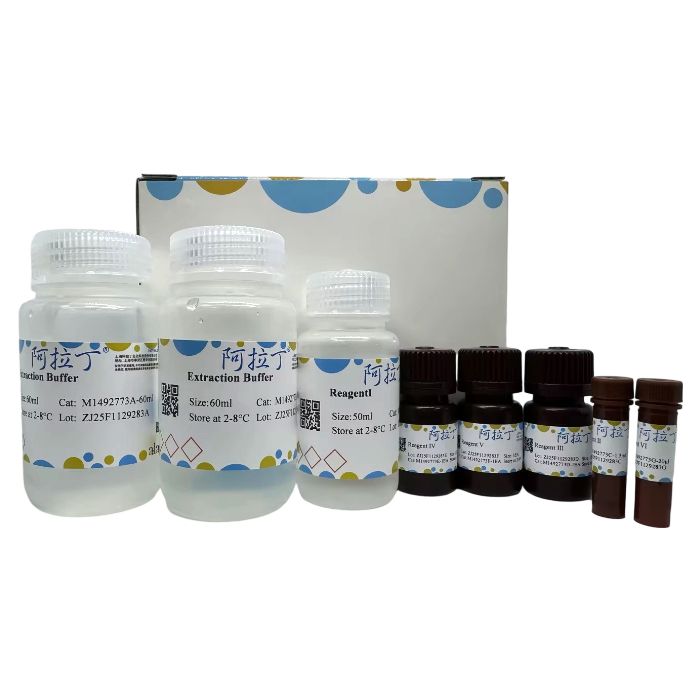
M1492773
| Component
| 96T | Storage
|
M1492773A
| Extraction Buffer
| 60 mL×2
| 2-8℃ |
M1492773B
| ReagentⅠ
| 50 mL
| 2-8℃
|
M1492773C
| Reagent Ⅱ
| 1.5 mL
| -20℃. Store in the dark. |
M1492773D
| Reagent Ⅲ
| 1EA | 2-8℃. Store in the dark.
|
M1492773E
| Reagent Ⅳ
| 1EA | 2-8℃. Store in the dark.
|
M1492773F
| Reagent Ⅴ
| 1EA | 2-8℃. Store in the dark.
|
M1492773G
| Reagent Ⅵ
| 20 μL
| -20℃. Store in the dark. |
注意:正式检测前,建议选择2-3个预期差异较大的样本进行预实验。
自备仪器和耗材
可调节式移液枪及枪头
匀浆器、低温离心机、96孔全黑酶标板或全白酶标板
恒温培养箱、多功能酶标仪
实验流程
1、试剂准备
试剂名称
| 试剂准备
| 注意事项
|
Extraction Buffer
| 即用型;使用前平衡到室温
| 4℃保存
|
ReagentⅠ
| 即用型;使用前平衡到室温
| 4℃保存
|
ReagentⅡ
| 即用型
| -20℃避光保存
|
ReagentⅢ
| 临用前配制,96T加入6mL ReagentⅠ充分溶解
| 未用完的已溶解的ReagentⅢ可4℃避光保存1个月
|
ReagentⅣ
| 临用前配制,96T加入6mL ReagentⅠ充分溶解
| 未用完的已溶解的ReagentⅣ可4℃避光保存1个月
|
ReagentⅤ
| 临用前配制,96T加入6mL ReagentⅠ充分溶解
| 未用完的已溶解的ReagentⅤ可4℃避光保存1个月
|
ReagentⅥ
|
| ReagentⅥ有一定的刺激性,建议在使用过程中做好个人防护
|
Working ReagentⅥ
| 临用前配制,按照用量将ReagentⅥ用ReagentⅠ稀释300倍后使用
| 稀释好的Working ReagentⅥ不可重复使用 |
2、样本制备
组织、细胞线粒体提取:
2.1 称取约0.1g组织或收集500万个细胞,加入1mL Extraction Buffer和10µL Reagent Ⅱ,匀浆器冰浴匀浆,600g,4℃离心5min,收集上清至新的离心管中,舍弃沉淀。
2.2 再次离心上清,11,000g,4℃离心10min,沉淀即为提取的线粒体。
2.3 弃上清,沉淀加入200µL ReagentⅠ重悬,置于冰上待测。
注意:
(1) 建议使用新鲜样本。如果不立即使用,可将样品在-80℃下保存一个月。
(2) 提取好的线粒体样本需要在当天检测完,不可冷冻保存。
(3) 如需测定蛋白浓度,推荐使用阿拉丁 B774074 Bradford蛋白浓度测定试剂盒或B406195 Bradford测定溶液 (即用型) [蛋白质测定用]。
3、实验步骤
3.1 多功能酶标仪预热到37℃,调节荧光激发波长488 nm,发射波长525 nm。
3.2 在96孔全黑酶标板或全白酶标板按照如下方式加样:
试剂
| 空白孔(μL)
| 测定孔(μL)
|
Sample
| 0
| 20 |
ReagentⅠ
| 20 | 0 |
ReagentⅢ
| 50
| 50
|
ReagentⅣ
| 50
| 50
|
ReagentⅤ
| 50
| 50
|
Working ReagentⅥ
| 30 | 30 |
3.3 混匀,37℃避光孵育15min。孵育完成后,用多功能酶标仪测定10min内的荧光值,激发波长488 nm,发射波长525 nm,仪器温度保持在37℃,记录10min内的荧光值变化。
注意:
(1) 需37℃恒温下测定10min内荧光强度变化。
(2) 用移液器混匀时,要小心吸打,避免产生气泡。
(3) 检测时需使用全黑色或白色的96孔板,防止相邻孔的干扰。
4、结果计算
4.1 对采样数据点即荧光强度随时间的变化进行线性回归拟合处理,计算出回归系数,即直线斜率(k)。
实际线粒体ROS产生速率等于样本荧光强度随时间变化(s)的数据点线性回归直线斜率(k测定)减去本底荧光强度随时间变化的数据点线性回归直线斜率(k空白),k=(RFU10min-RFU0min)/600。
4.2 结果计算
注意:我们为您提供的计算公式,包括推导过程计算公式和简洁计算公式。两者完全相等。建议以加粗的简洁计算公式为最终计算公式。
(1) 按样本质量计算:
每g组织线粒体每秒钟荧光单位的变化,即u/s/g鲜重。
ROS产生速率 (u/s/g 鲜重) =(k测定-k空白)÷(V样÷V总×W)=100×(k测定 -k空白)
(2) 按样本蛋白浓度计算:
每mg蛋白线粒体每秒钟荧光单位的变化,即u/s/mg prot。
ROS产生速率 (u/s/mg prot) =(k测定-k空白)÷(V样÷V总×Cpr)=10×(k测定-k空白)÷Cpr
(3) 按细胞数量计算:
每10⁴个细胞每秒钟荧光单位的变化,即u/s/10⁴Cells。
ROS产生速率 (u/s/10⁴ Cells)=(k测定-k空白)÷(500×V样÷V总)=(k测定-k空白)÷50
参数说明
V样 :加入样本体积,0.02 mL;
V总 :重悬样本总体积,0.2 mL;
W:样本质量,0.1 g;
500:细胞数量,以10⁴为单位。
注意事项
1、生化检测试剂普遍具有刺激性、生物毒性等,为了您的安全和健康,请在实验全程做好生物安全防护,穿戴实验服、口罩、手套、头套等安全护具,在通风橱、生物安全柜中进行实验。
2、本产品仅供科学研究使用,不适用于临床诊断。
Reactive oxygen species (ROS) are natural by-products of normal oxygen metabolism, including superoxide radicals, hydrogen peroxide, and their downstream products such as peroxides and hydroxides. Studies show that over 95% of ROS in organisms originate from mitochondria. An imbalance leading to oxidative stress is associated with cell growth, proliferation, development, differentiation, aging, apoptosis, and many physiological and pathological processes. Under normal conditions, a balance exists between the intracellular antioxidant defense system and oxygen free radicals, maintaining ROS at low physiological levels. Under pathological conditions, this balance is disrupted, leading to excessive intracellular ROS levels. This can damage mitochondrial enzymes, lipids, and nucleic acids, causing oxidative stress. Additionally, ROS can attack mitochondrial DNA, causing oxidative damage that leads to structural and functional changes such as reduced mitochondrial ATP synthesis and disrupted mitochondrial membrane potential.
Mitochondrial Reactive Oxygen Species (ROS) Production Rate Assay Kit (Fluorometric Method) provides a simple, sensitive, and rapid method for detecting mitochondrial ROS production rate. The principle utilizes the fluorescent probe DCFH-DA for ROS detection. DCFH-DA (2',7'-Dichlorodihydrofluorescein diacetate) diffuses across the mitochondrial membrane and is hydrolyzed by esterases inside the mitochondria to form non-fluorescent DCFH. DCFH is then oxidized by ROS to generate fluorescent DCF. The rate of increase in DCF fluorescence intensity is proportional to the rate of ROS production.
M1492773
| Component
| 96T | Storage
|
M1492773A
| Extraction Buffer
| 60 mL×2
| 2-8℃ |
M1492773B
| ReagentⅠ
| 50 mL
| 2-8℃
|
M1492773C
| Reagent Ⅱ
| 1.5 mL
| -20℃. Store in the dark. |
M1492773D
| Reagent Ⅲ
| 1EA | 2-8℃. Store in the dark.
|
M1492773E
| Reagent Ⅳ
| 1EA | 2-8℃. Store in the dark.
|
M1492773F
| Reagent Ⅴ
| 1EA | 2-8℃. Store in the dark.
|
M1492773G
| Reagent Ⅵ
| 20 μL
| -20℃. Store in the dark. |
Note: It is recommended to perform preliminary experiments using 2-3 samples expected to have significant differences before formal testing.
User-Provided Instruments and Consumables
Adjustable pipettes and tips
Homogenizer, Low-temperature centrifuge, 96-well solid black or solid white microplate
Constant temperature incubator, Multifunctional microplate reader
Experimental Procedure
1. Reagent Preparation
Reagent Name
| Reagent Preparation
| Precautions
|
Extraction Buffer
| Ready-to-use; equilibrate to room temperature before use.
| Store at 4°C
|
ReagentⅠ
| Ready-to-use; equilibrate to room temperature before use.
| Store at 4°C
|
ReagentⅡ
| Ready-to-use
| Store at -20°C protected from light.
|
ReagentⅢ
| Prepare before use: Dissolve contents for 96 tests in 6 mL Reagent I. Mix well.
| Unused dissolved Reagent III can be stored at 4°C protected from light for 1 month.
|
ReagentⅣ
| Prepare before use: Dissolve contents for 96 tests in 6 mL Reagent I. Mix well.
| Unused dissolved Reagent IV can be stored at 4°C protected from light for 1 month.
|
ReagentⅤ
| Prepare before use: Dissolve contents for 96 tests in 6 mL Reagent I. Mix well.
| Unused dissolved Reagent V can be stored at 4°C protected from light for 1 month.
|
ReagentⅥ
|
| Reagent VI is somewhat irritating; personal protection is recommended during use.
|
Working ReagentⅥ
| Prepare before use: Dilute Reagent VI 300-fold with Reagent I according to the required volume.
| Diluted Working Reagent VI cannot be reused. |
2. Sample Preparation (Tissue/Cell Mitochondria Extraction)
2.1 Weigh approximately 0.1 g of tissue or collect 5 million cells. Add 1 mL of Extraction Buffer and 10 µL of Reagent II. Homogenize on ice using a homogenizer. Centrifuge at 600 g, 4°C for 5 minutes. Collect the supernatant into a new centrifuge tube, discard the pellet.
2.2 Centrifuge the supernatant again at 11,000 g, 4°C for 10 minutes. The pellet contains the extracted mitochondria.
2.3 Discard the supernatant. Resuspend the pellet in 200 µL of Reagent I. Keep on ice for immediate assay.
Notes:
(1) Fresh samples are recommended. If not used immediately, samples can be stored at -80°C for one month.
(2) Extracted mitochondrial samples must be assayed on the same day and should not be frozen.
(3) For protein concentration determination, Aladdin B774074 Bradford Protein Assay Kit or B406195 Bradford Assay Solution (Ready-to-Use) [for Protein Determination] is recommended.
3. Assay Steps
3.1 Pre-heat the multifunctional microplate reader to 37°C. Set the fluorescence excitation wavelength to 488 nm and emission wavelength to 525 nm.
3.2 Add reagents to a 96-well solid black or solid white microplate as follows:
Reagent
| Blank Well (µL)
| Test Well (µL)
|
Sample
| 0
| 20 |
ReagentⅠ
| 20 | 0 |
ReagentⅢ
| 50
| 50
|
ReagentⅣ
| 50
| 50
|
ReagentⅤ
| 50
| 50
|
Working ReagentⅥ
| 30 | 30 |
3.3 Mix well. Incubate at 37°C protected from light for 15 minutes.
3.4 After incubation, measure the fluorescence intensity over 10 minutes using the microplate reader (Ex/Em = 488/525 nm). Maintain the instrument temperature at 37°C. Record the fluorescence change over 10 minutes.
Notes:
(1) Fluorescence intensity changes must be measured at a constant 37°C over 10 minutes.
(2) When mixing with a pipette, pipette gently to avoid generating bubbles.
(3) Use solid black or white 96-well plates to prevent interference between adjacent wells.
4. Result Calculation
4.1 Data Processing
Perform linear regression analysis on the sampled data points (fluorescence intensity vs. time) to calculate the regression coefficient, i.e., the slope (k) of the line.
The actual mitochondrial
ROS production rate equals the slope (k test ) from the linear regression of the sample's fluorescence intensity vs. time data points minus the slope (k blank ) from the linear regression of the background fluorescence intensity vs. time data points.
k = (RFU 10min - RFU 0min ) / 600 (assuming time in seconds; 10 min = 600 s)
4.2 Activity Calculation
Note: We provide both derived and simplified calculation formulas, which are equivalent. The simplified formulas in bold are recommended as the final calculation formulas.
(1) Based on sample mass:
(1) Based on sample mass:
ROS Production Rate (RFU/s/g fresh weight) = (k test - k blank ) ÷ (V sample ÷ V total × W) = 100 × (k test - k blank )
(2) Based on sample protein concentration:
ROS Production Rate (RFU/s/mg prot) = (k test - k blank ) ÷ (V sample ÷ V total × Cpr) = 10 × (k test - k blank ) ÷ Cpr
(3) Based on cell count:
ROS Production Rate (RFU/s/10⁴ Cells) = (k tes t - k blank ) ÷ (500 × V sample ÷ V total ) = (k test - k blank ) ÷ 50
Parameter Description:
V sample : Sample volume added, 0.02 mL
V total : Total resuspension volume of the sample, 0.2 mL
Cpr: Sample protein concentration, mg/mL
W: Sample mass, 0.1 g
500: Cell count, in units of 10⁴
Precautions
1.Biochemical reagents are generally irritating and biologically toxic. For your safety and health, please implement appropriate biosafety precautions throughout the experiment. Wear personal protective equipment such as lab coats, masks, gloves, and hair caps. Perform experiments in a fume hood or biosafety cabinet.
2.This product is for scientific research use only. Not intended for clinical diagnosis.

 I2618983


 危险品化学品经营许可证(带存储)