
计算溶液所需的质量、体积或浓度。
乙醇脱氢酶 (ADH)提取试剂
有货
BioReagent,植物样品抽提用 级 ,适用于对基线干扰要求严格的色谱和分析工作流程。
2-8°C储存,-20°C储存。超低温运输 。请查阅批次 COA 获取详细规格。
SDS、COA、产品数据表及规格说明书均可下载。可通过批号查询获取批次 COA。
在色谱分析、有机合成和交叉偶联反应领域已被 0 篇同行评审文献引用。
乙醇脱氢酶 (Alcohol Dehydrogenase, ADH)的系统名为乙醇:辅酶I氧化还原酶 (alcohol: NAD+ oxidoreductase),大量存在于人和动物肝脏、植物及微生物细胞之中,是一种含锌金属酶,具有广泛的底物特异性。乙醇脱氢酶够以烟酰胺腺嘌呤二核苷酸(NAD)为辅酶,催化伯醇和醛之间的可逆反应: CH3CH2OH+ NAD+→ CH3CHO +NADH+ H+。在人和哺乳动物体内,乙醇脱氢酶与乙醛脱氢酶 (ALDH)构成了乙醇脱氢酶系,参乙醇脱氢酶与体内乙醇代谢,是人和动物体内重要的代谢酶;作为生物体内主要短链醇代谢的关键酶,它在很多生理过程中起着重要作用,丙酮酸脱羧酶 (PDC)、乙醇脱氢酶 (ADH)是乙醇发酵途径的关键酶,无氧呼吸途径代谢产物的过程积累对细胞产生毒性,影响线粒体结构和三羧酸循环的相关酶活性。
乙醇脱氢酶 (ADH)提取试剂主要用于裂解植物组织,提取样品中的乙醇脱氢酶。该试剂仅用于科研领域,不适用于临床诊断或其他用途。
产品组成:
|
自备材料:
1、蒸馏水
2、离心管或试管、匀浆器或研钵、低温离心机
操作步骤 (仅供参考):
1、取植物组织清洗干净,切碎。
2、配制乙醇脱氢酶提取工作液: 取出乙醇脱氢酶提取试剂和PMSF,恢复至室温,按乙醇脱氢酶提取试剂:PMSF=499: 1的比例混合,混匀,即配即用,不易久置,否则蛋白酶抑制剂PMSF的效率会有所下降。
3、按植物组织: 乙醇脱氢酶提取工作液=1 g: 4 ml的比例,加入预冷的乙醇脱氢酶提取工作液,冰浴情况下充分匀浆或研磨。
4、12000 g,4 ℃离心20 min,留取上清液即为乙醇脱氢酶粗提液,4 ℃保存,用于乙醇脱氢酶的检测或其他用途。
计算:
样品粗酶液获得率 (ml/g)=上清液体积 (ml)/样品质量 (g)×100%
注意事项:
1、实验材料应尽量新鲜,如取材后不立即使用,应存于-20~-80 ℃。
2、待测样品中不能含有磷酸酶抑制剂,同时需避免反复冻融。
3、所测样本的值高于标准曲线的上限,应用乙醇脱氢酶提取工作液稀释样品后重新测定。
4、试剂开封后请尽快使用,以防影响后续实验效果。
5、为了您的安全和健康,请穿实验服并戴一次性手套操作。
Alcohol Dehydrogenase (ADH), systematically named alcohol: NAD⁺ oxidoreductase, is abundant in the liver of humans and animals, plants, and microbial cells. It is a zinc-containing metalloenzyme with broad substrate specificity. Using nicotinamide adenine dinucleotide (NAD⁺) as a coenzyme, ADH catalyzes the reversible reaction between primary alcohols and aldehydes:CH₃CH₂OH + NAD⁺ → CH₃CHO + NADH + H⁺. In humans and mammals, ADH and Aldehyde Dehydrogenase (ALDH) constitute the alcohol dehydrogenase system, which participates in ethanol metabolism and serves as an important metabolic enzyme in humans and animals. As a key enzyme in the metabolism of short-chain alcohols in organisms, ADH plays an important role in many physiological processes. Pyruvate Decarboxylase (PDC) and Alcohol Dehydrogenase (ADH) are key enzymes in the ethanol fermentation pathway. The accumulation of metabolites from the anaerobic respiration pathway is toxic to cells, affecting mitochondrial structure and the activities of enzymes related to the tricarboxylic acid cycle.
Alcohol Dehydrogenase (ADH) Extraction Reagent is mainly used for lysing plant tissues and extracting alcohol dehydrogenase from samples.This product is for research use only and not suitable for clinical diagnosis or other applications.
Components
|
Materials Provided by User
1. Distilled water
2. Centrifuge tubes or test tubes, homogenizer or mortar, refrigerated centrifuge
Protocol (For Reference Only)
1. Collect plant tissues, wash clean, and cut into small pieces.
2. Prepare ADH Extraction Working Solution:
Take ADH Extraction Reagent and PMSF to room temperature. Mix at a ratio of ADH Extraction Reagent: PMSF = 499: 1. Prepare fresh before use; do not store for a long time, otherwise the inhibitory efficiency of PMSF will decrease.
3. Add pre-cooled ADH Extraction Working Solution at a ratio of plant tissue: working solution=1 g: 4 mL, then homogenize or grind thoroughly in an ice bath.
4. Centrifuge at 12000×g, 4℃ for 20 min. The supernatant is the crude ADH extract. Store at 4℃ for ADH assay or other experiments.
Calculation
Crude Enzyme Extract Yield (mL/g)=Supernatant Volume (mL)/Sample Weight (g) × 100%
Precautions
1. Experimental materials should be as fresh as possible. If not used immediately, store at −20 to −80℃.
2. Test samples should not contain phosphatase inhibitors, and repeated freeze-thaw cycles should be avoided.
3. If the measured value exceeds the upper limit of the standard curve, dilute the sample with ADH Extraction Working Solution and re-assay.
4. Please use the reagent as soon as possible after opening to avoid affecting experimental results.
5. For your safety and health, please wear lab coat and disposable gloves during operation.
通过匹配包装上的批号来查找并下载产品的 COA,每批产品都进行了严格的验证,您可放心使用!
| 批号(Lot Number) | 证书类型 | 货号 |
|---|---|---|
 ZJ26F0434120 ZJ26F0434120 |
分析证书 | E1518221 |
我们的级别选择指南涵盖了目录中所有的变体的纯度、稳定剂状态和应用适用性。
查看 BioReagent 级别指南 → 查看 Suitable for plant cell and tissue extracts 级别指南 →

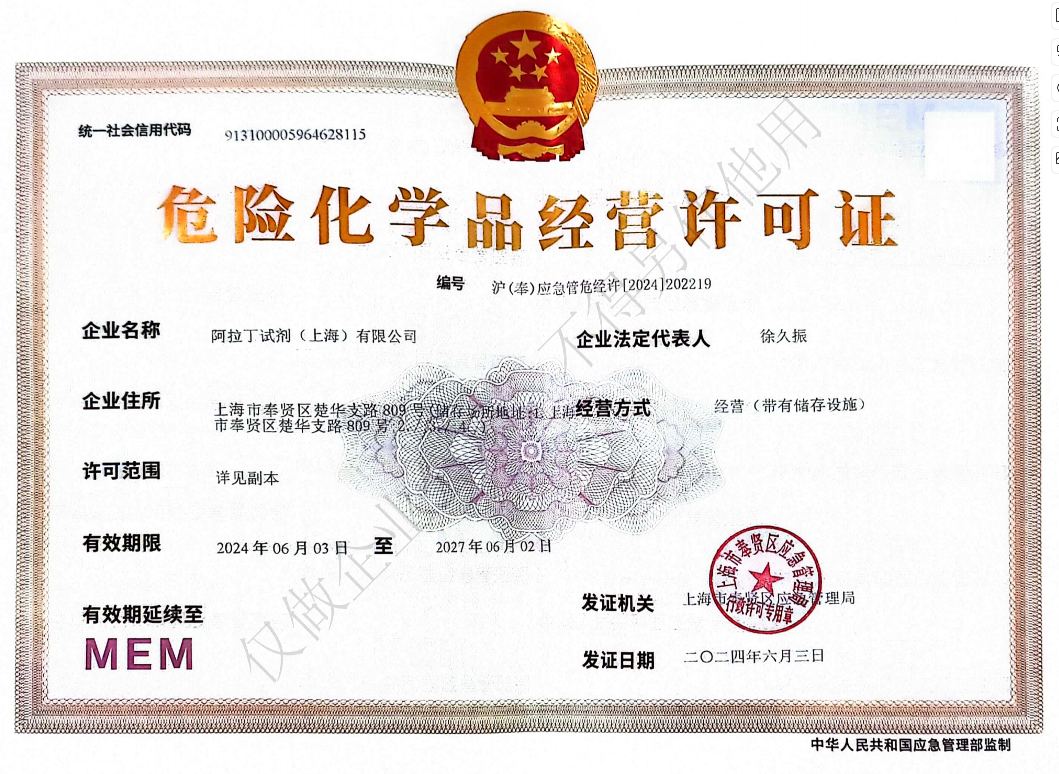 危险品化学品经营许可证(带存储)