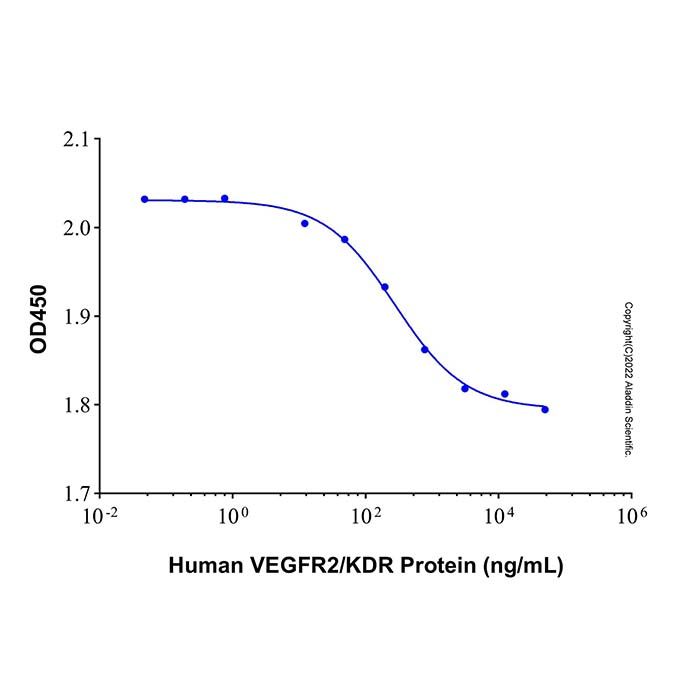
Measured by its ability to inhibit the VEGF-dependent proliferation of HUVEC human umbilical vein endothelial cells. The ED50 for this effect is 0.297 μg/mL in the presence of 8.0 ng/mL Recombinant Human VEGF (rp155965).
Protein Function: VEGFR2 also called KDR or Flk-1, is identified as the receptor for VEGF and VEGFC and an early marker for endothelial cell progenitors, whose expression is restricted to endothelial cells in vivo. VEGFR2 was shown to be the primary signal transducer for angiogenesis and the development of pathological conditions such as cancer and diabetic retinopathy. It has been shown that VEGFR2 is expressed mainly in the endothelial cells, and the expression is upregulated in the tumor vasculature. Thus the inhibition of VEGFR2 activity and its downstream signaling are important targets for the treatment of diseases involving angiogenesis. VEGFR2 transduces the major signals for angiogenesis via its strong tyrosine kinase activity. However, unlike other representative tyrosine kinase receptors, VEGFR2 does not use the Ras pathway as major downstream signaling but rather uses the phospholipase C-protein kinase C pathway to signal mitogen-activated protein (MAP)-kinase activation and DNA synthesis. VEGFR2 is a direct and major signal transducer for pathological angiogenesis, including cancer and diabetic retinopathy, in cooperation with many other signaling partners; thus, VEGFR2 and its downstream signaling appear to be critical targets for the suppression of these diseases. VEGF and VEGFR2-mediated survival signaling are critical to endothelial cell survival, maintenance of the vasculature and alveolar structure, and regeneration of lung tissue. Reduced VEGF and VEGFR2 expression in emphysematous lungs has been linked to increased endothelial cell death and vascular regression.
Measured by its ability to inhibit the VEGF-dependent proliferation of HUVEC human umbilical vein endothelial cells. The ED50 for this effect is 0.297 μg/mL in the presence of 8.0 ng/mL Recombinant Human VEGF (rp155965).
118.3 kDa, under reducing conditions; 118.3 kDa, under non-reducing conditions
分子类型
蛋白质
产品线
biological_products
储存与运输
物理形态
冻干(Lyophilized)
储存缓冲液
Lyophilized from PBS, pH 7.4
复溶
We recommend that this vial be briefly centrifuged prior to opening to bring the contents to the bottom. Reconstitute at 1.0 mg/mL in sterile distilled water. Stock solutions should be apportioned into working aliquots and stored at ≤ -20 °C. Further dilutions should be made in appropriate buffered solutions.
储存条件
-20°C储存,避免反复冻融
运输条件
超低温运输
稳定性与储存
在 -20°C 下可保存 1 年。避免冷冻/解冻循环。
图片
Recombinant Human VEGFR2/KDR Protein (rp176713) - Protein Bioactivity Measured by its ability to inhibit the VEGF-dependent proliferation of HUVEC human umbilical vein endothelial cells. The ED50 for this effect is 0.297 μg/mL in the presence of 8.0 ng/mL Recombinant Human VEGF (rp155965).
Recombinant Human VEGFR2/KDR Protein (rp176713) - SDS-PAGE 2 μg/lane of Recombinant Human VEGFR2/KDR Protein was resolved with SDS-PAGE under reducing (R) and non-reducing (N) conditions and visualized by Coomassie® Blue staining, showing a band at 118.3 kDa.

 ZJ24F0707682


 危险品化学品经营许可证(带存储)