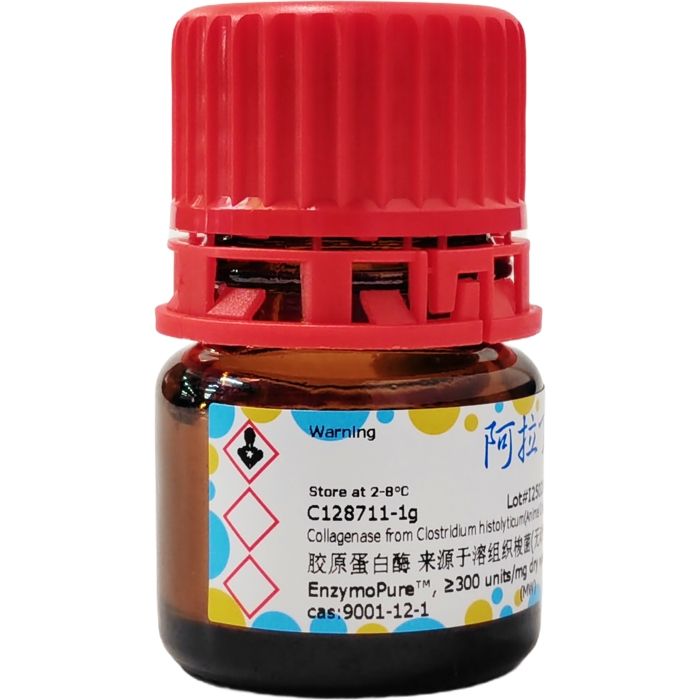
Collagenase from Clostridium histolyticum(Animal Origin Free,B) is prepared from cultures grown in medium devoid of animal based components to contain higher collagenase and caseinase activities than C128710.
Crude collagenase preparations contain several isoforms of two different collagenases, a sulfhydryl protease, clostripain, a trypsin-like enzyme, and an aminopeptidase. This combination of collagenolytic and proteolytic activities is effective at breaking down intercellular matrices, the essential part of tissue dissociation. One component of the complex is a hydrolytic enzyme which degrades the helical regions in native collagen preferentially at the Y-Gly bond in the sequence Pro-Y-Gly-Pro, where Y is most frequently a neutral amino acid. This cleavage yields products susceptible to further peptidase digestion. Crude collagenase is inhibited by metal chelating agents such as cysteine, EDTA or o-phenanthroline but not DFP. It is also inhibited by α2-macroglobulin, a large plasma glycoprotein. Ca²⁺ is required for enzyme activity.
Particular enzymatic profiles of each collagenase have been correlated with the tissues from which the cells for study were obtained (or with the uses to which the cells are put) and as a result of the correlations several types of crude collagenases have been established by Aladdin: Types 1, 2, 3, and 4.
• Type 1 crude collagenase has the original balance of collagenase, caseinase, clostripain and tryptic activities.
• Type 2 contains higher relative levels of protease activity, particularly clostripain.
• Type 3 contains lowest levels of secondary proteases.
• Type 4 is designed to be especially low in tryptic activity to limit damage to membrane proteins and receptors.
The collagenase assay is a modification of Mandl wherein collagenase is incubated for five hours with native collagen and the extent of collagen breakdown is determined using the Moore and Stein, JBC, 176, 367, (1948) colorimetric ninhydrin method. Amino acids released are expressed as micromoles leucine per milligram collagenase.
Uses: Crude collagenases are widely used in enzymatic primary cell isolation and tissue dissociation procedures. Most researchers employ either crude collagenase preparations such as Types 1, 2, 3, and 4 or chromatographically purified collagenase (Code: C128695); the latter usually combined with secondary enzymes such as elastase, hyaluronidase, etc. For best results, the precise mixture of proteolytic activities must be tailored to the tissue to be dissociated. Correlations between type and effectiveness with different tissues have been good, but not perfect, and may be dependent partly on parameters of use and objectives as well as lot-to-lot variations.

 L2205709


 危险品化学品经营许可证(带存储)