
 F2612167
计算溶液所需的质量、体积或浓度。
为什么选择此级别
,适用于对基线干扰要求严格的色谱和分析工作流程。
储存与运输
室温。常规运输 。请查阅批次 COA 获取详细规格。
质量文档
SDS、COA、产品数据表及规格说明书均可下载。可通过批号查询获取批次 COA。
文献证明
在色谱分析、有机合成和交叉偶联反应领域已被 499 篇同行评审文献引用。
概述
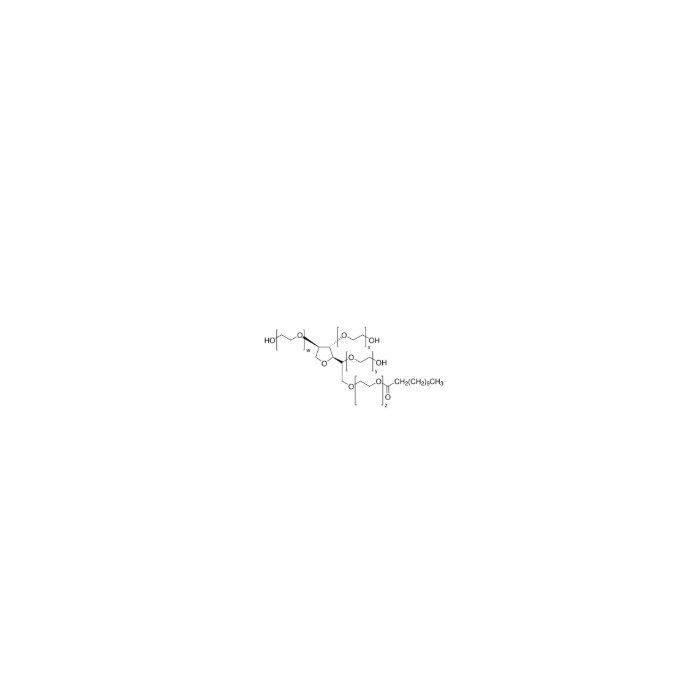
吐温20是一种基于天然脂肪酸(月桂酸)的乙氧基化(20)山梨糖醇酯。这乙氧基化物在形成油水型乳化剂时非常高效,特别是和非乙氧基化衍生物司班20结合使用时尤为如此。
化学基团:
非离子表面活性剂 - 脱水山梨醇酯和乙氧基化脱水山梨醇酯
Form @ 25oC Clear yellow liquid
HLB 16.7
产品生产厂家:英国禾大(Croda)
非离子型表面活性剂。气相色谱固定液(最高使用温度120℃)分离分析挥发油、脂肪酸酯、醇、酮和卤化物。水溶性乳化剂。加溶剂。纺织工业用抗静电剂和纤维润滑剂。
产品应用
TWEEN 20作为组分已用于:
Western blotting中的洗涤和封闭缓冲液
免疫组化中的封闭缓冲液
ELISA(酶联免疫吸附测定)中的洗涤缓冲液
PCR(聚合酶链反应)中的反应混合液
TWEEN 20是一种广泛用于生化应用的非离子型去污剂。它已被作为乳化剂用于稳定的水包油乳液的制备。TWEEN 20已用于膜的预提取以去除外周蛋白(以2%用于膜结合蛋白的提取)。
通常0.05%浓度的TWEEN 20在基于膜的免疫检测中被用作封闭剂。0.005至0.5%的TWEEN 20可用于裂解哺乳动物细胞。
非离子洗涤剂
Tween 20 is an ethoxylated (20) sorbitan ester based on a natural fatty acid (lauric acid). This ethoxylate is highly effective at forming O/W emulsions, particularly when used in combination with its non-ethoxylated derivative, Span 20. Chemical group Nonionic Surfactants - Sorbitan Esters and Ethoxylated Sorbitan Esters Form @ 25oC Clear yellow liquid HLB 16.7 Manufacturer:Croda
Non-ionic detergent
ECO TWEEN® 20, also known as Polyoxyethylenesorbitan monolaurate, is a bio-based, nonionic detergent manufactured from a natural fatty acid. This surfactant, derived from natural sources, provides various functional advantages, such as detergency, emulsification, and wetting. Its versatility makes it well-suited for a variety of applications in biochemical and biological research, with common uses including cell lysis, protein extraction, nuclei isolation and cell fractionation. We are committed to bringing you Greener Alternative Products, which adhere to one or more of The 12 Principles of Green Chemistry. This product is a biobased surfactant and is aligned with the 7th principle of Green Chemistry "Use of Renewable Feedstocks" and the 10th principle "Design for Degradation".
TWEEN 20 is a polyoxyethylene sorbitol ester that belongs to the polysorbate family. It is a nonionic detergent having a molecular weight of 1,225 daltons, assuming 20 ethylene oxide units, 1 sorbitol, and 1 lauric acid as the primary fatty acid. The ethylene oxide subunits are responsible for the hydrophilic nature of the surfactant, while the hydrocarbon chains provide the hydrophobic environment. Sorbitol forms the backbone ring to which the ethylene oxide polymers are attached.
Product Application
TWEEN 20 has been used as a component of:
washing buffer and blocking buffer in Western blotting
blocking buffer in immunohistochemistry
washing buffer in ELISA (enzyme linked immunosorbent assay)
reaction mixture in PCR (polymerase chain reaction)
TWEEN 20 is a nonionic detergent widely used in biochemical applications. It has been used as an emulsifying agent for the preparation of stable oil-in-water emulsions. TWEEN 20 has been used in pre-extraction of membranes to remove peripheral proteins (used at 2% for extraction of membrane-bound proteins).
TWEEN 20 has been used as a blocking agent for membrane based immunoassays at a typical concentration of 0.05%. TWEEN 20 can be used for lysing mammalian cells at a concentration of 0.005 to 0.5%.
规格
别名
聚氧乙烯山梨糖醇酐单月桂酸酯, 聚氧乙烯脱水山梨醇单月桂酸酯
规格或纯度
Acid Value≤3.0
英文名称
TWEEN ® 20
储存条件
室温
运输条件
常规运输
法律信息
TWEEN registered trademark from:Croda International PLC
名称和识别符
EC号
500-018-3
分子类型
未知
IUPAC Name
2-[2-[3,4-bis(2-hydroxyethoxy)oxolan-2-yl]-2-(2-hydroxyethoxy)ethoxy]ethyl dodecanoate
INCHI
1S/C26H50O10/c1-2-3-4-5-6-7-8-9-10-11-24(30)34-19-18-31-20-22(32-15-12-27)26-25(35-17-14-29)23(21-36-26)33-16-13-28/h22-23,25-29H,2-21H2,1H3
InChi Key
HMFKFHLTUCJZJO-UHFFFAOYSA-N
Smiles
CCCCCCCCCCCC(=O)OCCOCC(C1C(C(CO1)OCCO)OCCO)OCCO
Isomeric SMILES
CCCCCCCCCCCC(=O)OCCOCC(C1C(C(CO1)OCCO)OCCO)OCCO
分子量
1228 (for n= 20)
技术文档
高级数据
系统学分类
分类树(Taxonomy Tree)
| 界(kingdom) | 有机化合物 |
|---|---|
| 超类(Superclass) | 脂质和脂质样分子 |
| 类(Class) | 脂肪酰基 |
| 亚类(Subclass) | 脂肪酸酯 |
| 中间层级节点(Intermediate Tree Nodes) | 暂无 |
| 直接上位类(Direct Parent) | 脂肪酸酯 |
| 其他上位类(Alternative Parents) | 四氢呋喃 羧酸酯 氧环化合物 一元羧酸及其衍生物 二烷基醚 伯醇 有机氧化物 碳氢化合物衍生物 羰基化合物 |
| 分子骨架(Molecular Framework) | 脂肪族杂单环化合物 |
| 取代基(Substituents) | 羟基苯甲酸酯 - 脂肪族杂单环化合物 - 羰基 - 羧酸衍生物 - 羧酸酰胺 - 二烷基醚 - 乙醚 - 脂肪酸酯 - 烃衍生物 - 单羧酸或其衍生物 - 有机氧化物 - 有机氧化合物 - 有机杂环化合物 - 有机氧化合物 - 氧杂环 - 初级醇 - 四氢呋喃 |
| 描述(Description) | 该化合物属于有机化合物中的脂肪酸酯类。这类化合物是脂肪酸的羧酸酯衍生物。 |
| 外部描述符(External Descriptors) | a small molecule |
三维结构
交互式化学结构模型
化学和物理性质
溶解性
可溶于水;可溶于二恶烷、乙醇、甲醇
密度
1.11
敏感性
对湿度敏感;热敏感
折光率
1.4685-1.4715
闪点(℃)
>149℃
沸点
100°C
熔点
-14 °C
分子量
522.700 g/mol
XLogP3
2.500
氢键供体数Hydrogen Bond Donor Count
3
氢键受体数Hydrogen Bond Acceptor Count
10
可旋转键计数Rotatable Bond Count
26
精确质量Exact Mass
522.34 Da
单同位素质量Monoisotopic Mass
522.34 Da
拓扑极表面积Topological Polar Surface Area
133.000 Ų
重原子数Heavy Atom Count
36
形式电荷Formal Charge
0
复杂度Complexity
507.000
同位素原子数Isotope Atom Count
0
定义的原子立体中心计数Defined Atom Stereocenter Count
0
未定义的原子立体中心计数Undefined Atom Stereocenter Count
4
定义的键立体中心计数Defined Bond Stereocenter Count
0
未定义的键立体中心计数Undefined Bond Stereocenter Count
0
所有立体化学键的总数The total count of all stereochemical bonds
0
共价键合单元计数Covalently-Bonded Unit Count
1
安全和危险性(GHS)
WGK Germany
1
RTECS
TR7400000
个人防护装备
Eyeshields,Gloves
质检证书(CoA,COO,BSE/TSE 和分析图谱)
技术文档和文章
酶保护剂及延长酶活性的常用方法
目录: 技术文章
防止蛋白沉淀的缓冲液添加剂
目录: 技术文章
蛋白储存常用保护剂与配方
目录: 技术文章
常见的11种蛋白质浓度测定方法
目录: 技术文章
NPE (NP-n) Selection Guide: How EO Number Affects Solubility, HLB, Cloud Point, and CMC | With an Aladdin Product Reference Table
目录: 技术文章
A Practical Guide to Fragrance Compositions: Turning a Black-Box Formula into an Engineerable System—Compatibility, Stability, Controlled Release, Traceability, and Selection
目录: 技术文章
A Panoramic Guide to Surfactants: Definitions & Mechanisms, Key Metrics, Application Scenarios, and Selection Navigation (Tables 1–3)
目录: 技术文章
Protein Tags Demystified: Classification, Properties, and Suitable Experimental Applications
目录: 技术文章
Why Acridine Can Turn “Trace Molecules” into a Measurable Light Signal: A Mechanistic, Selection, and Troubleshooting Guide to Acridinium Ester Chemiluminescent Immunoassays (Including Product Tables 1–4)
目录: 技术文章
Acid Phosphatase: Dephosphorylation Reactions in Acidic Microenvironments and Their Research, Assay, and Detection Applications
目录: 技术文章
Diaphorase: NAD(P)H-Dependent Electron-Transfer Activity and Its Applications in Detection and Research
目录: 技术文章
Haptoglobin (Hp): A Key Carrier in the Free Hemoglobin Clearance–Detoxification Axis, with Assays and Applications
目录: 技术文章
Urinary Follicle-Stimulating Hormone (uFSH): Source Attributes, Molecular Properties, and Research Application Frameworks
目录: 技术文章
Cholesterol Esterase: Mechanistic Insights and Application Frameworks Driven by Interfacial Hydrolysis
目录: 技术文章
Angiotensin-Converting Enzyme (ACE): A Review of Molecular Features, Catalytic Functions, and Research and Translational Applications
目录: 技术文章
Hemicellulases: A Review of Substrate Specificity, Catalytic Systems, and Research and Industrial Applications
目录: 技术文章
Chitinases: Substrate-Specific Degradation Mechanisms, Enzymatic Properties, and Application Directions
目录: 技术文章
Review of the Principles, Common Methods, and Key Application Considerations for the Determination of Glycerol and Triglyceride Contents
目录: 技术文章
Glycoprotein Hormone Family: Molecular Features, Signaling Bias, and In Vivo Pharmacokinetics
目录: 技术文章
Solvents, Co-solvents, and Solubilization Systems in Home and Personal Care Formulations: Classification, Functions, and Selection Guide
目录: 技术文章
Practical Guide to TSA Tyramide Signal Amplification: How to Select Reagents, Optimize the Workflow, and Reduce Background When Detection Signals Are Weak for Low-Abundance Targets
目录: 技术文章
Signal Transduction Mechanism of Graphene Biosensors: From Molecular Recognition to Electrical/Optical Signal Readout and Materials Selection
目录: 技术文章
Why Limonene Can Soften Greasy Soils Yet Is Difficult to Dissolve in Water: Understanding the Cleaning Mechanism and Formulation Applications of Naturally Derived Solvents from Molecular Structure
目录: 技术文章
Interfacial Mechanism and Formulation Applications of AEO-9 (Fatty Alcohol Polyoxyethylene Ether): An Analysis of Emulsification, Wetting, Oil Soil Removal, and Co-Formulation Compatibility
目录: 技术文章
Analysis of the Foaming Performance Differences Between K12 and AOS: Structure, Acid–Base Stability, and Formulation Selection
目录: 技术文章
Structural Characteristics, Low-Temperature Flowability, and Home-Care Cleaning Applications of Palm-Derived Isomeric Alcohol Polyoxyethylene Ether PLE-S9
目录: 技术文章
Structural Logic of Nonionic Surfactants: Mechanisms of Action, Classification Features, and Selection Principles
目录: 技术文章
Why Are Daily Chemical Products Prone to Viscosity Thinning in Summer? Core Mechanisms, Troubleshooting Methods, and Solutions
目录: 技术文章
Understanding the Four Classes of Surfactants Through Molecular Charge: Application Logic of Anionic, Cationic, Amphoteric and Zwitterionic, and Nonionic Surfactants in Personal Care and Home Care
目录: 技术文章
Comparison of Bilirubin Detection Methods: Application Selection of the Diazo Method, Vanadate Oxidation Method, Bilirubin Oxidase Method, and HPLC
目录: 技术文章
此产品的引用文献
溶液计算器
产品仅提供给经过验证的企业、机构和合格的专业人员用于研发。不适用于人类、动物、诊断或治疗。
Copyright © 2023至今 上海阿拉丁生化科技股份有限公司 保留所有权利。


 危险品化学品经营许可证(带存储)