NF-kappa-B is a pleiotropic transcription factor which is present in almost all cell types and is involved in many biological processed such as inflammation, immunity, differentiation, cell growth, tumorigenesis and apoptosis. NF-kappa-B is a homo- or heterodimeric complex formed by the Rel-like domain-containing proteins RELA/p65, RELB, NFKB1/p105, NFKB1/p50, REL and NFKB2/p52 and the heterodimeric p65-p50 complex appears to be most abundant one. The dimers bind at kappa-B sites in the DNA of their target genes and the individual dimers have distinct preferences for different kappa-B sites that they can bind with distinguishable affinity and specificity. Different dimer combinations act as transcriptional activators or repressors, respectively. NF-kappa-B is controlled by various mechanisms of post-translational modification and subcellular compartmentalization as well as by interactions with other cofactors or corepressors. NF-kappa-B complexes are held in the cytoplasm in an inactive state complexed with members of the NF-kappa-B inhibitor (I-kappa-B) family. In a conventional activation pathway, I-kappa-B is phosphorylated by I-kappa-B kinases (IKKs) in response to different activators, subsequently degraded thus liberating the active NF-kappa-B complex which translocates to the nucleus. NF-kappa-B heterodimeric p65-p50 and p65-c-Rel complexes are transcriptional activators. The NF-kappa-B p65-p65 complex appears to be involved in invasin-mediated activation of IL-8 expression. The inhibitory effect of I-kappa-B upon NF-kappa-B the cytoplasm is exerted primarily through the interaction with p65. p65 shows a weak DNA-binding site which could contribute directly to DNA binding in the NF-kappa-B complex. Associates with chromatin at the NF-kappa-B promoter region via association with DDX1.
Post-translational: Ubiquitinated, leading to its proteasomal degradation. Degradation is required for termination of NF-kappa-B response. Monomethylated at Lys-310 by SETD6. Monomethylation at Lys-310 is recognized by the ANK repeats of EHMT1 and promotes the formation of repressed chromatin at target genes, leading to down-regulation of NF-kappa-B transcription factor activity. Phosphorylation at Ser-311 disrupts the interaction with EHMT1 without preventing monomethylation at Lys-310 and relieves the repression of target genes.
Phosphorylation at Ser-311 disrupts the interaction with EHMT1 and promotes transcription factor activity (By similarity). Phosphorylation on Ser-536 stimulates acetylation on Lys-310 and interaction with CBP; the phosphorylated and acetylated forms show enhanced transcriptional activity. Reversibly acetylated; the acetylation seems to be mediated by CBP, the deacetylation by HDAC3. Acetylation at Lys-122 enhances DNA binding and impairs association with NFKBIA. Acetylation at Lys-310 is required for full transcriptional activity in the absence of effects on DNA binding and NFKBIA association. Acetylation can also lower DNA-binding and results in nuclear export. Interaction with BRMS1 promotes deacetylation of 'Lys-310'.
宿主种属
兔(Rabbit)
特异性
NF-kB p65
种属反应性
人(Human),大鼠(Rat),小鼠(Mouse)
免疫原
A synthetic peptide derived from human NF-kB p65 (AA 460-551).
阳性对照
WB: HT-1080, K562, HEK293, Jurkat, HeLa and NIH/3T3 cell lysates. IHC: Human bladder cancer tissue. IF/ICC: HeLa cells. IP: HeLa cells.
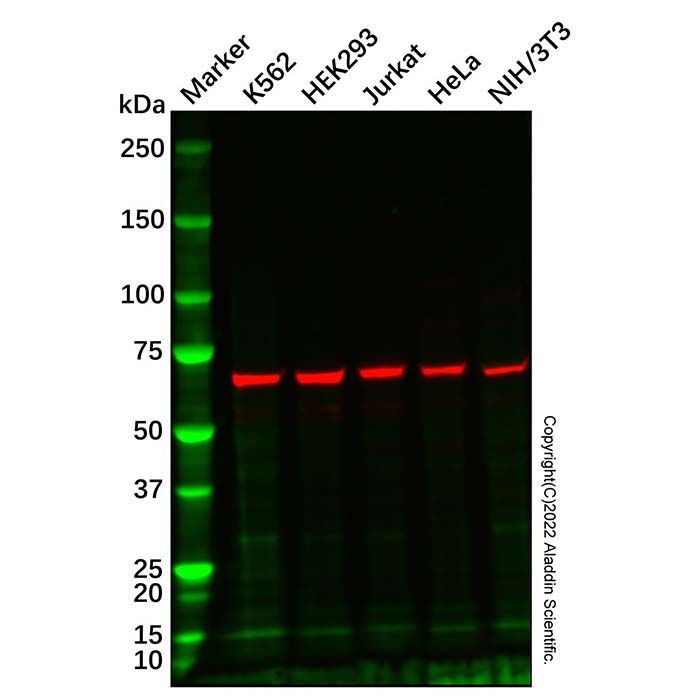
Recombinant NF-kB p65 Antibody (Ab117947) - Western Blot All lanes: Recombinant NF-kB p65 Antibody (Ab117947) at 1/1000 dilution Samples: Lysates at 20 µg per lane Secondary: Goat Anti-Rabbit IgG H&L (HRP) (Ab170144) at 1/20000 dilution
Predicted band size: 60 kDa Observed band size: 68 kDa Exposure time: 13.7 s
Recombinant NF-kB p65 Antibody (Ab117947) - Western Blot All lanes use Recombinant NF-kB p65 Antibody (Ab117947) at 1/5000 dilution for 1 hour at room temperature.
Recombinant NF-kB p65 Antibody (Ab117947) - IF/ICC Immunofluorescent analysis of HeLa cells, using Recombinant NF-kB p65 Antibody (Ab117947) at 1/50 dilution.
Recombinant NF-kB p65 Antibody (Ab117947) - IHC Immunohistochemical analysis of paraffin-embedded human transitional cell carcinoma of bladder, using Recombinant NF-kB p65 Antibody (Ab117947).
Recombinant NF-kB p65 Antibody (Ab117947) - IP Immunoprecipitate (IP) analysis using Recombinant NF-kB p65 Antibody (Ab117947) at 1/50 dilution. (WB with Recombinant NF-kB p65 Antibody (Ab117947) at 1/6000 dilution)

 ZJ25F0622231


 危险品化学品经营许可证(带存储)