
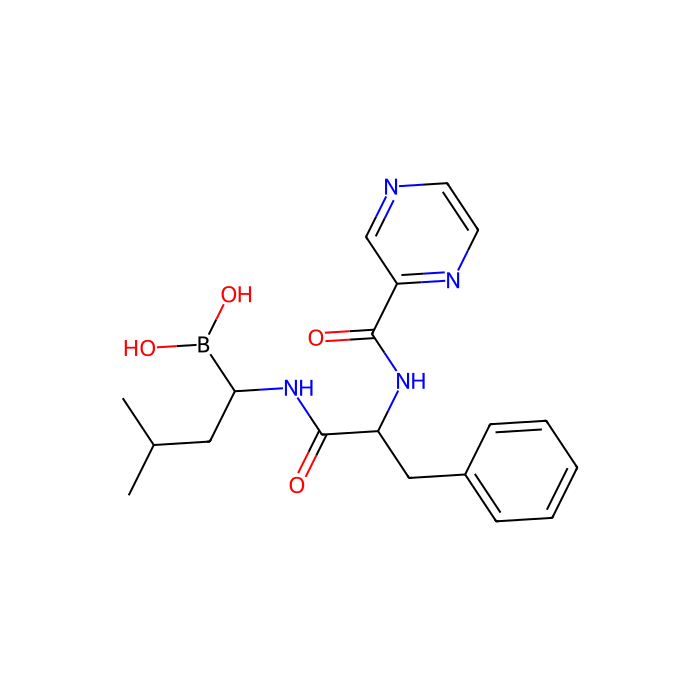
Bortezomib (PS-341), 26S 蛋白质体抑制剂

CAS: 179324-69-7 货号: B408725 分子式: C19H25BN4O4 分子量: 384.24 EC号: 605-854-3
有货
级别和纯度: Moligand™ ? Moligand™ —— 阿拉丁的配体和生物活性小分子系列。适用于需要明确小分子工具的受体、通路和结合研究。 10mM in DMSO
别名
硼替佐米(PS-341)
储存条件
-80℃储存
运输条件
特低温运输
★
规格
库存
价格
数量
1ml
B408725-1ml
期货 Stock Image
¥441.90
请输入您要添加的产品数量
🧪
为什么选择此级别

Moligand™ 级 ,适用于对基线干扰要求严格的色谱和分析工作流程。

🌡

储存与运输

-80℃储存。特低温运输 。请查阅批次 COA 获取详细规格。

📋

质量文档

SDS、COA、产品数据表及规格说明书均可下载。可通过批号查询获取批次 COA。

📚

文献证明

在色谱分析、有机合成和交叉偶联反应领域已被 12 篇同行评审文献引用。

概述

Bortezomib (硼替佐米; PS-341) 是20S蛋白酶体抑制剂,Ki为0.6 nM。A selective and robust 26S proteasome inhibitor

Information


In vitro

Bortezomib, a boronic acid dipeptide, is a highly selective, reversible inhibitor of the 26S proteasome which primarily functions in the degradation of mis-folded proteins and is essential for the regulation of the cell cycle. Exposure to Bortezomib has been shown to stabilize p21, p27, and p53, as well as the proapoptotic Bid and Bax proteins, caveolin-1, and inhibitor κB-α, which prevents activation of nuclear factor κB-induced cell survival pathways. Bortezomib also promotes the activation of the proapoptotic c-Jun-NH2 terminal kinase, as well as the endoplasmic reticulum stress response. Alteration of the levels of these cellular proteins leads to inhibition of proliferation, migration, and promotion of apoptosis of cancer cells. Bortezomib is shown to penetrate into cells and inhibit proteasome-mediated intracellular proteolysis of long-lived proteins with a concentration that inhibits 50% of the proteolysis of ∼0.1 μM. The average growth inhibition of 50% value for Bortezomib across the entire panel of 60 cancer cell lines derived from multiple human tumors from the US National Cancer Institute (NCI) is 7 nM. Treatment of PC-3 cells with Bortezomib (100 nM) for 8 h results in the accumulation of cells in G2-M, with a corresponding decrease in the number of cells in G1. Bortezomib kills PC-3 cells at 24 and 48 hr with IC50 of 100 and 20 nM, respectively. Bortezomib induces nuclear condensation at 16–24 hr after treatment. Bortezomib treatment leads to PARP cleavage in a time-dependent manner with concentrations as low as 100 nM being effective at 24 hr.

In vivo

The anticancer effects of bortezomib as a single agent have been demonstrated in xenograft models of multiple myeloma, adult T-cell leukemia, lung, breast, prostate, pancreatic, head and neck, and colon cancer, and in melanoma. Oral bortezomib 1.0 mg/ kg daily for 18 days causes tumor growth delays, as well as a decrease in the number of metastases in the Lewis lung cancer model. Bortezomib at a single dose of up to 5 mg/kg significantly decreased the surviving fraction of breast tumor cells. Bortezomib 1.0 mg/kg administrated weekly for 4 weeks reduces tumor growth by 60% in murine xenograft models of prostate cancer. 1.0 mg/kg Bortezomib administration for 4 weeks results in a 72% or 84% reduction in pancreatic cancer murine xenografts growth, as well as an increase in tumor cell apoptosis. 1.0 mg/kg Bortezomib treatment results in significant inhibition of human plasmacytoma xenograft growth, increase in tumor cells apoptosis and overall survival, and a decrease in tumor angiogenesis.
Cell Data

cell lines:Chronic lymphocytic leukemia (CLL)

Concentrations:~10 μM

Incubation Time:2 days

Powder Purity:≥99%

规格

别名
硼替佐米(PS-341)
英文别名
Velcade, LDP-341, MLM341, NSC 681239
规格或纯度
Moligand™, 10mM in DMSO
英文名称
Bortezomib (PS-341)
生化机理
硼替佐米(PS-341、Velcade、LDP-341、MLM341、NSC 681239)是一种强效的 20S 蛋白酶体抑制剂,Ki值为 0.6 nM。它对肿瘤细胞的选择性优于正常细胞。硼替佐米(PS-341)可抑制 NF-κB 并诱导 ERK 磷酸化,从而抑制 cathepsin B 并抑制卵巢癌和其他实体瘤的自噬催化过程。
储存条件
-80℃储存
运输条件
特低温运输
作用类型
抑制剂
作用机制
26S 蛋白质体抑制剂
名称和识别符
EC号
605-854-3
分子类型
小分子
Isomeric SMILES
B([C@H](CC(C)C)NC(=O)[C@H](CC1=CC=CC=C1)NC(=O)C2=NC=CN=C2)(O)O
NSC Number
681239
MeSH Entry Terms
341, PS;bortezomib;LDP 341;LDP-341;LDP341;PS 341;PS-341;PS341;Velcade
分子量
384.24
Reaxy-Rn
23876496
Reaxys-RN link address
https://www.reaxys.com/reaxys/secured/hopinto.do?context=S&query=IDE.XRN=23876496&ln=

技术文档

📋 安全数据表 (SDS)

全面的危险、操作、储存及法规合规文件。

下载 SDS →

✅ 分析证书 (COA)

批次质量数据。输入批号以获取对应 COA。

查询 COA →

📊 产品数据表

产品规格和应用的快速参考摘要。

查看数据表 →

🔬 规格说明书

该级别的完整质量属性和验收标准。

查看规格说明 →

高级数据

关联靶点(人)
CTRB1 Tchem 糜蛋白酶原B(Chymotrypsinogen B) (1 活性数据)
活性类型 活性值-log(M) 作用机制 期刊 参考文献(PubMed IDs)
CTSG Tchem 组织蛋白酶G(Cathepsin G) (2 活性数据)
活性类型 活性值-log(M) 作用机制 期刊 参考文献(PubMed IDs)
PSMB9 Tchem 蛋白酶体亚基β9型(Proteasome subunit beta type-9) (3 活性数据)
活性类型 活性值-log(M) 作用机制 期刊 参考文献(PubMed IDs)
PSMB5 Tclin 蛋白酶体亚基β5型(Proteasome subunit beta type-5) (28 活性数据)
活性类型 活性值-log(M) 作用机制 期刊 参考文献(PubMed IDs)
PSMB2 Tclin 蛋白酶体亚基β2型(Proteasome subunit beta type-2) (4 活性数据)
活性类型 活性值-log(M) 作用机制 期刊 参考文献(PubMed IDs)
PSMB10 Tchem 蛋白酶体亚基β10型(Proteasome subunit beta type-10) (2 活性数据)
活性类型 活性值-log(M) 作用机制 期刊 参考文献(PubMed IDs)
PSMB1 Tclin 蛋白酶体亚基β1型(Proteasome subunit beta type-1) (10 活性数据)
活性类型 活性值-log(M) 作用机制 期刊 参考文献(PubMed IDs)
PSMB8 Tclin 蛋白酶体亚基β8型(Proteasome subunit beta type-8) (6 活性数据)
活性类型 活性值-log(M) 作用机制 期刊 参考文献(PubMed IDs)
HDAC1 Tclin 组蛋白去乙酰化酶1(Histone deacetylase 1) (1 活性数据)
活性类型 活性值-log(M) 作用机制 期刊 参考文献(PubMed IDs)
HDAC2 Tclin 组蛋白去乙酰化酶2(Histone deacetylase 2) (1 活性数据)
活性类型 活性值-log(M) 作用机制 期刊 参考文献(PubMed IDs)
LONP1 Tchem Lon 蛋白酶同源物,线粒体(Lon protease homolog, mitochondrial) (1 活性数据)
活性类型 活性值-log(M) 作用机制 期刊 参考文献(PubMed IDs)
HDAC8 Tclin 组蛋白去乙酰化酶8(Histone deacetylase 8) (1 活性数据)
活性类型 活性值-log(M) 作用机制 期刊 参考文献(PubMed IDs)
化学和物理性质
溶解性
Solubility (25°C) In vitro DMSO: 27 mg/mL (201.28 mM); Water: 27 mg/mL (201.28 mM); Ethanol: 27 mg/mL (201.28 mM);
折光率
1.56
沸点
684.30° C
熔点
139-143°C
安全和危险性(GHS)
象形图
GHS06,   GHS08,   GHS09,   GHS07
信号词
Danger
危险声明

H315: 引起皮肤刺激

H319: 引起严重眼睛刺激

H411: 对水生生物有毒并具有长期持续影响

H300: 吞咽致命

H372: 通过长时间或反复暴露对器官造成损害

H361: 怀疑破坏生育力或未出生的孩子

预防措施声明

P305+P351+P338: 如进入眼睛:用水小心冲洗几分钟。如戴隐形眼镜并可方便地取出,取出隐形眼镜。继续冲洗。

P273: 避免释放到环境中。

P280: 戴防护手套/穿防护服/戴防护眼罩/戴防护面具。

P302+P352: 如皮肤沾染:用水充分清洗。

P321: 特殊处理(请参阅此标签上的...)。

P405: 密闭存放

P501: 将内容物/容器处理到。。。

P264: 处理后要彻底洗手。

P260: 不要吸入灰尘/烟雾/气体/雾/蒸汽/喷雾。

P270: 使用本产品时,请勿进食、饮水或吸烟。

P362+P364: 脱掉沾污的衣服,清洗后方可重新使用。

P391: 收集溢出物

P330: 漱口

P203: 使用前,获取、阅读并遵守所有安全说明。

P264+P265: 处理后彻底洗手[和…]。不要触摸眼睛。

P301+P316: 如果吞咽:立即寻求紧急医疗救助。

P318: 如果暴露或担心,请就医。

P337+P317: 如果眼睛刺激持续:寻求医疗帮助。

P332+P317: 如果出现皮肤刺激:请寻求医疗帮助。

P319: 如果你感到不适,请寻求医疗帮助。

Merck Index
1351
质检证书(CoA,COO,BSE/TSE 和分析图谱)
C of A & Other Certificates(BSE/TSE, COO):
输入批号以搜索分析图谱:
技术文档和文章
硼酸及其衍生物
Boronic Acids and Derivatives
泛素-蛋白酶体系统(UPS)
Ubiquitin–Proteasome System (UPS)
一个原子也能“改命”:药物设计的原子级旋钮与官能团工具箱(甲基/卤素键/3D砌块/后期氟化及选型产品表)
One Atom Can Change a Drug’s Fate: Atom-Level Knobs and a Functional-Group Toolbox for Medicinal Chemistry (Methyl / Halogen Bonding / 3D Building Blocks / Late-Stage Fluorination + Product-Selection Tables)
小分子抑制剂科研选型指南:最小证据链与场景化验证框架(含选型矩阵、案例卡片与产品表1–表4)
Small-Molecule Inhibitors: A Practical Guide for Research Selection — A Minimal Evidence Chain and Scenario-Based Validation Framework (Including a Selection Matrix, Case Cards, and Product Tables 1–4)
NF-κB 通路怎么定位、抑制剂怎么选:把炎症转录输出压到“可控区间”(附表A–F)
How to Map the NF-κB Pathway and Choose Inhibitors: Bringing Inflammatory Transcriptional Output into a “Controllable Range” (Tables A–F)
如何判断一个蛋白是否适合靶向降解:从降解通路、分子设计到机制验证
How to Determine Whether a Protein Is Suitable for Targeted Degradation: From Degradation Pathway and Molecular Design to Mechanism Validation
NF-κB 经典与非经典通路解析:激活机制、检测方法与研究工具选择
Analysis of the Canonical and Non-Canonical NF-κB Pathways: Activation Mechanisms, Detection Methods, and Research Tool Selection
蛋白降解靶向嵌合体(PROTAC):分子设计、降解机制、实验评价及研究工具
Protein Degradation-Targeting Chimeras (PROTACs): Molecular Design, Degradation Mechanisms, Experimental Evaluation, and Research Tools
靶向共价抑制剂的作用机制、 设计策略与研究评价
Mechanisms of Action, Design Strategies, and Research Evaluation of Targeted Covalent Inhibitors
从代谢流到蛋白质降解:代谢酶与蛋白质降解系统如何共同调控细胞命运
From Metabolic Flux to Protein Degradation: How Metabolic Enzymes and Protein Degradation Systems Jointly Regulate Cell Fate
内质网应激下错误折叠蛋白的ERAD、ER-phagy与细胞命运调控
ERAD, ER-phagy, and Cell-Fate Regulation of Misfolded Proteins Under Endoplasmic Reticulum Stress
AUTAC还是AUTOTAC?第一代、第二代自噬靶向降解技术的机制差异
AUTAC or AUTOTAC? Mechanistic Differences Between First- and Second-Generation Autophagy-Targeting Degradation Technologies
含硼药效团的靶点识别:四面体状态模拟、顺式二醇捕获与双金属中心配位
Target Recognition by Boron-Containing Pharmacophores: Tetrahedral-State Mimicry, cis-Diol Trapping, and Bimetal-Center Coordination
此产品的引用文献
溶液计算器
