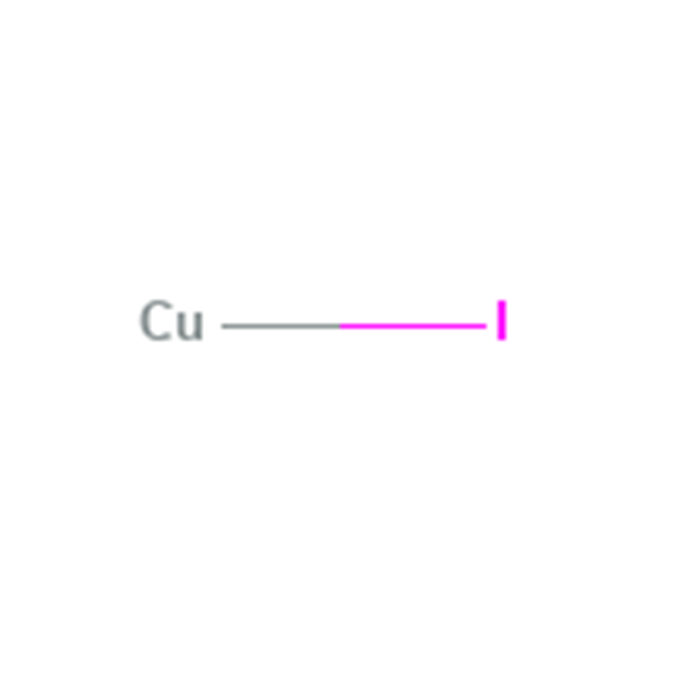
碘化亚铜

CAS: 7681-65-4 货号: C433810 分子式: CuI 分子量: 190.45 EC号: 231-674-6 PubChem CID: 24350
有货
级别和纯度: PrimorTrace™ ? PrimorTrace™ —— 阿拉丁的痕量金属分析系列,金属背景极低。适用于污染须极小的 ICP/AAS 痕量金属工作。 ≥99.999% metals basis
别名
碘化铜(I)
储存条件
避光,室温,干燥
运输条件
常规运输
★
规格
库存
价格
数量
5g
C433810-5g
现货 Stock Image
¥369.90
25g
C433810-25g
现货 Stock Image
¥1,329.90
100g
C433810-100g
现货 Stock Image
¥3,719.90
请输入您要添加的产品数量

概述

碘化亚铜可作为催化剂用于:
在温和、无配体条件下,通过偶联芳香重氮类化合物,芳基化吡唑及衍生物。
通过二溴烯烃与杂亲核试剂的选择性交叉偶联反应,形成各种合成砌块,例如1-溴烯酰胺、炔酰胺、烯酮N,N-缩醛、1-溴烯醇醚、炔醇醚、烯酮O,O-缩醛、乙烯基膦酸酯。
环硅丙烷和羰基化合物的立体特异性和区域选择性反应。
也可用作起始原料,用于二苯基吡啶基膦衍生物(PyrPHOS)-碘化亚铜配合物的制备,用于OLED。


规格

别名
碘化铜(I)
英文别名
Cuprous iodide
规格或纯度
PrimorTrace™, ≥99.999% metals basis
英文名称
Copper(I) iodide
应用
Copper(I) iodide can be used as a catalyst for: For arylation of pyrazole and derivatives by coupling arenediazonium species under mild and ligand-free conditions. Selective cross-coupling of dibromo alkenes and heteronucleophiles which leads to numerous building blocks such as 1-bromoenamides, ynamides, ketene N, N-acetals, 1-bromoenol ethers, ynol ethers, ketene O, O-acetals, and vinyl phosphonates. Stereospecific and the regioselective reaction of silacyclopropanes with carbonyl compounds. It can also be used as a starting material in the preparation of diphenylphosphinepyridine-derivatives (PyrPHOS)-copper iodide complexes which are suitable for use in OLEDs.
储存条件
避光,室温,干燥
运输条件
常规运输
纯度
≥99.999% metals basis
名称和识别符
PubChem SID
EC号
231-674-6
分子类型
小分子
InChI
1S/Cu.HI/h;1H/q+1;/p-1
InChIKey
LSXDOTMGLUJQCM-UHFFFAOYSA-M
SMILES
[Cu]I;[I-].[Cu+]
Isomeric SMILES
[Cu]I
关联CAS
PubChem CID
UN Number
Packing Group
III
分子量
190.45

高级数据

系统学分类

分类树(Taxonomy Tree)

界(kingdom) 无机化合物
超类(Superclass) 混合金属/非金属化合物
类(Class) 过渡金属盐
亚类(Subclass) 过渡金属碘化物
中间层级节点(Intermediate Tree Nodes) 暂无
直接上位类(Direct Parent) 过渡金属碘化物
其他上位类(Alternative Parents) 无机盐  
分子骨架(Molecular Framework) 暂无
取代基(Substituents) 无机盐 - 钼酸盐
描述(Description) 该化合物属于过渡金属碘化物类无机化合物。此类化合物中最大卤素原子为碘,最重金属原子为过渡金属。
外部描述符(External Descriptors) 暂无
化学和物理性质
溶解性
稀水酸:不溶(升)
密度
5.62g/mLat 25°C (lit.)
敏感性
对光线敏感
沸点
1290°C
熔点
605°C
分子量
190.450 g/mol
XLogP3
氢键供体数Hydrogen Bond Donor Count
0
氢键受体数Hydrogen Bond Acceptor Count
0
可旋转键计数Rotatable Bond Count
0
精确质量Exact Mass
189.834 Da
单同位素质量Monoisotopic Mass
189.834 Da
拓扑极表面积Topological Polar Surface Area
0.000 Ų
重原子数Heavy Atom Count
2
形式电荷Formal Charge
0
复杂度Complexity
2.000
同位素原子数Isotope Atom Count
0
定义的原子立体中心计数Defined Atom Stereocenter Count
0
未定义的原子立体中心计数Undefined Atom Stereocenter Count
0
定义的键立体中心计数Defined Bond Stereocenter Count
0
未定义的键立体中心计数Undefined Bond Stereocenter Count
0
所有立体化学键的总数The total count of all stereochemical bonds
0
共价键合单元计数Covalently-Bonded Unit Count
1
安全和危险性(GHS)
象形图
GHS05,   GHS07,   GHS09
信号词
危险
危险声明

H302: 吞食有害

H315: 引起皮肤刺激

H317: 可能引起皮肤过敏反应

H318: 造成严重的眼睛损伤

H410: 对水生生物毒性极大并具有长期持续影响

预防措施声明

P261: 避免吸入灰尘/烟雾/气体/雾/蒸汽/喷雾

P264: 处理后要彻底洗手。

P270: 使用本产品时,请勿进食、饮水或吸烟。

P272: 被污染的工作服不允许离开工作场所

P273: 避免释放到环境中。

P280: 戴防护手套/穿防护服/戴防护眼罩/戴防护面具。

P310: 立即致电解毒中心或医生。

P391: 收集溢出物

P302+P352: 如皮肤沾染:用水充分清洗。

P305+P351+P338: 如进入眼睛:用水小心冲洗几分钟。如戴隐形眼镜并可方便地取出,取出隐形眼镜。继续冲洗。

P333+P313: 如发生皮肤刺激或皮疹:求医/就诊。

P501: 将内容物/容器送到批准的废物处理厂处理

P301+P312+P330: 如误吞咽:如感觉不适,呼叫急救中心/医生。漱口

WGK Germany
3
Class
9
个人防护装备
dust mask type N95 (US),Eyeshields,Gloves
质检证书(CoA,COO,BSE/TSE 和分析图谱)
C of A & Other Certificates(BSE/TSE, COO):
输入批号以搜索分析图谱:

通过匹配包装上的批号来查找并下载产品的 COA,每批产品都进行了严格的验证,您可放心使用!

找到16个结果

批号(Lot Number) 证书类型 货号
C2626369C2626369 分析证书 C433810
C2626377C2626377 分析证书 C433810
C2626378C2626378 分析证书 C433810
D2327096D2327096 分析证书 C433810
D2327097D2327097 分析证书 C433810
D2327100D2327100 分析证书 C433810
A2517270A2517270 分析证书 C433810
A2517283A2517283 分析证书 C433810
A2517284A2517284 分析证书 C433810
E2428292E2428292 分析证书 C433810
E2428293E2428293 分析证书 C433810
E2428294E2428294 分析证书 C433810
D2327089D2327089 分析证书 C433810
D2327094D2327094 分析证书 C433810
D2327095D2327095 分析证书 C433810
L2327008L2327008 分析证书 C433810
技术文档和文章
偶氮二甲酸二乙酯(DEAD)
Diethyl azodicarboxylate (DEAD)
过氧化二叔丁基(DTBP)
不对称催化合成手性 1,2-双硼酸酯的策略与进展:路线类型、选择性挑战与序列化位点利用(含产品选型导航与表1–4)
Strategies and Progress in the Asymmetric Catalytic Synthesis of Chiral 1,2-Bis(boronic) Esters: Route Types, Selectivity Challenges, and Sequential Site Utilization (with Product Selection Navigator and Tables 1–4)
小分子化学探针实用指南:概念纠偏、因果验证与实验选型(含产品导航与表A–D)
A Practical Guide to Small-Molecule Chemical Probes: Concept Clarification, Causal Validation, and Experimental Selection (with Product Navigation and Tables A–D)
OSF/ASF 双通道工具箱:四元小环磺酰氟的分流反应、条件旋钮与选型导航
OSF/ASF Dual-Channel Toolbox: Divergent Reactions of Four-Membered Ring Sulfonyl Fluorides, Condition “Knobs,” and Selection Navigation
从哌啶到吡啶:2013–2023 FDA 小分子新药里“最常见含氮杂环”更替与选型导航(表1–4)
From Piperidine to Pyridine: The “Most Common N-Heterocycle” Shift in FDA Small-Molecule New Drugs (2013–2023) and a Selection Guide (Tables 1–4)
钙钛矿光伏/PeLED 前驱体指南:金属卤化物盐的选型、关键条件与可复现性能(含产品表1–表4及选型导航)
Perovskite PV/PeLED Precursor Guide: Selecting Metal Halide Salts, Key Conditions, and Reproducible Performance (including Product Tables 1–4 and a Selection Navigation Guide)
过渡金属盐/前驱体选型导览:同金属不同盐的起点差异与复现要点(含选型导航及产品表1–表5)
Transition-Metal Salts/Precursor Selection Guide: How “Different Salts of the Same Metal” Start from Different Chemical Realities—and How to Reproduce Results (including a Selection Navigator and Product Tables 1–5)
卤代杂环与交叉偶联:从底物识别到成键路线的科研选型框架(含产品导航及表1–表5)
Haloheterocycles and Cross-Coupling: A Research-Oriented Selection Framework from Substrate Identification to Bond-Forming Routes (Including Product Navigation and Tables 1–5)
腈基如何构建:直接引入、前体脱水、氧化/脱氢与无氰工艺的路线判断
How to Construct Nitriles: Route Selection Across Direct Introduction, Precursor Dehydration, Oxidation/Dehydrogenation, and Cyanide-Free Processes
C-C键构建的实验选型逻辑:按成键任务理解片段偶联、羰基延链、烯基化及后期成键路径
Experimental Selection Logic for C-C Bond Construction: Understanding Fragment Coupling, Carbonyl Chain Extension, Olefination, and Late-Stage Bond-Forming Pathways by Bond-Forming Task
小分子合成中的反应选择:从转化类型判断到实验路径筛选
Reaction Selection in Small-Molecule Synthesis: From Transformation-Type Assessment to Experimental Route Screening
交叉偶联反应的实验判断方法:目标键型、底物组合与催化体系选择
Experimental Decision-Making for Cross-Coupling Reactions: Target Bond Type, Substrate Combination, and Catalytic System Selection
三氮唑类化合物的结构特色、性能调控与典型应用
Structural Features, Property Modulation, and Typical Applications of Triazole Compounds
三氮唑及相关化合物的合成应用逻辑:结构引入、反应位点与目标分子构建
Synthetic Application Logic of Triazoles and Related Compounds: Structural Introduction, Reactive Sites, and Target Molecule Construction
Di-tert-butyl peroxide (DTBP)
吲唑骨架的药物化学设计:互变异构、分子识别、取代位点设计与合成策略
Medicinal Chemistry Design of the Indazole Scaffold: Tautomerism, Molecular Recognition, Substitution-Site Design, and Synthetic Strategies
先构建三元环,还是先形成碳—氮键?——环丙胺合成的逆合成策略、路线选择与立体控制
Build the Three-Membered Ring First, or Form the Carbon–Nitrogen Bond First?—Retrosynthetic Strategies, Route Selection, and Stereochemical Control in Cyclopropylamine Synthesis
硫醇合成的路线选择:C—S键构建、硫源形式与巯基释放
Route Selection for Thiol Synthesis: C–S Bond Construction, Sulfur Source Forms, and Thiol Release
此产品的引用文献
溶液计算器
