
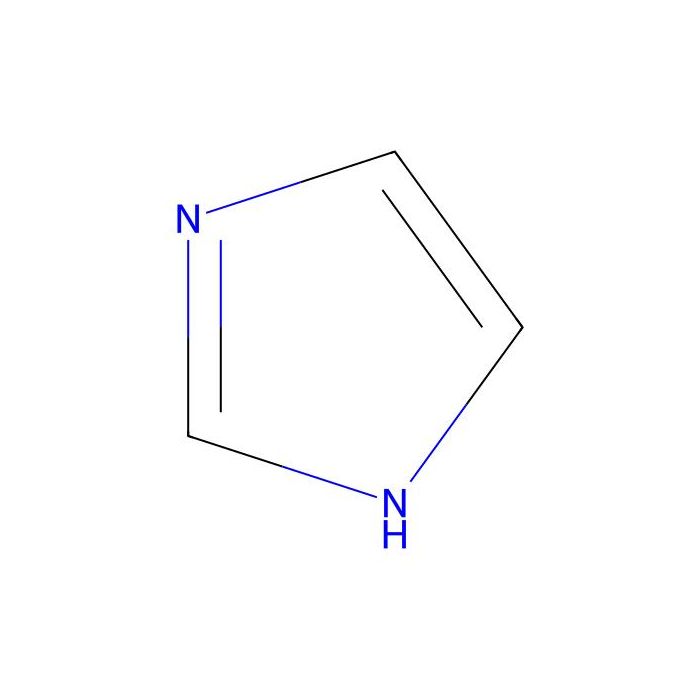
咪唑

CAS: 288-32-4 货号: I755524 分子式: C3H4N2 分子量: 68.08 Beilstein号: 103853 EC号: 206-019-2
有货
级别和纯度: 超纯级 ? 超纯 —— 各项杂质含量极低。适用于痕量分析、电子或不耐受污染的工艺。 ≥99%(NMR) useful in pH range 6.2-7.8
储存条件
室温
运输条件
常规运输
★
规格
库存
价格
数量
100g
I755524-100g
期货 Stock Image
¥6,440.90
请输入您要添加的产品数量
🧪
为什么选择此级别

超纯级 提供 ≥99%(NMR) 纯度,适用于对基线干扰要求严格的色谱和分析工作流程。

🌡

储存与运输

室温。常规运输 。请查阅批次 COA 获取详细规格。

📋

质量文档

SDS、COA、产品数据表及规格说明书均可下载。可通过批号查询获取批次 COA。

📚

文献证明

在色谱分析、有机合成和交叉偶联反应领域已被 434 篇同行评审文献引用。

概述

Prediction of adsorption performance of ZIF-67 for malachite green based on artificial neural network using L-BFGS algorithm.: Utilizing imidazole-based frameworks, specifically ZIF-67, this study showcases the effectiveness of imidazole structures in adsorbing and removing industrial dyes from water, highlighting environmental applications of imidazole in water treatment processes (Xiong C et al., 2024).应用:

在6.2-7.8的pH范围内有效。在6.2-7.8的pH范围内的优异缓冲液。在 20°C 下的 pKa 为7.0。

Superior buffer in the pH range of 6.2-7.8. Has a pKa of 7.0 at 20°C.
Useful in the pH range of 6.2-7.8.
Application:

  • Prediction of adsorption performance of ZIF-67 for malachite green based on artificial neural network using L-BFGS algorithm.: Utilizing imidazole-based frameworks, specifically ZIF-67, this study showcases the effectiveness of imidazole structures in adsorbing and removing industrial dyes from water, highlighting environmental applications of imidazole in water treatment processes (Xiong C et al., 2024).

规格

规格或纯度
超纯级, ≥99%(NMR), useful in pH range 6.2-7.8
英文名称
Imidazole
储存条件
室温
运输条件
常规运输
纯度
≥99%(NMR)
名称和识别符
EC号
206-019-2
分子类型
小分子
IUPAC Name
1H-imidazole
INCHI
1S/C3H4N2/c1-2-5-3-4-1/h1-3H,(H,4,5)
InChi Key
RAXXELZNTBOGNW-UHFFFAOYSA-N
Smiles
C1=CN=CN1
Isomeric SMILES
C1=CN=CN1
UN Number
分子量
68.08
Beilstein号
103853
Reaxy-Rn
103853
Reaxys-RN link address
https://www.reaxys.com/reaxys/secured/hopinto.do?context=S&query=IDE.XRN=103853&ln=

技术文档

📋 安全数据表 (SDS)

全面的危险、操作、储存及法规合规文件。

下载 SDS →

✅ 分析证书 (COA)

批次质量数据。输入批号以获取对应 COA。

查询 COA →

📊 产品数据表

产品规格和应用的快速参考摘要。

查看数据表 →

🔬 规格说明书

该级别的完整质量属性和验收标准。

查看规格说明 →

高级数据

系统学分类

分类树(Taxonomy Tree)

界(kingdom) 有机化合物
超类(Superclass) 有机杂环化合物
类(Class) 唑类
亚类(Subclass) 咪唑类
中间层级节点(Intermediate Tree Nodes) 暂无
直接上位类(Direct Parent) 咪唑类
其他上位类(Alternative Parents) 杂芳族化合物  氮杂环化合物  有机光子化合物  有机氮化合物  碳氢化合物衍生物  
分子骨架(Molecular Framework) 芳香族杂单环化合物
取代基(Substituents) 芳香族杂单环化合物 - 氮杂环 - 杂芳香族化合物 - 烃衍生物 - 咪唑 - 有机硝基化合物 - 有机氮化合物 - 有机氮化合物
描述(Description) 该化合物属于咪唑类有机化合物。这类化合物含有咪唑环,即具有两个氮原子位于1位和3位、三个碳原子的芳香五元环。
外部描述符(External Descriptors) an aromatic compound
三维结构
交互式化学结构模型


化学和物理性质
溶解性
water: 100 mg/mL
闪点(℃)
145℃
沸点
257°C
熔点
90-91°C
分子量
68.080 g/mol
XLogP3
-0.100
氢键供体数Hydrogen Bond Donor Count
1
氢键受体数Hydrogen Bond Acceptor Count
1
可旋转键计数Rotatable Bond Count
0
精确质量Exact Mass
68.0374 Da
单同位素质量Monoisotopic Mass
68.0374 Da
拓扑极表面积Topological Polar Surface Area
28.700 Ų
重原子数Heavy Atom Count
5
形式电荷Formal Charge
0
复杂度Complexity
28.100
同位素原子数Isotope Atom Count
0
定义的原子立体中心计数Defined Atom Stereocenter Count
0
未定义的原子立体中心计数Undefined Atom Stereocenter Count
0
定义的键立体中心计数Defined Bond Stereocenter Count
0
未定义的键立体中心计数Undefined Bond Stereocenter Count
0
所有立体化学键的总数The total count of all stereochemical bonds
0
共价键合单元计数Covalently-Bonded Unit Count
1
安全和危险性(GHS)
象形图
GHS05,   GHS07,   GHS08
信号词
危险
危险声明

H302: 吞食有害

H314: 造成严重的皮肤灼伤和眼睛损伤

H360D: 可能会伤害未出生的孩子

WGK Germany
1
RTECS
NI3325000
Merck Index
4912
个人防护装备
Eyeshields,Faceshields,full-face particle respirator type N100 (US),Gloves,respirator cartridge type N100 (US),type P1 (EN143) respirator filter,type P3 (EN 143) respirator cartridges
质检证书(CoA,COO,BSE/TSE 和分析图谱)
C of A & Other Certificates(BSE/TSE, COO):
输入批号以搜索分析图谱:
技术文档和文章
盐酸胍和尿素溶解包涵体的对比
Comparing Guanidine Hydrochloride and Urea for Inclusion-Body Solubilization
为什么镍琼脂糖微球失去了颜色?
Why Did Nickel Agarose Beads Lose Their Color?
为什么我的镍琼脂糖微球变为黑色或棕色?
Why Did My Ni-Agarose Beads Turn Black or Brown?
如何优化镍琼脂糖微球的缓冲液组分
How to Optimize Buffer Components for Ni-Agarose Beads
Ni²⁺–琼脂糖树脂的剥离、清洗与金属再生流程
Stripping, Cleaning, and Metal Recharging Workflow for Ni²⁺–Agarose Resins
从包涵体中获得可溶且有活性的重组蛋白
Obtaining soluble and biologically active recombinant proteins from inclusion bodies
如何选择最佳蛋白质纯化技术
How to Choose the Best Protein Purification Technique
His标签蛋白纯化
His-Tagged Protein Purification
His-Tag蛋白纯化时常见问题及解决方法
His-Tag Protein Purification: Common Troubleshooting Questions and Practical Solutions
层析纯化缓冲液选择:Tris-HCl与磷酸盐体系的科学决策
Scientific Decision-Making for Chromatography Buffer Selection: Tris-HCl vs Phosphate Systems
OSF/ASF 双通道工具箱:四元小环磺酰氟的分流反应、条件旋钮与选型导航
OSF/ASF Dual-Channel Toolbox: Divergent Reactions of Four-Membered Ring Sulfonyl Fluorides, Condition “Knobs,” and Selection Navigation
一文读懂蛋白标签:分类、特性及适用实验
Protein Tags Demystified: Classification, Properties, and Suitable Experimental Applications
铜在水系统为何会局部穿孔:苯并三唑(BTA)成膜护铜的机理、关键变量与选型导航(表1–表3)
Why Copper Develops Local Pinholes in Water Systems: The Film-Forming Protection Mechanism of Benzotriazole (BTA), Key Variables, and a Selection Guide (Tables 1–3)
咪唑类杂环构件的调控逻辑:双氮位点与取代/盐型/并环如何调控电荷、氢键与配位(附表A–E)
Tuning Logic of Imidazole Heteroaromatic Building Blocks: How Dual Nitrogen Sites and Substitution / Salt Forms / Ring Fusion Modulate Charge, Hydrogen Bonding, and Coordination (with Tables A–E)
无脊椎动物氧载体蛋白在免疫与疫苗研究中的作用
Invertebrate Oxygen Carrier Proteins in Immunology and Vaccine Research
硅试剂助力多肽合成:未保护底物成肽的研究进展与方法价值
Silicon Reagent-Assisted Peptide Synthesis: Research Progress and Methodological Value of Peptide Bond Formation from Unprotected Substrates
多肽合成路线的判断逻辑:从 SPPS、LPPS 到重组表达的适用情形与判断依据
Decision Logic for Peptide Synthesis Routes: Applicability and Criteria for Choosing among SPPS, LPPS, and Recombinant Expression
DMAP 不只是有机碱:从亲核酰基转移到酯化与大环内酯化的实验判断
DMAP Is More Than Just an Organic Base: Experimental Judgment from Nucleophilic Acyl Transfer to Esterification and Macrolactonization
SEM-Cl 的实验选用:从 O/N-SEM 保护、杂环定向官能化到受保护 C1 片段引入
Experimental Selection of SEM-Cl: From O/N-SEM Protection and Directed Functionalization of N-Heterocycles to the Introduction of Protected C1 Fragments
4-[(叔丁基二甲基硅基)氧基]丁-1-醇:作为单保护 1,4-丁二醇构件和受保护 C4 连接臂的实验选型判断
4-[(tert-Butyldimethylsilyl)oxy]butan-1-ol: Experimental Selection Logic as a Monoprotected 1,4-Butanediol Building Block and a Protected C4 Linker
环氧体系中胺类固化剂的配方设计与选用
Formulation Design and Selection of Amine Curing Agents in Epoxy Systems
蛋白质结构分析:从问题定义到功能验证的实验路径
Protein Structure Analysis: An Experimental Path from Defining the Question to Functional Validation
认识胺类固化剂:结构、类型与应用选择
Understanding Amine Curing Agents: Structure, Types, and Application Selection
给 NCO 加上温度触发开关:封闭型异氰酸酯如何影响 1K 烘烤涂料的储存、固化与涂膜性能
Adding a Temperature-Triggered Switch to NCO: How Blocked Isocyanates Affect the Storage, Curing, and Film Performance of 1K Baking Coatings
环氧酚醛涂料:为什么常用于耐化学、耐溶剂、耐热及金属内壁防护?
Epoxy Phenolic Coatings: Why Are They Commonly Used for Chemical Resistance, Solvent Resistance, Heat Resistance, and Internal Metal Surface Protection?
合成生物学是什么?从上游试剂工具链到生物制造应用的产业化路径
What Is Synthetic Biology? The Industrialization Pathway from Upstream Reagent Toolchains to Biomanufacturing Applications
含间氟吡啶基序为什么难做?从 Balz–Schiemann 风险看稳定烯胺砌块的合成逻辑
Why Is the meta-Fluoropyridine Motif Difficult to Make? Understanding the Synthetic Logic of Stable Enamine Building Blocks from the Risks of the Balz–Schiemann Reaction
三氮唑类化合物的结构特色、性能调控与典型应用
Structural Features, Property Modulation, and Typical Applications of Triazole Compounds
三氮唑及相关化合物的合成应用逻辑:结构引入、反应位点与目标分子构建
Synthetic Application Logic of Triazoles and Related Compounds: Structural Introduction, Reactive Sites, and Target Molecule Construction
哌啶α位C–H键的一锅芳基化:从定向锂化、Li→Zn转金属化到Negishi偶联
One-Pot Arylation of the Piperidine α-C–H Bond: From Directed Lithiation and Li→Zn Transmetalation to Negishi Coupling
突破氟芳烃亲核芳香取代的电子效应限制:t-Bu-P4的阴离子活化、协同取代与HF捕获
Overcoming the Electronic-Effect Limitations of Nucleophilic Aromatic Substitution in Fluoroarenes: Anion Activation, Concerted Substitution, and HF Capture by t-Bu-P4
“植物胶原蛋白”是什么:原料类型、结构差异、生产方式与护肤作用辨析
What Is “Plant Collagen”? Distinguishing Ingredient Types, Structural Differences, Production Methods, and Skincare Effects
从45.9万个已记录环系统到3902种候选环:临床相关环系统的结构选择规律
From 459,000 Recorded Ring Systems to 3,902 Candidate Ring Systems: Selection Patterns of Clinically Relevant Ring Systems
此产品的引用文献
溶液计算器

常见问题

本产品应如何储存?
请于室温条件下保存。
本产品的纯度是多少?如何测定?
本产品的纯度为 ≥99%,采用核磁共振测定。批次的具体数值以分析证书(COA)为准。
什么是「超纯级」?
「超纯级」是一个明确定义的分析纯度级别,适用于通用分析和试剂应用。它规定了最低含量百分比、对常见杂质(水分、重金属、灼烧残渣)的受控限值,以及批间一致性。「超纯级」是几个纯度级别之一——请根据方法的灵敏度和监管要求进行选择。
本产品如何运输?
本产品按常温标准条件运输,无需温控包装。
本产品的 CAS 号、分子式和分子量是多少?
本产品的 CAS 号为 288-32-4,分子式为 C3H4N2,分子量为 68.08 g/mol。InChIKey RAXXELZNTBOGNW-UHFFFAOYSA-N。
如何获取批次专用COA?
每个订单都会随附分析证书(COA),您也可以从账户订单历史中下载。如需订购前的COA,请联系您的客户代表,或使用PDP上的"申请COA"按钮——我们将提供代表性批次的COA。
