
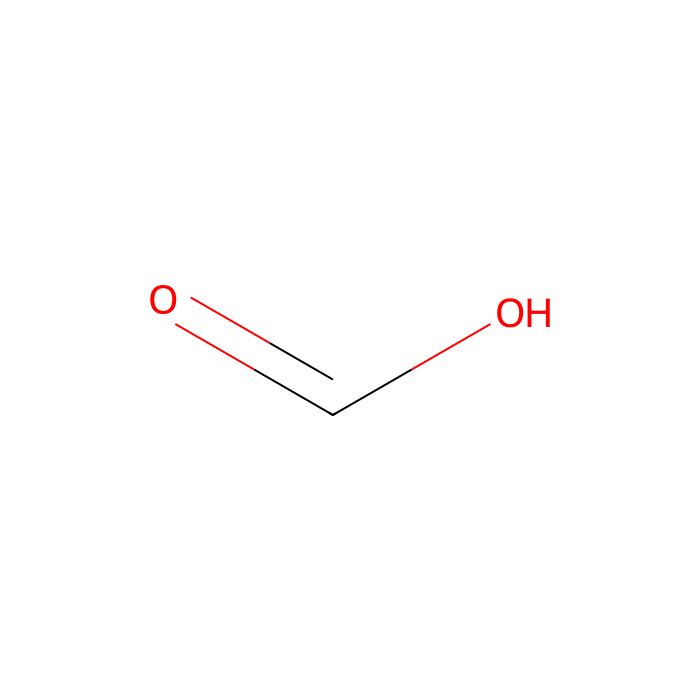
计算溶液所需的质量、体积或浓度。
| 活性类型 | Relation | Activity value | Units | Action Type | 期刊 | PubMed Id | doi | Assay Aladdin ID |
|---|
AR 级 提供 ≥98% 纯度,适用于对基线干扰要求严格的色谱和分析工作流程。
室温,充氩。DG运输 。请查阅批次 COA 获取详细规格。
SDS、COA、产品数据表及规格说明书均可下载。可通过批号查询获取批次 COA。
在色谱分析、有机合成和交叉偶联反应领域已被 2839 篇同行评审文献引用。
具有刺激性气味,能与水、醇、醚、丙三醇相混合. 还原剂,测定砷、铋、铝、铜、金、铟、铁、铅、锰、汞、钼、银和锌等,检定铈,铼和钨,检验芳香族伯胺和仲胺,测定分子量及结晶的溶剂,测定甲氧基,显微分析中用作固定剂,制造甲酸盐类。
应避免的条件:加热
应用
甲酸可作为试剂用于:羰基化合物与硝基化合物的
Co-Nx-催化一锅还原胺化反应,以合成仲胺。
多环和杂环硝基芳烃的光还原,形成相应的胺。
烯烃的 Pd 催化化学选择性氢化反应,形成饱和烃。
分类树(Taxonomy Tree)
| 界(kingdom) | 有机化合物 |
|---|---|
| 超类(Superclass) | 有机酸及其衍生物 |
| 类(Class) | 羧酸及其衍生物 |
| 亚类(Subclass) | 羧酸 |
| 中间层级节点(Intermediate Tree Nodes) | 暂无 |
| 直接上位类(Direct Parent) | 羧酸 |
| 其他上位类(Alternative Parents) | 一元羧酸及其衍生物 有机氧化物 碳氢化合物衍生物 羰基化合物 |
| 分子骨架(Molecular Framework) | 脂肪族无环化合物 |
| 取代基(Substituents) | 脂肪族非环化合物 - 羰基 - 羧酰胺基 - 烃衍生物 - 单羧酸或其衍生物 - 有机氧化物 - 有机氧化合物 - 有机氧化合物 |
| 描述(Description) | 该化合物属于有机化合物中的羧酸类。这类化合物含有羧基,其化学式为-C(=O)OH。 |
| 外部描述符(External Descriptors) | Straight chain fatty acids - Saturated fatty acids |
| 作用机制 | Action Type | target ID | Target Name | Target Type | Target Organism | Binding Site Name | 参考文献 |
|---|
H226: 易燃液体和蒸气
H302: 吞食有害
H314: 造成严重的皮肤灼伤和眼睛损伤
H331: 吸入会中毒
P233: 保持容器密闭。
P235: 保持凉爽
P241: 使用防爆的[电气/通风/照明/.../]设备。
P242: 仅使用无火花的工具。
P243: 采取防静电措施
P261: 避免吸入灰尘/烟雾/气体/雾/蒸汽/喷雾
P270: 使用本产品时,请勿进食、饮水或吸烟。
P271: 仅在室外或通风良好的地方使用。
P280: 戴防护手套/穿防护服/戴防护眼罩/戴防护面具。
P310: 立即致电解毒中心或医生。
P363: 再次使用之前,请清洗受污染的衣物。
P301+P330+P331: 如误吞咽:漱口。不要诱导呕吐。
P303+P361+P353: 如皮肤(或头发)沾染:立即脱掉所有沾染的衣服。用水清洗皮肤/淋浴。
P304+P340: 如误吸入:将人转移到空气新鲜处,保持呼吸舒适体位。
P305+P351+P338: 如进入眼睛:用水小心冲洗几分钟。如戴隐形眼镜并可方便地取出,取出隐形眼镜。继续冲洗。
P370+P378: 火灾时:使用干砂、干粉或抗醇泡沫灭火。
P405: 密闭存放
P501: 将内容物/容器处理到。。。
P301+P312+P330: 如误吞咽:如感觉不适,呼叫急救中心/医生。漱口
通过匹配包装上的批号来查找并下载产品的 COA,每批产品都进行了严格的验证,您可放心使用!
| 批号(Lot Number) | 证书类型 | 货号 |
|---|---|---|
 H2624114 |
分析证书 | F100377 |
| H2624115 |
分析证书 | F100377 |
| J2608279 |
分析证书 | F100377 |
| F2601209 |
分析证书 | F100377 |
| F2615238 |
分析证书 | F100377 |
| F2629485 |
分析证书 | F100377 |
| G2607773 |
分析证书 | F100377 |
| G2617254 |
分析证书 | F100377 |
| G2617256 |
分析证书 | F100377 |
| G2620609 |
分析证书 | F100377 |
| G2628204 |
分析证书 | F100377 |
| C2617274 |
分析证书 | F100377 |
| C2617275 |
分析证书 | F100377 |
| C2627231 |
分析证书 | F100377 |
| C2627232 |
分析证书 | F100377 |
| D2608116 |
分析证书 | F100377 |
| D2617273 |
分析证书 | F100377 |
| D2617274 |
分析证书 | F100377 |
| E2606146 |
分析证书 | F100377 |
| E2620298 |
分析证书 | F100377 |
| A2605191 |
分析证书 | F100377 |
| A2622218 |
分析证书 | F100377 |
| A2622232 |
分析证书 | F100377 |
| B2603175 |
分析证书 | F100377 |
| B2603176 |
分析证书 | F100377 |
| B2610001 |
分析证书 | F100377 |
| B2625221 |
分析证书 | F100377 |
| B2625251 |
分析证书 | F100377 |
| C2604209 |
分析证书 | F100377 |
| L2501160 |
分析证书 | F100377 |
| L2511214 |
分析证书 | F100377 |
| L2517195 |
分析证书 | F100377 |
| L2526022 |
分析证书 | F100377 |
| L2526023 |
分析证书 | F100377 |
| J2522243 |
分析证书 | F100377 |
| J2522244 |
分析证书 | F100377 |
| K2504149 |
分析证书 | F100377 |
| K2504197 |
分析证书 | F100377 |
| K2513143 |
分析证书 | F100377 |
| K2525258 |
分析证书 | F100377 |
| I2518228 |
分析证书 | F100377 |
| I2526106 |
分析证书 | F100377 |
| J2509365 |
分析证书 | F100377 |
| J2509409 |
分析证书 | F100377 |
| J2515143 |
分析证书 | F100377 |
| I2503239 |
分析证书 | F100377 |
| I2509188 |
分析证书 | F100377 |
| H2521154 |
分析证书 | F100377 |
| H2521191 |
分析证书 | F100377 |
| H2526146 |
分析证书 | F100377 |
| H2526147 |
分析证书 | F100377 |
| G2510127 |
分析证书 | F100377 |
| G2510190 |
分析证书 | F100377 |
| G2524128 |
分析证书 | F100377 |
| H2504126 |
分析证书 | F100377 |
| H2504170 |
分析证书 | F100377 |
| H2513341 |
分析证书 | F100377 |
| H2513342 |
分析证书 | F100377 |
| E2528179 |
分析证书 | F100377 |
| F2504182 |
分析证书 | F100377 |
| F2504218 |
分析证书 | F100377 |
| F2517196 |
分析证书 | F100377 |
| F2523194 |
分析证书 | F100377 |
| D2530047 |
分析证书 | F100377 |
| D2530061 |
分析证书 | F100377 |
| E2512157 |
分析证书 | F100377 |
| E2516220 |
分析证书 | F100377 |
| E2516221 |
分析证书 | F100377 |
| E2523109 |
分析证书 | F100377 |
| D2511295 |
分析证书 | F100377 |
| D2518267 |
分析证书 | F100377 |
| C2524591 |
分析证书 | F100377 |
| D2501142 |
分析证书 | F100377 |
| B2514125 |
分析证书 | F100377 |
| B2526124 |
分析证书 | F100377 |
| C2505113 |
分析证书 | F100377 |
| C2517366 |
分析证书 | F100377 |
| A2510219 |
分析证书 | F100377 |
| A2516433 |
分析证书 | F100377 |
| B2506283 |
分析证书 | F100377 |
| B2508182 |
分析证书 | F100377 |
| A2503105 |
分析证书 | F100377 |
| L2409273 |
分析证书 | F100377 |
| L2417060 |
分析证书 | F100377 |
| L2424106 |
分析证书 | F100377 |
| K2406256 |
分析证书 | F100377 |
| K2419192 |
分析证书 | F100377 |
| K2429674 |
分析证书 | F100377 |
| J2410002 |
分析证书 | F100377 |
| J2422872 |
分析证书 | F100377 |
| J2422885 |
分析证书 | F100377 |
| J2429289 |
分析证书 | F100377 |
| H2430166 |
分析证书 | F100377 |
| H2430176 |
分析证书 | F100377 |
| I2404041 |
分析证书 | F100377 |
| I2412247 |
分析证书 | F100377 |
| I2419229 |
分析证书 | F100377 |
| G2405497 |
分析证书 | F100377 |
| G2422066 |
分析证书 | F100377 |
| H2406142 |
分析证书 | F100377 |
| H2419303 |
分析证书 | F100377 |
| E2423332 |
分析证书 | F100377 |
| E2431179 |
分析证书 | F100377 |
| F2420444 |
分析证书 | F100377 |
| G2402280 |
分析证书 | F100377 |
| D2415047 |
分析证书 | F100377 |
| D2418305 |
分析证书 | F100377 |
| E2411358 |
分析证书 | F100377 |
| E2416244 |
分析证书 | F100377 |
| C2408311 |
分析证书 | F100377 |
| C2413024 |
分析证书 | F100377 |
| C2419128 |
分析证书 | F100377 |
| D2410168 |
分析证书 | F100377 |
| A2412317 |
分析证书 | F100377 |
| A2430026 |
分析证书 | F100377 |
| A2431088 |
分析证书 | F100377 |
| A2402431 |
分析证书 | F100377 |
| A2404785 |
分析证书 | F100377 |
| A2404786 |
分析证书 | F100377 |
| A2404797 |
分析证书 | F100377 |
| L2319002 |
分析证书 | F100377 |
| L2322330 |
分析证书 | F100377 |
| K2314602 |
分析证书 | F100377 |
| K2330225 |
分析证书 | F100377 |
| J2331447 |
分析证书 | F100377 |
| I2327006 |
分析证书 | F100377 |
| I2327037 |
分析证书 | F100377 |
| I2327038 |
分析证书 | F100377 |
| J2311545 |
分析证书 | F100377 |
| J2314443 |
分析证书 | F100377 |
| H2314432 |
分析证书 | F100377 |
| H2322615 |
分析证书 | F100377 |
| G2318788 |
分析证书 | F100377 |
| G2329552 |
分析证书 | F100377 |
| F23131095 |
分析证书 | F100377 |
| F2327028 |
分析证书 | F100377 |
| G23051201 |
分析证书 | F100377 |
| D23211124 |
分析证书 | F100377 |
| D23211144 |
分析证书 | F100377 |
| A2331100 |
分析证书 | F100377 |
| L2215136 |
分析证书 | F100377 |
| L2209064 |
分析证书 | F100377 |
| K2209036 |
分析证书 | F100377 |
| K2209058 |
分析证书 | F100377 |
| K2210178 |
分析证书 | F100377 |
| J2215277 |
分析证书 | F100377 |
| J2214110 |
分析证书 | F100377 |
| J2214111 |
分析证书 | F100377 |
| H2231379 |
分析证书 | F100377 |
| G2216250 |
分析证书 | F100377 |
| G2216668 |
分析证书 | F100377 |
| H2212200 |
分析证书 | F100377 |
| H2212201 |
分析证书 | F100377 |
| F2222172 |
分析证书 | F100377 |
| C2208192 |
分析证书 | F100377 |
| C2208195 |
分析证书 | F100377 |


 危险品化学品经营许可证(带存储)