
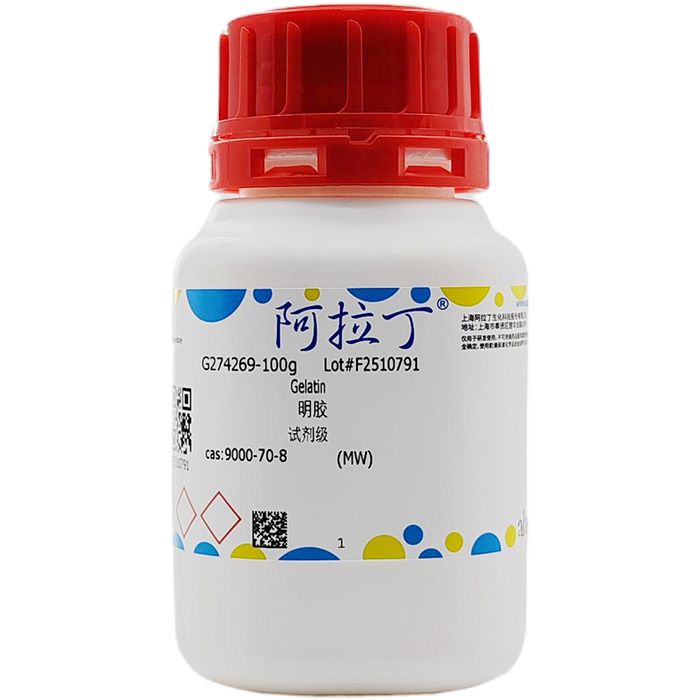
明胶

CAS: 9000-70-8 货号: G274269 EC号: 232-554-6
有货
级别和纯度: 试剂级 ? 试剂级 —— 适用于大多数实验室工作的通用试剂纯度。当无特定更高等级要求时作为可靠的默认选择。
储存条件
室温,干燥
运输条件
常规运输
★
规格
库存
价格
数量
100g
G274269-100g
现货 Stock Image
¥195.90
500g
G274269-500g
期货 Stock Image
¥597.90
12×100g
G274269-12×100g
现货 Stock Image
¥2,059.90
12×500g
G274269-12×500g
期货 Stock Image
¥6,437.90
请输入您要添加的产品数量
🧪
为什么选择此级别

试剂级 ,适用于对基线干扰要求严格的色谱和分析工作流程。

🌡

储存与运输

室温,干燥。常规运输 。请查阅批次 COA 获取详细规格。

📋

质量文档

SDS、COA、产品数据表及规格说明书均可下载。可通过批号查询获取批次 COA。

📚

文献证明

在色谱分析、有机合成和交叉偶联反应领域已被 1219 篇同行评审文献引用。

概述

明胶是多种食品和药品的关键成分,包括果冻、调味汁、甜点、胶囊、片剂和血液替代品。通常,大多数明胶产品都是用猪皮制成的。

组分

明胶存在于胶原蛋白中,是一种具有高平均分子量的水溶性蛋白质的异质性混合物。 通过在水中将相关的皮肤、肌腱、韧带、骨骼等进行煮沸来提取蛋白质。

A类明胶来自于酸固化组织。 B类明胶来自于石灰固化组织。

Gelatin acts as a key element in a variety of foodstuffs and pharmaceutical products, including jellies, aspics, desserts, capsule, tablets and blood substitutes. Usually, most gelatin products have been manufactured from porcine skin.

Components

Gelatin is a heterogeneous mixture of water-soluble proteins of high average molecular masses, present in collagen. Proteins are extracted by boiling the relevant skin, tendons, ligaments, bones, etc. in water. 

Type A gelatin is derived from acid-cured tissue. Type B is derived from lime-cured tissue.

规格

英文别名
GINGI-PAK MAX Z-TWIST NO 2 | HY-W011910 | Adrenaline chloride | Adrenalin chloride | Epinephrine hydrochloride (JAN) | Q27107122 | GINGI-PAK MAX 2-PLY | epinephrine-hcl-adrenaline | ADRENALINE CHLORHYDRATE | GINGI-PAK MAX Z-TWIST NO 3 | Tonogen | CCRIS 23
规格或纯度
试剂级
英文名称
Gelatin
储存条件
室温,干燥
运输条件
常规运输
备注
A型
名称和识别符
PubChem SID
EC号
232-554-6
分子类型
小分子
IUPAC Name
4-[(1R)-1-hydroxy-2-(methylamino)ethyl]benzene-1,2-diol;hydrochloride
INCHI
1S/C9H13NO3.ClH/c1-10-5-9(13)6-2-3-7(11)8(12)4-6;/h2-4,9-13H,5H2,1H3;1H/t9-;/m0./s1
InChi Key
ATADHKWKHYVBTJ-FVGYRXGTSA-N
Smiles
CNCC(C1=CC(=C(C=C1)O)O)O.Cl
Isomeric SMILES
CNC[C@@H](C1=CC(=C(C=C1)O)O)O.Cl
Reaxy-Rn
4019338
Reaxys-RN link address
https://www.reaxys.com/reaxys/secured/hopinto.do?context=S&query=IDE.XRN=4019338&ln=

技术文档

📋 安全数据表 (SDS)

全面的危险、操作、储存及法规合规文件。

下载 SDS →

✅ 分析证书 (COA)

批次质量数据。输入批号以获取对应 COA。

查询 COA →

📊 产品数据表

产品规格和应用的快速参考摘要。

查看数据表 →

🔬 规格说明书

该级别的完整质量属性和验收标准。

查看规格说明 →

高级数据

系统学分类

分类树(Taxonomy Tree)

界(kingdom) 有机化合物
超类(Superclass) 苯类化合物
类(Class) 酚类
亚类(Subclass) 苯二醇
中间层级节点(Intermediate Tree Nodes) 暂无
直接上位类(Direct Parent) 儿茶酚
其他上位类(Alternative Parents) 芳烷基胺  1-羟基-4-未取代苯类化合物  1-羟基-2-未取代苯类化合物  苯及其取代衍生物  仲醇  1,2-氨基醇  二烷基胺  有机光子化合物  盐酸盐  碳氢化合物衍生物  芳香醇  
分子骨架(Molecular Framework) 芳香族同单环化合物
取代基(Substituents) 1-羟基-2-未取代苯环化合物 - 1-羟基-4-未取代苯环化合物 - 1,2-氨基醇 - 羟基苯甲酸酯 - 氨基酸 - 芳烷基胺 - 芳香醇 - 芳香族同单环化合物 - 儿茶酚 - 烃衍生物 - 氟氯烃 - 单环苯基基团 - 有机硝基化合物 - 有机氧化合物 - 有机氮化合物 - 有机氧化合物 - 有机氮化合物 - 醛基 - 二级脂肪胺 - 醛基
描述(Description) 该化合物属于有机化合物中的儿茶酚类。这类化合物含有1,2-苯二酚结构单元。
外部描述符(External Descriptors) hydrochloride
三维结构
交互式化学结构模型


作用机制
作用机制 Action Type target ID Target Name Target Type Target Organism Binding Site Name 参考文献
安全和危险性(GHS)
WGK Germany
3
RTECS
LX8580000
个人防护装备
Eyeshields,Gloves,type N95 (US),type P1 (EN143) respirator filter
质检证书(CoA,COO,BSE/TSE 和分析图谱)
C of A & Other Certificates(BSE/TSE, COO):
输入批号以搜索分析图谱:

通过匹配包装上的批号来查找并下载产品的 COA,每批产品都进行了严格的验证,您可放心使用!

找到17个结果

批号(Lot Number) 证书类型 货号
L2404352 分析证书 G274269
A2329686 分析证书 G274269
L2311054 分析证书 G274269
F2510791 分析证书 G274269
F2510792 分析证书 G274269
L2404290 分析证书 G274269
G2417167 分析证书 G274269
G2417285 分析证书 G274269
G2220692 分析证书 G274269
L2311055 分析证书 G274269
A2329687 分析证书 G274269
H2303064 分析证书 G274269
J2323048 分析证书 G274269
A2329685 分析证书 G274269
E2322613 分析证书 G274269
G2220693 分析证书 G274269
B2209165 分析证书 G274269
技术文档和文章
类器官芯片概述
Overview of Organs-on-Chips
科研实验如何选试剂等级?带你读懂 Reagent Grade(试剂级)
How to Choose Reagent Grades in Scientific Research? A Practical Guide to Reagent Grade
贻贝粘蛋白的结构特性、生物学功能及应用前景
Structural Characteristics, Biological Functions, and Application Prospects of Mussel Adhesive Proteins
香精科普:从配方黑箱到可工程化体系——相容性、稳定性、控释、可追溯与选型指南
A Practical Guide to Fragrance Compositions: Turning a Black-Box Formula into an Engineerable System—Compatibility, Stability, Controlled Release, Traceability, and Selection
木瓜蛋白酶(Papain):组成结构、生产工艺与应用技术指南
Papain (Papaya Cysteine Protease): Composition, Structure, Manufacturing, and Application Guidance
亲水性聚合物的水相行为解析:水化机制、结构旋钮与任务导向选型导航(含表1–表3)
Understanding Hydrophilic Polymers in Aqueous Systems: Hydration Mechanisms, Structural Knobs, and Task-Oriented Selection Guide (Including Tables 1–3)
生物医用聚合物解析:任务角色地图、六大材料旋钮与风险导向证据链(含产品导航与产品表1–表3)
Biomedical Polymer Insights: Role-Based Task Map, Six Key Material Levers, and a Risk-Driven Evidence Chain (including the Product Navigation Guide and Product Tables 1–3)
皮肤之下:护肤与医美体系中的蛋白质与肽类活性物质
Beneath the Skin: Protein- and Peptide-Based Actives in Skincare and Aesthetic Medicine
菠萝蛋白酶:酶学特性与食品、医药及工业应用要点
Bromelain: Enzymological Properties and Key Points for Food, Pharmaceutical, and Industrial Applications
戊二醛介导的微生物灭活:化学机制、影响因素与验证要点综述
Glutaraldehyde-mediated Microbial Inactivation: Chemical Mechanisms, Determinants, and Key Validation Considerations
胶原酶(Collagenase)的酶学特征、类型体系与科研应用综述
Review of Collagenase: Enzymological Features, Type Systems, and Research Applications
番茄红素的结构特征、生物学作用与应用进展综述
Review of the Structural Characteristics, Biological Functions, and Application Advances of Lycopene
羟脯氨酸含量检测的技术比较与方法学选择
Technical Comparison and Method Selection for Hydroxyproline Determination
常用细胞培养包被液的选型逻辑、操作参数与应用边界
Selection Logic, Operating Parameters, and Application Boundaries of Common Cell Culture Coating Solutions
医用水凝胶研发中的关键判断:从聚合物来源、交联方式到灭菌安排、放大可行性与质量控制
Key Judgments in Medical Hydrogel R&D: From Polymer Source and Crosslinking Strategy to Sterilization Planning, Scale-Up Feasibility, and Quality Control
免疫学实验中封片体系的类型比较与选择策略
Comparative Analysis and Selection Strategies for Mounting Media in Immunological Experiments
CK、CK-MB与CK-MM检测在组织损伤判读中的意义
Significance of CK, CK-MB, and CK-MM Testing in the Interpretation of Tissue Injury
酶促蛋白交联体系在凝胶构建与功能评价中的应用
Applications of Enzymatic Protein Crosslinking Systems in Gel Construction and Functional Evaluation
把水凝胶支架设计成可编程细胞微环境:从点击化学功能化到三维细胞培养实验设计
Designing Hydrogel Scaffolds as Programmable Cell Microenvironments: From Click-Chemistry Functionalization to 3D Cell Culture Experimental Design
单宁类物质在植物提取物涩味、沉淀和抗氧化中的作用
The Role of Tannins in Astringency, Precipitation, and Antioxidant Activity of Plant Extracts
粉体香精与香精递送材料的结构、性能与作用机理:稳定性、释放机制与选型逻辑
Structure, Properties, and Mechanisms of Powdered Fragrances and Fragrance Delivery Materials: Stability, Release Mechanisms, and Selection Logic
细菌菌种冻存方法:甘油保藏、超低温保存与复苏质量控制
Bacterial Strain Cryopreservation Methods: Glycerol Preservation, Ultra-Low Temperature Storage, and Recovery Quality Control
常见食品胶体的研发选型与实验评价
R&D Selection and Experimental Evaluation of Common Food Hydrocolloids
血脑屏障通透性评价:示踪剂外渗、TEER 检测与体外模型结果判读
Evaluation of Blood-Brain Barrier Permeability: Tracer Extravasation, TEER Measurement, and Interpretation of In Vitro Model Results
胶原蛋白肽如何作用于皮肤?从表面水合、经皮递送到成纤维细胞与胶原稳态
How Do Collagen Peptides Act on the Skin? From Surface Hydration and Percutaneous Delivery to Fibroblasts and Collagen Homeostasis
棕榈酰五肽-4如何作用于皮肤:从KTTKS序列、皮肤递送到胶原基质响应
How Palmitoyl Pentapeptide-4 Acts on the Skin: From the KTTKS Sequence and Skin Delivery to Collagen Matrix Responses
胶原三肽如何作用于皮肤:角质层递送、基质保护与胶原稳态调节
How Does Collagen Tripeptide Act on the Skin: Stratum Corneum Delivery, Matrix Protection, and Regulation of Collagen Homeostasis
胶原蛋白的功能由什么决定:从三股螺旋形成到层级组装、交联成熟与动态重塑
What Determines Collagen Function: From Triple-Helix Formation to Hierarchical Assembly, Crosslink Maturation, and Dynamic Remodeling
“植物胶原蛋白”是什么:原料类型、结构差异、生产方式与护肤作用辨析
What Is “Plant Collagen”? Distinguishing Ingredient Types, Structural Differences, Production Methods, and Skincare Effects
棕榈酰三肽-1与棕榈酰五肽-4的组合逻辑:皮肤递送、基质信号与胶原稳态调节
The Combination Logic of Palmitoyl Tripeptide-1 and Palmitoyl Pentapeptide-4: Skin Delivery, Matrix Signaling, and Regulation of Collagen Homeostasis
动物源胶原蛋白与重组胶原蛋白在护肤中的差异:序列与结构、安全性、皮肤作用及证据评价
Differences Between Animal-Derived Collagen and Recombinant Collagen in Skincare: Sequence and Structure, Safety, Skin Effects, and Evidence Evaluation
此产品的引用文献
溶液计算器

需要帮助选择级别?

我们的级别选择指南涵盖了目录中所有的变体的纯度、稳定剂状态和应用适用性。

查看 Reagent Grade 级别指南 →
