
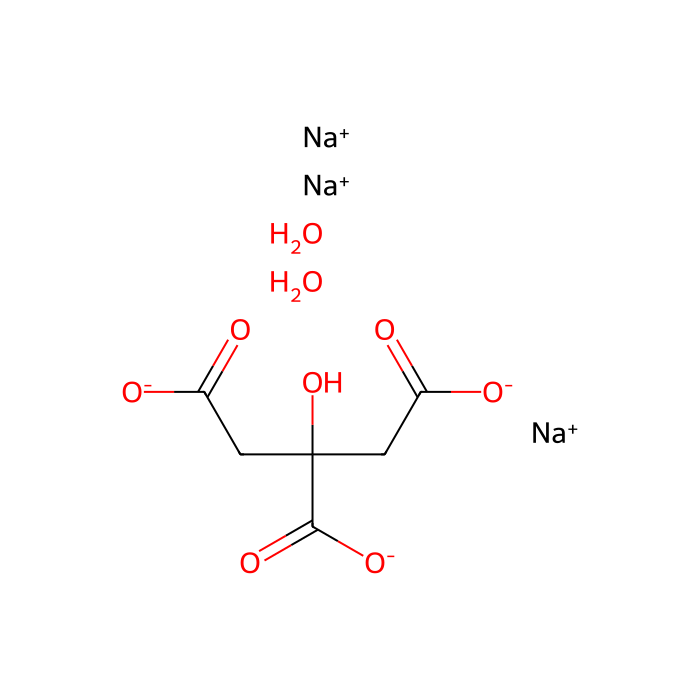
柠檬酸钠,二水

CAS: 6132-04-3 货号: S116311 分子式: C6H5Na3O7·2H2O 分子量: 294.10 Beilstein号: 6104939 EC号: 612-118-5
有货
级别和纯度: AR ? 分析纯(AR)—— 符合严格含量限度的高纯度试剂,适用于实验室分析。当精度要求高、痕量杂质可能影响结果时使用。 ≥99%
别名
柠檬酸钠二水合物
储存条件
室温
运输条件
常规运输
★
规格
库存
价格
数量
100g
S116311-100g
现货 Stock Image
¥31.90
500g
S116311-500g
现货 Stock Image
¥46.90
2.5kg
S116311-2.5kg
现货 Stock Image
¥162.90
5kg
S116311-5kg
现货 Stock Image
¥298.90
12×500g
S116311-12×500g
现货 Stock Image
¥477.90
请输入您要添加的产品数量
🧪
为什么选择此级别

AR 级 提供 ≥99% 纯度,适用于对基线干扰要求严格的色谱和分析工作流程。

🌡

储存与运输

室温。常规运输 。请查阅批次 COA 获取详细规格。

📋

质量文档

SDS、COA、产品数据表及规格说明书均可下载。可通过批号查询获取批次 COA。

📚

文献证明

在色谱分析、有机合成和交叉偶联反应领域已被 912 篇同行评审文献引用。

概述

Sodium citrate tribasic dihydrate, a conjμgate base of a weak acid, can perform as a biological buffering agent because it resists changes in pH. Citric acid is one of a series of compounds responsible for the physiological oxidation of fats, carbohydrates and proteins to carbon dioxide and water. Sodium Citrate, Dihydrate is often used to prepare sodium citrate buffer for antigen retrieval of tissue samples. The citrate solution is designed to break protein cross-links; thus, unmasking antigens and epitopes in formalin-fixed and paraffin embedded tissue sections, resulting in enhancing staining intensity of antibodies. Citrate has anticoagulant activity and as a calcium chelator, it forms complexes that disrupt the tendency of blood to clot.An anticoagulant also used as a biological buffer

Sodium citrate tribasic dihydrate, a conjugate base of a weak acid, can perform as a biological buffering agent because it resists changes in pH. Citric acid is one of a series of compounds responsible for the physiological oxidation of fats, carbohydrates and proteins to carbon dioxide and water. Sodium Citrate, Dihydrate is often used to prepare sodium citrate buffer for antigen retrieval of tissue samples. The citrate solution is designed to break protein cross-links; thus, unmasking antigens and epitopes in formalin-fixed and paraffin embedded tissue sections, resulting in enhancing staining intensity of antibodies. Citrate has anticoagulant activity and as a calcium chelator, it forms complexes that disrupt the tendency of blood to clot.
An anticoagulant also used as a biological buffer

规格

别名
柠檬酸钠二水合物
英文别名
B22547B95K | Citric acid, trisodium salt, dihydrate | SODIUM CITRATE [EP MONOGRAPH] | Trisodium citrate dihydrate, ACS | Emetrol Chewables Orange | F82065 | Sodium citrate dihydrate Biochemical grade, Fine Granular | SODIUM CITRATE HYDRATE [JAN] | Sodium
规格或纯度
AR, ≥99%
英文名称
Sodium citrate dihydrate
应用
An anticoagulant also used as a biological buffer
储存条件
室温
运输条件
常规运输
纯度
≥99%
名称和识别符
PubChem SID
EC号
200-675-3
分子类型
小分子
IUPAC Name
trisodium;2-hydroxypropane-1,2,3-tricarboxylate;dihydrate
INCHI
1S/C6H8O7.3Na.2H2O/c7-3(8)1-6(13,5(11)12)2-4(9)10;;;;;/h13H,1-2H2,(H,7,8)(H,9,10)(H,11,12);;;;2*1H2/q;3*+1;;/p-3
InChi Key
NLJMYIDDQXHKNR-UHFFFAOYSA-K
Smiles
C(C(=O)[O-])C(CC(=O)[O-])(C(=O)[O-])O.O.O.[Na+].[Na+].[Na+]
Isomeric SMILES
C(C(=O)[O-])C(CC(=O)[O-])(C(=O)[O-])O.O.O.[Na+].[Na+].[Na+]
分子量
294.10
Beilstein号
6104939

技术文档

📋 安全数据表 (SDS)

全面的危险、操作、储存及法规合规文件。

下载 SDS →

✅ 分析证书 (COA)

批次质量数据。输入批号以获取对应 COA。

查询 COA →

📊 产品数据表

产品规格和应用的快速参考摘要。

查看数据表 →

🔬 规格说明书

该级别的完整质量属性和验收标准。

查看规格说明 →

高级数据

系统学分类

分类树(Taxonomy Tree)

界(kingdom) 有机化合物
超类(Superclass) 有机酸及其衍生物
类(Class) 羧酸及其衍生物
亚类(Subclass) 三羧酸及其衍生物
中间层级节点(Intermediate Tree Nodes) 暂无
直接上位类(Direct Parent) 三羧酸及其衍生物
其他上位类(Alternative Parents) 叔醇  羧酸盐  羧酸  有机钠盐  有机氧化物  碳氢化合物衍生物  羰基化合物  
分子骨架(Molecular Framework) 脂肪族无环化合物
取代基(Substituents) 羟基苯甲酸酯 - 脂肪族非环化合物 - 羰基 - 羧酰胺基 - 羧酸盐 - 烃衍生物 - 有机碱金属盐 - 有机氧化物 - 有机氧化合物 - 有机盐 - 有机钠盐 - 有机氧化合物 - 三烷基醇 - 三羧酸或其衍生物
描述(Description) 该化合物属于有机化合物中的三羧酸及其衍生物类。这类化合物是含有三个羧基的羧酸。
外部描述符(External Descriptors) hydrate
三维结构
交互式化学结构模型


化学和物理性质
溶解性
Soluble in water (29.4 g/l) at 20 °C. Insoluble in ethanol
密度
1.76
敏感性
对湿度敏感
熔点
300°C
分子量
294.100 g/mol
XLogP3
氢键供体数Hydrogen Bond Donor Count
3
氢键受体数Hydrogen Bond Acceptor Count
9
可旋转键计数Rotatable Bond Count
2
精确质量Exact Mass
293.994 Da
单同位素质量Monoisotopic Mass
293.994 Da
拓扑极表面积Topological Polar Surface Area
143.000 Ų
重原子数Heavy Atom Count
18
形式电荷Formal Charge
0
复杂度Complexity
211.000
同位素原子数Isotope Atom Count
0
定义的原子立体中心计数Defined Atom Stereocenter Count
0
未定义的原子立体中心计数Undefined Atom Stereocenter Count
0
定义的键立体中心计数Defined Bond Stereocenter Count
0
未定义的键立体中心计数Undefined Bond Stereocenter Count
0
所有立体化学键的总数The total count of all stereochemical bonds
0
共价键合单元计数Covalently-Bonded Unit Count
6
安全和危险性(GHS)
WGK Germany
1
个人防护装备
Eyeshields,Gloves,type N95 (US),type P1 (EN143) respirator filter
质检证书(CoA,COO,BSE/TSE 和分析图谱)
C of A & Other Certificates(BSE/TSE, COO):
输入批号以搜索分析图谱:

通过匹配包装上的批号来查找并下载产品的 COA,每批产品都进行了严格的验证,您可放心使用!

找到74个结果

批号(Lot Number) 证书类型 货号
H2604692 分析证书 S116311
H2604686 分析证书 S116311
H2604478 分析证书 S116311
H2604691 分析证书 S116311
D2608176 分析证书 S116311
D2608175 分析证书 S116311
D2608174 分析证书 S116311
D2608173 分析证书 S116311
A2627213 分析证书 S116311
A2627225 分析证书 S116311
A2627226 分析证书 S116311
L2501516 分析证书 S116311
L2501515 分析证书 S116311
L2501544 分析证书 S116311
L2501517 分析证书 S116311
I2525454 分析证书 S116311
I2525453 分析证书 S116311
I2525414 分析证书 S116311
I2525243 分析证书 S116311
I2509670 分析证书 S116311
I2509523 分析证书 S116311
I2509522 分析证书 S116311
F2530300 分析证书 S116311
F2530236 分析证书 S116311
A2522194 分析证书 S116311
A2522191 分析证书 S116311
A2522180 分析证书 S116311
A2522189 分析证书 S116311
L2409706 分析证书 S116311
K2429464 分析证书 S116311
K2429465 分析证书 S116311
K2429466 分析证书 S116311
I2420638 分析证书 S116311
I2420646 分析证书 S116311
I2420659 分析证书 S116311
I2420665 分析证书 S116311
G2425366 分析证书 S116311
G2425704 分析证书 S116311
G2425709 分析证书 S116311
G2425707 分析证书 S116311
D2530259 分析证书 S116311
G2418075 分析证书 S116311
E2416427 分析证书 S116311
E2416389 分析证书 S116311
J2325018 分析证书 S116311
J2310446 分析证书 S116311
J2310422 分析证书 S116311
J2310421 分析证书 S116311
J2310420 分析证书 S116311
C2317547 分析证书 S116311
C2317546 分析证书 S116311
C2317779 分析证书 S116311
C2317549 分析证书 S116311
A2331480 分析证书 S116311
A2304207 分析证书 S116311
L2215085 分析证书 S116311
L2215064 分析证书 S116311
L2215173 分析证书 S116311
L2215048 分析证书 S116311
J2209241 分析证书 S116311
J2209239 分析证书 S116311
J2209242 分析证书 S116311
J2209240 分析证书 S116311
F2225614 分析证书 S116311
F2225610 分析证书 S116311
F2225609 分析证书 S116311
C2224330 分析证书 S116311
C2224329 分析证书 S116311
C2224299 分析证书 S116311
C2201414 分析证书 S116311
C2201398 分析证书 S116311
F2225616 分析证书 S116311
C2201415 分析证书 S116311
C2201388 分析证书 S116311
技术文档和文章
阿拉丁@生物实验常用缓冲液配方指南
Aladdin@Guidelines for the formulation of commonly used buffers for biological experiments
人全血血小板分离术
从光谱失配到器件增益:镧系上转换与下转换(量子剪裁)在太阳能电池中的关键机制、实验清单与阿拉丁材料选型推荐
From Spectral Mismatch to Device Gain: Key Mechanisms, Experimental Guidance, and Aladdin Material Selection for Lanthanide Upconversion and Downconversion (Quantum Cutting) in Solar Cells
香精科普:从配方黑箱到可工程化体系——相容性、稳定性、控释、可追溯与选型指南
A Practical Guide to Fragrance Compositions: Turning a Black-Box Formula into an Engineerable System—Compatibility, Stability, Controlled Release, Traceability, and Selection
羧甲基纤维素钠(CMC-Na)实用指南:增稠/稳定机理、配液关键控制点与选型导航(含表1、表A–C)
Practical Guide to Sodium Carboxymethyl Cellulose (CMC-Na): Thickening/Stabilizing Mechanisms, Key Controls for Solution Preparation, and Selection Navigation (including Table 1 and Tables A–C)
核酸研究中检测定量与相互作用解析的十种常用技术综述
A Review of Ten Commonly Used Techniques for Detection, Quantification, and Interaction Analysis in Nucleic Acid Research
科研常用盐类选型:碱金属盐 & 碱土金属盐的任务地图(含产品表1–表6)
Selection of Common Research Salts: A Task Map for Alkali Metal Salts & Alkaline Earth Metal Salts (with Product Tables 1–6)
金属纳米催化剂为何“更省能耗也更易掉性能”:从活性位到载体/界面工程的耐久逻辑(含选型导航及产品表A–D)
Why Metal Nanocatalysts Can “Save Energy Yet Lose Performance Easily”: Durability Logic from Active Sites to Support/Interface Engineering (Including Selection Guide and Product Tables A–D)
酸性磷酸酶:酸性微环境中的去磷酸化反应及其研究与检测应用
Acid Phosphatase: Dephosphorylation Reactions in Acidic Microenvironments and Their Research, Assay, and Detection Applications
β-N-乙酰氨基葡萄糖苷酶:底物特异性水解酶学特征与检测、科研及产业应用
β-N-Acetylglucosaminidase: Substrate-Specific Hydrolytic Enzymology, Assays, and Research and Industrial Applications
植酸酶:酶学特性、作用机理与饲料及食品领域应用
Phytase: Enzymological Properties, Mechanism of Action, and Applications in Feed and Food
海藻酸(Alginate)提取纯化工艺、质量鉴别与多领域用途综述
Alginate : An Overview of Extraction and Purification Processes, Quality Identification, and Multidomain Applications
从蔗糖到单糖:糖转化过程中的关键酶节点与调控逻辑
From Sucrose to Monosaccharides: Key Enzymatic Nodes and Regulatory Logic in Sugar Conversion
淀粉代谢相关酶在食品科学研究与品质调控机制分析中的功能体系
Functional Framework of Starch Metabolism-Related Enzymes in Food Science Research and Mechanistic Analysis of Quality Regulation
乙酰基代谢酶网络与体外酶学分析
Acetyl-Group Metabolic Enzyme Network and In Vitro Enzymology Analysis
酪胺信号放大技术在原位荧光检测中的应用
Tyramide Signal Amplification in In Situ Fluorescence Detection
细胞样本保存体系对形态保持、抗凝稳定与检测结果的影响
Effects of Cell Sample Preservation Systems on Morphological Integrity, Anticoagulant Stability, and Analytical Results
IHC实验中低pH、高pH及酶法抗原修复体系的应用比较
Comparison of Low-pH, High-pH, and Enzymatic Antigen Retrieval Systems in IHC
细胞凋亡检测中的TUNEL标记与结果判读
Cell Apoptosis Detection by TUNEL Labeling: Signal Interpretation and Result Evaluation
脂肪酸钾皂的结构与配方应用:生产工艺、偏碱性、泡沫调控及低泡清洗解析
Potassium Fatty Acid Soaps: Structure and Formulation Applications—Production Processes, Alkalinity, Foam Control, and Low-Foam Cleaning
为什么日化清洁配方常用 LABSA(磺酸):中和机理、去污作用与配方应用要点
Why LABSA (Sulfonic Acid) Is Commonly Used in Household Cleaning Formulations: Neutralization Mechanism, Detergency Action, and Formulation Application Points
偏硅酸钠与三聚磷酸钠在洗涤清洁配方中的区别、作用机理与选型
Differences, Mechanisms of Action, and Selection of Sodium Metasilicate and Sodium Tripolyphosphate in Detergent and Cleaning Formulations
日化配方中螯合剂的作用、选型与验证方法
The Role, Selection, and Validation of Chelating Agents in Daily Chemical Formulations
从结构到流变:卡波姆如何形成凝胶结构并实现增稠、悬浮与乳液辅助稳定?
From Structure to Rheology: How Carbomer Forms Gel Structures and Enables Thickening, Suspension, and Auxiliary Emulsion Stabilization
黄原胶在日化配方中的增稠、悬浮、辅助稳定与结团机制:从分子结构到工艺应用
Thickening, Suspension, Auxiliary Stabilization, and Agglomeration Mechanisms of Xanthan Gum in Personal Care Formulations: From Molecular Structure to Processing Applications
日化生产中片碱、粒碱、液碱与火碱的区别及选用要点:氢氧化钠的作用与应用逻辑
Differences, Functions, and Selection Guidelines for Sodium Hydroxide Flakes, Granules, Liquid Caustic Soda, and Caustic Soda in Household and Personal Care Product Manufacturing: The Functional and Application Logic of Sodium Hydroxide
TSA 酪胺信号放大实用指南:低丰度靶标检测信号弱时,如何选试剂、优化流程、降低背景?
Practical Guide to TSA Tyramide Signal Amplification: How to Select Reagents, Optimize the Workflow, and Reduce Background When Detection Signals Are Weak for Low-Abundance Targets
日化清洁配方中的分散剂、抗再沉积剂与抗垢材料:作用机制、选型逻辑与代表产品
Dispersants, Anti-Redeposition Agents, and Scale-Control Materials in Household Cleaning Formulations: Mechanisms of Action, Selection Logic, and Representative Products
日化配方为什么需要碱性成分:从 pH 调节、皂化反应到助洗去污与选型逻辑
Why Daily Chemical Formulations Need Alkaline Ingredients: From pH Adjustment and Saponification to Detergency Boosting and Selection Logic
日化清洁配方中的 AES(脂肪醇聚氧乙烯醚硫酸盐):结构、性能与低温流动性解析
AES (Fatty Alcohol Polyoxyethylene Ether Sulfate) in Personal and Home-Care Cleansing Formulations: An Analysis of Structure, Performance, and Low-Temperature Flowability
从结构看懂 CAPB:椰油酰胺丙基甜菜碱如何改善泡沫、提升温和性并辅助增稠?
Understanding CAPB from Its Structure: How Cocamidopropyl Betaine Improves Foam, Enhances Mildness, and Supports Thickening
三聚磷酸钠 STPP 如何替代?从助洗机理到低磷/无磷助洗体系的配方选择
How Can Sodium Tripolyphosphate (STPP) Be Replaced? From Detergency Mechanisms to Formulation Choices for Low-Phosphorus/Phosphorus-Free Builder Systems
不仅是 pH 调节剂:柠檬酸在日化清洁中的作用机理、选型逻辑与替代酸源分析
More Than a pH Adjuster: Mechanisms, Selection Logic, and Alternative Acid Source Analysis of Citric Acid in Home-Care Cleaning
十二烷基苯磺酸钠/SDBS 与 LAS、α-烯烃磺酸钠/AOS 有什么区别:合成、结构、作用机理与复配选型对比
What Are the Differences Among Sodium Dodecylbenzenesulfonate/SDBS, LAS, and Sodium α-Olefin Sulfonate/AOS: A Comparative Overview of Synthesis, Structure, Mechanism of Action, and Formulation Selection
从结构到选型:脂肪酸甲酯乙氧基化物(FMEE)低泡除油除蜡的机理与应用判断
From Structure to Selection: Mechanisms and Application Assessment of Low-Foam Oil and Wax Removal with Fatty Acid Methyl Ester Ethoxylates (FMEE)
偏硅酸钠清洗应用解析:水合形态差异、作用机理与选型逻辑
Sodium Metasilicate in Cleaning Applications: Hydration-Form Differences, Mechanisms of Action, and Selection Logic
K12 与 AOS 发泡性能差异解析:结构、酸碱稳定性与配方选型
Analysis of the Foaming Performance Differences Between K12 and AOS: Structure, Acid–Base Stability, and Formulation Selection
日化配方泡沫下降的机理与排查:破膜、界面弱膜、表活供给不足和相态扰动
Mechanisms and Troubleshooting of Foam Reduction in Personal and Household Care Formulations: Film Rupture, Weak Interfacial Films, Insufficient Surfactant Supply, and Phase-State Disturbance
夏季日化产品为什么容易返稀?核心机理、排查方法与解决思路
Why Are Daily Chemical Products Prone to Viscosity Thinning in Summer? Core Mechanisms, Troubleshooting Methods, and Solutions
中性腻子为什么会出现锈点?铁源、水分迁移、氧化显色与防控要点
Why Do Rust Spots Appear on Neutral Wall Putty? Iron Sources, Moisture Migration, Oxidative Color Development, and Prevention Measures
糖尿病动物模型建立与评价方法
Establishment and Evaluation Methods of Diabetic Animal Models
木质纤维素糖化中内切葡聚糖酶、CBH I与β-葡萄糖苷酶协同作用的实验评价
Experimental Evaluation of the Synergistic Actions of Endoglucanase, CBH I, and β-Glucosidase in Lignocellulosic Saccharification
TCA循环代谢物检测方法与结果判读
TCA Cycle Metabolite Detection Methods and Result Interpretation
Human Whole Blood Platelet Separation Protocol
β-N-Acetylglucosaminidase: Substrate-Specific Hydrolytic Enzymology, Assays, and Research and Industrial Applications
日化清洁配方中的分散剂、抗再沉积剂与抗垢材料:作用机制、选型逻辑与代表产品
Dispersants, Anti-Redeposition Agents, and Scale-Control Materials in Household Cleaning Formulations: Mechanisms of Action, Selection Logic, and Representative Products
β-羟丁酸检测方法与代谢意义:酶法、血酮仪与LC-MS检测的应用比较
β-Hydroxybutyrate Detection Methods and Metabolic Significance: Comparative Applications of Enzymatic Assays, Blood Ketone Meters, and LC-MS
还原糖检测方法比较:斐林试剂、Benedict法、 DNS法与HPLC法的应用选择
Comparison of Reducing Sugar Detection Methods: Selection of Fehling’s Reagent, Benedict’s Method, DNS Method, and HPLC
琥珀酸在痤疮护理中的潜在作用机制:从二羧酸酸碱平衡到皮肤微生物间的代谢拮抗
Potential Mechanisms of Succinic Acid in Acne Care: From Dicarboxylic Acid–Base Equilibria to Metabolic Antagonism Among Skin Microorganisms
茶多酚在油痘肌中的潜在作用机制:以EGCG对皮脂生成、脂质过氧化与炎症反应的影响为例
Potential Mechanisms of Tea Polyphenols in Oily, Acne-Prone Skin: Effects of EGCG on Sebum Production, Lipid Peroxidation, and Inflammatory Responses
银耳多糖的保湿机制:从多糖结构、水合流变到皮肤表面动态成膜
Moisturizing Mechanisms of Tremella fuciformis Polysaccharides: From Polysaccharide Structure and Hydration Rheology to Dynamic Film Formation on the Skin Surface
熊果苷如何调节黑色素生成:α/β异头构型与酪氨酸酶作用
How Arbutin Regulates Melanin Production: α/β Anomeric Configuration and Tyrosinase Action
烟酰胺提亮机制与配方设计:黑素小体转移、pH调控与复配策略
Niacinamide Brightening Mechanisms and Formulation Design: Melanosome Transfer, pH Regulation, and Combination Strategies
水裂解酶的催化机制、底物选择性与代谢功能
Catalytic Mechanisms, Substrate Selectivity, and Metabolic Functions of Hydro-Lyases
此产品的引用文献
溶液计算器

常见问题

本产品的纯度是多少?
本产品的化学纯度(含量)为 ≥99%。批次的具体数值以分析证书(COA)为准。
什么是「AR」?
「AR」是一个明确定义的分析纯度级别,适用于通用分析和试剂应用。它规定了最低含量百分比、对常见杂质(水分、重金属、灼烧残渣)的受控限值,以及批间一致性。「AR」是几个纯度级别之一——请根据方法的灵敏度和监管要求进行选择。
本产品应如何储存?
请于室温条件下保存。
本产品如何运输?
本产品按常温标准条件运输,无需温控包装。
本产品的 CAS 号、分子式和分子量是多少?
本产品的 CAS 号为 6132-04-3,分子式为 C6H5Na3O7·2H2O,分子量为 294.10 g/mol。InChIKey NLJMYIDDQXHKNR-UHFFFAOYSA-K。
如何获取批次专用COA?
每个订单都会随附分析证书(COA),您也可以从账户订单历史中下载。如需订购前的COA,请联系您的客户代表,或使用PDP上的"申请COA"按钮——我们将提供代表性批次的COA。
