
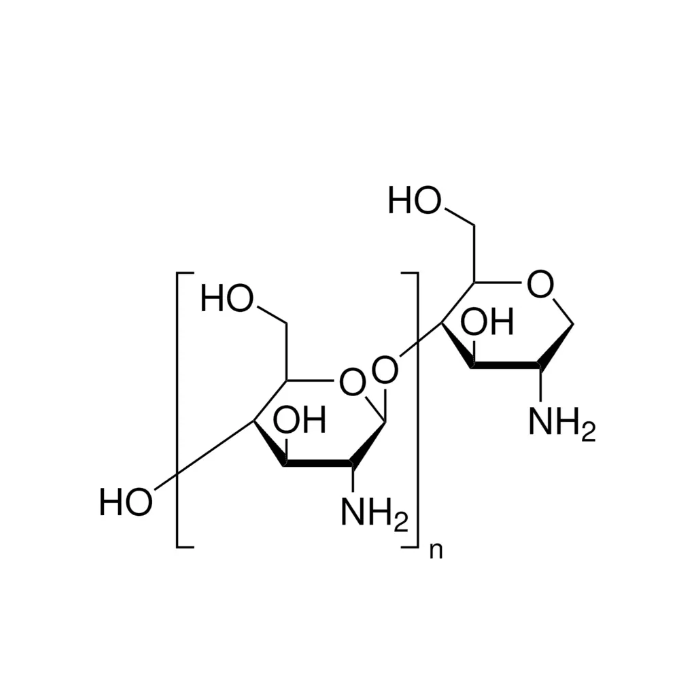
壳聚糖

CAS: 9012-76-4 货号: C299272 分子式: (C6H11NO4)n EC号: 618-480-0
有货
级别和纯度: ≥75%(deacetylated)
别名
聚(D-氨基葡萄糖) | 脱乙酰几丁质
储存条件
室温
运输条件
常规运输
★
规格
库存
价格
数量
100g
C299272-100g
现货 Stock Image
¥82.90
500g
C299272-500g
现货 Stock Image
¥288.90
2.5kg
C299272-2.5kg
现货 Stock Image
¥999.90
请输入您要添加的产品数量
🧪
为什么选择此级别

提供 ≥75%(deacetylated) 纯度,适用于对基线干扰要求严格的色谱和分析工作流程。

🌡

储存与运输

室温。常规运输 。请查阅批次 COA 获取详细规格。

📋

质量文档

SDS、COA、产品数据表及规格说明书均可下载。可通过批号查询获取批次 COA。

📚

文献证明

在色谱分析、有机合成和交叉偶联反应领域已被 3072 篇同行评审文献引用。

概述

与多价阴离子形成凝胶。 产生透明溶液,干燥后形成坚固、透明的薄膜。 虾壳衍生的壳聚糖、脱乙酰几丁质(聚β-1,4-D-葡糖胺)可用作生物相容、抗菌和环境友好的聚电解质生物材料,其具有多种应用,包括用于水处理、色谱法、化妆品添加剂、抗微生物活性的纺织品处理、纺织品的新型纤维、照相纸、可生物降解的薄膜、生物医学装置、以及用于药物递送中控制释放的微胶囊植入物。它可以通过衍生化以进一步扩展其用途。

Forms gels with multivalent anions. Gives clear solutions that dry to strong, clear films.
Shrimp shell derived chitosan, deacetylated chitin (poly β-1,4-D-glucosamine), may be used as a biocompatible, antibacterial and environmentally friendly polyelectrolyte biomaterial with a variety of applications including uses in water treatment, chromatography, additives for cosmetics, textile treatment for antimicrobial activity, novel fibers for textiles, photographic papers, biodegradable films, biomedical devices, and microcapsule implants for controlled release in drug delivery. It may be derivatized to further expand its uses.

规格

别名
聚(D-氨基葡萄糖) | 脱乙酰几丁质
英文别名
Kytex M | Toluene, o-chloro- | Chitopearl BCW 3505 | Chitopearl BCW 2500 | YEA | Toluene, o-bromo- | AKOS037652919 | Chitopearl BCW 3507 | Chitosan | Sea Cure F | Q408510 | AKOS015918343
规格或纯度
≥75%(deacetylated)
英文名称
Chitosan
储存条件
室温
运输条件
常规运输
纯度
≥75%(deacetylated)
名称和识别符
PubChem SID
EC号
618-480-0
分子类型
聚合物
IUPAC Name
methyl N-[(2S,3R,4R,5S,6R)-5-[(2S,3R,4R,5S,6R)-3-amino-5-[(2S,3R,4R,5S,6R)-3-amino-5-[(2S,3R,4R,5S,6R)-3-amino-5-[(2S,3R,4R,5S,6R)-3-amino-5-[(2S,3R,4R,5S,6R)-3-amino-5-[(2S,3R,4R,5S,6R)-3-amino-4,5-dihydroxy-6-(hydroxymethyl)oxan-2-yl]oxy-4-hydroxy-6-(hydroxymethyl)oxan-2-yl]oxy-4-hydroxy-6-(hydroxymethyl)oxan-2-yl]oxy-4-hydroxy-6-(hydroxymethyl)oxan-2-yl]oxy-4-hydroxy-6-(hydroxymethyl)oxan-2-yl]oxy-4-hydroxy-6-(hydroxymethyl)oxan-2-yl]oxy-2-[(2R,3S,4R,5R,6S)-5-amino-6-[(2R,3S,4R,5R,6R)-5-amino-4,6-dihydroxy-2-(hydroxymethyl)oxan-3-yl]oxy-4-hydroxy-2-(hydroxymethyl)oxan-3-yl]oxy-4-hydroxy-6-(hydroxymethyl)oxan-3-yl]carbamate
INCHI
1S/C56H103N9O39/c1-87-56(86)65-28-38(84)46(19(10-74)96-55(28)104-45-18(9-73)95-49(27(64)37(45)83)97-39-12(3-67)88-47(85)20(57)31(39)77)103-54-26(63)36(82)44(17(8-72)94-54)102-53-25(62)35(81)43(16(7-71)93-53)101-52-24(61)34(80)42(15(6-70)92-52)100-51-23(60)33(79)41(14(5-69)91-51)99-50-22(59)32(78)40(13(4-68)90-50)98-48-21(58)30(76)29(75)11(2-66)89-48/h11-55,66-85H,2-10,57-64H2,1H3,(H,65,86)/t11-,12-,13-,14-,15-,16-,17-,18-,19-,20-,21-,22-,23-,24-,25-,26-,27-,28-,29-,30-,31-,32-,33-,34-,35-,36-,37-,38-,39-,40-,41-,42-,43-,44-,45-,46-,47-,48+,49+,50+,51+,52+,53+,54+,55+/m1/s1
InChi Key
FLASNYPZGWUPSU-SICDJOISSA-N
Isomeric SMILES
COC(=O)N[C@@H]1[C@H]([C@@H]([C@H](O[C@H]1O[C@@H]2[C@H](O[C@H]([C@@H]([C@H]2O)N)O[C@@H]3[C@H](O[C@H]([C@@H]([C@H]3O)N)O)CO)CO)CO)O[C@H]4[C@@H]([C@H]([C@@H]([C@H](O4)CO)O[C@H]5[C@@H]([C@H]([C@@H]([C@H](O5)CO)O[C@H]6[C@@H]([C@H]([C@@H]([C@H](O6)CO)O[C@H]7[C@@H]([C@H]([C@@H]([C@H](O7)CO)O[C@H]8[C@@H]([C@H]([C@@H]([C@H](O8)CO)O[C@H]9[C@@H]([C@H]([C@@H]([C@H](O9)CO)O)O)N)O)N)O)N)O)N)O)N)O)N)O

技术文档

📋 安全数据表 (SDS)

全面的危险、操作、储存及法规合规文件。

下载 SDS →

✅ 分析证书 (COA)

批次质量数据。输入批号以获取对应 COA。

查询 COA →

📊 产品数据表

产品规格和应用的快速参考摘要。

查看数据表 →

🔬 规格说明书

该级别的完整质量属性和验收标准。

查看规格说明 →

高级数据

系统学分类

分类树(Taxonomy Tree)

界(kingdom) 有机化合物
超类(Superclass) 有机氧化合物
类(Class) 有机氧化合物
亚类(Subclass) 碳水化合物和碳水化合物结合物
中间层级节点(Intermediate Tree Nodes) 暂无
直接上位类(Direct Parent) 寡糖
其他上位类(Alternative Parents) 氨基糖苷类  O-糖基化合物  氧烷  甲基氨基甲酸酯  1,2-氨基醇  仲醇  半缩醛  有机碳酸及其衍生物  缩醛  氧环化合物  单烷基胺  伯醇  碳氢化合物衍生物  羰基化合物  有机氧化物  有机光子化合物  
分子骨架(Molecular Framework) 脂肪族杂单环化合物
取代基(Substituents) 1,2-氨基醇 - 乙醛酸 - 羟基苯甲酸酯 - 脂肪族杂单环化合物 - 氨基酸 - 氨基糖苷 - 氨基糖苷核心 - 脲酸酯 - 碳酸衍生物 - 羰基 - 糖基化合物 - 半缩醛 - 烃衍生物 - 甲基氨基甲酸酯 - O-羧基化合物 - 萜类化合物 - 有机硝基化合物 - 有机氧化物 - 有机杂环化合物 - 有机氮化合物 - 有机氮化合物 - 氧杂环 - 氧杂环丁烷 - 初级醇 - 初级脂肪胺 - 初级胺 - 醛基
描述(Description) 该化合物属于有机化合物中的寡糖类。这类碳水化合物由3至10个单糖单元通过糖苷键相互连接而成。
外部描述符(External Descriptors) 暂无
化学和物理性质
熔点
102.5°C
分子量
1526.500 g/mol
XLogP3
-21.400
氢键供体数Hydrogen Bond Donor Count
29
氢键受体数Hydrogen Bond Acceptor Count
47
可旋转键计数Rotatable Bond Count
27
精确质量Exact Mass
1525.64 Da
单同位素质量Monoisotopic Mass
1525.64 Da
拓扑极表面积Topological Polar Surface Area
808.000 Ų
重原子数Heavy Atom Count
104
形式电荷Formal Charge
0
复杂度Complexity
2630.000
同位素原子数Isotope Atom Count
0
定义的原子立体中心计数Defined Atom Stereocenter Count
45
未定义的原子立体中心计数Undefined Atom Stereocenter Count
0
定义的键立体中心计数Defined Bond Stereocenter Count
0
未定义的键立体中心计数Undefined Bond Stereocenter Count
0
所有立体化学键的总数The total count of all stereochemical bonds
0
共价键合单元计数Covalently-Bonded Unit Count
1
安全和危险性(GHS)
信号词
警告
危险声明

H401: 对水生生物有毒

预防措施声明

P273: 避免释放到环境中。

P501: 将内容物/容器处理到。。。

个人防护装备
Eyeshields,Gloves,type N95 (US),type P1 (EN143) respirator filter
质检证书(CoA,COO,BSE/TSE 和分析图谱)
C of A & Other Certificates(BSE/TSE, COO):
输入批号以搜索分析图谱:

通过匹配包装上的批号来查找并下载产品的 COA,每批产品都进行了严格的验证,您可放心使用!

找到22个结果

批号(Lot Number) 证书类型 货号
F2605409 分析证书 C299272
F2605410 分析证书 C299272
F2618043 分析证书 C299272
H2525222 分析证书 C299272
H2525221 分析证书 C299272
A2510304 分析证书 C299272
A2510307 分析证书 C299272
H2409328 分析证书 C299272
H2409327 分析证书 C299272
H2409326 分析证书 C299272
L2305098 分析证书 C299272
H1920126 分析证书 C299272
G2226368 分析证书 C299272
G2305156 分析证书 C299272
G2226369 分析证书 C299272
G2226367 分析证书 C299272
C2413084 分析证书 C299272
B2307235 分析证书 C299272
A2225091 分析证书 C299272
A2225151 分析证书 C299272
J2311023 分析证书 C299272
A2225098 分析证书 C299272
技术文档和文章
FITC标记多糖——荧光探针下的多糖世界
FITC-Labeled Polysaccharides—— The Polysaccharide World Under Fluorescent Probes
基因转染的非病毒载体——聚乙烯亚胺
纳米粘土在材料与配方中的应用:分散机理、性能提升与产品选型
Applications of Nanoclay in Materials and Formulations: Dispersion Mechanisms, Performance Enhancement, and Product Selection
香精科普:从配方黑箱到可工程化体系——相容性、稳定性、控释、可追溯与选型指南
A Practical Guide to Fragrance Compositions: Turning a Black-Box Formula into an Engineerable System—Compatibility, Stability, Controlled Release, Traceability, and Selection
研究用碳水化合物(Carbohydrates)入门:读懂“糖链语言”与产品选型导航(附表1–3)
An Introduction to Research-Grade Carbohydrates: Decoding the “Glycan Language” and a Product-Selection Guide (with Tables 1–3)
材料也会“开关”:智能聚合物如何响应温度、pH 与光(附实验选型与产品导航)
Materials Can “Switch”: How Smart Polymers Respond to Temperature, pH, and Light (with Experimental Selection Tips & Product Navigation)
亲水性聚合物的水相行为解析:水化机制、结构旋钮与任务导向选型导航(含表1–表3)
Understanding Hydrophilic Polymers in Aqueous Systems: Hydration Mechanisms, Structural Knobs, and Task-Oriented Selection Guide (Including Tables 1–3)
生物医用聚合物解析:任务角色地图、六大材料旋钮与风险导向证据链(含产品导航与产品表1–表3)
Biomedical Polymer Insights: Role-Based Task Map, Six Key Material Levers, and a Risk-Driven Evidence Chain (including the Product Navigation Guide and Product Tables 1–3)
科研场景下药物制剂与递送:核心定义、可控框架与实践指南
Pharmaceutical Formulation and Delivery in Research Settings: Core Definitions, Controllable Frameworks and Practical Guidelines
壳聚糖(Chitosan)选型与应用指南:pH 响应正电性、关键参数与实验场景选型导航(附表1–4)
Chitosan Selection and Application Guide: pH-Responsive Cationic Charge, Key Parameters, and Scenario-Based Experimental Selection Map (Tables 1–4)
海藻酸(Alginate)提取纯化工艺、质量鉴别与多领域用途综述
Alginate : An Overview of Extraction and Purification Processes, Quality Identification, and Multidomain Applications
果聚糖酶的基本特性、催化机制及应用进展综述
番茄红素的结构特征、生物学作用与应用进展综述
Review of the Structural Characteristics, Biological Functions, and Application Advances of Lycopene
邻苯二甲酰基:伯胺保护的应用定位与实验选用思路
Phthaloyl: Its Role in Primary Amine Protection and Practical Considerations for Experimental Selection
聚电解质多层膜的研究价值:界面组成、传质与功能的逐层设计
Research Value of Polyelectrolyte Multilayers: Layer-by-Layer Design of Interfacial Composition, Mass Transport, and Function
医用水凝胶研发中的关键判断:从聚合物来源、交联方式到灭菌安排、放大可行性与质量控制
Key Judgments in Medical Hydrogel R&D: From Polymer Source and Crosslinking Strategy to Sterilization Planning, Scale-Up Feasibility, and Quality Control
酶促蛋白交联体系在凝胶构建与功能评价中的应用
Applications of Enzymatic Protein Crosslinking Systems in Gel Construction and Functional Evaluation
从天然纤维素到纳米晶体:CNC 的结构特性、应用方向与产业化挑战
From Natural Cellulose to Nanocrystals: Structural Characteristics, Application Directions, and Industrialization Challenges of CNC
涂料配方中的天然树脂:作用定位、结构-性能关系与选型验证
Natural Resins in Coating Formulations: Functional Positioning, Structure–Property Relationships, and Selection Validation
石墨烯生物传感器的信号转换机制:从分子识别到电学/光学信号读出与材料选型
Signal Transduction Mechanism of Graphene Biosensors: From Molecular Recognition to Electrical/Optical Signal Readout and Materials Selection
粉体香精与香精递送材料的结构、性能与作用机理:稳定性、释放机制与选型逻辑
Structure, Properties, and Mechanisms of Powdered Fragrances and Fragrance Delivery Materials: Stability, Release Mechanisms, and Selection Logic
日化产品如何延长留香:香精结构、表面沉积与释放调控
How to Extend Fragrance Longevity in Personal and Home Care Products: Fragrance Structure, Surface Deposition, and Release Modulation
Non-viral Vectors for Gene Transfection: Polyethyleneimine
阿伏苯宗的UVA吸收机制:酮—烯醇互变、光化学失稳与配方光稳定化策略
UVA Absorption Mechanism of Avobenzone: Keto–Enol Tautomerism, Photochemical Instability, and Formulation Photostabilization Strategies
对伞花烃在问题肌肤中的潜在作用机制:膜扰动、炎症信号调节与局部递送
Potential Mechanisms of p-Cymene in Problem-Prone Skin: Membrane Perturbation, Inflammatory Signaling Modulation, and Localized Delivery
灵芝提取物的结构—功能关系:多糖与三萜的皮肤保护作用及配方递送策略
Structure–Function Relationships of Ganoderma lucidum Extract: Skin-Protective Effects of Polysaccharides and Triterpenoids and Formulation Delivery Strategies
熊果苷如何调节黑色素生成:α/β异头构型与酪氨酸酶作用
How Arbutin Regulates Melanin Production: α/β Anomeric Configuration and Tyrosinase Action
烟酰胺提亮机制与配方设计:黑素小体转移、pH调控与复配策略
Niacinamide Brightening Mechanisms and Formulation Design: Melanosome Transfer, pH Regulation, and Combination Strategies
此产品的引用文献
溶液计算器
