
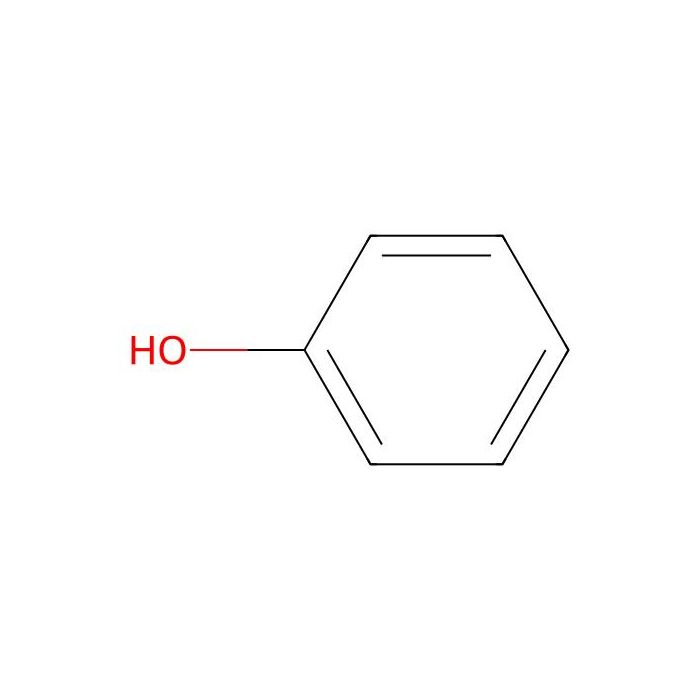
苯酚

CAS: 108-95-2 货号: P755666 分子式: C6H6O 分子量: 94.11 Beilstein号: 969616 EC号: 203-632-7
有货
级别和纯度: UltraBio™ ? UltraBio™ —— 阿拉丁面向分子生物学应用的系列。适用于分子流程中无核酸酶、高一致性的试剂。 分子生物学级 ? 适用于分子生物学 —— 不含降解 DNA/RNA 的核酸酶和污染物。适用于克隆、PCR 和需要洁净试剂的核酸工作。 TE-saturated, ~73% (T)
储存条件
2-8°C储存,避光,充氩
运输条件
低温运输,DG运输
★
规格
库存
价格
数量
50ml
P755666-50ml
现货 Stock Image
¥1,099.90
250ml
P755666-250ml
现货 Stock Image
¥3,199.90
请输入您要添加的产品数量
🧪
为什么选择此级别

UltraBio™,分子生物学级 ,适用于对基线干扰要求严格的色谱和分析工作流程。

🌡

储存与运输

2-8°C储存,避光,充氩。低温运输,DG运输 。请查阅批次 COA 获取详细规格。

📋

质量文档

SDS、COA、产品数据表及规格说明书均可下载。可通过批号查询获取批次 COA。

📚

文献证明

在色谱分析、有机合成和交叉偶联反应领域已被 1535 篇同行评审文献引用。

概述

苯酚(TE-饱和)已用于分离质粒DNA前的萃取过程。此外,在DNA线性化和mRNA合成过程中,它还可用于萃取水相。应用:

用 10 mM TRIS 缓冲液 (pH 8.0) 和 1 mM EDTA 饱和苯酚(也称为羟基苯)是一种天然和人工合成的芳香族化合物。它是一种消毒剂,具有很高的毒性。吸入、皮肤吸附或口服摄入苯酚会致细胞蛋白变性和沉淀,进而导致中毒。

Phenol, also known as hydroxybenzene, is an aromatic compound produced both naturally and synthetically. It acts as a disinfectant and is highly toxic. Exposure to phenol through inhalation, cutaneous adsorption, or oral ingestion causes denaturation and precipitation of cellular protein, which in turn leads to poisoning.
saturated with 10 mM TRIS buffer pH 8.0 and 1 mM EDTA

Application:

Phenol (TE-saturated) has been used in the phenol-chloroform extraction procedure for plasmid DNA isolation. It has also been used to extract the aqueous phase during DNA linearization and mRNA synthesis.

规格

规格或纯度
UltraBio™, 分子生物学级, TE-saturated, ~73% (T)
英文名称
Phenol
储存条件
2-8°C储存,避光,充氩
运输条件
低温运输,DG运输
名称和识别符
EC号
203-632-7
分子类型
小分子
IUPAC Name
phenol
INCHI
1S/C6H6O/c7-6-4-2-1-3-5-6/h1-5,7H
InChi Key
ISWSIDIOOBJBQZ-UHFFFAOYSA-N
Smiles
C1=CC=C(C=C1)O
Isomeric SMILES
C1=CC=C(C=C1)O
UN Number
Packing Group
II
分子量
94.11
Beilstein号
969616
Reaxy-Rn
969616
Reaxys-RN link address
https://www.reaxys.com/reaxys/secured/hopinto.do?context=S&query=IDE.XRN=969616&ln=

技术文档

📋 安全数据表 (SDS)

全面的危险、操作、储存及法规合规文件。

下载 SDS →

✅ 分析证书 (COA)

批次质量数据。输入批号以获取对应 COA。

查询 COA →

📊 产品数据表

产品规格和应用的快速参考摘要。

查看数据表 →

🔬 规格说明书

该级别的完整质量属性和验收标准。

查看规格说明 →

高级数据

系统学分类

分类树(Taxonomy Tree)

界(kingdom) 有机化合物
超类(Superclass) 苯类化合物
类(Class) 酚类
亚类(Subclass) 1-羟基-4-未取代苯类化合物
中间层级节点(Intermediate Tree Nodes) 暂无
直接上位类(Direct Parent) 1-羟基-4-未取代苯类化合物
其他上位类(Alternative Parents) 1-羟基-2-未取代苯类化合物  苯及其取代衍生物  有机氧化合物  碳氢化合物衍生物  
分子骨架(Molecular Framework) 芳香族同单环化合物
取代基(Substituents) 1-羟基-2-未取代苯环化合物 - 1-羟基-4-未取代苯环化合物 - 芳香族同单环化合物 - 烃衍生物 - 单环苯基基团 - 有机氧化合物 - 有机氧化合物
描述(Description) 该化合物属于有机化合物中的1-羟基-4-位未取代苯环类。这类酚类化合物在4位未发生取代。
外部描述符(External Descriptors) a phenol
三维结构
交互式化学结构模型


产品属性
pH ~7.8(aqueous phase)
化学和物理性质
密度
1.071 g/mL at 25 °C (lit.)
敏感性
对光线敏感
折光率
1.54178
闪点(℉)
177.8 °F - closed cup
闪点(℃)
79.44℃(closed cup)
沸点
181.7°C
熔点
43°C
分子量
94.110 g/mol
XLogP3
1.500
氢键供体数Hydrogen Bond Donor Count
1
氢键受体数Hydrogen Bond Acceptor Count
1
可旋转键计数Rotatable Bond Count
0
精确质量Exact Mass
94.0419 Da
单同位素质量Monoisotopic Mass
94.0419 Da
拓扑极表面积Topological Polar Surface Area
20.200 Ų
重原子数Heavy Atom Count
7
形式电荷Formal Charge
0
复杂度Complexity
46.100
同位素原子数Isotope Atom Count
0
定义的原子立体中心计数Defined Atom Stereocenter Count
0
未定义的原子立体中心计数Undefined Atom Stereocenter Count
0
定义的键立体中心计数Defined Bond Stereocenter Count
0
未定义的键立体中心计数Undefined Bond Stereocenter Count
0
所有立体化学键的总数The total count of all stereochemical bonds
0
共价键合单元计数Covalently-Bonded Unit Count
1
安全和危险性(GHS)
一般危化品
一般危化品
象形图
GHS05,   GHS06,   GHS08,   GHS09
信号词
危险
危险声明

H314: 造成严重的皮肤灼伤和眼睛损伤

H341: 怀疑引起遗传缺陷

H373: 通过长时间或反复暴露对器官造成损害

H411: 对水生生物有毒并具有长期持续影响

H301+H311+H331: 吞咽、皮肤接触或吸入中毒。

预防措施声明

P260: 不要吸入灰尘/烟雾/气体/雾/蒸汽/喷雾。

P261: 避免吸入灰尘/烟雾/气体/雾/蒸汽/喷雾

P264: 处理后要彻底洗手。

P270: 使用本产品时,请勿进食、饮水或吸烟。

P271: 仅在室外或通风良好的地方使用。

P280: 戴防护手套/穿防护服/戴防护眼罩/戴防护面具。

P281: 根据需要使用个人防护设备。

P321: 特殊处理(请参阅此标签上的...)。

P330: 漱口

P363: 再次使用之前,请清洗受污染的衣物。

P301+P330+P331: 如误吞咽:漱口。不要诱导呕吐。

P302+P352: 如皮肤沾染:用水充分清洗。

P304+P340: 如误吸入:将人转移到空气新鲜处,保持呼吸舒适体位。

P361+P364: 立即脱掉所有沾染的衣服,清洗后方可重新使用。

P405: 密闭存放

P403+P233: 存放在通风良好的地方。保持容器密闭。

P501: 将内容物/容器处理到。。。

P203: 使用前,获取、阅读并遵守所有安全说明。

P301+P316: 如果吞咽:立即寻求紧急医疗救助。

P305+P354+P338: 如果进入眼睛:立即用水冲洗几分钟。取下隐形眼镜(如果有的话),并且操作简单。继续冲洗。

P318: 如果暴露或担心,请就医。

P302+P361+P354: 如果接触皮肤:立即脱掉所有被污染的衣服。立即用水冲洗几分钟。

P316: 立即寻求紧急医疗救助。

P319: 如果你感到不适,请寻求医疗帮助。

WGK Germany
2
RTECS
SJ3325000
Class
6.1
Merck Index
7241
个人防护装备
Eyeshields, Faceshields, Gloves, type P1 (EN143) respirator filter, type P3 (EN 143) respirator cartridges
质检证书(CoA,COO,BSE/TSE 和分析图谱)
C of A & Other Certificates(BSE/TSE, COO):
输入批号以搜索分析图谱:

通过匹配包装上的批号来查找并下载产品的 COA,每批产品都进行了严格的验证,您可放心使用!

找到4个结果

批号(Lot Number) 证书类型 货号
H2627059 分析证书 P755666
H2627060 分析证书 P755666
D2613482 分析证书 P755666
G2607613 分析证书 P755666
技术文档和文章
UltraBio™:定义分子生物学应用的卓越性
UltraBio™: Defining Excellence in Molecular Biology Applications
分子生物学级
Molecular Biology Grade
从链霉亲和素载体洗脱生物素化蛋白和核酸的策略
Strategies for Eluting Biotinylated Proteins and Nucleic Acids from Streptavidin Supports
植物可溶性糖检测技术研究进展
Research Progress in Detection Technologies for Soluble Sugars in Plants
核酸研究中检测定量与相互作用解析的十种常用技术综述
A Review of Ten Commonly Used Techniques for Detection, Quantification, and Interaction Analysis in Nucleic Acid Research
植物淀粉相关指标检测方法与应用选择研究进展
Recent Advances in Methods for Measuring Starch-Related Indices in Plants and Their Application-Oriented Selection
RNA提取技术:方法体系、操作流程与质量控制要点
RNA Extraction Technologies: Method Systems, Operational Workflows, and Key Quality-Control Considerations
胆固醇酯酶:界面水解特性驱动的机制解析与应用体系
Cholesterol Esterase: Mechanistic Insights and Application Frameworks Driven by Interfacial Hydrolysis
科研中的血脂四项含量检测:指标体系、检测原理与技术路线及应用综述
Lipid Panel Testing in Research (TC, TG, HDL-C, LDL-C): Indicator System, Assay Principles, Technical Routes, and Application Overview
微球菌核酸酶(MNase):酶学特性、反应控制与科研及生物制造应用技术综述
Micrococcal Nuclease (MNase): A Technical Review of Enzymatic Properties, Reaction Control, and Research and Biomanufacturing Applications
白介素29(IL-29/IFN-λ1):分子特征、信号网络与科研应用体系
Interleukin-29 (IL-29/IFN-λ1): Molecular Features, Signaling Networks, and a Systematic Framework for Research Applications
二苯胺的理化特性、分析应用及其与DNA显色反应综述
Physicochemical Properties of Diphenylamine, Analytical Applications, and a Review of Its DNA Colorimetric Reaction
甘油和甘油三酯含量检测的原理、常用方法与应用要点综述
Review of the Principles, Common Methods, and Key Application Considerations for the Determination of Glycerol and Triglyceride Contents
卤代杂环与交叉偶联:从底物识别到成键路线的科研选型框架(含产品导航及表1–表5)
Haloheterocycles and Cross-Coupling: A Research-Oriented Selection Framework from Substrate Identification to Bond-Forming Routes (Including Product Navigation and Tables 1–5)
β-酰氧基烯基酰胺(AAAs):一种值得关注的酰胺键与肽键构建新思路
β-Acyloxy Alkenyl Amides (AAAs): A New Approach to Amide Bond and Peptide Bond Construction Worth Attention
重新认识四氯化钛:羧酸直接酰胺化与酯化的新进展
Revisiting Titanium Tetrachloride: New Advances in the Direct Amidation and Esterification of Carboxylic Acids
认识 ATD-DMAP:从试剂设计到成酯、成酰胺与手性保持
Understanding ATD-DMAP: From Reagent Design to Esterification, Amidation, and Stereochemical Integrity
二溴三苯基膦(PPh₃Br₂)不只是溴化剂:从醇转溴代物到羧酸活化与一锅酯化、烯基溴与腈构建的实验选型逻辑
Triphenylphosphine Dibromide (PPh₃Br₂) Is More Than Just a Brominating Reagent: Experimental Selection Logic from Alcohol-to-Alkyl Bromide Conversion to Carboxylic Acid Activation and One-Pot Esterification, Vinyl Bromide Formation, and Nitrile Constructi
DBU 在不同体系中的反应角色:强有机碱、亲核催化与反应路径参与的实验判断
Reaction Roles of DBU in Different Systems: Experimental Judgment from a Strong Organic Base to Nucleophilic Catalysis and Participation in the Reaction Pathway
DMAP 不只是有机碱:从亲核酰基转移到酯化与大环内酯化的实验判断
DMAP Is More Than Just an Organic Base: Experimental Judgment from Nucleophilic Acyl Transfer to Esterification and Macrolactonization
三光气在有机合成中的实验判断:按反应任务理解其选用逻辑
Experimental Evaluation of Triphosgene in Organic Synthesis: Understanding Its Selection Logic Through Reaction Tasks
免疫学实验中封片体系的类型比较与选择策略
Comparative Analysis and Selection Strategies for Mounting Media in Immunological Experiments
环氧体系中胺类固化剂的配方设计与选用
Formulation Design and Selection of Amine Curing Agents in Epoxy Systems
交叉偶联反应的实验判断方法:目标键型、底物组合与催化体系选择
Experimental Decision-Making for Cross-Coupling Reactions: Target Bond Type, Substrate Combination, and Catalytic System Selection
给 NCO 加上温度触发开关:封闭型异氰酸酯如何影响 1K 烘烤涂料的储存、固化与涂膜性能
Adding a Temperature-Triggered Switch to NCO: How Blocked Isocyanates Affect the Storage, Curing, and Film Performance of 1K Baking Coatings
真菌孢子碘染色反应的显微判读与分类鉴定价值
Microscopic Interpretation and Taxonomic Value of Iodine Staining Reaction in Fungal Spores
1K、2K、水性、湿固化、封闭型:聚氨酯涂料固化体系的分类逻辑与判断方法
1K, 2K, Waterborne, Moisture-Curing, and Blocked Systems: Classification Logic and Identification Methods for Polyurethane Coating Curing Systems
聚氨酯涂料配方设计与施工应用中的关键控制要点
Key Control Points in Polyurethane Coating Formulation Design and Application
微生物形态鉴别的观察体系、染色方法与结果判读
Microbial Morphological Identification: Observation Systems, Staining Methods, and Result Interpretation
多肽合成异常杂质如何排查?从氨基相关副反应看工艺问题定位
How to Troubleshoot Abnormal Impurities in Peptide Synthesis? Locating Process Issues Through Amino-Related Side Reactions
酚醛树脂为什么耐热、耐化学性好?从分子结构到固化网络解析性能来源
Why Do Phenolic Resins Have Good Heat and Chemical Resistance? Analyzing the Source of Their Performance from Molecular Structure to Cured Networks
环氧酚醛涂料:为什么常用于耐化学、耐溶剂、耐热及金属内壁防护?
Epoxy Phenolic Coatings: Why Are They Commonly Used for Chemical Resistance, Solvent Resistance, Heat Resistance, and Internal Metal Surface Protection?
酚醛改性醇酸树脂:快干工业涂料中的性能提升与应用
Phenolic-Modified Alkyd Resin: Performance Enhancement and Applications in Fast-Drying Industrial Coatings
酚醛树脂在涂料中的选型与配方设计要点:适用场景、应用限制与性能验证
Selection and Formulation Design Guidelines for Phenolic Resins in Coatings: Applicable Scenarios, Application Limitations, and Performance Verification
松香及改性松香树脂在涂料与油墨中的应用:结构—性能关系、改性路径与使用要点
Applications of Rosin and Modified Rosin Resins in Coatings and Inks: Structure–Property Relationships, Modification Pathways, and Usage Guidelines
腰果壳油(CNSL):从腰果加工副产物到生物基涂料树脂反应型原料
Cashew Nut Shell Liquid (CNSL): From Cashew Processing By-Product to Reactive Bio-Based Raw Material for Coating Resins
胆碱代谢与检测方法:胆碱、磷脂酰胆碱、甜菜碱、乙酰胆碱和TMAO的通路解析
Choline Metabolism and Detection Methods: Pathway Analysis of Choline, Phosphatidylcholine, Betaine, Acetylcholine, and TMAO
氮杂三环烷烃的张力释放:三维氮杂桥环的桥位模块化官能团化与立体控制
Strain Release of Azatricycloalkanes: Modular Bridge-Position Functionalization and Stereochemical Control of Three-Dimensional Bridged Aza Scaffolds
银耳多糖的保湿机制:从多糖结构、水合流变到皮肤表面动态成膜
Moisturizing Mechanisms of Tremella fuciformis Polysaccharides: From Polysaccharide Structure and Hydration Rheology to Dynamic Film Formation on the Skin Surface
如何绕开α-氟消除:α,α-二氟苄基阴离子的溴转移捕获与氧化偶联
How to Bypass α-Fluoride Elimination: Bromine-Transfer Capture and Oxidative Coupling of α,α-Difluorobenzylic Anions
DNA与RNA酚法提取的分相原理、体系差异与应用选择
Phase-Partitioning Principles, System Differences, and Application Selection in Phenol-Based DNA and RNA Extraction
灵芝提取物的结构—功能关系:多糖与三萜的皮肤保护作用及配方递送策略
Structure–Function Relationships of Ganoderma lucidum Extract: Skin-Protective Effects of Polysaccharides and Triterpenoids and Formulation Delivery Strategies
一级、二级胺为何难以直接参与经典Mitsunobu反应:BEHT介导醇胺化的机理、构型翻转与反应范围
Why Primary and Secondary Amines Have Difficulty Participating Directly in the Classical Mitsunobu Reaction: Mechanism, Inversion of Configuration, and Reaction Scope of BEHT-Mediated Alcohol Amination
I₂/DMSO介导芳基甲基酮氧化的反应逻辑:芳基乙二醛的原位生成、捕获与杂环构建
Reaction Logic of I₂/DMSO-Mediated Oxidation of Aryl Methyl Ketones: In Situ Generation, Trapping, and Heterocycle Construction of Aryl Glyoxals
从临时共价组装到分子内 Smiles 芳基迁移:DCPDC 介导的酚–伯胺 C–N 交叉偶联
From Temporary Covalent Assembly to Intramolecular Smiles Aryl Migration: DCPDC-Mediated Phenol–Primary Amine C–N Cross-Coupling
此产品的引用文献
溶液计算器
