
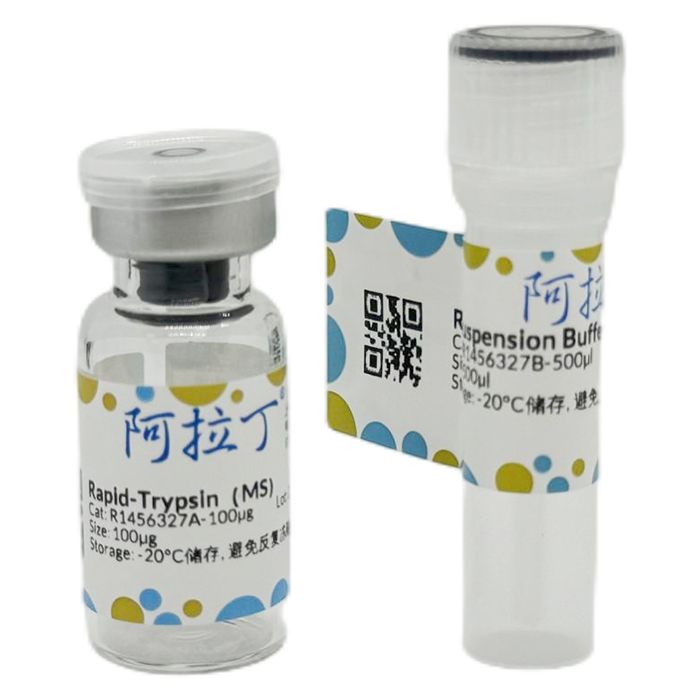
快速胰蛋白酶(质谱级)

CAS: 9002-07-7 货号: R1456327 EC号: 607-831-3
有货
级别和纯度: 无动物源 ? 无动物源(Animal Free)—— 不含动物源成分生产,降低污染风险。适用于避免动物源材料的生物制造和培养。 无载体 ? 无载体(Carrier Free)—— 不含添加的载体蛋白/稳定剂。当载体(如 BSA)会干扰偶联或敏感检测时使用。 重组 ? 重组(Recombinant)—— 通过重组表达生产,序列确定、批次稳定。适用于来源明确、无动物源的可重现蛋白。 质谱级 (MS) ? 适用于质谱(MS)—— 非挥发性和离子残留低,与质谱兼容。用于在质谱流程中尽量降低背景和离子抑制。 EnzymoPure™ ? EnzymoPure™ —— 阿拉丁的高质量酶解决方案系列。当酶纯度和明确活性决定检测或工艺性能时使用。 PBS Only ? 仅 PBS 配方 —— 以磷酸盐缓冲液供应,不含其他添加剂。当需要不含稳定剂/载体的洁净 PBS 缓冲液时使用。 ≥95%(SDS-PAGE) ≥3800USP U/mg protein
Accession #
P00761
蛋白标签
No tag
生物活性
≥3800USP U/mg protein
★
规格
库存
价格
数量
100μg
R1456327-100μg
现货 Stock Image
¥999.90
10×100μg
R1456327-10×100μg
现货 Stock Image
¥4,999.90
请输入您要添加的产品数量
🧪
为什么选择此级别

EnzymoPure™,PBS Only,无动物源,无载体,质谱级 (MS),重组 级 提供 ≥95%(SDS-PAGE) 纯度,适用于对基线干扰要求严格的色谱和分析工作流程。

🌡

储存与运输

-20°C储存,避免反复冻融。超低温运输 。请查阅批次 COA 获取详细规格。

📋

质量文档

SDS、COA、产品数据表及规格说明书均可下载。可通过批号查询获取批次 COA。

📚

文献证明

在色谱分析、有机合成和交叉偶联反应领域已被 441 篇同行评审文献引用。

概述

  蛋白组学分析中可靠且可重复的结果高度依赖于稳定的样品制备,样品的制备过程繁琐耗时,通常包括16-18小时的过夜孵育酶解过程,在酶解过程中平衡速度与酶切完整性是一个持续的挑战。快速胰蛋白酶(质谱级)属于质谱级别的基因工程酶,能够实现在3小时内完成蛋白组学研究中的酶解过程,其能够特异性地切割赖氨酸(K)及精氨酸(R)酸C末端肽键,适用于多种类型样本,包括但不限于动物组织来源样本、细胞样本及IP样本。 

产品用途

  可用于肽图谱分析、蛋白序列分析以及蛋白组学研究中的蛋白酶解过程。

产品特点

高效酶解:酶解时间缩短至3 h以内,节约了样品前处理的时间。

高纯度:无其他污染蛋白酶,纯度≥95%。

高稳定性:每批产品经严格的质量控制,保证产品批次间稳定性。

无动物源性:本产品为重组表达,生产过程中不使用任何动物源的材料,无外源性的病毒污染。
产品数据

图1. 结果表明Rapid-Trypsin在3 h完成酶切 

组分表

R1456327
Component100μg
10x100μgStorage
R1456327ARapid-Trypsin(MS)
100μg
10x100μg-20℃. Avoid freeze/thaw cycle.
R1456327BResuspension Buffer
500μl10x500μL-20℃. Avoid freeze/thaw cycle.

操作流程

①推荐使用50mM的醋酸溶液溶解Rapid-Trypsin (MS)冻干粉。比如:取1管20μg的Rapid-Trypsin (MS)冻干粉,加入40μL 50mM的醋酸溶液溶解,可进行Votex震荡溶解,配置成0.5μg/uL的Rapid-Trypsin (MS)溶液,每管5μL,分装成8管保存。

②Rapid-Trypsin (MS)推荐的使用比例为Rapid-Trypsin (MS) :目的蛋白=1:20,该比例为质量比,比如1μg的Rapid-Trypsin (MS)可以切20μg的总蛋白。(推荐酶切时间为3-4h,对于较难消化的蛋白或复杂样品,酶切时间可延长至6h。)

注意事项和免责声明

  本品仅限于专业人员的科学研究使用,不得用于临床诊断或治疗,不得用于食品或药品。

  In proteomic analysis, reliable and reproducible results are highly dependent on stable sample preparation. The sample preparation process is cumbersome and time-consuming, usually involving an overnight incubation and enzymatic hydrolysis process of 16-18 hours. Balancing speed and enzymatic cleavage completeness during the enzymatic hydrolysis process is an ongoing challenge. Fast Trypsin (Mass Spectrometry Grade) is a mass spectrometry-grade genetic engineering enzyme that can complete the enzymatic hydrolysis process in proteomic research within 3 hours. It can specifically cleave the C-terminal peptide bonds of lysine (K) and arginine (R), and is suitable for various types of samples, including but not limited to samples derived from animal tissues, cell samples, and IP samples. 

Product Applications
  It can be used in peptide mapping analysis, protein sequence analysis, and the proteolytic process in proteomic research.

Product Features
Efficient enzymatic hydrolysis: The enzymatic hydrolysis time is shortened to less than 3 hours, saving the time for sample pretreatment.
High purity: Free of other contaminating proteases, with a purity of ≥95%.
High stability: Each batch of products undergoes strict quality control to ensure stability between batches.
Animal origin-free: This product is recombinantly expressed, and no animal-derived materials are used in the production process, thus avoiding exogenous virus contamination.

Product Data 

Fig. 1. The results showed that Rapid-Trypsin (MS) completed the enzyme digestion in 3 h.

Component List

R1456327
Component100μg
10x100μgStorage
R1456327ARapid-Trypsin(MS)
100μg
10x100μg-20℃. Avoid freeze/thaw cycle.
R1456327BResuspension Buffer
500μl10x500μL-20℃. Avoid freeze/thaw cycle.

Operating Procedures
① It is recommended to dissolve the Rapid-Trypsin (MS) lyophilized powder using 50mM acetic acid solution. For example: Take 1 tube of 20μg Rapid-Trypsin (MS) lyophilized powder, add 40μL of 50mM acetic acid solution, and dissolve by vortexing to prepare a 0.5μg/μL Rapid-Trypsin (MS) solution. Aliquot into 8 tubes, 5μL per tube, for storage.
② The recommended usage ratio of Rapid-Trypsin (MS) is Rapid-Trypsin (MS) : target protein = 1:20 (mass ratio). For instance, 1μg of Rapid-Trypsin (MS) can digest 20μg of total protein. (The recommended digestion time is 3-4 hours; for hard-to-digest proteins or complex samples, the digestion time can be extended to 6 hours.)
Precautions and Disclaimer
  This product is limited to scientific research use by professionals. It must not be used for clinical diagnosis or treatment, nor for food or pharmaceutical purposes.

规格

产品名称
快速胰蛋白酶(质谱级)
别名
胰蛋白酶 | 质谱级胰蛋白酶 | 测序级 胰蛋白酶
英文别名
Trypsin
规格或纯度
无动物源,无载体,重组,质谱级 (MS),EnzymoPure™,PBS Only,≥95%(SDS-PAGE),≥3800USP U/mg protein
生物活性
≥3800USP U/mg protein
种属
猪(Pig)
蛋白标签
No tag
来源
重组表达
预测分子量
23.5 kDa
CAS编号和信息
9002-07-7
酶学委员会编号
EC 3.4.21.4
分子类型
酶
产品线
生物产品
储存与运输
物理形态
冻干(Lyophilized)
储存缓冲液
Lyophilized from 10mM PBS, pH7.5.
浓度
≥3800USP U/mg protein
复溶
Reconstitute in Resuspension Buffer (50mM Acetic acid). Upon reconstitution, it is recommended to aliquot, store at -20℃ (1 month) , store at -80℃ (6 months).
储存条件
-20°C储存,避免反复冻融
运输条件
超低温运输
稳定性与储存
长期储存-20℃(2年);复溶后建议分装,避免反复冻融。
单位定义
1 个 USP蛋白酶单位(USP unit) 定义为:在 25 °C、pH 7.6 条件下,每分钟水解 1 μmol BAEE 所需的酶量。在实际测定中,常通过监测 253 nm 处吸光度变化来量化酶活性。具体换算为实验条件下的定义是:每分钟使 ΔA₂₅₃ 增加 0.003 的酶量 = 1 USP 单位。

技术文档

📋 安全数据表 (SDS)

全面的危险、操作、储存及法规合规文件。

下载 SDS →

✅ 分析证书 (COA)

批次质量数据。输入批号以获取对应 COA。

查询 COA →

📊 产品数据表

产品规格和应用的快速参考摘要。

查看数据表 →

🔬 规格说明书

该级别的完整质量属性和验收标准。

查看规格说明 →

高级数据

质检证书(CoA,COO,BSE/TSE 和分析图谱)
C of A & Other Certificates(BSE/TSE, COO):
输入批号以搜索分析图谱:

通过匹配包装上的批号来查找并下载产品的 COA,每批产品都进行了严格的验证,您可放心使用!

找到3个结果

批号(Lot Number) 证书类型 货号
ZJ26F0434485 分析证书 R1456327
ZJ25F0926437 分析证书 R1456327
ZJ25F0926436 分析证书 R1456327
技术文档和文章
重组胰蛋白酶
Recombinant Trypsin
简介:“适用于质谱分析” (又名:质谱级)
Introduction: “Suitable for Mass Spectrometry”
质谱级 (MS)
MS Grade
BRET(生物发光共振能量转移)方法
BRET (Bioluminescence Resonance Energy Transfer) Method
酶保护剂及延长酶活性的常用方法
Enzyme Protectants and Common Methods to Prolong Enzymatic Activity
红细胞裂解液技术说明与操作指南
Red Blood Cell Lysis Buffer — Technical Description & Operating Guide
胰蛋白酶与重组胰蛋白酶药典标准比较
Comparison of Pharmacopoeial Standards for Trypsin and Recombinant Trypsin
肽图检查法鉴定蛋白质结构
Peptide Mapping for Protein Structure Identification
质谱级酶:精准蛋白质组学分析的“分子剪刀”
MS-Grade Enzymes:“Molecular Scissors” for Precision Proteomics Analysis
抗体表征工具
Antibody Characterization Tools
CCK-8细胞活性检测实验方案
CCK-8 Cell Viability Assay Protocol
LPS诱导细胞炎症模型建立实验步骤
LPS-Induced Cellular Inflammation Model: Experimental Procedure
EdU染色实验的基本原理和实验流程
EdU Staining: Basic Principle and Experimental Workflow
HepG2细胞脂肪变性模型建立实验流程
HepG2 Cell Steatosis Model Establishment Protocol
骨髓间充质干细胞分离培养及诱导分化为破骨细胞实验操作流程
Isolation, Culture, and Induced Differentiation of Bone Marrow Mesenchymal Stem Cells into Osteoclasts: Experimental Procedure
关于细胞培养的常见问答
Frequently Asked Questions about Cell Culture
多种组织单细胞解离酶的应用与优化
Applications and Optimization of Multi-Tissue Single-Cell Dissociation Enzymes
常见组织解离酶的原理与选择策略
Principles and Selection Strategies for Common Tissue Dissociation Enzymes
抑肽酶技术综述:结构特征、作用机制与应用
A Technical Review of Aprotinin: Structural Features, Mechanisms of Action, and Applications
姬姆萨(Giemsa)染色实验Protocol:血液涂片与骨髓涂片
Giemsa Staining Protocol: Peripheral Blood and Bone Marrow Smears
赖氨酰内切酶Lys-C:赖氨酸位点特异性消化酶的机理、应用与方法学控制要点
Endoproteinase Lys-C: Mechanism, Applications, and Method-Control Considerations for Lysine-Specific Digestion
植物组学技术全景:基因组—转录组—蛋白质组—代谢组的流程框架与多组学整合应用
Plant Omics Panorama: Workflow Frameworks and Multi-Omics Integration from Genomics to Transcriptomics, Proteomics, and Metabolomics
乳清蛋白:组成谱、制备路径与产品类型要点
Whey Protein: Composition Profile, Manufacturing Routes, and Key Product-Type Essentials
弗林蛋白酶(Furin)的结构特征、底物识别与科研应用综述
Furin: A Review of Its Structural Features, Substrate Recognition, and Research Applications
羧肽酶家族在蛋白末端加工与实验分析中的作用
Roles of the Carboxypeptidase Family in Protein C-Terminal Processing and Experimental Analysis
糖蛋白结构表征与质量属性分析的方法学研究
Methodological Studies on Glycoprotein Structural Characterization and Quality Attribute Analysis
组织单细胞制备的样本处理与质控策略
Tissue Dissociation for Single-Cell Preparation: Sample Handling and Quality Control Strategies
多酶消化策略与蛋白质组学覆盖度优化研究框架
Research Framework for Multi-Enzyme Digestion Strategies and Optimization of Proteomic Coverage
聚电解质多层膜的研究价值:界面组成、传质与功能的逐层设计
Research Value of Polyelectrolyte Multilayers: Layer-by-Layer Design of Interfacial Composition, Mass Transport, and Function
蛋白质羰基检测
Protein Carbonyl Detection
IHC实验中低pH、高pH及酶法抗原修复体系的应用比较
Comparison of Low-pH, High-pH, and Enzymatic Antigen Retrieval Systems in IHC
常用哺乳动物细胞抗性筛选体系比较:嘌呤霉素、G418、潮霉素B与杀稻瘟菌素
Comparison of Common Mammalian Cell Antibiotic Selection Systems: Puromycin, G418, Hygromycin B, and Blasticidin
内肽酶与外肽酶的功能差异及其在疾病机制研究中的应用
Functional Differences Between Endopeptidases and Exopeptidases and Their Applications in Disease Mechanism Research
生物模拟肽的皮肤作用逻辑:序列与构象、皮肤递送、稳定性及靶点匹配
The Logic of Biomimetic Peptide Action in Skin: Sequence and Conformation, Skin Delivery, Stability, and Target Matching
丝氨酸内切蛋白酶的催化机制、分类特征与实验应用
Catalytic Mechanisms, Classification Characteristics, and Experimental Applications of Serine Endopeptidases
此产品的引用文献
溶液计算器

常见问题

本产品的纯度是多少?如何测定?
本产品的纯度为 ≥95%,采用SDS-PAGE测定。批次的具体数值以分析证书(COA)为准。
什么是「无动物源」?
「无动物源」表示该物料经过加工和检测,适用于特种工业加工。规格侧重于影响该应用性能的杂质——例如,电子应用的金属含量、电池应用的粒度、光学应用的折射率,或对水分敏感工艺的水分含量。
什么是「无载体」?
「无载体」表示该物料经过加工和检测,适用于特种工业加工。规格侧重于影响该应用性能的杂质——例如,电子应用的金属含量、电池应用的粒度、光学应用的折射率,或对水分敏感工艺的水分含量。
本产品应如何储存?
请于?20 °C条件下保存。避免反复冻融。建议按单次用量分装保存。
本产品如何运输?
本产品采用保温箱配冰袋运输。收货后请立即拆包,并按上述储存条件保存。
本产品的 CAS 号、分子式和分子量是多少?
本产品的 CAS 号为 9002-07-7。
如何获取批次专用COA?
每个订单都会随附分析证书(COA),您也可以从账户订单历史中下载。如需订购前的COA,请联系您的客户代表,或使用PDP上的"申请COA"按钮——我们将提供代表性批次的COA。
