
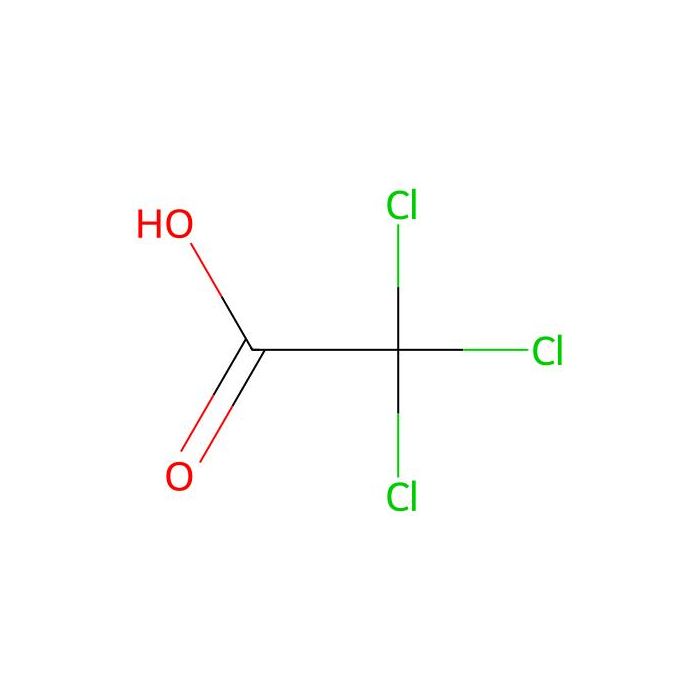
三氯乙酸(TCA)

CAS: 76-03-9 货号: T755664 分子式: C2HCl3O2 分子量: 163.39 Beilstein号: 970119 EC号: 200-927-2
有货
级别和纯度: UltraBio™ ? UltraBio™ —— 阿拉丁面向分子生物学应用的系列。适用于分子流程中无核酸酶、高一致性的试剂。 ≥99.5%(T)
储存条件
室温
运输条件
DG运输
★
规格
库存
价格
数量
25g
T755664-25g
期货 Stock Image
¥357.90
100g
T755664-100g
现货 Stock Image
¥1,099.90
500g
T755664-500g
现货 Stock Image
¥3,299.90
1kg
T755664-1kg
现货 Stock Image
¥4,399.90
请输入您要添加的产品数量

概述

三氯乙酸(TCA)已用于:确定其在涵盖心脏规格(cardiac specification)的暴露窗口(exposure window)期间对禽类胚胎的影响作为细胞固定剂 终止O-乙酰丝氨酸(硫醇)裂解酶(OASTL)酶促测定用于沉淀酸性核糖体蛋白(RP)传统上用于沉淀蛋白质。用于通过定量沉淀测定蛋白质浓度。用作脱钙剂和显微镜样品的固定剂。应用:

三氯乙酸(TCA)来源于三氯乙烯(TCE)代谢。它可用作酸脱钙剂。TCA可用作核染色和蛋白质沉淀的固定剂。

Trichloroacetic acid (TCA) is derived from Trichloroethylene (TCE) metabolism. It is used as an acid decalcifying agent. TCA is used as a fixative for nuclear staining and protein precipitation.

Application:

Trichloroacetic acid (TCA) has been used:
  • to determine its effect on avian embryos during an exposure window encompassing cardiac specification
  • as a cell fixative
  • to terminate the O-acetylserine (thiol)lyase (OASTL) enzymatic assay
  • for the precipitation of acidic ribosomal proteins (RPs)

Traditionally used to precipitate protein. Has been used to determine protein concentration by quantitative precipitation. Used as decalcifier and fixative in microscopy.

规格

规格或纯度
UltraBio™, ≥99.5%(T)
英文名称
Trichloroacetic acid(TCA)
储存条件
室温
运输条件
DG运输
纯度
≥99.5%(T)
名称和识别符
PubChem SID
EC号
200-927-2
分子类型
小分子
IUPAC Name
2,2,2-trichloroacetic acid
InChI
1S/C2HCl3O2/c3-2(4,5)1(6)7/h(H,6,7)
InChIKey
YNJBWRMUSHSURL-UHFFFAOYSA-N
SMILES
C(=O)(C(Cl)(Cl)Cl)O
Isomeric SMILES
C(=O)(C(Cl)(Cl)Cl)O
UN Number
Packing Group
II
分子量
163.39
Beilstein号
970119
Reaxy-Rn
970119
Reaxys-RN link address
https://www.reaxys.com/reaxys/secured/hopinto.do?context=S&query=IDE.XRN=970119&ln=

高级数据

系统学分类

分类树(Taxonomy Tree)

界(kingdom) 有机化合物
超类(Superclass) 有机酸及其衍生物
类(Class) 羧酸及其衍生物
亚类(Subclass) α-卤代羧酸及其衍生物
中间层级节点(Intermediate Tree Nodes) 暂无
直接上位类(Direct Parent) α-卤代羧酸
其他上位类(Alternative Parents) 一元羧酸及其衍生物  羧酸  有机氯化物  有机氧化物  碳氢化合物衍生物  羰基化合物  烷基氯  
分子骨架(Molecular Framework) 脂肪族无环化合物
取代基(Substituents) 脂肪族非环化合物 - 氟化烷基 - 烷基溴化物 - α-卤代羧酸 - 羰基 - 羧酰胺基 - 烃衍生物 - 单羧酸或其衍生物 - 有机氧化物 - 有机氧化合物 - 有机氯化物 - 有机卤化物 - 有机氧化合物
描述(Description) 该化合物属于α-卤代羧酸类有机化合物。这类羧酸的α碳原子上直接连接有卤素原子。
外部描述符(External Descriptors) Pesticides
三维结构
交互式化学结构模型


产品属性
pH <1.0 (25 °C, 0.5 M in H 2 O)
化学和物理性质
溶解性
H 2 O: 0.5 M at 20 °C, clear, colorless
密度
1.62 g/mL at 25 °C (lit.)
折光率
1.4603
沸点
197.5°C
熔点
58°C
分子量
163.380 g/mol
XLogP3
1.300
氢键供体数Hydrogen Bond Donor Count
1
氢键受体数Hydrogen Bond Acceptor Count
2
可旋转键计数Rotatable Bond Count
0
精确质量Exact Mass
161.904 Da
单同位素质量Monoisotopic Mass
161.904 Da
拓扑极表面积Topological Polar Surface Area
37.300 Ų
重原子数Heavy Atom Count
7
形式电荷Formal Charge
0
复杂度Complexity
83.400
同位素原子数Isotope Atom Count
0
定义的原子立体中心计数Defined Atom Stereocenter Count
0
未定义的原子立体中心计数Undefined Atom Stereocenter Count
0
定义的键立体中心计数Defined Bond Stereocenter Count
0
未定义的键立体中心计数Undefined Bond Stereocenter Count
0
所有立体化学键的总数The total count of all stereochemical bonds
0
共价键合单元计数Covalently-Bonded Unit Count
1
安全和危险性(GHS)
一般危化品
一般危化品
象形图
GHS05,   GHS07,   GHS09
信号词
危险
危险声明

H303: 要是吞了可能有害

H314: 造成严重皮肤灼伤和眼损伤

H335: 可能引起呼吸道刺激

H410: 对水生生物毒性极大并具有长期持续影响

预防措施声明

P260: 不要吸入灰尘/烟雾/气体/雾/蒸汽/喷雾。

P264: 处理后要彻底洗手。

P271: 仅在室外或通风良好的地方使用。

P273: 避免释放到环境中。

P280: 戴防护手套/穿防护服/戴防护眼罩/戴防护面具。

P312: 打电话给毒物中心或医生/... 如果你觉得不舒服

P363: 再次使用之前,请清洗受污染的衣物。

P391: 收集溢出物

P301+P330+P331: 如误吞咽:漱口。不要诱导呕吐。

P303+P361+P353: 如皮肤(或头发)沾染:立即脱掉所有沾染的衣服。用水清洗皮肤/淋浴。

P405: 密闭存放

P403+P233: 存放在通风良好的地方。保持容器密闭。

P501: 将内容物/容器送到批准的废物处理厂处理

P304+P340+P310: 如误吸入:将人转移到空气新鲜处,保持呼吸舒适体位。立即呼叫急救中 心/医生。

P305+P351+P338+P310: 如进入眼睛:用水小心冲洗几分钟。如戴隐形眼镜并可方便地取出,取出 隐形眼镜。继续冲洗。立即呼叫急救中心/医生。

WGK Germany
2
RTECS
AJ7875000
Class
8
Merck Index
9627
个人防护装备
Faceshields,full-face respirator (US),Gloves,Goggles,multi-purpose combination respirator cartridge (US)
质检证书(CoA,COO,BSE/TSE 和分析图谱)
C of A & Other Certificates(BSE/TSE, COO):
输入批号以搜索分析图谱:

通过匹配包装上的批号来查找并下载产品的 COA,每批产品都进行了严格的验证,您可放心使用!

找到4个结果

批号(Lot Number) 证书类型 货号
C2505070C2505070 分析证书 T755664
I2603202I2603202 分析证书 T755664
C2505064C2505064 分析证书 T755664
C2505076C2505076 分析证书 T755664
技术文档和文章
UltraBio™:定义分子生物学应用的卓越性
UltraBio™: Defining Excellence in Molecular Biology Applications
RNA Pull-Down实验操作规程
RNA Pull-Down Standard Operating Procedure (SOP)
DNA Pull-Down实验操作规程
DNA Pull-Down Standard Operating Procedure (SOP)
植物蛋白类指标检测方法与应用选择研究进展
Recent Advances in Methods for Measuring Plant Protein-Related Indices and Application-Oriented Selection
常见动植物生理生化指标的作用与意义
Functions and Significance of Common Physiological and Biochemical Indices in Animals and Plants
植物组学技术全景:基因组—转录组—蛋白质组—代谢组的流程框架与多组学整合应用
Plant Omics Panorama: Workflow Frameworks and Multi-Omics Integration from Genomics to Transcriptomics, Proteomics, and Metabolomics
氨基酸氧化酶:氧依赖性氧化脱氨反应体系及其分析与应用
Amino Acid Oxidases: Oxygen-Dependent Oxidative Deamination Systems and Their Analytical and Applied Uses
谷胱甘肽(GSH)含量检测:方法体系、实验流程与质量控制要点
Glutathione (GSH) Quantification: Method Systems, Experimental Workflows, and Key Quality-Control Considerations
血管紧张素转换酶(ACE):分子特征、催化功能与科研及转化应用综述
Angiotensin-Converting Enzyme (ACE): A Review of Molecular Features, Catalytic Functions, and Research and Translational Applications
凝乳酶:分子特征、凝乳动力学与活力评价的研究综述
Chymosin: A Review of Molecular Features, Coagulation Kinetics, and Activity Evaluation
菠萝蛋白酶:酶学特性与食品、医药及工业应用要点
Bromelain: Enzymological Properties and Key Points for Food, Pharmaceutical, and Industrial Applications
植酸酶:酶学特性、作用机理与饲料及食品领域应用
Phytase: Enzymological Properties, Mechanism of Action, and Applications in Feed and Food
几丁质酶:底物特异性降解机制、酶学特性与应用方向
Chitinases: Substrate-Specific Degradation Mechanisms, Enzymatic Properties, and Application Directions
黄酮:结构特征、理化性质与科研及应用要点
Flavones: Structural Features, Physicochemical Properties, and Key Points for Research and Applications
胰酶(Pancreatin)科研应用综述
Research Applications of Pancreatin: An Overview
二苯胺的理化特性、分析应用及其与DNA显色反应综述
Physicochemical Properties of Diphenylamine, Analytical Applications, and a Review of Its DNA Colorimetric Reaction
麦芽四糖(Maltotetraose)功能特性、应用场景与制备工艺综述
Functional Properties, Application Scenarios, and Manufacturing Processes of Maltotetraose (G4): A Review
糜蛋白酶(Chymotrypsin)的酶学特性、催化机制与科研应用综述
Review of Chymotrypsin: Enzymological Properties, Catalytic Mechanism, and Research Applications
果聚糖酶的基本特性、催化机制及应用进展综述
梭菌蛋白酶的类型谱系、分子机制与科研应用综述
Clostridial Proteases: Classification, Molecular Mechanisms, and Research Applications
羟脯氨酸含量检测的技术比较与方法学选择
Technical Comparison and Method Selection for Hydroxyproline Determination
生物样本中巯基与二硫键状态的检测方法及应用
Thiol and Disulfide Status in Biological Samples: Detection Methods and Applications
羟自由基清除能力检测方法的原理比较、体系控制与结果判读
Comparison of Principles, System Control, and Result Interpretation in Hydroxyl Radical Scavenging Capacity Assays
寡核苷酸化学合成中的偶联活化剂、核苷砌块与修饰设计:对合成效率、纯度和性质的影响
Coupling Activators, Nucleoside Building Blocks, and Modification Design in Oligonucleotide Chemical Synthesis: Their Effects on Synthetic Efficiency, Purity, and Product Properties
多孔石墨化碳(PGC)色谱柱:用分子形状和石墨表面 π 电子云建立困难分离的新选择性
Porous Graphitic Carbon (PGC) Chromatography Columns: Creating New Selectivity for Challenging Separations through Molecular Shape and the π-Electron Cloud on the Graphitic Surface
水杨酸向儿茶酚转化的酶促羟化机制
Enzymatic Hydroxylation Mechanism of Salicylate Conversion to Catechol
丙二醛含量检测的原理、方法选择与结果判读
Principles, Method Selection, and Result Interpretation for Malondialdehyde Content Detection
β-羟丁酸检测方法与代谢意义:酶法、血酮仪与LC-MS检测的应用比较
β-Hydroxybutyrate Detection Methods and Metabolic Significance: Comparative Applications of Enzymatic Assays, Blood Ketone Meters, and LC-MS
甲醛的显色检测原理、方法比较与样品分析应用
Principles, Method Comparison, and Sample Analysis Applications of Colorimetric Formaldehyde Detection
此产品的引用文献
溶液计算器
