
计算溶液所需的质量、体积或浓度。
为什么选择此级别
,适用于对基线干扰要求严格的色谱和分析工作流程。
储存与运输
室温。 。请查阅批次 COA 获取详细规格。
质量文档
SDS、COA、产品数据表及规格说明书均可下载。可通过批号查询获取批次 COA。
文献证明
在色谱分析、有机合成和交叉偶联反应领域已被 113 篇同行评审文献引用。
规格
别名
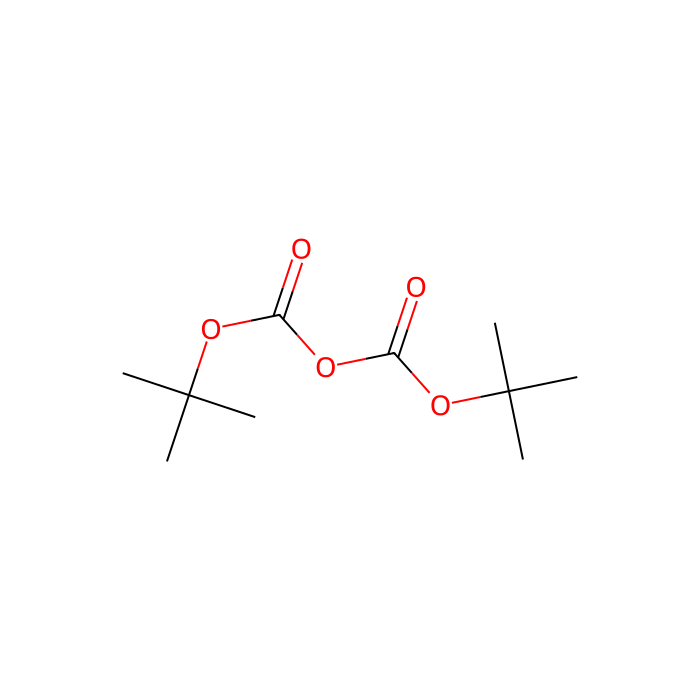
焦碳酸二叔丁酯
英文别名
di-t-butyldicarbonate | di-t-butyl-dicarbonate | Di-tert-butyl dicarbonate 2.0M in THF | (di-tert-butyl)dicarbonate | Di tert-butyl dicarbonate | di-t-butylpyrocarbonate | di-tert-butyl dicabonate | tBoc2O | t-Boc2O | Di-tert-butyl dicarbonate 2.0M in Dic
规格或纯度
2 M in methylene chloride
英文名称
Di-tert-butyl dicarbonate solution
储存条件
室温
名称和识别符
EC号
246-240-1
分子类型
小分子
IUPAC Name
tert-butyl (2-methylpropan-2-yl)oxycarbonyl carbonate
INCHI
1S/C10H18O5/c1-9(2,3)14-7(11)13-8(12)15-10(4,5)6/h1-6H3
InChi Key
DYHSDKLCOJIUFX-UHFFFAOYSA-N
Smiles
CC(C)(C)OC(=O)OC(=O)OC(C)(C)C
Isomeric SMILES
CC(C)(C)OC(=O)OC(=O)OC(C)(C)C
UN Number
Packing Group
II
分子量
218.25
Beilstein号
1911173
Reaxy-Rn
1911173
Reaxys-RN link address
https://www.reaxys.com/reaxys/secured/hopinto.do?context=S&query=IDE.XRN=1911173&ln=
技术文档
高级数据
系统学分类
分类树(Taxonomy Tree)
| 界(kingdom) | 有机化合物 |
|---|---|
| 超类(Superclass) | 有机酸及其衍生物 |
| 类(Class) | 有机碳酸及其衍生物 |
| 亚类(Subclass) | 暂无 |
| 中间层级节点(Intermediate Tree Nodes) | 暂无 |
| 直接上位类(Direct Parent) | 有机碳酸及其衍生物 |
| 其他上位类(Alternative Parents) | 有机氧化物 碳氢化合物衍生物 羰基化合物 |
| 分子骨架(Molecular Framework) | 脂肪族无环化合物 |
| 取代基(Substituents) | 脂肪族非环化合物 - 碳酸衍生物 - 羰基 - 烃衍生物 - 有机氧化物 - 有机氧化合物 - 有机氧化合物 |
| 描述(Description) | 该化合物属于有机碳酸及其衍生物类有机化合物。这类化合物包含有机碳酸或其衍生物。 |
| 外部描述符(External Descriptors) | acyclic carboxylic anhydride |
三维结构
交互式化学结构模型
化学和物理性质
密度
1.162g/mLat 25°C
折光率
1.409
闪点(℉)
98.6 °F
闪点(℃)
37℃
沸点
56-57 °C/0.5 mmHg
熔点
23°C
分子量
218.250 g/mol
XLogP3
2.700
氢键供体数Hydrogen Bond Donor Count
0
氢键受体数Hydrogen Bond Acceptor Count
5
可旋转键计数Rotatable Bond Count
6
精确质量Exact Mass
218.115 Da
单同位素质量Monoisotopic Mass
218.115 Da
拓扑极表面积Topological Polar Surface Area
61.800 Ų
重原子数Heavy Atom Count
15
形式电荷Formal Charge
0
复杂度Complexity
218.000
同位素原子数Isotope Atom Count
0
定义的原子立体中心计数Defined Atom Stereocenter Count
0
未定义的原子立体中心计数Undefined Atom Stereocenter Count
0
定义的键立体中心计数Defined Bond Stereocenter Count
0
未定义的键立体中心计数Undefined Bond Stereocenter Count
0
所有立体化学键的总数The total count of all stereochemical bonds
0
共价键合单元计数Covalently-Bonded Unit Count
1
安全和危险性(GHS)
信号词
危险
危险声明
H315: 引起皮肤刺激
H317: 可能引起皮肤过敏反应
H318: 造成严重的眼睛损伤
H330: 吸入致命
H335: 可能引起呼吸道刺激
H336: 可能引起嗜睡或头晕
H351: 怀疑引起遗传缺陷
H370: 对器官造成损害
H372: 通过长时间或反复暴露对器官造成损害
预防措施声明
P210: 远离热源,热表面,火花,明火和其他点火源。 - 禁止抽烟。
P233: 保持容器密闭。
P240: 地面/粘结容器和接收设备
P241: 使用防爆的[电气/通风/照明/.../]设备。
P242: 仅使用无火花的工具。
P243: 采取防静电措施
P260: 不要吸入灰尘/烟雾/气体/雾/蒸汽/喷雾。
P261: 避免吸入灰尘/烟雾/气体/雾/蒸汽/喷雾
P264: 处理后要彻底洗手。
P271: 仅在室外或通风良好的地方使用。
P272: 被污染的工作服不允许离开工作场所
P280: 戴防护手套/穿防护服/戴防护眼罩/戴防护面具。
P284: 如果通风不良,请佩戴呼吸防护装置。
P320: 迫切需要特殊治疗(请参阅此标签上的...)。
P321: 特殊处理(请参阅此标签上的...)。
P302+P352: 如皮肤沾染:用水充分清洗。
P303+P361+P353: 如皮肤(或头发)沾染:立即脱掉所有沾染的衣服。用水清洗皮肤/淋浴。
P304+P340: 如误吸入:将人转移到空气新鲜处,保持呼吸舒适体位。
P305+P351+P338: 如进入眼睛:用水小心冲洗几分钟。如戴隐形眼镜并可方便地取出,取出隐形眼镜。继续冲洗。
P333+P313: 如发生皮肤刺激或皮疹:求医/就诊。
P362+P364: 脱掉沾污的衣服,清洗后方可重新使用。
P370+P378: 火灾时:使用干砂、干粉或抗醇泡沫灭火。
P405: 密闭存放
P403+P233: 存放在通风良好的地方。保持容器密闭。
P403+P235: 存放在通风良好的地方。保持低温。
P501: 将内容物/容器处理到。。。
P264+P265: 处理后彻底洗手[和…]。不要触摸眼睛。
P305+P354+P338: 如果进入眼睛:立即用水冲洗几分钟。取下隐形眼镜(如果有的话),并且操作简单。继续冲洗。
P317: 寻求紧急医疗救助。
P337+P317: 如果眼睛刺激持续:寻求医疗帮助。
P332+P317: 如果出现皮肤刺激:请寻求医疗帮助。
P316: 立即寻求紧急医疗救助。
P319: 如果你感到不适,请寻求医疗帮助。
WGK Germany
3
RTECS
HT0230000
Class
6.1 (3)
个人防护装备
Eyeshields,Faceshields,full-face respirator (US),Gloves,multi-purpose combination respirator cartridge (US),type ABEK (EN14387) respirator filter
质检证书(CoA,COO,BSE/TSE 和分析图谱)
C of A & Other Certificates(BSE/TSE, COO):
输入批号以搜索分析图谱:
技术文档和文章
β-Acyloxy Alkenyl Amides (AAAs): A New Approach to Amide Bond and Peptide Bond Construction Worth Attention
目录: 技术文章
Improved Methods for Introducing tert-Butyl Groups: From TriAT-tBu to Direct tert-Butylation
目录: 技术文章
Understanding Cbz (Benzyloxycarbonyl): Selection Logic and Practical Value of a Classical Amino Protecting Group
目录: 技术文章
Reconsidering N-Acyl Amino Protecting Groups: Deprotection Differences, Strategic Roles, and Experimental Selection of Ac, Bz, and Tfa
目录: 技术文章
The Methodological Value of Boc-Oxyma: Low-Racemization Coupling, Route Continuity, and Extended Applications
目录: 技术文章
Decision Logic for Peptide Synthesis Routes: Applicability and Criteria for Choosing among SPPS, LPPS, and Recombinant Expression
目录: 技术文章
Experimental Selection Logic for Carboxylic Acid Preactivation Pathways: Differences and Suitable Use Cases for Classical Mixed Anhydrides, CDI, Sulfonyl Chloride Systems, and the Yamaguchi System
目录: 技术文章
Selection Logic for the Teoc Amino Protecting Group: From Fluoride-Triggered Deprotection to Orthogonal Protecting-Group Design
目录: 技术文章
Boc₂O Selection Cannot Be Judged by Protection Installation Alone: Experimental Decision-Making from Substrate Nucleophilicity and Medium Effects to Deprotection Pathways
目录: 技术文章
Experimental Judgment for Differential Deprotection of Double Boc and Related N-Boc Systems: Substrate Type, Site-Response Differences, and Initial Condition Selection
目录: 技术文章
Experimental Selection of SEM-Cl: From O/N-SEM Protection and Directed Functionalization of N-Heterocycles to the Introduction of Protected C1 Fragments
目录: 技术文章
Reaction Selection in Small-Molecule Synthesis: From Transformation-Type Assessment to Experimental Route Screening
目录: 技术文章
How to Troubleshoot Abnormal Impurities in Peptide Synthesis? Locating Process Issues Through Amino-Related Side Reactions
目录: 技术文章
Peptide Intermediates Difficult to Dissolve and Separate? Route Design and Workup Strategies for Tag-Assisted Liquid-Phase Peptide Synthesis (TAG-LPPS)
目录: 技术文章
What Are Polyamines? Structural Features, Classification and Representative Compounds, Applications, and Synthetic Strategies
目录: 技术文章
AITF-Mediated Carboxylic Acid Activation for the Synthesis of Amides, Peptides, and Esters: Activation Mechanism and Applicable Scenarios
目录: 技术文章
Stabilization Design of Bridgehead α-Fluoroamines and Their Value as Medicinal Chemistry Building Blocks
目录: 技术文章
Scalable Three-Dimensional Building Blocks: Synthesis, Derivatization, and Physicochemical Evaluation of Heteroatom-Proximal Oxa/Azaspiro[2.n]alkanes
目录: 技术文章
CTSOBt Benzotriazole–Sulfonate Coupling Reagent: Carboxylic Acid Activation and Synthetic Application Value
目录: 技术文章
Strain Release of Azatricycloalkanes: Modular Bridge-Position Functionalization and Stereochemical Control of Three-Dimensional Bridged Aza Scaffolds
目录: 技术文章
Sulfonyl Hydrazide-Mediated Introduction of Small C(sp³) Fragments: Nickel-Catalyzed Cross-Coupling, Medicinal Chemistry Applications, and Reagent Selection
目录: 技术文章
Construction of 7-Azaindoles Using O-Vinylhydroxylamines: N-Oxide Activation and [3,3]-Sigmatropic Rearrangement
目录: 技术文章
One-Pot Arylation of the Piperidine α-C–H Bond: From Directed Lithiation and Li→Zn Transmetalation to Negishi Coupling
目录: 技术文章
Where Does the Selectivity in Piperidine C–H Functionalization Come From? — Nitrogen Effects, Chair Conformations, and Four Classes of Key Intermediates
目录: 技术文章
Design Logic of Fluorinated 3,3-Disubstituted Oxetane Building Blocks: Structural Construction and Modulation of Amine Basicity, Lipophilicity, and Metabolic Stability
目录: 技术文章
Build the Three-Membered Ring First, or Form the Carbon–Nitrogen Bond First?—Retrosynthetic Strategies, Route Selection, and Stereochemical Control in Cyclopropylamine Synthesis
目录: 技术文章
Construction and Transformation of Aziridines in Drug Synthesis: Ring Strain, N-Substituent Control, Selective Ring Opening, and Scaffold Expansion
目录: 技术文章
此产品的引用文献
溶液计算器
常见问题
本产品应如何储存?
请于室温条件下保存。
本产品的 CAS 号、分子式和分子量是多少?
本产品的 CAS 号为 24424-99-5,分子式为 C10H18O5,分子量为 218.25 g/mol。InChIKey DYHSDKLCOJIUFX-UHFFFAOYSA-N。
如何获取批次专用COA?
每个订单都会随附分析证书(COA),您也可以从账户订单历史中下载。如需订购前的COA,请联系您的客户代表,或使用PDP上的"申请COA"按钮——我们将提供代表性批次的COA。
产品仅提供给经过验证的企业、机构和合格的专业人员用于研发。不适用于人类、动物、诊断或治疗。
Copyright © 2023至今 上海阿拉丁生化科技股份有限公司 保留所有权利。


 危险品化学品经营许可证(带存储)