
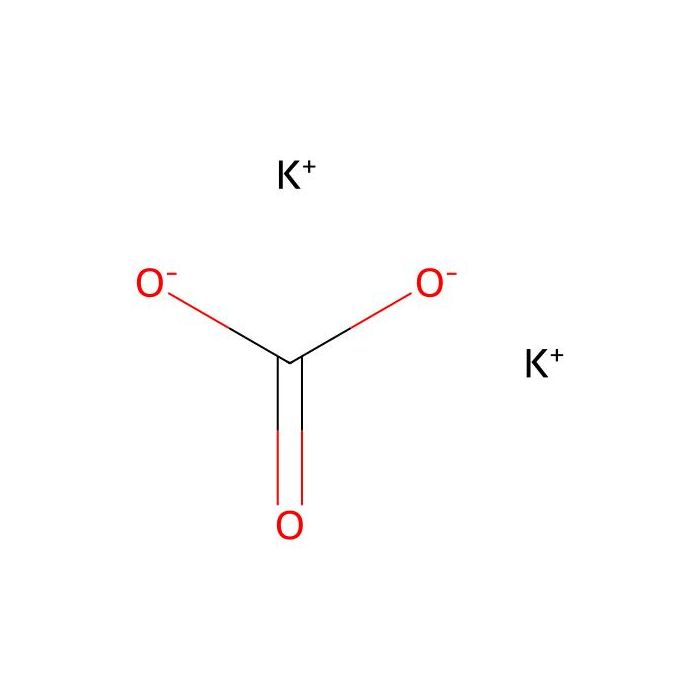
碳酸钾

CAS: 584-08-7 货号: P755525 分子式: K2CO3 分子量: 138.21 Beilstein号: 4267587 EC号: 209-529-3
有货
级别和纯度: USP ? 美国药典级(USP)—— 符合 USP 专论规格,供药用。适用于药品生产、质控及需符合美国药典的应用。
储存条件
室温
运输条件
常规运输
★
规格
库存
价格
数量
500g
P755525-500g
期货 Stock Image
¥565.90
请输入您要添加的产品数量
🧪
为什么选择此级别

USP 级 ,适用于对基线干扰要求严格的色谱和分析工作流程。

🌡

储存与运输

室温。常规运输 。请查阅批次 COA 获取详细规格。

📋

质量文档

SDS、COA、产品数据表及规格说明书均可下载。可通过批号查询获取批次 COA。

📚

文献证明

在色谱分析、有机合成和交叉偶联反应领域已被 1285 篇同行评审文献引用。

概述

Improved 2-pyridyl reductive homocoupling reaction using biorenewable solvent Cyrene™(dihydrolevoglucosenone).: This study highlights the use of potassium carbonate as a base in a green chemistry context, demonstrating improved reductive homocoupling reactions with the use of the biorenewable solvent Cyrene™. The findings suggest significant applications in sustainable chemical processes (Webb et al., 2023).Synthesis, Characterization and Biological Evaluation of Magnolol and Honokiol Derivatives with 1,3,5-Triazine of Metformin Cyclization.: This research discusses the synthesis and biological evaluation of novel derivatives using potassium carbonate, which plays a crucial role in the cyclization process. The study has implications for drug development and medicinal chemistry (Ren et al., 2020).Synthesis of (18)F-radiolabeled organophosphine fluorides for thiol-chemoselective peptide conjugation.: The use of potassium carbonate in the synthesis of radiolabeled compounds is detailed in this paper, highlighting its application in biochemistry and molecular biology for the development of novel imaging agents (Zhuang et al., 2020).Synthesis of well-defined phosphate-methylated DNA fragments: the application of potassium carbonate in methanol as deprotecting reagent.: This study focuses on the critical role of potassium carbonate in the deprotection step during the synthesis of methylated DNA fragments, with implications for genetic research and biotechnology (Kuijpers et al., 1990).应用:

碳酸钾(K2CO3)又称钾肥或草木灰,是一种白色钾盐。它可溶于水,形成强碱性溶液。

Potassium carbonate(K2CO3), also known as potash or pearl ash, is a white potassium salt. It is soluble in water to form a strong alkaline solution.
Application:

  • Improved 2-pyridyl reductive homocoupling reaction using biorenewable solvent Cyrene(dihydrolevoglucosenone).: This study highlights the use of potassium carbonate as a base in a green chemistry context, demonstrating improved reductive homocoupling reactions with the use of the biorenewable solvent Cyrene. The findings suggest significant applications in sustainable chemical processes (Webb et al., 2023).

  • Synthesis, Characterization and Biological Evaluation of Magnolol and Honokiol Derivatives with 1,3,5-Triazine of Metformin Cyclization.: This research discusses the synthesis and biological evaluation of novel derivatives using potassium carbonate, which plays a crucial role in the cyclization process. The study has implications for drug development and medicinal chemistry (Ren et al., 2020).

  • Synthesis of (18)F-radiolabeled organophosphine fluorides for thiol-chemoselective peptide conjugation.: The use of potassium carbonate in the synthesis of radiolabeled compounds is detailed in this paper, highlighting its application in biochemistry and molecular biology for the development of novel imaging agents (Zhuang et al., 2020).

  • Synthesis of well-defined phosphate-methylated DNA fragments: the application of potassium carbonate in methanol as deprotecting reagent.: This study focuses on the critical role of potassium carbonate in the deprotection step during the synthesis of methylated DNA fragments, with implications for genetic research and biotechnology (Kuijpers et al., 1990).

规格

规格或纯度
USP
英文名称
Potassium carbonate
生化机理
碳酸钾(K2CO3)用作酮、醇、胺和非酸性化合物蒸馏前的干燥剂。在葡萄酒和蜂蜜酒生产工艺中,它可用作缓冲剂,控制 pH 值。碳酸钾还用于从青蒿植物提取物中提取有效的抗疟药物成分——青蒿素。
储存条件
室温
运输条件
常规运输
名称和识别符
EC号
209-529-3
分子类型
小分子
IUPAC Name
dipotassium;carbonate
INCHI
1S/CH2O3.2K/c2-1(3)4;;/h(H2,2,3,4);;/q;2*+1/p-2
InChi Key
BWHMMNNQKKPAPP-UHFFFAOYSA-L
Smiles
C(=O)([O-])[O-].[K+].[K+]
Isomeric SMILES
C(=O)([O-])[O-].[K+].[K+]
分子量
138.21
Beilstein号
4267587
Reaxy-Rn
4267587
Reaxys-RN link address
https://www.reaxys.com/reaxys/secured/hopinto.do?context=S&query=IDE.XRN=4267587&ln=

技术文档

📋 安全数据表 (SDS)

全面的危险、操作、储存及法规合规文件。

下载 SDS →

✅ 分析证书 (COA)

批次质量数据。输入批号以获取对应 COA。

查询 COA →

📊 产品数据表

产品规格和应用的快速参考摘要。

查看数据表 →

🔬 规格说明书

该级别的完整质量属性和验收标准。

查看规格说明 →

高级数据

系统学分类

分类树(Taxonomy Tree)

界(kingdom) 有机化合物
超类(Superclass) 有机酸及其衍生物
类(Class) 有机碳酸及其衍生物
亚类(Subclass) 有机碳酸
中间层级节点(Intermediate Tree Nodes) 暂无
直接上位类(Direct Parent) 有机碳酸
其他上位类(Alternative Parents) 碳酸盐  有机钾盐  有机氧化物  碳氢化合物衍生物  羰基化合物  
分子骨架(Molecular Framework) 脂肪族无环化合物
取代基(Substituents) 脂肪族非环化合物 - 碳酸酯 - 碳酸 - 羰基 - 烃衍生物 - 有机碱金属盐 - 有机氧化物 - 有机氧化合物 - 有机钾盐 - 有机盐 - 有机氧化合物
描述(Description) 该化合物属于有机碳酸类有机化合物。这类化合物具有碳酸官能团。
外部描述符(External Descriptors) 暂无
三维结构
交互式化学结构模型


化学和物理性质
溶解性
soluble 138 g/L at 20 °C (completely)
熔点
891°C
分子量
138.205 g/mol
XLogP3
氢键供体数Hydrogen Bond Donor Count
0
氢键受体数Hydrogen Bond Acceptor Count
3
可旋转键计数Rotatable Bond Count
0
精确质量Exact Mass
137.912 Da
单同位素质量Monoisotopic Mass
137.912 Da
拓扑极表面积Topological Polar Surface Area
63.200 Ų
重原子数Heavy Atom Count
6
形式电荷Formal Charge
0
复杂度Complexity
18.800
同位素原子数Isotope Atom Count
0
定义的原子立体中心计数Defined Atom Stereocenter Count
0
未定义的原子立体中心计数Undefined Atom Stereocenter Count
0
定义的键立体中心计数Defined Bond Stereocenter Count
0
未定义的键立体中心计数Undefined Bond Stereocenter Count
0
所有立体化学键的总数The total count of all stereochemical bonds
0
共价键合单元计数Covalently-Bonded Unit Count
3
安全和危险性(GHS)
象形图
信号词
警告
危险声明

H302: 吞食有害

H315: 引起皮肤刺激

H319: 引起严重眼睛刺激

H335: 可能引起呼吸道刺激

预防措施声明

P261: 避免吸入灰尘/烟雾/气体/雾/蒸汽/喷雾

P264: 处理后要彻底洗手。

P270: 使用本产品时,请勿进食、饮水或吸烟。

P271: 仅在室外或通风良好的地方使用。

P280: 戴防护手套/穿防护服/戴防护眼罩/戴防护面具。

P321: 特殊处理(请参阅此标签上的...)。

P330: 漱口

P302+P352: 如皮肤沾染:用水充分清洗。

P304+P340: 如误吸入:将人转移到空气新鲜处,保持呼吸舒适体位。

P305+P351+P338: 如进入眼睛:用水小心冲洗几分钟。如戴隐形眼镜并可方便地取出,取出隐形眼镜。继续冲洗。

P362+P364: 脱掉沾污的衣服,清洗后方可重新使用。

P405: 密闭存放

P403+P233: 存放在通风良好的地方。保持容器密闭。

P501: 将内容物/容器处理到。。。

P264+P265: 处理后彻底洗手[和…]。不要触摸眼睛。

P301+P317: 如果被吞咽:请寻求医疗帮助。

P337+P317: 如果眼睛刺激持续:寻求医疗帮助。

P332+P317: 如果出现皮肤刺激:请寻求医疗帮助。

P319: 如果你感到不适,请寻求医疗帮助。

WGK Germany
1
RTECS
TS7750000
个人防护装备
dust mask type N95 (US),Eyeshields,Gloves
质检证书(CoA,COO,BSE/TSE 和分析图谱)
C of A & Other Certificates(BSE/TSE, COO):
输入批号以搜索分析图谱:
技术文档和文章
从规格到实验台:理解与使用 USP 级试剂
From Spec to Bench: Understanding and Using USP Grade Reagents
钯催化反应一站式手册:催化循环、失活排查、配体/预催化剂选型与阿拉丁清单
One-Stop Handbook for Palladium-Catalyzed Reactions: Catalytic Cycles, Deactivation Troubleshooting, Ligand/Precatalyst Selection, and an Aladdin Reference List
TEMPO 催化氧化速查(醇氧化主线):三条再生路线(NaOCl / Cu–O₂ / PIDA)与选型排故
TEMPO-Catalyzed Oxidation Quick Reference (Alcohol Oxidation Focus): Three Regeneration Routes (NaOCl / Cu–O₂ / PIDA) + Selection & Troubleshooting
不对称催化合成手性 1,2-双硼酸酯的策略与进展:路线类型、选择性挑战与序列化位点利用(含产品选型导航与表1–4)
Strategies and Progress in the Asymmetric Catalytic Synthesis of Chiral 1,2-Bis(boronic) Esters: Route Types, Selectivity Challenges, and Sequential Site Utilization (with Product Selection Navigator and Tables 1–4)
后期氟化工具箱:给候选分子做“微创升级”:四类“氟旋钮”→ 亲电/亲核两大路线 → ¹⁸F-PET 示踪分线 → 选型导航与代表产品清单
Late-Stage Fluorination Toolbox: “Minimally Invasive Upgrades” for Lead Candidates: Four “Fluorine Knobs” → Two major routes (electrophilic vs nucleophilic) → An ¹⁸F-PET tracer branch → Selection navigation & representative product list
OSF/ASF 双通道工具箱:四元小环磺酰氟的分流反应、条件旋钮与选型导航
OSF/ASF Dual-Channel Toolbox: Divergent Reactions of Four-Membered Ring Sulfonyl Fluorides, Condition “Knobs,” and Selection Navigation
从哌啶到吡啶:2013–2023 FDA 小分子新药里“最常见含氮杂环”更替与选型导航(表1–4)
From Piperidine to Pyridine: The “Most Common N-Heterocycle” Shift in FDA Small-Molecule New Drugs (2013–2023) and a Selection Guide (Tables 1–4)
发光聚合物(LEPs)实用全景:PL/EL 核心机制框架、材料家族地图与结构旋钮(含产品表1–4及选型导航)
Light-Emitting Polymers (LEPs): A Practical Panorama - A Core PL/EL Mechanistic Framework, Material Family Map, and Structural “Design Knobs” (including Product Tables 1–4 and a selection guide)
甲氧基(–OCH₃)在已上市小分子药物中的结构功能解析:作用机制、证据链与产品选型导航(附相关产品表)
Structural–Functional Analysis of the Methoxy Group (–OCH₃) in Approved Small-Molecule Drugs: Mechanisms, Evidence Chains, and Product-Selection Navigation (with Related Product Tables)
科研常用盐类选型:碱金属盐 & 碱土金属盐的任务地图(含产品表1–表6)
Selection of Common Research Salts: A Task Map for Alkali Metal Salts & Alkaline Earth Metal Salts (with Product Tables 1–6)
金鸡纳生物碱手性工具箱:从伪对映体切换到 PTC/Sharpless AD/手性分离的选型与排错(含产品表A–D)
Cinchona Alkaloid Chiral Toolbox: Selection & Troubleshooting from Pseudoenantiomer Switching to PTC/Sharpless AD/Chiral Resolution (including Product Tables A–D)
把“芳基氯 + 低Pd + 放大复现”做稳:Pd–NHC(钯-N-杂环卡宾)交叉偶联的启动与耐久逻辑(含选型导航与产品表)
Make “Aryl Chlorides + Low Pd Loading + Scale-Up Reproducibility” Reliable: The Initiation and Durability Logic of Pd–NHC (Palladium–N-Heterocyclic Carbene) Cross-Coupling (with Selection Navigation and Product Tables)
把反应做稳的硼源选择:硼酸、硼酸酯、BF₃K 与 MIDA 如何提升 Suzuki–Miyaura 的起速与放大复现 (含产品表1–5)
Choosing Boron Sources to Make Reactions Robust: How Boronic Acids, Boronate Esters, BF₃K Salts, and MIDA Improve Suzuki–Miyaura Start-Up and Scale-Up Reproducibility (with Product Tables 1–5)
Suzuki–Miyaura 反应怎么做稳:定位瓶颈,锁定可复现窗口(含选型导航及产品表1–表5)
How to Make the Suzuki–Miyaura Reaction Robust: Pinpoint the Bottleneck and Lock in a Reproducible Operating Window (with Selection Navigation and Product Tables 1–5)
卤代杂环与交叉偶联:从底物识别到成键路线的科研选型框架(含产品导航及表1–表5)
Haloheterocycles and Cross-Coupling: A Research-Oriented Selection Framework from Substrate Identification to Bond-Forming Routes (Including Product Navigation and Tables 1–5)
从“先还原再酰化”到“直接成酰胺”:硝基及亚硝基底物与 α-酮羧酸的非常规酰胺键构建路线
From “Reduction First, Then Acylation” to “Direct Amidation”: An Unconventional Route to Amide Bond Formation from Nitro and Nitroso Substrates with α-Keto Carboxylic Acids
重新认识 N-酰基型氨基保护基:Ac、Bz 与 Tfa 的脱保护差异、路线分工与实验选用思路
Reconsidering N-Acyl Amino Protecting Groups: Deprotection Differences, Strategic Roles, and Experimental Selection of Ac, Bz, and Tfa
TfOH(三氟甲磺酸)介导 N-芳基磺酰胺的选择性脱保护与磺酰基迁移:反应规律及合成启发
Selective Deprotection and Sulfonyl Group Migration of N-Aryl Sulfonamides Mediated by TfOH (Trifluoromethanesulfonic Acid): Reaction Patterns and Synthetic Implications
Boc₂O 的选用不能只看保护引入:从底物亲核性、介质效应到脱保护路径的实验判断
Boc₂O Selection Cannot Be Judged by Protection Installation Alone: Experimental Decision-Making from Substrate Nucleophilicity and Medium Effects to Deprotection Pathways
Fmoc 引入路线的实验判断:杂质谱差异、原料带入与质量控制
Experimental Assessment of Fmoc Introduction Routes: Impurity Profile Differences, Raw Material Carryover, and Quality Control
TFPN 在羧酸活化中的实验判断:适用情形、中间体分布与亲核体适配
Experimental Judgment for TFPN in Carboxylic Acid Activation: Suitable Scenarios, Intermediate Distribution, and Nucleophile Compatibility
相转移催化剂的实验选型逻辑:按相态体系、阴离子物种来源与反应任务选催化剂
Experimental Selection Logic for Phase-Transfer Catalysts: Choosing Catalysts by Phase-State System, Source of Anionic Species, and Reaction Task
交叉偶联反应的实验判断方法:目标键型、底物组合与催化体系选择
Experimental Decision-Making for Cross-Coupling Reactions: Target Bond Type, Substrate Combination, and Catalytic System Selection
脂肪酸钾皂的结构与配方应用:生产工艺、偏碱性、泡沫调控及低泡清洗解析
Potassium Fatty Acid Soaps: Structure and Formulation Applications—Production Processes, Alkalinity, Foam Control, and Low-Foam Cleaning
日化生产中片碱、粒碱、液碱与火碱的区别及选用要点:氢氧化钠的作用与应用逻辑
Differences, Functions, and Selection Guidelines for Sodium Hydroxide Flakes, Granules, Liquid Caustic Soda, and Caustic Soda in Household and Personal Care Product Manufacturing: The Functional and Application Logic of Sodium Hydroxide
日化配方为什么需要碱性成分:从 pH 调节、皂化反应到助洗去污与选型逻辑
Why Daily Chemical Formulations Need Alkaline Ingredients: From pH Adjustment and Saponification to Detergency Boosting and Selection Logic
羟烷基取代芳基/烯基硼酸酯脱氧氟化:经 BF3K 中间体实现 C–F 键构建与 C–B 键保留
Deoxyfluorination of Hydroxyalkyl-Substituted Aryl/Alkenyl Boronates: C–F Bond Construction and C–B Bond Retention via a BF3K Intermediate
CTSOBt 苯并三氮唑-磺酸酯缩合试剂:羧酸活化与合成应用价值
CTSOBt Benzotriazole–Sulfonate Coupling Reagent: Carboxylic Acid Activation and Synthetic Application Value
吲唑骨架的药物化学设计:互变异构、分子识别、取代位点设计与合成策略
Medicinal Chemistry Design of the Indazole Scaffold: Tautomerism, Molecular Recognition, Substitution-Site Design, and Synthetic Strategies
非共价3CL蛋白酶抑制剂S-217622的发现与结构优化
Discovery and Structural Optimization of the Noncovalent 3CL Protease Inhibitor S-217622
突破氟芳烃亲核芳香取代的电子效应限制:t-Bu-P4的阴离子活化、协同取代与HF捕获
Overcoming the Electronic-Effect Limitations of Nucleophilic Aromatic Substitution in Fluoroarenes: Anion Activation, Concerted Substitution, and HF Capture by t-Bu-P4
先构建三元环,还是先形成碳—氮键?——环丙胺合成的逆合成策略、路线选择与立体控制
Build the Three-Membered Ring First, or Form the Carbon–Nitrogen Bond First?—Retrosynthetic Strategies, Route Selection, and Stereochemical Control in Cyclopropylamine Synthesis
硫醇合成的路线选择:C—S键构建、硫源形式与巯基释放
Route Selection for Thiol Synthesis: C–S Bond Construction, Sulfur Source Forms, and Thiol Release
3,3-螺环α-脯氨酸分子砌块:结构特征、互补合成路线与多克级制备
3,3-Spiro-α-Proline Building Blocks: Structural Features, Complementary Synthetic Routes, and Multigram-Scale Preparation
含甲基磺酰基杂环的直接构建:预功能化三碳脒鎓盐的合成与应用
Direct Construction of Methylsulfonyl-Containing Heterocycles: Synthesis and Applications of Prefunctionalized Three-Carbon Vinamidinium Salts
氮杂环膦酸酯的合成路线设计:C–P键形成时机与三类路线策略
Synthetic Route Design for Azaheterocyclic Phosphonates: Timing of C–P Bond Formation and Three Route Strategies
光/镍 C(sp²)–C(sp³) 偶联的动力学匹配:自由基生成、镍物种稳定性与光子通量
Kinetic Matching in Photoredox/Nickel C(sp²)–C(sp³) Coupling: Radical Generation, Nickel-Species Stability, and Photon Flux
分子内 [2+2] 光环加成的连接链效应:直向型与交叉型区域选择性及逐步 C–C 成键
Tether Effects in Intramolecular [2+2] Photocycloadditions: Straight and Crossed Regioselectivity and Stepwise C–C Bond Formation
此产品的引用文献
溶液计算器
