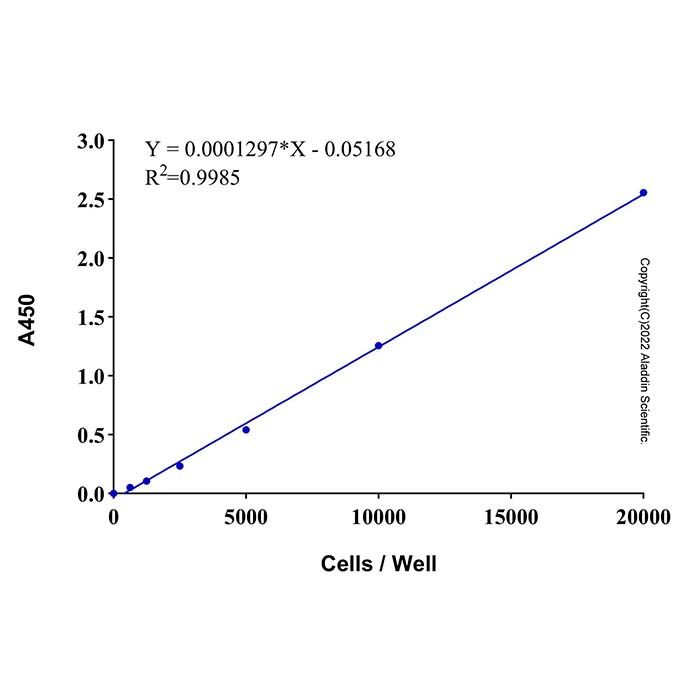
水溶性四唑(2-(2-甲氧基-4硝基苯)-3-(4-硝基苯)-5-(2,4-二磺基苯)-2H-四唑单钠盐),是一种类似于MTT的化合物,在电子耦合试剂存在的情况下,被线粒体内的脱氢酶还原成橙黄色的水溶性的甲臜染料(formazan,下图), 这种甲臜染料直接溶解在培养基中。水溶性四唑被细胞内脱氢酶生物还原后生成的甲臜能够。细胞增殖越多越快,则培养基的颜色越深;细胞毒性越大,则颜色越浅。对于同样的细胞,生成的甲臜物的数量与活细胞的数量成正比,颜色的深浅和细胞数目呈线性关系。正是利用这一特性开发的CCK-8试剂盒直接进行细胞增殖和毒性分析。CCK-8法应用非常广泛,可以用于生物活性因子的活性检测,抗肿瘤药物的筛选,细胞增值的测定,细胞毒性检测以及药敏等与细胞活性和增殖相关的实验。本试剂盒使用方便,试剂盒包含一管已经配制好的含有水溶性四唑的CCK-8溶液,即开即用,无需其他准备步骤。检测过程也无需采用额外的步骤去溶解甲臜,可直接使用96孔板或者384孔板在酶标仪上检测,适合大规模高通量的样品检测。

CCK-8法与MTT比较:
CCK8试剂盒提供了一种灵敏度高,操作简便,使用安全,重现性好的细胞增殖与活性检测方法。与传统的MTT相比无需有机溶剂和放射性同位素,步骤少,无损失,结果准确!本试剂盒检测非常便捷。试剂盒仅一管已经配制好的含有WST-8的CCK-8溶液,无须再进行任何配制等操作 。无须使用同位素,所有的检测步骤仅在同一块96孔板内完成。不必洗涤细胞,不必收集细胞,也不必采用额外的步骤去溶解formazan。可以用于大批量样品的检测。
1.MTT实验生成的甲臜不是水溶性的,需要使用DMSO等有机溶剂溶解;而本方法产生的甲臜是水溶性的,不仅省去了溶解的步骤,更因此而减少了该操作步骤带来的误差。
2.与MTT方法相比,本方法线性范围更宽,灵敏度更高。本方法对细胞无毒性,因此加入WST-8显色后,可以在不同时间反复用酶标仪读数多次测定从而找到最佳测定时间。
3.本方法所用试剂在培养基中比MTT更加稳定,实验效果重复性好。
4.MTT具有毒性,同时其生成的甲臜需要有机溶剂溶解,会对操作人员身体造成危害。本试剂无毒,使用中无需有机溶剂,操作更加安全。
5.本试剂盒在4℃避光可长期保存,使用无需配制,即开即用。
6.酚红和血清对CCK法的检测不会造成干扰(扣除空白孔即可)。
CCK-8法与其他细胞增殖/毒性检测方法的优势比较

使用方法
1. 通常细胞增殖实验每孔加入100 μL 2000个细胞,细胞毒性实验每孔加入100 μL 5000个细胞(具体每孔所用的细胞的数目,需根据细胞的大小、细胞增殖速度的快慢等因素决定)。按照实验需要,进行培养并给予0-10 μL 特定的药物刺激。
2. 每孔加入10 μL CCK-8溶液。如果起始的培养体积为200微升,则需加入20 μL CCK-8溶液,其它情况以此类推。可以用加了相应量细胞培养液和CCK-8溶液但没有加入细胞的孔作为空白对照。如果担心所使用的药物会干扰检测,需设置加了相应量细胞培养液、药物和CCK-8溶液但没有加入细胞的孔作为空白对照。
3. 在细胞培养箱内继续孵育0.5 - 4小时,对于大多数情况孵育1小时就可以了。时间的长短根据细胞的类型和细胞的密度等实验情况而定,初次实验时可以在0.5、1、2和4小时后分别用酶标仪检测,然后选取吸光度范围比较适宜的一个时间点用于后续实验。
4. 在450nm测定吸光度。如无450nm滤光片,可以使用420-480nm的滤光片。可以使用大于600nm的波长,例如650nm,作为参考波长进行双波长测定。
注意事项
1. 如果已开封,经常使用请将试剂存放在4ºC,并尽快用完。反复冻融会增加背景值,干扰实验测定。
2. 由于使用96孔板进行检测,如果细胞培养时间较长,一定要注意蒸发问题。一方面,由于96孔板周围一圈最容易蒸发,可以采取弃用周围一圈的办法,改加相同量的PBS、水或培养液;另一方面,可以把96孔板置于靠近培养箱内水源的地方,以缓解蒸发。
3. 本试剂盒的检测依赖于脱氢酶催化的反应,所以还原剂(例如一些抗氧化剂)会干扰检测,如果待检测体系中存在较多的还原剂,需设法去除。
4. 用酶标仪检测前需确保每个孔内没有气泡,否则会干扰测定。
5. 本产品仅限于专业人员的科学研究用,不得用于临床诊断或治疗,不得用于食品或药品,不得存放于普通住宅内。
6. 为了您的安全和健康,请穿实验服并戴一次性手套操作。
Water-soluble tetrazole (2-(2-methoxy-4nitrobenzene)-3-(4-nitrobenzene)-5-(2,4-disulfobenzene)-2H-tetrazole monosodium salt ), is a compound similar to MTT. In the presence of an electron coupling reagent, it is reduced by dehydrogenase in the mitochondria to an orange-yellow water-soluble formazan dye (formazan, below). This formazan dye Dissolve directly in the medium. The water-soluble tetrazole is bioreduced by intracellular dehydrogenase to produce formazan. The more cells proliferate, the darker the color of the medium; the more cytotoxic, the lighter the color. For the same cell, the number of formazan compounds produced is proportional to the number of living cells, and the color intensity is linearly related to the number of cells. It is the CCK-8 kit developed using this feature to directly analyze cell proliferation and toxicity. The CCK-8 method is widely used and can be used for the activity detection of biologically active factors, the screening of anti-tumor drugs, the determination of cell proliferation, the detection of cytotoxicity, and drug sensitivity and other experiments related to cell viability and proliferation. This kit is easy to use. The kit contains a prepared tube of CCK-8 solution containing water-soluble tetrazole, ready to use, no other preparation steps are required. The detection process does not require additional steps to dissolve formazan. It can be directly detected on a microplate reader using a 96-well plate or a 384-well plate, which is suitable for large-scale high-throughput sample detection.
Comparison of CCK-8 method and MTT
The CCK-8 Kit provides a highly sensitive, easy-to-operate, safe, and reproducible method for the detection of cell proliferation and viability.Compared with the traditional MTT assay, it does not require organic solvents or radioactive isotopes, featuring fewer steps, no sample loss, and accurate results.This kit is extremely convenient to use.It contains only one pre-prepared CCK-8 solution containing WST-8, and no further preparation is needed.No radioisotopes are required, and all detection steps can be performed in a single 96-well plate.There is no need to wash cells, collect cells, or perform additional steps to dissolve formazan.The kit is suitable for the detection of large batches of samples.
1. The formazan produced by the MTT experiment is not water-soluble and needs to be dissolved in organic solvents such as DMSO; while the formazan produced by this method is water-soluble, which not only eliminates the dissolution step, but also reduces the operating steps. Error.
2. Compared with the MTT method, this method has a wider linear range and higher sensitivity. This method is non-toxic to cells, so after adding WST-8 for color development, it can be repeatedly measured with a microplate reader at different times to find the best measurement time.
3. The reagent used in this method is more stable than MTT in the culture medium, and the experimental effect is reproducible.
4. MTT is toxic, and the formazan produced by it needs to be dissolved by organic solvents, which will cause harm to the operators. This reagent is non-toxic, no organic solvent is needed in use, and the operation is safer.
5.This kit can be stored for a long time at 4℃ and protected from light. It does not need to be prepared for use, and it is ready to use.
6. Phenol red and serum will not interfere with CCK detection (just deduct blank holes)
Comparison of the advantages of CCK-8 method and other cell proliferation/toxicity detection methods

Instructions
1. For cell proliferation assays, seed 2000 cells in 100 μL per well.For cytotoxicity assays, seed 5000 cells in 100 μL per well.The exact cell number per well should be determined according to factors such as cell size and proliferation rate.Culture the cells and treat with 0–10 μL of the specified drug as required.
2. Add 10 μL of CCK-8 solution to each well.If the initial culture volume is 200 μL, add 20 μL of CCK-8 solution, and scale proportionally for other volumes.Wells containing the corresponding volume of cell culture medium and CCK-8 solution but no cells can be used as blank controls.If the drug may interfere with the assay, set blank control wells containing medium, drug, and CCK-8 solution but no cells.
3. Incubate for 0.5–4 hours in a cell culture incubator;1 hour is sufficient for most cell types.
The incubation time depends on cell type and density.For the first use, measure absorbance at 0.5, 1, 2, and 4 hours using a microplate reader,then select the time point with an appropriate absorbance range for subsequent experiments.Measure absorbance at 450 nm.
4. If a 450 nm filter is unavailable, a filter within 420–480 nm can be used.A wavelength above 600 nm (650 nm) can be used as the reference wavelength for dual-wavelength measurement.
Precautions
1. If opened, store the reagent at 4°C and use up as soon as possible with frequent use.Repeated freezing and thawing will increase background values and interfere with experimental determination.
2. As the assay is performed using a 96‑well plate, evaporation must be considered during long‑term cell culture.On one hand, the outer wells of the plate are most prone to evaporation; these can be left unused and filled with an equal volume of PBS, water, or medium.On the other hand, placing the plate near the water source inside the incubator can help reduce evaporation.
3. The detection in this kit relies on dehydrogenase‑catalyzed reactions.Therefore, reducing agents (such as certain antioxidants) may interfere with the assay.If a high level of reducing agents is present in the test system, they should be removed beforehand.
4. Ensure there are no air bubbles in any well before measurement with a microplate reader, as bubbles will interfere with the absorbance reading.
5. This product is for research use only by qualified personnel.It is not intended for clinical diagnosis or treatment, or for use in food or drug products.Do not store in ordinary residential premises.
6. For your safety and health, please wear a lab coat and disposable gloves during operation.

 F2308948

 危险品化学品经营许可证(带存储)