
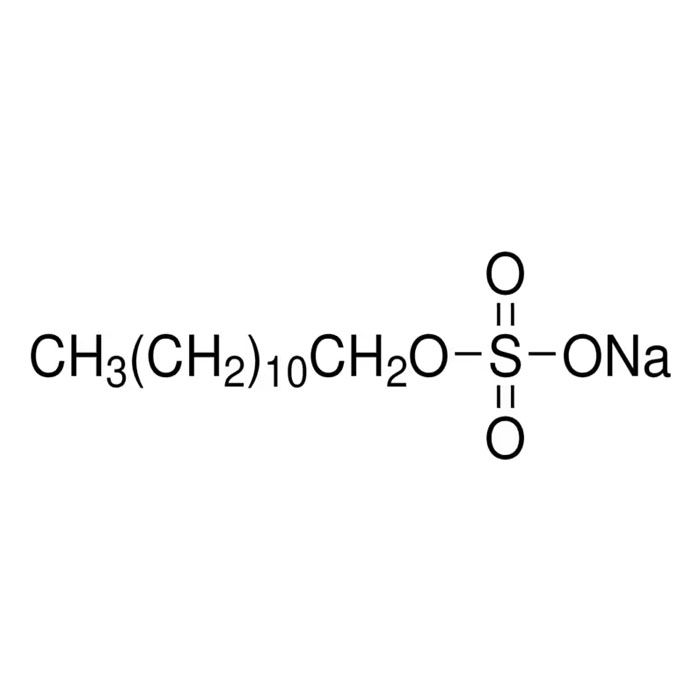
10% SDS

CAS: 151-21-3 货号: S743045 分子式: CH3(CH2)11OSO3Na 分子量: 288.38 EC号: 205-788-1
有货
级别和纯度: DNase, RNase & Protease free, Sterile
别名
10% 十二烷基硫酸钠 | 月桂基硫酸盐 钠盐 | 月桂基硫酸钠 溶液
储存条件
室温,干燥
运输条件
常规运输
★
规格
库存
价格
数量
100ml
S743045-100ml
现货 Stock Image
¥119.90
请输入您要添加的产品数量
🧪
为什么选择此级别

,适用于对基线干扰要求严格的色谱和分析工作流程。

🌡

储存与运输

室温,干燥。常规运输 。请查阅批次 COA 获取详细规格。

📋

质量文档

SDS、COA、产品数据表及规格说明书均可下载。可通过批号查询获取批次 COA。

📚

文献证明

在色谱分析、有机合成和交叉偶联反应领域已被 1832 篇同行评审文献引用。

概述

应用:
十二烷基硫酸钠溶液已用于:
制备2x提取缓冲液
作为用于免疫沉淀的洗脱缓冲液中的组分
SDS-聚丙烯酰胺凝胶电泳(PAGE)分析

生化/生理作用:
十二烷基硫酸钠(SDS)/十二烷基硫酸钠是一种离子去污剂,具有破坏生物膜的能力。它可以阻断核糖核酸酶(RNase)和脱氧核糖核酸酶(DNase)活性。SDS是几种试剂的主要成分之一,可用于核酸纯化。它也被认为是口服制剂中的渗透性增强剂。

产品介绍:

阿拉丁生产的10% SDS (DNase, RNase & Protease free, Sterile)为常用生化试剂,用途广泛,由进口试剂配制,无菌、无DNA酶、无RNA酶以及无蛋白酶污染,可以用于SDS-PAGE、细菌碱裂解等。SDS即Sodium dodecyl sulfate,中文名为十二烷基磺酸钠,也称十二烷基硫酸钠,CAS为151-21-3,分子量为288.38。10% SDS为100毫升溶液中含有10克SDS,本试剂用水配制。室温保存。本产品对人体有害,操作时请小心,并注意有效防护以避免直接接触人体或吸入体内。本产品仅限于专业人员的科学研究用,不得用于临床诊断或治疗,不得用于食品或药品,不得存放于普通住宅内。为了您的安全和健康,请穿实验服并戴一次性手套操作。

Application:

Sodium dodecyl sulfate solution has been used:
in the preparation of 2x extraction buffer
as a component in elution buffer for immunoprecipitation
in SDS–polyacrylamide gel electrophoresis (PAGE) analysis

Biochem/physiol Actions:

Sodium dodecyl sulfate (SDS)/lauryl sulfate, is an ionic detergent has the ability to disrupt biological membranes. It can block ribonuclease (RNase) and deoxyribonuclease (DNase) activity. SDS is one of the main constituents of several reagents, that are used to purify nucleic acids. It is also considered as a permeability enhancer in oral formulations.

Precautions:

This product is harmful to humans. Please take effective measures to avoid direct contact or inhalation.This product is for R&D only. Not for drug, household, or other uses.For your safety and health, please wear a lab coat and disposable gloves during the operation.

Instructions for Use:

none

规格

别名
10% 十二烷基硫酸钠 | 月桂基硫酸盐 钠盐 | 月桂基硫酸钠 溶液
英文别名
Lauryl sulfate sodium salt | Sodium lauryl sulfate solution
规格或纯度
DNase, RNase & Protease free, Sterile
稳定性与储存
室温保存。
英文名称
10% SDS
储存条件
室温,干燥
运输条件
常规运输
名称和识别符
EC号
205-788-1
分子类型
小分子
IUPAC Name
sodium;dodecyl sulfate
INCHI
1S/C12H26O4S.Na/c1-2-3-4-5-6-7-8-9-10-11-12-16-17(13,14)15;/h2-12H2,1H3,(H,13,14,15);/q;+1/p-1
InChi Key
DBMJMQXJHONAFJ-UHFFFAOYSA-M
Smiles
[Na+].CCCCCCCCCCCCOS([O-])(=O)=O
Isomeric SMILES
CCCCCCCCCCCCOS(=O)(=O)[O-].[Na+]
UN Number
Packing Group
III
分子量
288.38

技术文档

📋 安全数据表 (SDS)

全面的危险、操作、储存及法规合规文件。

下载 SDS →

✅ 分析证书 (COA)

批次质量数据。输入批号以获取对应 COA。

查询 COA →

📊 产品数据表

产品规格和应用的快速参考摘要。

查看数据表 →

🔬 规格说明书

该级别的完整质量属性和验收标准。

查看规格说明 →

高级数据

系统学分类

分类树(Taxonomy Tree)

界(kingdom) 有机化合物
超类(Superclass) 有机酸及其衍生物
类(Class) 有机硫酸及其衍生物
亚类(Subclass) 硫酸酯
中间层级节点(Intermediate Tree Nodes) 暂无
直接上位类(Direct Parent) 硫酸单酯
其他上位类(Alternative Parents) 烷基硫酸盐  有机氧化合物  有机钠盐  有机氧化物  碳氢化合物衍生物  
分子骨架(Molecular Framework) 脂肪族无环化合物
取代基(Substituents) 脂肪族非环化合物 - 烷基硝酸酯 - 烃衍生物 - 有机碱金属盐 - 有机氧化物 - 有机氧化合物 - 有机盐 - 有机钠盐 - 有机氧化合物 - 磺酸酯 - 硫酸单酯
描述(Description) 该化合物属于有机化合物中的硫酸单酯类。这类有机化合物含有硫酸单酯官能团,通用结构为ROS(O)(=O)=O(R=有机酰基)。
外部描述符(External Descriptors) alkyl sulfate
三维结构
交互式化学结构模型


化学和物理性质
密度
1.0
熔点
204-207°C
安全和危险性(GHS)
象形图
信号词
危险
危险声明

H303: 要是吞了可能有害

H315: 引起皮肤刺激

H318: 造成严重的眼睛损伤

预防措施声明

P264: 处理后要彻底洗手。

P280: 戴防护手套/穿防护服/戴防护眼罩/戴防护面具。

P302+P352: 如皮肤沾染:用水充分清洗。

P305+P351+P338: 如进入眼睛:用水小心冲洗几分钟。如戴隐形眼镜并可方便地取出,取出隐形眼镜。继续冲洗。

P332+P313: 如发生皮肤刺激:求医/就诊。

P337+P313: 如仍觉眼刺激:求医/就诊。

P362+P364: 脱掉沾污的衣服,清洗后方可重新使用。

P405: 密闭存放

P501: 将内容物/容器处理到。。。

Class
4.1
Merck Index
8636
质检证书(CoA,COO,BSE/TSE 和分析图谱)
C of A & Other Certificates(BSE/TSE, COO):
输入批号以搜索分析图谱:

通过匹配包装上的批号来查找并下载产品的 COA,每批产品都进行了严格的验证,您可放心使用!

找到9个结果

批号(Lot Number) 证书类型 货号
H2621336 分析证书 S743045
D2630445 分析证书 S743045
B2605242 分析证书 S743045
I2529417 分析证书 S743045
I2515766 分析证书 S743045
G2508569 分析证书 S743045
B2507335 分析证书 S743045
B2507336 分析证书 S743045
A2522298 分析证书 S743045
技术文档和文章
双交联ChIP方案
Dual Cross-linking ChIP Protocol
如何使用透析袋对样品进行缓冲液置换
Buffer exchange of a sample using a dialysis bag
SDS-PAGE实验常见问题及回答
Common Questions and Answers for SDS-PAGE Experiments
蛋白Marker产品常见问题及回答之转膜
Common Questions and Answers for Protein Marker Products — Membrane Transfer
蛋白质Bis-Tris聚丙烯酰胺凝胶电泳系统标准操作规程
Standard Operating Procedure (SOP) for Bis-Tris Polyacrylamide Gel Electrophoresis (SDS-PAGE)
蛋白质Tris-Acetate电泳系统标准操作规程
Protein Tris-Acetate Electrophoresis System Standard Operating Procedure
防止蛋白沉淀的缓冲液添加剂
Buffer Additives to Prevent Protein Precipitation
蛋白质Tris-Glycine电泳系统标准操作规程
Standard Operating Procedure (SOP) for the Protein Tris–Glycine Electrophoresis System
蛋白质Tris-Tricine电泳系统标准操作规程
Protein Tris-Tricine Electrophoresis System Standard Operating Procedure
常见的蛋白质凝胶染色方法
Common Protein Gel Staining Methods
常见八种裂解液
Eight Common Lysis Buffers
常见的11种蛋白质浓度测定方法
11 Common Methods for Protein Concentration Determination
WB/FC/IP/CHIP/IF/IHC的抗体有什么区别?
Differences Among Antibodies for WB/FC/IP/ChIP/IF/IHC
GST标签蛋白纯化
GST-Tagged Protein Purification
析氢催化剂怎么选:水电解的动力学门槛、AWE/PEM/AEM 路线与材料家族导航(含产品地图)
How to Choose a Hydrogen Evolution (HER) Catalyst: Kinetic Barriers in Water Electrolysis, AWE/PEM/AEM Pathways, and a Materials-Family Roadmap (with a Product Map)
RNA Pull-Down实验操作规程
RNA Pull-Down Standard Operating Procedure (SOP)
DNA Pull-Down实验操作规程
DNA Pull-Down Standard Operating Procedure (SOP)
离子对反相色谱(IPC / IP-RP)全指南:机理、四旋钮调参、排故与试剂分类表(表1–表4)
A Complete Guide to Ion-Pair Reversed-Phase Chromatography (IPC / IP-RP): Mechanisms, Four Tuning Knobs, Troubleshooting, and Ion-Pair Reagent Families (Tables 1–4)
凝胶迁移实验(EMSA)操作规程
Electrophoretic Mobility Shift Assay (EMSA) Standard Operating Procedure (SOP)
表面活性剂全景指南:定义与机理、关键指标、应用场景与选型导航(表1–表3)
A Panoramic Guide to Surfactants: Definitions & Mechanisms, Key Metrics, Application Scenarios, and Selection Navigation (Tables 1–3)
小分子化学探针实用指南:概念纠偏、因果验证与实验选型(含产品导航与表A–D)
A Practical Guide to Small-Molecule Chemical Probes: Concept Clarification, Causal Validation, and Experimental Selection (with Product Navigation and Tables A–D)
碳纳米管(CNT)分散实用指南:三大旋钮、SOP及选型导航(表A–F)
Practical Guide to Carbon Nanotube (CNT) Dispersion: Three Key Knobs, SOP, and Selection Roadmap (Tables A–F)
核酸研究中检测定量与相互作用解析的十种常用技术综述
A Review of Ten Commonly Used Techniques for Detection, Quantification, and Interaction Analysis in Nucleic Acid Research
一文读懂蛋白标签:分类、特性及适用实验
Protein Tags Demystified: Classification, Properties, and Suitable Experimental Applications
Proteinase K常见问题
Proteinase K: Frequently Asked Questions
植物组学技术全景:基因组—转录组—蛋白质组—代谢组的流程框架与多组学整合应用
Plant Omics Panorama: Workflow Frameworks and Multi-Omics Integration from Genomics to Transcriptomics, Proteomics, and Metabolomics
脱氧核糖核酸酶(DNase):DNA水解切割特性、方法学价值与多场景应用
Deoxyribonuclease (DNase): DNA Hydrolytic Cleavage Properties, Methodological Value, and Multi-Context Applications
凝乳酶:分子特征、凝乳动力学与活力评价的研究综述
Chymosin: A Review of Molecular Features, Coagulation Kinetics, and Activity Evaluation
微球菌核酸酶(MNase):酶学特性、反应控制与科研及生物制造应用技术综述
Micrococcal Nuclease (MNase): A Technical Review of Enzymatic Properties, Reaction Control, and Research and Biomanufacturing Applications
白介素29(IL-29/IFN-λ1):分子特征、信号网络与科研应用体系
Interleukin-29 (IL-29/IFN-λ1): Molecular Features, Signaling Networks, and a Systematic Framework for Research Applications
乳清蛋白:组成谱、制备路径与产品类型要点
Whey Protein: Composition Profile, Manufacturing Routes, and Key Product-Type Essentials
双链脱氧核糖核酸酶(dsDNase)介导的双链DNA水解:酶学特征、方法学策略与生物分析应用综述
dsDNase-Mediated Hydrolysis of Double-Stranded DNA: Enzymatic Characteristics, Methodological Strategies, and Bioanalytical Applications
糜蛋白酶(Chymotrypsin)的酶学特性、催化机制与科研应用综述
Review of Chymotrypsin: Enzymological Properties, Catalytic Mechanism, and Research Applications
梭菌蛋白酶的类型谱系、分子机制与科研应用综述
Clostridial Proteases: Classification, Molecular Mechanisms, and Research Applications
糖蛋白结构表征与质量属性分析的方法学研究
Methodological Studies on Glycoprotein Structural Characterization and Quality Attribute Analysis
多酶消化策略与蛋白质组学覆盖度优化研究框架
Research Framework for Multi-Enzyme Digestion Strategies and Optimization of Proteomic Coverage
硅烷偶联剂底涂液的配制方法与注意事项
Preparation Methods and Precautions for Silane Coupling Agent Primer Solutions
涂料用丙烯酸树脂结构与性能设计:单体组成、关键参数与成膜固化机制
Structural and Performance Design of Acrylic Resins for Coatings: Monomer Composition, Key Parameters, and Film Formation/Curing Mechanisms
从天然纤维素到纳米晶体:CNC 的结构特性、应用方向与产业化挑战
From Natural Cellulose to Nanocrystals: Structural Characteristics, Application Directions, and Industrialization Challenges of CNC
脂肪酸钾皂的结构与配方应用:生产工艺、偏碱性、泡沫调控及低泡清洗解析
Potassium Fatty Acid Soaps: Structure and Formulation Applications—Production Processes, Alkalinity, Foam Control, and Low-Foam Cleaning
半导体型单壁碳纳米管晶体管关态电流偏高的原因、诊断与调控策略
Causes, Diagnosis, and Control Strategies for Elevated Off-State Current in Semiconducting Single-Walled Carbon Nanotube Transistors
PVAc、VAE 与醋酸乙烯酯类乳液:建筑涂料中的成膜逻辑与性能边界
PVAc, VAE, and Vinyl Acetate-Based Emulsions: Film-Forming Logic and Performance Boundaries in Architectural Coatings
水性树脂技术解析:水性化形态、性能平衡与技术地图
Waterborne Resin Technology Explained: Waterborne Forms, Performance Balance, and a Technology Map
水性树脂应用指南:配方协同、问题排查与技术发展趋势
Waterborne Resin Application Guide: Formulation Synergy, Troubleshooting, and Technology Development Trends
涂料配方中的树脂极性:从分子结构到溶解、相容、界面作用与配方设计
Resin Polarity in Coating Formulations: From Molecular Structure to Dissolution, Compatibility, Interfacial Interactions, and Formulation Design
为什么日化清洁配方常用 LABSA(磺酸):中和机理、去污作用与配方应用要点
Why LABSA (Sulfonic Acid) Is Commonly Used in Household Cleaning Formulations: Neutralization Mechanism, Detergency Action, and Formulation Application Points
脂肪酸甲酯磺酸盐(MES)在日化洗涤清洁配方中的应用:去污、硬水适应性与选用要点
Application of Fatty Acid Methyl Ester Sulfonate (MES) in Household Detergent and Cleaning Formulations: Detergency, Hard-Water Tolerance, and Selection Criteria
烷基糖苷(APG)与椰油酰胺丙基甜菜碱(CAPB)有何不同:结构、泡沫表现与日化复配应用解析
How Alkyl Polyglucosides (APG) Differ from Cocamidopropyl Betaine (CAPB): Structure, Foam Performance, and Applications in Personal Care and Household-Care Formulations
K12(十二烷基硫酸钠/SLS)不只是起泡剂:结构、性能与日化配方应用解析
K12 (Sodium Lauryl Sulfate/SLS) Is More Than a Foaming Agent: Structure, Properties, and Applications in Personal Care and Household Care Formulations
从结构到流变:卡波姆如何形成凝胶结构并实现增稠、悬浮与乳液辅助稳定?
From Structure to Rheology: How Carbomer Forms Gel Structures and Enables Thickening, Suspension, and Auxiliary Emulsion Stabilization
三乙醇胺与二乙醇胺有何不同:从分子结构看日化配方作用、应用差异与选用逻辑
What Is the Difference Between Triethanolamine and Diethanolamine: Understanding Their Formulation Functions, Application Differences, and Selection Logic from a Molecular-Structure Perspective
黄原胶在日化配方中的增稠、悬浮、辅助稳定与结团机制:从分子结构到工艺应用
Thickening, Suspension, Auxiliary Stabilization, and Agglomeration Mechanisms of Xanthan Gum in Personal Care Formulations: From Molecular Structure to Processing Applications
6501(椰油酰胺DEA)为什么能稳泡增稠?结构机理、1:1/1:1.5差异与应用选型
Why Can 6501 (Cocamide DEA) Stabilize Foam and Build Viscosity? Structural Mechanism, 1:1/1:1.5 Differences, and Application Selection
日化生产中片碱、粒碱、液碱与火碱的区别及选用要点:氢氧化钠的作用与应用逻辑
Differences, Functions, and Selection Guidelines for Sodium Hydroxide Flakes, Granules, Liquid Caustic Soda, and Caustic Soda in Household and Personal Care Product Manufacturing: The Functional and Application Logic of Sodium Hydroxide
烷基糖苷 APG 在清洁配方中的作用:结构特点、核心性能与选用要点
Role of Alkyl Glucosides APG in Cleaning Formulations: Structural Features, Core Performance, and Selection Considerations
日化清洁配方中的 AES(脂肪醇聚氧乙烯醚硫酸盐):结构、性能与低温流动性解析
AES (Fatty Alcohol Polyoxyethylene Ether Sulfate) in Personal and Home-Care Cleansing Formulations: An Analysis of Structure, Performance, and Low-Temperature Flowability
柠檬烯为何能软化油污却难溶于水:从分子结构理解天然来源溶剂的清洁机理与配方应用
Why Limonene Can Soften Greasy Soils Yet Is Difficult to Dissolve in Water: Understanding the Cleaning Mechanism and Formulation Applications of Naturally Derived Solvents from Molecular Structure
从分子结构看除油剂:AEO、APG 等如何替代壬基酚聚氧乙烯醚(NPE)
Degreasing Agents from a Molecular-Structure Perspective: How AEO, APG, and Related Surfactants Can Replace Nonylphenol Ethoxylates (NPE)
从结构看懂 CAPB:椰油酰胺丙基甜菜碱如何改善泡沫、提升温和性并辅助增稠?
Understanding CAPB from Its Structure: How Cocamidopropyl Betaine Improves Foam, Enhances Mildness, and Supports Thickening
AEO-9(脂肪醇聚氧乙烯醚)的界面作用机理与配方应用——乳化、润湿、油污去除与复配相容性解析
Interfacial Mechanism and Formulation Applications of AEO-9 (Fatty Alcohol Polyoxyethylene Ether): An Analysis of Emulsification, Wetting, Oil Soil Removal, and Co-Formulation Compatibility
不仅是 pH 调节剂:柠檬酸在日化清洁中的作用机理、选型逻辑与替代酸源分析
More Than a pH Adjuster: Mechanisms, Selection Logic, and Alternative Acid Source Analysis of Citric Acid in Home-Care Cleaning
日化清洁体系中渗透剂的润湿渗透机理与代表结构解析——以 JFC、OEP-70 和 DOSS 为例
Wetting and Penetration Mechanisms of Penetrating Agents in Household and Personal Care Cleaning Systems: Representative Structural Analysis Using JFC, OEP-70, and DOSS as Examples
十二烷基苯磺酸钠/SDBS 与 LAS、α-烯烃磺酸钠/AOS 有什么区别:合成、结构、作用机理与复配选型对比
What Are the Differences Among Sodium Dodecylbenzenesulfonate/SDBS, LAS, and Sodium α-Olefin Sulfonate/AOS: A Comparative Overview of Synthesis, Structure, Mechanism of Action, and Formulation Selection
从结构到选型:脂肪酸甲酯乙氧基化物(FMEE)低泡除油除蜡的机理与应用判断
From Structure to Selection: Mechanisms and Application Assessment of Low-Foam Oil and Wax Removal with Fatty Acid Methyl Ester Ethoxylates (FMEE)
偏硅酸钠清洗应用解析:水合形态差异、作用机理与选型逻辑
Sodium Metasilicate in Cleaning Applications: Hydration-Form Differences, Mechanisms of Action, and Selection Logic
K12 与 AOS 发泡性能差异解析:结构、酸碱稳定性与配方选型
Analysis of the Foaming Performance Differences Between K12 and AOS: Structure, Acid–Base Stability, and Formulation Selection
从结构看懂日化阴离子表面活性剂:LAS、AES、K12、AOS、MES、FMES 等代表原料的结构与性能差异
Understanding Anionic Surfactants in Household and Personal-Care Formulations from a Structural Perspective: Structural and Performance Differences among Representative Raw Materials such as LAS, AES, K12, AOS, MES, and FMES
棕榈来源异构醇聚氧乙烯醚 PLE-S9 的结构特性、低温流动性与日化清洁应用
Structural Characteristics, Low-Temperature Flowability, and Home-Care Cleaning Applications of Palm-Derived Isomeric Alcohol Polyoxyethylene Ether PLE-S9
两性表面活性剂的结构逻辑:代表原料、性能机制与日化配方应用
The Structural Logic of Amphoteric Surfactants: Representative Ingredients, Performance Mechanisms, and Formulation Applications in Personal Care and Home Care
日化配方泡沫下降的机理与排查:破膜、界面弱膜、表活供给不足和相态扰动
Mechanisms and Troubleshooting of Foam Reduction in Personal and Household Care Formulations: Film Rupture, Weak Interfacial Films, Insufficient Surfactant Supply, and Phase-State Disturbance
夏季日化产品为什么容易返稀?核心机理、排查方法与解决思路
Why Are Daily Chemical Products Prone to Viscosity Thinning in Summer? Core Mechanisms, Troubleshooting Methods, and Solutions
导电炭黑在涂料中的应用:选型依据、分散控制与导电网络构建
Application of Conductive Carbon Black in Coatings: Selection Criteria, Dispersion Control, and Conductive Network Construction
水性色浆长期稳定的关键变量:分散剂分子量分布(MWD)如何影响颜料分散、表面吸附层构筑与储存稳定性
Key Variable in the Long-Term Stability of Waterborne Pigment Concentrates: How Dispersant Molecular Weight Distribution (MWD) Affects Pigment Dispersion, Surface Adsorption-Layer Formation, and Storage Stability
从分子电荷看懂四类表面活性剂:阴离子、阳离子、两性及两性离子与非离子的日化应用逻辑
Understanding the Four Classes of Surfactants Through Molecular Charge: Application Logic of Anionic, Cationic, Amphoteric and Zwitterionic, and Nonionic Surfactants in Personal Care and Home Care
细菌细胞壁降解技术
Bacterial Cell Wall Degradation Technology
皮肤护理中的益生菌、益生元与后生元:概念辨析、作用机制及其在干痒与粗糙护理中的应用
Probiotics, Prebiotics, and Postbiotics in Skin Care: Conceptual Distinctions, Mechanisms of Action, and Their Applications in the Care of Dry, Itchy, and Rough Skin
青刺果油对皮肤屏障的保护与潜在修护机制:脂肪酸组成、表皮脂质代谢及研究证据
Protective and Potential Reparative Mechanisms of Prinsepia utilis Seed Oil on the Skin Barrier: Fatty Acid Composition, Epidermal Lipid Metabolism, and Research Evidence
多孔二氧化硅在控油散粉中的作用机理:孔结构、毛细浸润与表面改性
Mechanism of Action of Porous Silica in Oil-Control Loose Powder: Pore Structure, Capillary Imbibition, and Surface Modification
辛酰水杨酸的结构、角质层分布与角质调理机制:屏障影响与安全性评价
Structure, Stratum Corneum Distribution, and Stratum Corneum Conditioning Mechanism of Capryloyl Salicylic Acid: Barrier Effects and Safety Evaluation
龙胆根提取物与龙胆苦苷:化学组成、抗氧化与炎症调节机制及对皮肤屏障稳态的潜在影响
Gentiana Root Extract and Gentiopicroside: Chemical Composition, Antioxidant and Inflammation-Modulating Mechanisms, and Their Potential Effects on Skin Barrier Homeostasis
富果聚糖麦冬块根提取物的保湿与皮肤屏障支持机制
Mechanisms by Which Fructan-Rich Ophiopogon japonicus Tuberous Root Extract Supports Skin Moisturization and Barrier Function
DNA与RNA酚法提取的分相原理、体系差异与应用选择
Phase-Partitioning Principles, System Differences, and Application Selection in Phenol-Based DNA and RNA Extraction
“植物胶原蛋白”是什么:原料类型、结构差异、生产方式与护肤作用辨析
What Is “Plant Collagen”? Distinguishing Ingredient Types, Structural Differences, Production Methods, and Skincare Effects
直接压片是什么?工艺特点、适用条件与辅料选择
What Is Direct Compression? Process Characteristics, Suitability Criteria, and Excipient Selection
动物源胶原蛋白与重组胶原蛋白在护肤中的差异:序列与结构、安全性、皮肤作用及证据评价
Differences Between Animal-Derived Collagen and Recombinant Collagen in Skincare: Sequence and Structure, Safety, Skin Effects, and Evidence Evaluation
泛醇的角质层渗透与皮肤作用机制:保湿、屏障修护及舒缓作用
Stratum Corneum Penetration and Skin Mechanisms of Panthenol: Moisturization, Barrier Repair, and Soothing Effects
此产品的引用文献
溶液计算器

常见问题

本产品应如何储存?
请于阴凉处、干燥条件下保存。请与干燥剂一同密封保存,本品对湿气敏感。
本产品如何运输?
本产品按常温标准条件运输,无需温控包装。
本产品的 CAS 号、分子式和分子量是多少?
本产品的 CAS 号为 151-21-3,分子式为 CH3(CH2)11OSO3Na,分子量为 288.38 g/mol。InChIKey DBMJMQXJHONAFJ-UHFFFAOYSA-M。
如何获取批次专用COA?
每个订单都会随附分析证书(COA),您也可以从账户订单历史中下载。如需订购前的COA,请联系您的客户代表,或使用PDP上的"申请COA"按钮——我们将提供代表性批次的COA。
