
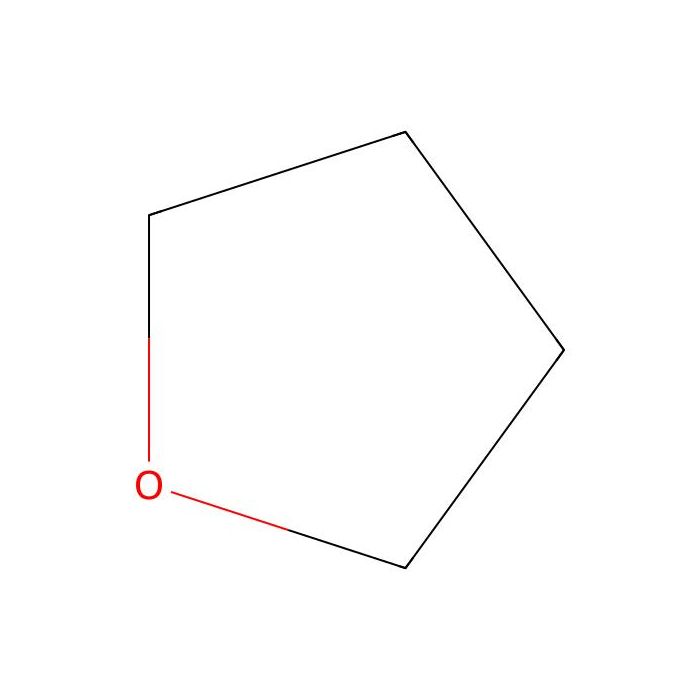
四氢呋喃(THF)

CAS: 109-99-9 货号: T1373930 分子式: C4H8O 分子量: 72.11 Beilstein号: 102391 EC号: 203-726-8
有货
级别和纯度: 超干级 ? 超干 —— 水含量极低,包装隔绝水分。适用于对水敏感的反应和无水化学。 ≥99.9% H2O≤50ppm, 无稳定剂
储存条件
避光,室温,充氩
运输条件
DG运输
★
规格
库存
价格
数量
100ml
T1373930-100ml
现货 Stock Image
¥142.90
500ml
T1373930-500ml
现货 Stock Image
¥329.90
1L
T1373930-1L
现货 Stock Image
¥549.90
请输入您要添加的产品数量
🧪
为什么选择此级别

超干级 提供 ≥99.9% 纯度,适用于对基线干扰要求严格的色谱和分析工作流程。

🌡

储存与运输

避光,室温,充氩。DG运输 。请查阅批次 COA 获取详细规格。

📋

质量文档

SDS、COA、产品数据表及规格说明书均可下载。可通过批号查询获取批次 COA。

📚

文献证明

在色谱分析、有机合成和交叉偶联反应领域已被 2472 篇同行评审文献引用。

概述

有醚样气味。能与水、醇类、醚类、酮类、酯类和烃类混溶。易燃。有刺激性。 氨基酸和肽的纸层析。溶剂。有机合成。高效液相色谱,紫外发光光度分析。

四氢呋喃(THF)是一种饱和环醚,主要用作有机溶剂。长期储存时,它会形成有机过氧化物。可通过添加丁基羟基甲苯(BHT)作为稳定剂而抑制这一过程。BHT能去除形成过氧化物所需的自由基。它是各种天然产物(聚醚类抗生素)的关键片段。THF可与硫化氢形成双水合物,其晶体结构已经过三维单晶研究法进行过研究。
应用:
干燥四氢呋喃(THF)已用于合成二氯{双[1,1′,1′′-(膦三基)三哌啶]钯[(P(NC5H10)3)2Pd(Cl)2],广泛用作Heck反应中的催化剂。它已被用于各种芳基溴和烯烃的Heck交叉偶联反应介质。

Tetrahydrofuran (THF) is a saturated cyclic ether that is mainly used as an organic solvent. When stored for a long time, it forms organic peroxides. This process can be inhibited by adding butylhydroxytoluene (BHT) as a stabilizer. BHT removes free radicals needed to form peroxides. It is a key fragment of various natural products (polyether antibiotics). THF can form double hydrates with hydrogen sulfide, and its crystal structure has been studied by three-dimensional single crystal method.
Application:
Dried tetrahydrofuran (THF) has been used to synthesize dichloride {bis [1,1 ',1 "-(phosphine triyl) tripiperidine] palladium [(P(NC5H10)3)2Pd(Cl)2], which is widely used as a catalyst in Heck reactions. It has been used as a Heck cross-coupling reaction medium for various aryl bromine and olefin.

规格

规格或纯度
超干级, ≥99.9%, H2O≤50ppm, 无稳定剂
英文名称
Tetrahydrofuran(THF)
储存条件
避光,室温,充氩
运输条件
DG运输
纯度
≥99.9%
名称和识别符
PubChem SID
EC号
203-726-8
分子类型
小分子
IUPAC Name
oxolane
INCHI
1S/C4H8O/c1-2-4-5-3-1/h1-4H2
InChi Key
WYURNTSHIVDZCO-UHFFFAOYSA-N
Smiles
C1CCOC1
Isomeric SMILES
C1CCOC1
UN Number
Packing Group
II
分子量
72.11
Beilstein号
102391
Reaxy-Rn
102391

技术文档

📋 安全数据表 (SDS)

全面的危险、操作、储存及法规合规文件。

下载 SDS →

✅ 分析证书 (COA)

批次质量数据。输入批号以获取对应 COA。

查询 COA →

📊 产品数据表

产品规格和应用的快速参考摘要。

查看数据表 →

🔬 规格说明书

该级别的完整质量属性和验收标准。

查看规格说明 →

高级数据

系统学分类

分类树(Taxonomy Tree)

界(kingdom) 有机化合物
超类(Superclass) 有机杂环化合物
类(Class) 四氢呋喃
亚类(Subclass) 暂无
中间层级节点(Intermediate Tree Nodes) 暂无
直接上位类(Direct Parent) 四氢呋喃
其他上位类(Alternative Parents) 氧环化合物  二烷基醚  碳氢化合物衍生物  
分子骨架(Molecular Framework) 脂肪族杂单环化合物
取代基(Substituents) 脂肪族杂单环化合物 - 二烷基醚 - 乙醚 - 烃衍生物 - 有机氧化合物 - 有机氧化合物 - 氧杂环 - 四氢呋喃
描述(Description) 该化合物属于四氢呋喃类有机化合物。这类杂环化合物含有饱和脂肪族五元环,其中一个碳原子被氧原子取代。
外部描述符(External Descriptors) saturated organic heteromonocyclic parent - cyclic ether - oxolanes
三维结构
交互式化学结构模型


化学和物理性质
溶解性
溶于水、乙醇、乙醚、丙酮、苯等多数有机溶剂。
密度
0.889
敏感性
对光线敏感,对湿度敏感
折光率
1.407
闪点(℃)
-17℃
沸点
66°C
熔点
-108.5°C
分子量
72.110 g/mol
XLogP3
0.500
氢键供体数Hydrogen Bond Donor Count
0
氢键受体数Hydrogen Bond Acceptor Count
1
可旋转键计数Rotatable Bond Count
0
精确质量Exact Mass
72.0575 Da
单同位素质量Monoisotopic Mass
72.0575 Da
拓扑极表面积Topological Polar Surface Area
9.200 Ų
重原子数Heavy Atom Count
5
形式电荷Formal Charge
0
复杂度Complexity
22.800
同位素原子数Isotope Atom Count
0
定义的原子立体中心计数Defined Atom Stereocenter Count
0
未定义的原子立体中心计数Undefined Atom Stereocenter Count
0
定义的键立体中心计数Defined Bond Stereocenter Count
0
未定义的键立体中心计数Undefined Bond Stereocenter Count
0
所有立体化学键的总数The total count of all stereochemical bonds
0
共价键合单元计数Covalently-Bonded Unit Count
1
安全和危险性(GHS)
一般危化品
一般危化品
象形图
GHS02,   GHS07,   GHS08
信号词
危险
危险声明

H225: 高度易燃的液体和蒸气

H302: 吞食有害

H319: 引起严重眼睛刺激

H335: 可能引起呼吸道刺激

H336: 可能引起嗜睡或头晕

H351: 怀疑引起遗传缺陷

预防措施声明

P201: 使用前获取特殊说明

P210: 远离热源,热表面,火花,明火和其他点火源。 - 禁止抽烟。

P202: 在阅读并理解所有安全预防措施之前,不要进行操作。

P233: 保持容器密闭。

P240: 地面/粘结容器和接收设备

P241: 使用防爆的[电气/通风/照明/.../]设备。

P242: 仅使用无火花的工具。

P243: 采取防静电措施

P261: 避免吸入灰尘/烟雾/气体/雾/蒸汽/喷雾

P264: 处理后要彻底洗手。

P270: 使用本产品时,请勿进食、饮水或吸烟。

P271: 仅在室外或通风良好的地方使用。

P280: 戴防护手套/穿防护服/戴防护眼罩/戴防护面具。

P303+P361+P353: 如皮肤(或头发)沾染:立即脱掉所有沾染的衣服。用水清洗皮肤/淋浴。

P305+P351+P338: 如进入眼睛:用水小心冲洗几分钟。如戴隐形眼镜并可方便地取出,取出隐形眼镜。继续冲洗。

P308+P313: 如接触到或有疑虑:求医/就诊。

P337+P313: 如仍觉眼刺激:求医/就诊。

P370+P378: 火灾时:使用干砂、干粉或抗醇泡沫灭火。

P405: 密闭存放

P403+P233: 存放在通风良好的地方。保持容器密闭。

P403+P235: 存放在通风良好的地方。保持低温。

P501: 将内容物/容器处理到。。。

P301+P312+P330: 如误吞咽:如感觉不适,呼叫急救中心/医生。漱口

P304+P340+P312: 如误吸入:将人转移到空气新鲜处,保持呼吸舒适体位。如感觉不适,呼叫急救中心/医生。

WGK Germany
1
RTECS
LU5950000
Class
3
Merck Index
9211
个人防护装备
Eyeshields,Faceshields,full-face respirator (US),Gloves,multi-purpose combination respirator cartridge (US),type ABEK (EN14387) respirator filter
质检证书(CoA,COO,BSE/TSE 和分析图谱)
C of A & Other Certificates(BSE/TSE, COO):
输入批号以搜索分析图谱:

通过匹配包装上的批号来查找并下载产品的 COA,每批产品都进行了严格的验证,您可放心使用!

找到59个结果

批号(Lot Number) 证书类型 货号
I2611789 分析证书 T1373930
I2611826 分析证书 T1373930
I2611787 分析证书 T1373930
I2611801 分析证书 T1373930
I2611803 分析证书 T1373930
I2611804 分析证书 T1373930
I2611786 分析证书 T1373930
I2611788 分析证书 T1373930
I2611802 分析证书 T1373930
G2628441 分析证书 T1373930
G2628439 分析证书 T1373930
G2628440 分析证书 T1373930
G2610658 分析证书 T1373930
G2610644 分析证书 T1373930
G2610643 分析证书 T1373930
E2606376 分析证书 T1373930
E2606372 分析证书 T1373930
E2606370 分析证书 T1373930
E2606373 分析证书 T1373930
E2606374 分析证书 T1373930
E2606361 分析证书 T1373930
E2606377 分析证书 T1373930
E2606364 分析证书 T1373930
E2606363 分析证书 T1373930
E2606371 分析证书 T1373930
E2606375 分析证书 T1373930
E2606379 分析证书 T1373930
E2606378 分析证书 T1373930
E2606362 分析证书 T1373930
C2612673 分析证书 T1373930
C2612672 分析证书 T1373930
C2612671 分析证书 T1373930
C2604774 分析证书 T1373930
C2604773 分析证书 T1373930
C2604772 分析证书 T1373930
B2605277 分析证书 T1373930
B2605278 分析证书 T1373930
B2605279 分析证书 T1373930
A2629748 分析证书 T1373930
A2629749 分析证书 T1373930
A2629747 分析证书 T1373930
L2508656 分析证书 T1373930
L2508637 分析证书 T1373930
L2508646 分析证书 T1373930
K2511524 分析证书 T1373930
K2511694 分析证书 T1373930
K2511695 分析证书 T1373930
K2504560 分析证书 T1373930
K2504559 分析证书 T1373930
H2526754 分析证书 T1373930
H2526753 分析证书 T1373930
H2526638 分析证书 T1373930
J2517050 分析证书 T1373930
I2526098 分析证书 T1373930
G2521409 分析证书 T1373930
G2521408 分析证书 T1373930
G2521407 分析证书 T1373930
G2521406 分析证书 T1373930
G2521405 分析证书 T1373930
技术文档和文章
超干级:湿敏化学的水分优先标准
Ultra-Dry Grade: The Moisture-First Standard for Sensitive Chemistry
氰基-3-酪酰胺(Cyanine 3 Tyramide):TSA 信号放大原理、应用及实验选型指南
Cyanine 3 Tyramide (Cy3 Tyramide): Principles, Applications, and Experimental Selection Guide for Tyramide Signal Amplification (TSA)
类胡萝卜素:结构特性、膳食来源与科研应用综述-附阿拉丁天然色素产品选型指南
Carotenoids: Structural Features, Dietary Sources and Research Applications – With an Aladdin Natural Pigments Product Selection Guide
钯催化反应一站式手册:催化循环、失活排查、配体/预催化剂选型与阿拉丁清单
One-Stop Handbook for Palladium-Catalyzed Reactions: Catalytic Cycles, Deactivation Troubleshooting, Ligand/Precatalyst Selection, and an Aladdin Reference List
分钟级构建氟代含氮桥环:Pd(II)/Pd(IV) 串联反应与 Pd(IV)“成对迁移(dyotropic)”重排驱动的应力释放环扩张
Minute-Scale Construction of Fluorinated Nitrogen-Bridged Bicycles: Pd(II)/Pd(IV) Cascade Chemistry and a Pd(IV) “Dyotropic (Paired-Migration)” Rearrangement Driving Strain-Release Ring Expansion
OSF/ASF 双通道工具箱:四元小环磺酰氟的分流反应、条件旋钮与选型导航
OSF/ASF Dual-Channel Toolbox: Divergent Reactions of Four-Membered Ring Sulfonyl Fluorides, Condition “Knobs,” and Selection Navigation
从哌啶到吡啶:2013–2023 FDA 小分子新药里“最常见含氮杂环”更替与选型导航(表1–4)
From Piperidine to Pyridine: The “Most Common N-Heterocycle” Shift in FDA Small-Molecule New Drugs (2013–2023) and a Selection Guide (Tables 1–4)
发光聚合物(LEPs)实用全景:PL/EL 核心机制框架、材料家族地图与结构旋钮(含产品表1–4及选型导航)
Light-Emitting Polymers (LEPs): A Practical Panorama - A Core PL/EL Mechanistic Framework, Material Family Map, and Structural “Design Knobs” (including Product Tables 1–4 and a selection guide)
合成锌试剂(Organozinc Reagents)实用指南:结构特性、关键反应与实用选型导航(含阿拉丁产品表)
A Practical Guide to Organozinc Reagents for Synthesis (Organozinc Reagents): Structural Features, Key Reactions, and a Practical Selection Navigation (Including Aladdin Product Tables)
Suzuki–Miyaura 反应怎么做稳:定位瓶颈,锁定可复现窗口(含选型导航及产品表1–表5)
How to Make the Suzuki–Miyaura Reaction Robust: Pinpoint the Bottleneck and Lock in a Reproducible Operating Window (with Selection Navigation and Product Tables 1–5)
认识 ATD-DMAP:从试剂设计到成酯、成酰胺与手性保持
Understanding ATD-DMAP: From Reagent Design to Esterification, Amidation, and Stereochemical Integrity
TCFH–NMI 在高含水体系中的酰胺化:研究价值、方法认识与实验启示
TCFH–NMI Amidation in Highly Aqueous Media: Research Value, Methodological Understanding, and Experimental Insights
重新认识三甲基铝:未保护氨基酸一锅法肽链延长的方法设计与实验价值
Reassessing Trimethylaluminum: Method Design and Experimental Value of One-Pot Peptide Elongation from Unprotected Amino Acids
DSC 的方法学价值:NHS 型活化中间体的构建与选用判断
The Methodological Value of DSC: Building NHS-Type Activated Intermediates and Deciding When to Use Them
Boc₂O 的选用不能只看保护引入:从底物亲核性、介质效应到脱保护路径的实验判断
Boc₂O Selection Cannot Be Judged by Protection Installation Alone: Experimental Decision-Making from Substrate Nucleophilicity and Medium Effects to Deprotection Pathways
DMAP 不只是有机碱:从亲核酰基转移到酯化与大环内酯化的实验判断
DMAP Is More Than Just an Organic Base: Experimental Judgment from Nucleophilic Acyl Transfer to Esterification and Macrolactonization
硅烷偶联剂底涂液的配制方法与注意事项
Preparation Methods and Precautions for Silane Coupling Agent Primer Solutions
寡核苷酸化学合成中的偶联活化剂、核苷砌块与修饰设计:对合成效率、纯度和性质的影响
Coupling Activators, Nucleoside Building Blocks, and Modification Design in Oligonucleotide Chemical Synthesis: Their Effects on Synthetic Efficiency, Purity, and Product Properties
交叉偶联反应的实验判断方法:目标键型、底物组合与催化体系选择
Experimental Decision-Making for Cross-Coupling Reactions: Target Bond Type, Substrate Combination, and Catalytic System Selection
多孔石墨化碳(PGC)色谱柱:用分子形状和石墨表面 π 电子云建立困难分离的新选择性
Porous Graphitic Carbon (PGC) Chromatography Columns: Creating New Selectivity for Challenging Separations through Molecular Shape and the π-Electron Cloud on the Graphitic Surface
多肽中间体难溶、难分离?标签辅助液相肽合成(TAG-LPPS)的路线设计与后处理策略
Peptide Intermediates Difficult to Dissolve and Separate? Route Design and Workup Strategies for Tag-Assisted Liquid-Phase Peptide Synthesis (TAG-LPPS)
从分子设计到形貌控制:小分子给体如何提升有机太阳能电池的效率、稳定性与可加工性
From Molecular Design to Morphology Control: How Small-Molecule Donors Improve the Efficiency, Stability, and Processability of Organic Solar Cells
半导体型单壁碳纳米管晶体管关态电流偏高的原因、诊断与调控策略
Causes, Diagnosis, and Control Strategies for Elevated Off-State Current in Semiconducting Single-Walled Carbon Nanotube Transistors
AITF 介导羧酸活化用于酰胺、肽和酯合成:活化机制与适用场景
AITF-Mediated Carboxylic Acid Activation for the Synthesis of Amides, Peptides, and Esters: Activation Mechanism and Applicable Scenarios
CTSOBt 苯并三氮唑-磺酸酯缩合试剂:羧酸活化与合成应用价值
CTSOBt Benzotriazole–Sulfonate Coupling Reagent: Carboxylic Acid Activation and Synthetic Application Value
从硝基芳烃到药物相关吡啶:光诱导芳基氮宾介导的骨架编辑策略
From Nitroarenes to Pharmaceutically Relevant Pyridines: A Photochemically Induced Aryl Nitrene-Mediated Skeletal Editing Strategy
三种四元环锍盐模块化构建九类螺[2.3]己烷骨架:合成方法与生物电子等排体评价
Modular Construction of Nine Classes of Spiro[2.3]hexane Scaffolds Using Three Four-Membered-Ring Sulfonium Salts: Synthetic Methodology and Bioisosteric Evaluation
从亲核型到亲电型BCB合成等价体:高价碘介导的极性反转设计
From Nucleophilic to Electrophilic BCB Synthetic Equivalents: Hypervalent-Iodine-Mediated Umpolung Design
哌啶α位C–H键的一锅芳基化:从定向锂化、Li→Zn转金属化到Negishi偶联
One-Pot Arylation of the Piperidine α-C–H Bond: From Directed Lithiation and Li→Zn Transmetalation to Negishi Coupling
哌啶C–H官能团化的选择性从何而来?——氮原子效应、椅式构象与四类关键中间体
Where Does the Selectivity in Piperidine C–H Functionalization Come From? — Nitrogen Effects, Chair Conformations, and Four Classes of Key Intermediates
非共价3CL蛋白酶抑制剂S-217622的发现与结构优化
Discovery and Structural Optimization of the Noncovalent 3CL Protease Inhibitor S-217622
突破氟芳烃亲核芳香取代的电子效应限制:t-Bu-P4的阴离子活化、协同取代与HF捕获
Overcoming the Electronic-Effect Limitations of Nucleophilic Aromatic Substitution in Fluoroarenes: Anion Activation, Concerted Substitution, and HF Capture by t-Bu-P4
如何绕开α-氟消除:α,α-二氟苄基阴离子的溴转移捕获与氧化偶联
How to Bypass α-Fluoride Elimination: Bromine-Transfer Capture and Oxidative Coupling of α,α-Difluorobenzylic Anions
3,3-二氟烯丙基锍盐(DFASs)的反应与应用:小分子偕二氟烯丙基化、多肽选择性修饰与后续功能化
Reactions and Applications of 3,3-Difluoroallyl Sulfonium Salts (DFASs): Small-Molecule gem-Difluoroallylation, Selective Peptide Modification, and Subsequent Functionalization
呋喃类化合物的结构与反应性:取代基、环稠合与氢化程度如何影响反应位点与应用方向
Structure and Reactivity of Furan Compounds: How Substituents, Ring Fusion, and Degree of Hydrogenation Affect Reaction Sites and Application Directions
辅酶Q10如何作用于皮肤:线粒体电子传递、膜脂抗氧化与脂质载体递送
How Coenzyme Q10 Acts on the Skin: Mitochondrial Electron Transfer, Antioxidant Protection of Membrane Lipids, and Lipid-Carrier Delivery
一级、二级胺为何难以直接参与经典Mitsunobu反应:BEHT介导醇胺化的机理、构型翻转与反应范围
Why Primary and Secondary Amines Have Difficulty Participating Directly in the Classical Mitsunobu Reaction: Mechanism, Inversion of Configuration, and Reaction Scope of BEHT-Mediated Alcohol Amination
芳炔–四嗪三重串联反应的选择性机制:反应路径切换与中间体转化
Selectivity Mechanism of the Triple Aryne–Tetrazine Cascade Reaction: Reaction-Pathway Switching and Intermediate Transformations
吡啶区域选择性去质子金属化:C–H 酸性、配位效应与金属体系
Regioselective Deprotonative Metalation of Pyridines: C–H Acidity, Coordination Effects, and Metal Systems
光/镍 C(sp²)–C(sp³) 偶联的动力学匹配:自由基生成、镍物种稳定性与光子通量
Kinetic Matching in Photoredox/Nickel C(sp²)–C(sp³) Coupling: Radical Generation, Nickel-Species Stability, and Photon Flux
LY3509754关键α-溴代酮的构建:β-氧代酯策略与酶促酯水解后的伴随脱羧
Construction of the Key α-Bromoketone Intermediate for LY3509754: A β-Keto Ester Strategy and Concomitant Decarboxylation Following Enzymatic Ester Hydrolysis
吡啶二亚胺(PDI)-钴催化 Simmons–Smith 型环丙烷化的区域选择性:烯烃取代模式与亚甲基转移机理
Regioselectivity of Pyridine-Diimine (PDI)–Cobalt-Catalyzed Simmons–Smith-Type Cyclopropanation: Alkene Substitution Patterns and the Methylene-Transfer Mechanism
ACT-1014-6470公斤级合成:未保护吡唑的N7选择性还原胺化、后续N2烷基化与分子内脲化
ACT-1014-6470 Kilogram-Scale Synthesis: N7-Selective Reductive Amination of an Unprotected Pyrazole, Subsequent N2 Alkylation, and Intramolecular Urea Formation
LY3509754关键α-溴代酮的构建:β-氧代酯策略与酶促酯水解后的伴随脱羧
Construction of the Key α-Bromoketone Intermediate for LY3509754: A β-Keto Ester Strategy and Concomitant Decarboxylation Following Enzymatic Ester Hydrolysis
此产品的引用文献
溶液计算器
