
 I2518536
计算溶液所需的质量、体积或浓度。
为什么选择此级别
,适用于对基线干扰要求严格的色谱和分析工作流程。
储存与运输
室温,充氩,干燥。DG运输 。请查阅批次 COA 获取详细规格。
质量文档
SDS、COA、产品数据表及规格说明书均可下载。可通过批号查询获取批次 COA。
文献证明
在色谱分析、有机合成和交叉偶联反应领域已被 1122 篇同行评审文献引用。
概述
有辛辣气味。有吸湿性。能发烟。是一种强烈而非氧化性的酸。能与乙醚、丙酮、乙醇、苯、四氯化碳和己烷混溶。有毒,半数致死量(小鼠,静脉)1200mg/kg。有腐蚀性。
规格
规格或纯度
0.1% in Acetonitrile
英文名称
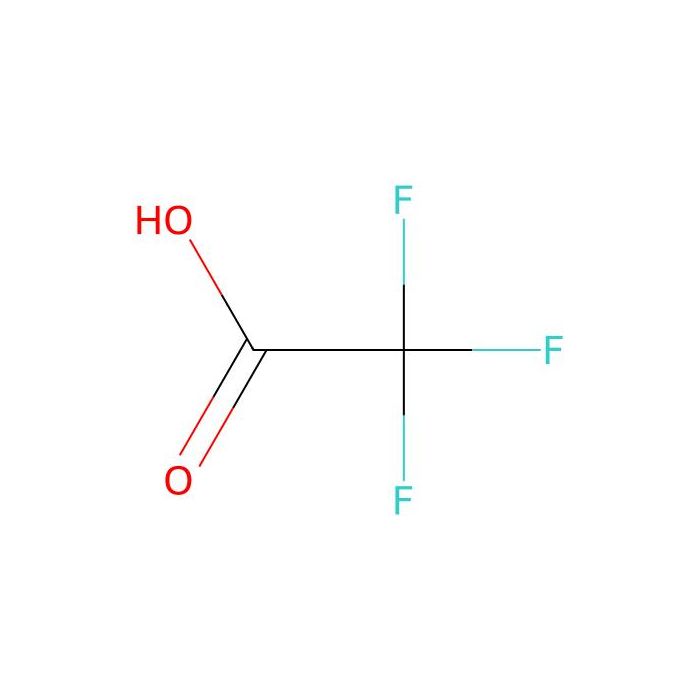
Trifluoroacetic acid(TFA)
储存条件
室温,充氩,干燥
运输条件
DG运输
名称和识别符
EC号
200-929-3
分子类型
小分子
IUPAC Name
2,2,2-trifluoroacetic acid
INCHI
1S/C2HF3O2/c3-2(4,5)1(6)7/h(H,6,7)
InChi Key
DTQVDTLACAAQTR-UHFFFAOYSA-N
Smiles
C(=O)(C(F)(F)F)O
Isomeric SMILES
C(=O)(C(F)(F)F)O
UN Number
Packing Group
I
分子量
114.02
Beilstein号
742035
Reaxy-Rn
742035
Reaxys-RN link address
https://www.reaxys.com/reaxys/secured/hopinto.do?context=S&query=IDE.XRN=742035&ln=
技术文档
高级数据
系统学分类
分类树(Taxonomy Tree)
-
界(kingdom)
有机化合物
-
超类(Superclass)
有机酸及其衍生物
-
类(Class)
羧酸及其衍生物
- 亚类(Subclass) α-卤代羧酸及其衍生物
-
类(Class)
羧酸及其衍生物
-
超类(Superclass)
有机酸及其衍生物
| 界(kingdom) | 有机化合物 |
|---|---|
| 超类(Superclass) | 有机酸及其衍生物 |
| 类(Class) | 羧酸及其衍生物 |
| 亚类(Subclass) | α-卤代羧酸及其衍生物 |
| 中间层级节点(Intermediate Tree Nodes) | 暂无 |
| 直接上位类(Direct Parent) | α-卤代羧酸 |
| 其他上位类(Alternative Parents) | 一元羧酸及其衍生物 羧酸 有机氟化物 有机氧化物 碳氢化合物衍生物 羰基化合物 烷基氟化物 |
| 分子骨架(Molecular Framework) | 脂肪族无环化合物 |
| 取代基(Substituents) | 脂肪族非环化合物 - 氟化烷基 - 烷基溴化物 - α-卤代羧酸 - 羰基 - 羧酰胺基 - 烃衍生物 - 单羧酸或其衍生物 - 有机氧化物 - 有机氧化合物 - 有机氟化物 - 有机卤化物 - 有机氧化合物 |
| 描述(Description) | 该化合物属于α-卤代羧酸类有机化合物。这类羧酸的α碳原子上直接连接有卤素原子。 |
| 外部描述符(External Descriptors) | organofluorine compound - monocarboxylic acid |
三维结构
交互式化学结构模型
化学和物理性质
密度
1.489
敏感性
易吸潮
折光率
n20/D 1.3 (lit.)
闪点(℃)
>100°C
沸点
72-73°
熔点
-15°
分子量
114.020 g/mol
XLogP3
0.900
氢键供体数Hydrogen Bond Donor Count
1
氢键受体数Hydrogen Bond Acceptor Count
5
可旋转键计数Rotatable Bond Count
0
精确质量Exact Mass
113.993 Da
单同位素质量Monoisotopic Mass
113.993 Da
拓扑极表面积Topological Polar Surface Area
37.300 Ų
重原子数Heavy Atom Count
7
形式电荷Formal Charge
0
复杂度Complexity
83.400
同位素原子数Isotope Atom Count
0
定义的原子立体中心计数Defined Atom Stereocenter Count
0
未定义的原子立体中心计数Undefined Atom Stereocenter Count
0
定义的键立体中心计数Defined Bond Stereocenter Count
0
未定义的键立体中心计数Undefined Bond Stereocenter Count
0
所有立体化学键的总数The total count of all stereochemical bonds
0
共价键合单元计数Covalently-Bonded Unit Count
1
安全和危险性(GHS)
一般危化品
一般危化品
信号词
危险
危险声明
H225: 高度易燃的液体和蒸气
H302: 吞食有害
H314: 造成严重的皮肤灼伤和眼睛损伤
H313+H333: 接触皮肤或吸入可能有害。
预防措施声明
P210: 远离热源,热表面,火花,明火和其他点火源。 - 禁止抽烟。
P233: 保持容器密闭。
P240: 地面/粘结容器和接收设备
P241: 使用防爆的[电气/通风/照明/.../]设备。
P242: 仅使用无火花的工具。
P243: 采取防静电措施
P264: 处理后要彻底洗手。
P270: 使用本产品时,请勿进食、饮水或吸烟。
P280: 戴防护手套/穿防护服/戴防护眼罩/戴防护面具。
P363: 再次使用之前,请清洗受污染的衣物。
P302+P352: 如皮肤沾染:用水充分清洗。
P304+P340: 如误吸入:将人转移到空气新鲜处,保持呼吸舒适体位。
P370+P378: 火灾时:使用干砂、干粉或抗醇泡沫灭火。
P405: 密闭存放
P403+P235: 存放在通风良好的地方。保持低温。
P501: 将内容物/容器处理到。。。
P301+P317: 如果被吞咽:请寻求医疗帮助。
P305+P354+P338: 如果进入眼睛:立即用水冲洗几分钟。取下隐形眼镜(如果有的话),并且操作简单。继续冲洗。
WGK Germany
2
RTECS
AJ9625000
Class
8
Merck Index
9681
个人防护装备
Faceshields,full-face respirator (US),Gloves,Goggles,multi-purpose combination respirator cartridge (US),type ABEK (EN14387) respirator filter
质检证书(CoA,COO,BSE/TSE 和分析图谱)
技术文档和文章
肽图检查法鉴定蛋白质结构
目录: 技术文章
Minute-Scale Construction of Fluorinated Nitrogen-Bridged Bicycles: Pd(II)/Pd(IV) Cascade Chemistry and a Pd(IV) “Dyotropic (Paired-Migration)” Rearrangement Driving Strain-Release Ring Expansion
目录: 技术文章
A Complete Guide to Ion-Pair Reversed-Phase Chromatography (IPC / IP-RP): Mechanisms, Four Tuning Knobs, Troubleshooting, and Ion-Pair Reagent Families (Tables 1–4)
目录: 技术文章
A Complete Guide to Choosing Resins for SPPS (Solid-Phase Peptide Synthesis): Fmoc/Boc Routes, C-Terminal Acid/Amide, and a Key-Parameter Navigator
目录: 技术文章
Installing a Redox Switch on Biomolecules: Principles, Conjugation Essentials, and an Application Guide for ATTO MB2 NHS ester
目录: 技术文章
A Practical Guide to Small-Molecule Chemical Probes: Concept Clarification, Causal Validation, and Experimental Selection (with Product Navigation and Tables A–D)
目录: 技术文章
Endoproteinase Lys-C: Mechanism, Applications, and Method-Control Considerations for Lysine-Specific Digestion
目录: 技术文章
Secondary Effects Behind Chromatographic Peak Tailing and Unstable Peak Shapes: How Residual Silanols (Si–OH) Affect Basic Compounds, and the Shortest Troubleshooting/Remediation Path (with Product Navigation and Tables 1–3)
目录: 技术文章
2-Methylpyridine–Borane (2-Picoline·BH₃) Reductive Amination Guide: Process Drivers for Replacing NaBH₃CN, the Practical Operating Window, and Scale-Up/Quench Close-Out Essentials (Including Product Tables 1–3)
目录: 技术文章
How Organic Acids “Stabilize a System”: Selection Logic via the pH Window, Salt Forms, and Metal-Ion Management (with a navigation guide to Tables A–E)
目录: 技术文章
Angiotensin-Converting Enzyme (ACE): A Review of Molecular Features, Catalytic Functions, and Research and Translational Applications
目录: 技术文章
Review of Chymotrypsin: Enzymological Properties, Catalytic Mechanism, and Research Applications
目录: 技术文章
β-Acyloxy Alkenyl Amides (AAAs): A New Approach to Amide Bond and Peptide Bond Construction Worth Attention
目录: 技术文章
DAST-Mediated Amidation at Room Temperature: Method Features, Practical Value, and Scope of Applicability
目录: 技术文章
Methodological Studies on Glycoprotein Structural Characterization and Quality Attribute Analysis
目录: 技术文章
From Analytical Instrument to Synthetic Platform: A New Strategy for Reconstructing Automated Flow Solid-Phase Peptide Synthesis with Standard Analytical HPLC
目录: 技术文章
New Progress in the Solid-Phase Synthesis of Sterically Hindered Peptides: Background, Core Breakthroughs, and Implications for Automation Compatibility of the RMMR Strategy
目录: 技术文章
Understanding Cbz (Benzyloxycarbonyl): Selection Logic and Practical Value of a Classical Amino Protecting Group
目录: 技术文章
From the Logic of Deprotection to Protecting Group Choice: Differences Among Bn, PMB, and Dmb in Experimental Design
目录: 技术文章
The Core Value of the Trityl Family of Protecting Groups: Acid-Deprotection Hierarchies and Selective Route Design
目录: 技术文章
Reassessing Trimethylaluminum: Method Design and Experimental Value of One-Pot Peptide Elongation from Unprotected Amino Acids
目录: 技术文章
Reconsidering N-Acyl Amino Protecting Groups: Deprotection Differences, Strategic Roles, and Experimental Selection of Ac, Bz, and Tfa
目录: 技术文章
Selective Deprotection and Sulfonyl Group Migration of N-Aryl Sulfonamides Mediated by TfOH (Trifluoromethanesulfonic Acid): Reaction Patterns and Synthetic Implications
目录: 技术文章
Low Racemization in Peptide Synthesis Is Not Just About Reagent Choice: Stereochemical Risk During the Activation Stage and Practical Strategies for Experimental Control
目录: 技术文章
Unstabilized Azomethine Ylide Chemistry from a Single Precursor: Acceptor-Controlled Divergence and Patterns of Scaffold Outcomes
目录: 技术文章
Decision Logic for Peptide Synthesis Routes: Applicability and Criteria for Choosing among SPPS, LPPS, and Recombinant Expression
目录: 技术文章
Selection Logic for the Teoc Amino Protecting Group: From Fluoride-Triggered Deprotection to Orthogonal Protecting-Group Design
目录: 技术文章
Boc₂O Selection Cannot Be Judged by Protection Installation Alone: Experimental Decision-Making from Substrate Nucleophilicity and Medium Effects to Deprotection Pathways
目录: 技术文章
Experimental Judgment for Differential Deprotection of Double Boc and Related N-Boc Systems: Substrate Type, Site-Response Differences, and Initial Condition Selection
目录: 技术文章
Experimental Selection of SEM-Cl: From O/N-SEM Protection and Directed Functionalization of N-Heterocycles to the Introduction of Protected C1 Fragments
目录: 技术文章
Reaction Selection in Small-Molecule Synthesis: From Transformation-Type Assessment to Experimental Route Screening
目录: 技术文章
Porous Graphitic Carbon (PGC) Chromatography Columns: Creating New Selectivity for Challenging Separations through Molecular Shape and the π-Electron Cloud on the Graphitic Surface
目录: 技术文章
How to Troubleshoot Abnormal Impurities in Peptide Synthesis? Locating Process Issues Through Amino-Related Side Reactions
目录: 技术文章
Peptide Intermediates Difficult to Dissolve and Separate? Route Design and Workup Strategies for Tag-Assisted Liquid-Phase Peptide Synthesis (TAG-LPPS)
目录: 技术文章
Formation and Control of Carboxyl- and Hydroxyl-Related Impurities in Peptide Synthesis — Using Asp/Glu and Ser/Thr Residue Side Reactions as Examples
目录: 技术文章
Moisturizing Mechanisms of Tremella fuciformis Polysaccharides: From Polysaccharide Structure and Hydration Rheology to Dynamic Film Formation on the Skin Surface
目录: 技术文章
How Palmitoyl Pentapeptide-4 Acts on the Skin: From the KTTKS Sequence and Skin Delivery to Collagen Matrix Responses
目录: 技术文章
How Cyclization Changes Peptide Behavior: Conformational Preorganization, Skin Delivery, and Integrin Binding, Using Cyclopeptide-5 as an Example
目录: 技术文章
The Logic of Biomimetic Peptide Action in Skin: Sequence and Conformation, Skin Delivery, Stability, and Target Matching
目录: 技术文章
Design Logic of Fluorinated 3,3-Disubstituted Oxetane Building Blocks: Structural Construction and Modulation of Amine Basicity, Lipophilicity, and Metabolic Stability
目录: 技术文章
Structure–Function Relationships of Ganoderma lucidum Extract: Skin-Protective Effects of Polysaccharides and Triterpenoids and Formulation Delivery Strategies
目录: 技术文章
The Combination Logic of Palmitoyl Tripeptide-1 and Palmitoyl Pentapeptide-4: Skin Delivery, Matrix Signaling, and Regulation of Collagen Homeostasis
目录: 技术文章
Mechanistic Basis of Acetyl Hexapeptide-8 in the Management of Expression Lines: SNARE Complex Interference, Constraints on Percutaneous Delivery, and Combination Strategies
目录: 技术文章
The Piperidine Bioisosteric Potential of 4-Azaspiro[2.3]hexane: Geometry, Physicochemical Properties, and Synthetic Accessibility
目录: 技术文章
Copper Tripeptide GHK-Cu and Skin Repair: From Copper Coordination Chemistry to Extracellular Matrix Remodeling
目录: 技术文章
Construction of the Key α-Bromoketone Intermediate for LY3509754: A β-Keto Ester Strategy and Concomitant Decarboxylation Following Enzymatic Ester Hydrolysis
目录: 技术文章
Regioselectivity of Pyridine-Diimine (PDI)–Cobalt-Catalyzed Simmons–Smith-Type Cyclopropanation: Alkene Substitution Patterns and the Methylene-Transfer Mechanism
目录: 技术文章
Desaturative Amination for the Synthesis of Amino Heteroarenes: Carbonyl-Site Predefinition of the C–N Bond-Forming Position and Subsequent Desaturative Aromatization
目录: 技术文章
ACT-1014-6470 Kilogram-Scale Synthesis: N7-Selective Reductive Amination of an Unprotected Pyrazole, Subsequent N2 Alkylation, and Intramolecular Urea Formation
目录: 技术文章
此产品的引用文献
溶液计算器
常见问题
本产品应如何储存?
请于室温、氩气保护、干燥条件下保存。本品在氩气保护下供应,每次取用后请在惰性气体下重新密封。
本产品如何运输?
本产品属危险品,通过 FedEx DG Service 运输。不提供陆运及其他经济型服务,部分目的地或地址类型可能受限。
本产品的 CAS 号、分子式和分子量是多少?
本产品的 CAS 号为 76-05-1,分子式为 CF3COOH,分子量为 114.02 g/mol。InChIKey DTQVDTLACAAQTR-UHFFFAOYSA-N。
如何获取批次专用COA?
每个订单都会随附分析证书(COA),您也可以从账户订单历史中下载。如需订购前的COA,请联系您的客户代表,或使用PDP上的"申请COA"按钮——我们将提供代表性批次的COA。
产品仅提供给经过验证的企业、机构和合格的专业人员用于研发。不适用于人类、动物、诊断或治疗。
Copyright © 2023至今 上海阿拉丁生化科技股份有限公司 保留所有权利。


 危险品化学品经营许可证(带存储)