
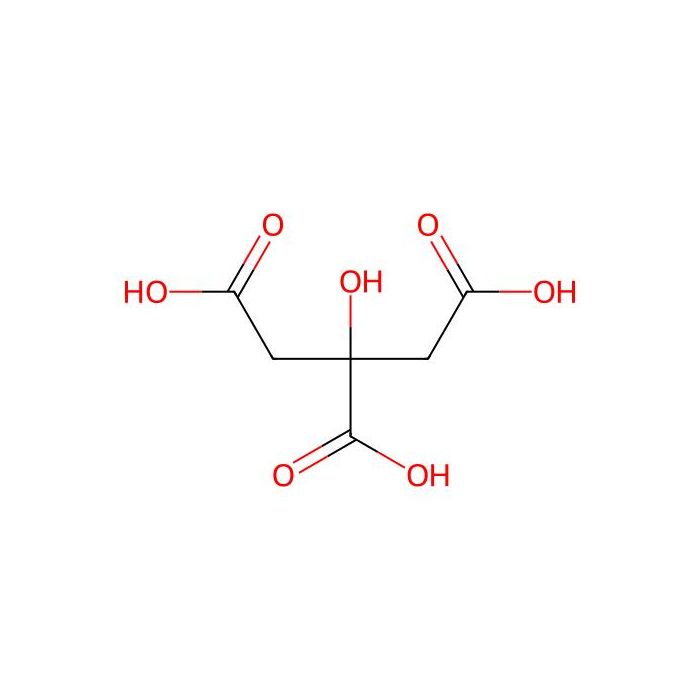
柠檬酸

CAS: 77-92-9 货号: C774599 分子式: C6H8O7 分子量: 192.12 Beilstein号: 782061 EC号: 201-069-1
有货
级别和纯度: 无水级 ? 无水级 —— 去除水分并干燥包装,供对水敏感的化学使用。适用于痕量水即会干扰或猝灭的反应。 PharmPure™ ? PharmPure™ —— 阿拉丁的生物制药原料和起始物料系列。适用于需要高纯度和文件的制药生产投入物料。 USP ? 美国药典级(USP)—— 符合 USP 专论规格,供药用。适用于药品生产、质控及需符合美国药典的应用。 JP ? 日本药典级(JP)—— 符合 JP 专论标准。适用于受日本法规要求约束的药品。 BP ? 英国药典级(BP)—— 符合 BP 专论要求。适用于按英国/BP 法规标准销售的药品。 欧洲药典(Ph.Eur) ? 欧洲药典级(Ph.Eur.)—— 符合欧盟成员国通用的 Ph.Eur. 专论。适用于需符合欧洲药典的药用工作。 fine-granular
储存条件
室温
★
规格
库存
价格
数量
5kg
C774599-GMP-5kg
现货 Stock Image
¥1,899.90
1kg
C774599-GMP-1kg
现货 Stock Image
¥389.90
请输入您要添加的产品数量
🧪
为什么选择此级别

BP,JP,PharmPure™,USP,无水级,欧洲药典(Ph.Eur) 级 ,适用于对基线干扰要求严格的色谱和分析工作流程。

🌡

储存与运输

室温。 。请查阅批次 COA 获取详细规格。

📋

质量文档

SDS、COA、产品数据表及规格说明书均可下载。可通过批号查询获取批次 COA。

📚

文献证明

在色谱分析、有机合成和交叉偶联反应领域已被 1994 篇同行评审文献引用。

概述

柠檬酸是一种常用作螯合剂、缓冲剂的有机酸,用于pH的调整和衍生化。应用柠檬酸已用于制备:柠檬酸磷酸盐缓冲液用于酶联免疫吸附测定。柠檬酸盐稳定的二氧化铈水溶胶,其可用于合成氧化铈纳米颗粒。柠檬酸-Na2HPO4缓冲储备溶液用于粪便脲酶活性的测定。抗凝血柠檬酸葡萄糖溶液A(ACD-A),可用于分离血液来源的内皮祖细胞。柠檬酸还可用于:在一种新方法中,它可实现在合成钯立方八面体时对粒子的大小进行控制。通过自下而上碳化法制备柠檬酸衍生的碳纳米点(CND)。作为一种双组分螯合剂,通过一种新型的溶胶-凝胶法合成Li4Ti5O12(钛酸锂)。

Finding the right excipient that matches your needs as well as regulatory demands can be a complicated challenge in formulation. With our know-how and regulatory expertise, we support you in every step of development, scale-up, and production. As part of our EMPROVE ® Program, our raw materials are offered with extensive documentation facilitating compliance of your pharma and biopharma product, full supply chain transparency and risk mitigation. Our SAFC ® portfolio of high-quality products for biopharmaceutical and pharmaceutical formulation and production withstands strict quality control procedures and is produced according to applicable cGMP guidelines.Citric acid is typically used as pH adjuster, buffer agent or as antioxidant in pharmaceutical formulations. Its range spans across different formulation types, including semi-solid dosage forms, liquid dosage forms such as solutions and solid dosage forms such as effervescent tablets or granules. Citric acid anhydrous powder EMPROVE ® Essential is citric acid present in its water-free, fine granulated form.

规格

规格或纯度
无水级,PharmPure™,USP,JP,BP,欧洲药典(Ph.Eur),fine-granular
英文名称
Citric acid
储存条件
室温
名称和识别符
EC号
201-069-1
分子类型
小分子
IUPAC Name
2-hydroxypropane-1,2,3-tricarboxylic acid
INCHI
1S/C6H8O7/c7-3(8)1-6(13,5(11)12)2-4(9)10/h13H,1-2H2,(H,7,8)(H,9,10)(H,11,12)
InChi Key
KRKNYBCHXYNGOX-UHFFFAOYSA-N
Smiles
C(C(=O)O)C(CC(=O)O)(C(=O)O)O
Isomeric SMILES
C(C(=O)O)C(CC(=O)O)(C(=O)O)O
分子量
192.12
Beilstein号
782061
Reaxy-Rn
782061
Reaxys-RN link address
https://www.reaxys.com/reaxys/secured/hopinto.do?context=S&query=IDE.XRN=782061&ln=

技术文档

📋 安全数据表 (SDS)

全面的危险、操作、储存及法规合规文件。

下载 SDS →

✅ 分析证书 (COA)

批次质量数据。输入批号以获取对应 COA。

查询 COA →

📊 产品数据表

产品规格和应用的快速参考摘要。

查看数据表 →

🔬 规格说明书

该级别的完整质量属性和验收标准。

查看规格说明 →

高级数据

系统学分类

分类树(Taxonomy Tree)

界(kingdom) 有机化合物
超类(Superclass) 有机酸及其衍生物
类(Class) 羧酸及其衍生物
亚类(Subclass) 三羧酸及其衍生物
中间层级节点(Intermediate Tree Nodes) 暂无
直接上位类(Direct Parent) 三羧酸及其衍生物
其他上位类(Alternative Parents) α-羟基酸及其衍生物  叔醇  羧酸  有机氧化物  碳氢化合物衍生物  羰基化合物  
分子骨架(Molecular Framework) 脂肪族无环化合物
取代基(Substituents) 羟基苯甲酸酯 - 脂肪族非环化合物 - α-羟基酸 - 羰基 - 羧酰胺基 - 烃衍生物 - 羟基酸 - 有机氧化物 - 有机氧化合物 - 有机氧化合物 - 三烷基醇 - 三羧酸或其衍生物
描述(Description) 该化合物属于有机化合物中的三羧酸及其衍生物类。这类化合物是含有三个羧基的羧酸。
外部描述符(External Descriptors) tricarboxylic acid
三维结构
交互式化学结构模型


化学和物理性质
溶解性
water: 1330g/L at20°C
密度
1.665g/cm3at 18°C
敏感性
Moisture sensitive
熔点
153-159°C
分子量
192.120 g/mol
XLogP3
-1.700
氢键供体数Hydrogen Bond Donor Count
4
氢键受体数Hydrogen Bond Acceptor Count
7
可旋转键计数Rotatable Bond Count
5
精确质量Exact Mass
192.027 Da
单同位素质量Monoisotopic Mass
192.027 Da
拓扑极表面积Topological Polar Surface Area
132.000 Ų
重原子数Heavy Atom Count
13
形式电荷Formal Charge
0
复杂度Complexity
227.000
同位素原子数Isotope Atom Count
0
定义的原子立体中心计数Defined Atom Stereocenter Count
0
未定义的原子立体中心计数Undefined Atom Stereocenter Count
0
定义的键立体中心计数Defined Bond Stereocenter Count
0
未定义的键立体中心计数Undefined Bond Stereocenter Count
0
所有立体化学键的总数The total count of all stereochemical bonds
0
共价键合单元计数Covalently-Bonded Unit Count
1
安全和危险性(GHS)
象形图
信号词
警告
危险声明

H315: 引起皮肤刺激

H319: 引起严重眼睛刺激

H335: 可能引起呼吸道刺激

预防措施声明

P261: 避免吸入灰尘/烟雾/气体/雾/蒸汽/喷雾

P264: 处理后要彻底洗手。

P271: 仅在室外或通风良好的地方使用。

P280: 戴防护手套/穿防护服/戴防护眼罩/戴防护面具。

P321: 特殊处理(请参阅此标签上的...)。

P302+P352: 如皮肤沾染:用水充分清洗。

P304+P340: 如误吸入:将人转移到空气新鲜处,保持呼吸舒适体位。

P305+P351+P338: 如进入眼睛:用水小心冲洗几分钟。如戴隐形眼镜并可方便地取出,取出隐形眼镜。继续冲洗。

P362+P364: 脱掉沾污的衣服,清洗后方可重新使用。

P405: 密闭存放

P403+P233: 存放在通风良好的地方。保持容器密闭。

P501: 将内容物/容器处理到。。。

P264+P265: 处理后彻底洗手[和…]。不要触摸眼睛。

P337+P317: 如果眼睛刺激持续:寻求医疗帮助。

P332+P317: 如果出现皮肤刺激:请寻求医疗帮助。

P319: 如果你感到不适,请寻求医疗帮助。

WGK Germany
1
RTECS
GE7350000
Merck Index
2326
个人防护装备
dust mask type N95 (US),Eyeshields,Gloves
质检证书(CoA,COO,BSE/TSE 和分析图谱)
C of A & Other Certificates(BSE/TSE, COO):
输入批号以搜索分析图谱:

通过匹配包装上的批号来查找并下载产品的 COA,每批产品都进行了严格的验证,您可放心使用!

找到2个结果

批号(Lot Number) 证书类型 货号
GME2608730 分析证书 C774599
GMA2627692 分析证书 C774599
技术文档和文章
GMP
GMP
从规格到实验台:理解与使用 USP 级试剂
From Spec to Bench: Understanding and Using USP Grade Reagents
JP 级试剂解读
JP Grade Reagents Explained
BP 级解读:揭秘《英国药典》
BP grade: The British Pharmacopoeia Standard, Demystified
试剂“无水级”指南
The Guide to Anhydrous Grade for Reagents
为什么我的镍琼脂糖微球变为黑色或棕色?
Why Did My Ni-Agarose Beads Turn Black or Brown?
Ni²⁺–琼脂糖树脂的剥离、清洗与金属再生流程
Stripping, Cleaning, and Metal Recharging Workflow for Ni²⁺–Agarose Resins
胃蛋白酶(Pepsin) ——结构特性、酶学性质与实验应用指南
Pepsin——Structural Features, Enzymatic Properties, and Experimental Application Guide
香精科普:从配方黑箱到可工程化体系——相容性、稳定性、控释、可追溯与选型指南
A Practical Guide to Fragrance Compositions: Turning a Black-Box Formula into an Engineerable System—Compatibility, Stability, Controlled Release, Traceability, and Selection
析氢催化剂怎么选:水电解的动力学门槛、AWE/PEM/AEM 路线与材料家族导航(含产品地图)
How to Choose a Hydrogen Evolution (HER) Catalyst: Kinetic Barriers in Water Electrolysis, AWE/PEM/AEM Pathways, and a Materials-Family Roadmap (with a Product Map)
苏木素的理化特性、染色机理与应用规范
Physicochemical Properties, Staining Mechanisms, and Practical Application Specifications of Hematoxylin
漆酶的技术特性、优化策略及工业应用进展
Laccase: Technical Characteristics, Optimization Strategies, and Industrial Application Progress
羧甲基纤维素钠(CMC-Na)实用指南:增稠/稳定机理、配液关键控制点与选型导航(含表1、表A–C)
Practical Guide to Sodium Carboxymethyl Cellulose (CMC-Na): Thickening/Stabilizing Mechanisms, Key Controls for Solution Preparation, and Selection Navigation (including Table 1 and Tables A–C)
有机酸如何“稳住体系”:pH 窗口、盐型与金属离子管理的选型逻辑(附表A–E导航)
How Organic Acids “Stabilize a System”: Selection Logic via the pH Window, Salt Forms, and Metal-Ion Management (with a navigation guide to Tables A–E)
酸性磷酸酶:酸性微环境中的去磷酸化反应及其研究与检测应用
Acid Phosphatase: Dephosphorylation Reactions in Acidic Microenvironments and Their Research, Assay, and Detection Applications
β-N-乙酰氨基葡萄糖苷酶:底物特异性水解酶学特征与检测、科研及产业应用
β-N-Acetylglucosaminidase: Substrate-Specific Hydrolytic Enzymology, Assays, and Research and Industrial Applications
半纤维素酶:底物特异性、催化体系与科研及产业应用综述
Hemicellulases: A Review of Substrate Specificity, Catalytic Systems, and Research and Industrial Applications
菠萝蛋白酶:酶学特性与食品、医药及工业应用要点
Bromelain: Enzymological Properties and Key Points for Food, Pharmaceutical, and Industrial Applications
植酸酶:酶学特性、作用机理与饲料及食品领域应用
Phytase: Enzymological Properties, Mechanism of Action, and Applications in Feed and Food
从蔗糖到单糖:糖转化过程中的关键酶节点与调控逻辑
From Sucrose to Monosaccharides: Key Enzymatic Nodes and Regulatory Logic in Sugar Conversion
淀粉代谢相关酶在食品科学研究与品质调控机制分析中的功能体系
Functional Framework of Starch Metabolism-Related Enzymes in Food Science Research and Mechanistic Analysis of Quality Regulation
乙酰基代谢酶网络与体外酶学分析
Acetyl-Group Metabolic Enzyme Network and In Vitro Enzymology Analysis
羟脯氨酸含量检测的技术比较与方法学选择
Technical Comparison and Method Selection for Hydroxyproline Determination
细菌钠离子驱动能量代谢与跨膜耦联转运机制
Bacterial Sodium Ion-Driven Energy Metabolism and Mechanisms of Transmembrane Coupled Transport
黄酮类化合物提取方法及工艺选择
Extraction Methods and Process Selection for Flavonoid Compounds
酪胺信号放大技术在原位荧光检测中的应用
Tyramide Signal Amplification in In Situ Fluorescence Detection
细胞样本保存体系对形态保持、抗凝稳定与检测结果的影响
Effects of Cell Sample Preservation Systems on Morphological Integrity, Anticoagulant Stability, and Analytical Results
IHC实验中低pH、高pH及酶法抗原修复体系的应用比较
Comparison of Low-pH, High-pH, and Enzymatic Antigen Retrieval Systems in IHC
钙钛矿氧化物能源与环境催化:氧空位、B 位金属与金属–氧键网络如何调控反应性能
Perovskite Oxides for Energy and Environmental Catalysis: How Oxygen Vacancies, B-Site Metals, and the Metal–Oxygen Bond Network Regulate Reaction Performance
癌细胞为什么要自己合成脂肪酸?从脂肪酸从头合成通路到实验判断
Why Do Cancer Cells Synthesize Their Own Fatty Acids? From the De Novo Fatty Acid Synthesis Pathway to Experimental Assessment
多孔石墨化碳(PGC)色谱柱:用分子形状和石墨表面 π 电子云建立困难分离的新选择性
Porous Graphitic Carbon (PGC) Chromatography Columns: Creating New Selectivity for Challenging Separations through Molecular Shape and the π-Electron Cloud on the Graphitic Surface
从天然纤维素到纳米晶体:CNC 的结构特性、应用方向与产业化挑战
From Natural Cellulose to Nanocrystals: Structural Characteristics, Application Directions, and Industrialization Challenges of CNC
为什么日化清洁配方常用 LABSA(磺酸):中和机理、去污作用与配方应用要点
Why LABSA (Sulfonic Acid) Is Commonly Used in Household Cleaning Formulations: Neutralization Mechanism, Detergency Action, and Formulation Application Points
从结构看性能:日化功能原料的调理、成膜、增稠与螯合应用
From Structure to Performance: Conditioning, Film-Forming, Thickening, and Chelating Applications of Functional Ingredients in Personal Care and Home Care
偏硅酸钠与三聚磷酸钠在洗涤清洁配方中的区别、作用机理与选型
Differences, Mechanisms of Action, and Selection of Sodium Metasilicate and Sodium Tripolyphosphate in Detergent and Cleaning Formulations
日化配方中螯合剂的作用、选型与验证方法
The Role, Selection, and Validation of Chelating Agents in Daily Chemical Formulations
K12(十二烷基硫酸钠/SLS)不只是起泡剂:结构、性能与日化配方应用解析
K12 (Sodium Lauryl Sulfate/SLS) Is More Than a Foaming Agent: Structure, Properties, and Applications in Personal Care and Household Care Formulations
从结构到流变:卡波姆如何形成凝胶结构并实现增稠、悬浮与乳液辅助稳定?
From Structure to Rheology: How Carbomer Forms Gel Structures and Enables Thickening, Suspension, and Auxiliary Emulsion Stabilization
三乙醇胺与二乙醇胺有何不同:从分子结构看日化配方作用、应用差异与选用逻辑
What Is the Difference Between Triethanolamine and Diethanolamine: Understanding Their Formulation Functions, Application Differences, and Selection Logic from a Molecular-Structure Perspective
黄原胶在日化配方中的增稠、悬浮、辅助稳定与结团机制:从分子结构到工艺应用
Thickening, Suspension, Auxiliary Stabilization, and Agglomeration Mechanisms of Xanthan Gum in Personal Care Formulations: From Molecular Structure to Processing Applications
6501(椰油酰胺DEA)为什么能稳泡增稠?结构机理、1:1/1:1.5差异与应用选型
Why Can 6501 (Cocamide DEA) Stabilize Foam and Build Viscosity? Structural Mechanism, 1:1/1:1.5 Differences, and Application Selection
日化生产中片碱、粒碱、液碱与火碱的区别及选用要点:氢氧化钠的作用与应用逻辑
Differences, Functions, and Selection Guidelines for Sodium Hydroxide Flakes, Granules, Liquid Caustic Soda, and Caustic Soda in Household and Personal Care Product Manufacturing: The Functional and Application Logic of Sodium Hydroxide
日化清洁配方中的 AES(脂肪醇聚氧乙烯醚硫酸盐):结构、性能与低温流动性解析
AES (Fatty Alcohol Polyoxyethylene Ether Sulfate) in Personal and Home-Care Cleansing Formulations: An Analysis of Structure, Performance, and Low-Temperature Flowability
小防白、大防白、PnB和DPnB:丁基醇醚在硬表面清洁配方中的作用机制与选型
Xiao Fang Bai, Da Fang Bai, PnB and DPnB: Mechanisms and Selection of Butyl Glycol Ethers in Hard-Surface Cleaning Formulations
柠檬烯为何能软化油污却难溶于水:从分子结构理解天然来源溶剂的清洁机理与配方应用
Why Limonene Can Soften Greasy Soils Yet Is Difficult to Dissolve in Water: Understanding the Cleaning Mechanism and Formulation Applications of Naturally Derived Solvents from Molecular Structure
从结构看懂 CAPB:椰油酰胺丙基甜菜碱如何改善泡沫、提升温和性并辅助增稠?
Understanding CAPB from Its Structure: How Cocamidopropyl Betaine Improves Foam, Enhances Mildness, and Supports Thickening
强酸清洁体系如何选择增稠剂:增稠机制比较与脂肪胺乙氧基化物应用思路
How to Select Thickeners for Strongly Acidic Cleaning Systems: Comparison of Thickening Mechanisms and Application Considerations for Fatty Amine Ethoxylates
三聚磷酸钠 STPP 如何替代?从助洗机理到低磷/无磷助洗体系的配方选择
How Can Sodium Tripolyphosphate (STPP) Be Replaced? From Detergency Mechanisms to Formulation Choices for Low-Phosphorus/Phosphorus-Free Builder Systems
AEO-9(脂肪醇聚氧乙烯醚)的界面作用机理与配方应用——乳化、润湿、油污去除与复配相容性解析
Interfacial Mechanism and Formulation Applications of AEO-9 (Fatty Alcohol Polyoxyethylene Ether): An Analysis of Emulsification, Wetting, Oil Soil Removal, and Co-Formulation Compatibility
不仅是 pH 调节剂:柠檬酸在日化清洁中的作用机理、选型逻辑与替代酸源分析
More Than a pH Adjuster: Mechanisms, Selection Logic, and Alternative Acid Source Analysis of Citric Acid in Home-Care Cleaning
偏硅酸钠清洗应用解析:水合形态差异、作用机理与选型逻辑
Sodium Metasilicate in Cleaning Applications: Hydration-Form Differences, Mechanisms of Action, and Selection Logic
K12 与 AOS 发泡性能差异解析:结构、酸碱稳定性与配方选型
Analysis of the Foaming Performance Differences Between K12 and AOS: Structure, Acid–Base Stability, and Formulation Selection
棕榈来源异构醇聚氧乙烯醚 PLE-S9 的结构特性、低温流动性与日化清洁应用
Structural Characteristics, Low-Temperature Flowability, and Home-Care Cleaning Applications of Palm-Derived Isomeric Alcohol Polyoxyethylene Ether PLE-S9
日化酵素原料的性能来源与配方应用:发酵转化、酶促反应及应用原则
Performance Sources and Formulation Applications of Enzyme-Based Ingredients in Daily Chemical Products: Fermentation Transformation, Enzymatic Reactions, and Application Principles
日化配方泡沫下降的机理与排查:破膜、界面弱膜、表活供给不足和相态扰动
Mechanisms and Troubleshooting of Foam Reduction in Personal and Household Care Formulations: Film Rupture, Weak Interfacial Films, Insufficient Surfactant Supply, and Phase-State Disturbance
腻子用羟丙基甲基纤维素(HPMC)生产工艺解析:从大配比与小配比看取代结构和凝胶温度差异
Analysis of the Production Process of Hydroxypropyl Methylcellulose (HPMC) for Putty: Understanding Differences in Substitution Structure and Gelation Temperature from High-Ratio and Low-Ratio Formulations
夏季日化产品为什么容易返稀?核心机理、排查方法与解决思路
Why Are Daily Chemical Products Prone to Viscosity Thinning in Summer? Core Mechanisms, Troubleshooting Methods, and Solutions
腻子中常用纤维素醚的类型、作用机理、质量指标与选择应用
Types, Mechanisms of Action, Key Quality Indicators, and Selection and Application of Common Cellulose Ethers in Wall Putty
耐水腻子打磨脱层的原因与机理分析
Causes and Mechanism Analysis of Delamination During Sanding of Water-Resistant Putty
中性腻子为什么会出现锈点?铁源、水分迁移、氧化显色与防控要点
Why Do Rust Spots Appear on Neutral Wall Putty? Iron Sources, Moisture Migration, Oxidative Color Development, and Prevention Measures
木质纤维素糖化中内切葡聚糖酶、CBH I与β-葡萄糖苷酶协同作用的实验评价
Experimental Evaluation of the Synergistic Actions of Endoglucanase, CBH I, and β-Glucosidase in Lignocellulosic Saccharification
TCA循环代谢物检测方法与结果判读
TCA Cycle Metabolite Detection Methods and Result Interpretation
β-N-Acetylglucosaminidase: Substrate-Specific Hydrolytic Enzymology, Assays, and Research and Industrial Applications
单宁酸-透钙磷石原位复合骨水泥的制备策略与体外生物性能评价
Preparation Strategy and In Vitro Biological Performance Evaluation of Tannic Acid–Brushite In Situ Composite Bone Cement
鉴定乙型肝炎病毒的组织学染色方法比较:HE、地衣红、醛品红、维多利亚蓝、免疫组化与原位杂交
Histological Staining Methods for Identifying Hepatitis B Virus: Comparison of HE, Orcein, Aldehyde Fuchsin, Victoria Blue, Immunohistochemistry, and In Situ Hybridization
曲酸淡化色素沉着的作用机制:从酪氨酸酶抑制到黑色素生成调控
Mechanism of Kojic Acid in Reducing Hyperpigmentation: From Tyrosinase Inhibition to Melanin Production Regulation
白藜芦醇在护肤研究中的抗氧化机制、稳定性与递送策略
Antioxidant Mechanisms, Stability, and Delivery Strategies of Resveratrol in Skincare Research
阿魏酸在护肤中的抗氧化机制、维生素C/E协同与稳定递送应用
Antioxidant Mechanisms of Ferulic Acid in Skincare, Vitamin C/E Synergy, and Stable Delivery Applications
琥珀酸在痤疮护理中的潜在作用机制:从二羧酸酸碱平衡到皮肤微生物间的代谢拮抗
Potential Mechanisms of Succinic Acid in Acne Care: From Dicarboxylic Acid–Base Equilibria to Metabolic Antagonism Among Skin Microorganisms
辛酰水杨酸的结构、角质层分布与角质调理机制:屏障影响与安全性评价
Structure, Stratum Corneum Distribution, and Stratum Corneum Conditioning Mechanism of Capryloyl Salicylic Acid: Barrier Effects and Safety Evaluation
茶多酚在油痘肌中的潜在作用机制:以EGCG对皮脂生成、脂质过氧化与炎症反应的影响为例
Potential Mechanisms of Tea Polyphenols in Oily, Acne-Prone Skin: Effects of EGCG on Sebum Production, Lipid Peroxidation, and Inflammatory Responses
银耳多糖的保湿机制:从多糖结构、水合流变到皮肤表面动态成膜
Moisturizing Mechanisms of Tremella fuciformis Polysaccharides: From Polysaccharide Structure and Hydration Rheology to Dynamic Film Formation on the Skin Surface
熊果苷如何调节黑色素生成:α/β异头构型与酪氨酸酶作用
How Arbutin Regulates Melanin Production: α/β Anomeric Configuration and Tyrosinase Action
乙酰基六肽-8在表情纹管理中的作用基础:SNARE复合体干预、经皮递送限制与复配思路
Mechanistic Basis of Acetyl Hexapeptide-8 in the Management of Expression Lines: SNARE Complex Interference, Constraints on Percutaneous Delivery, and Combination Strategies
烟酰胺提亮机制与配方设计:黑素小体转移、pH调控与复配策略
Niacinamide Brightening Mechanisms and Formulation Design: Melanosome Transfer, pH Regulation, and Combination Strategies
MTAD介导的吡啶氧化脱芳构化:暂时性对位环加成、烯烃氧化与杂原子官能化
MTAD-Mediated Oxidative Dearomatization of Pyridines: Transient para-Cycloaddition, Alkene Oxidation, and Heteroatom Functionalization
此产品的引用文献
溶液计算器

常见问题

什么是「无水级」?
「无水级」表示该物料经过加工和检测,适用于对水分敏感的化学反应。规格侧重于影响该应用性能的杂质——例如,电子应用的金属含量、电池应用的粒度、光学应用的折射率,或对水分敏感工艺的水分含量。
什么是「PharmPure?」?
「PharmPure?」指按照药品生产和受监管的工作流程要求生产和管控的物料。根据具体类别(GMP、RUO、生物医学级、注射级等),这可能包括受控的生产环境、经验证的工艺、可供审计的文件以及可追溯性。
本产品应如何储存?
请于室温条件下保存。
本产品的 CAS 号、分子式和分子量是多少?
本产品的 CAS 号为 77-92-9,分子式为 C6H8O7,分子量为 192.12 g/mol。InChIKey KRKNYBCHXYNGOX-UHFFFAOYSA-N。
如何获取批次专用COA?
每个订单都会随附分析证书(COA),您也可以从账户订单历史中下载。如需订购前的COA,请联系您的客户代表,或使用PDP上的"申请COA"按钮——我们将提供代表性批次的COA。
