
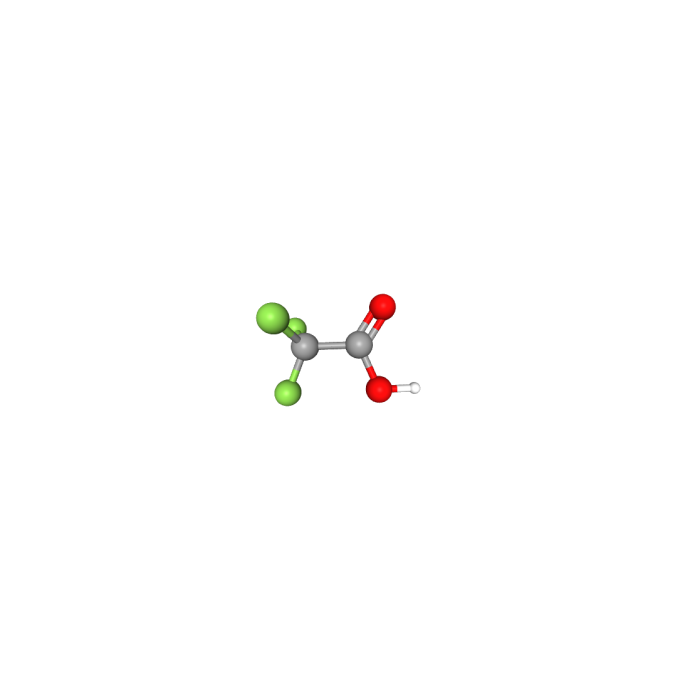
三氟乙酸(TFA)

CAS: 76-05-1 货号: T103292 分子式: CF3COOH 分子量: 114.02 Beilstein号: 742035 EC号: 200-929-3
有货
级别和纯度: Standard for GC ? GC 标准品 —— 用于校准 GC 方法的表征化合物。用于建立标准曲线和验证 GC 定量。 ≥99.5%(GC)
别名
三氟醋酸
储存条件
室温,干燥
运输条件
DG运输
★
规格
库存
价格
数量
5ml
T103292-5ml
现货 Stock Image
¥55.90
请输入您要添加的产品数量
🧪
为什么选择此级别

Standard for GC 级 提供 ≥99.5%(GC) 纯度,适用于对基线干扰要求严格的色谱和分析工作流程。

🌡

储存与运输

室温,干燥。DG运输 。请查阅批次 COA 获取详细规格。

📋

质量文档

SDS、COA、产品数据表及规格说明书均可下载。可通过批号查询获取批次 COA。

📚

文献证明

在色谱分析、有机合成和交叉偶联反应领域已被 1133 篇同行评审文献引用。

概述

有辛辣气味。有吸湿性。能发烟。是一种强烈而非氧化性的酸。能与乙醚、丙酮、乙醇、苯、四氯化碳和己烷混溶。有毒,半数致死量(小鼠,静脉)1200mg/kg。有腐蚀性。


规格

别名
三氟醋酸
英文别名
TFA | EN300-19296 | flurtamone TP1 | Perfluoroacetic acid | BP-20560 | trifluoracetate | Trifluoroacetic acid, >=99.995% Trace metals grade | Acetic acid, trifluoro- | EC 200-929-3 | Trifluoracetic acid | Trifluoroacetic acid, commercial grade | UNII-E5R8
规格或纯度
Standard for GC, ≥99.5%(GC)
英文名称
Trifluoroacetic acid
储存条件
室温,干燥
运输条件
DG运输
纯度
≥99.5%(GC)
名称和识别符
PubChem SID
EC号
200-929-3
分子类型
小分子
IUPAC Name
2,2,2-trifluoroacetic acid
INCHI
1S/C2HF3O2/c3-2(4,5)1(6)7/h(H,6,7)
InChi Key
DTQVDTLACAAQTR-UHFFFAOYSA-N
Smiles
C(=O)(C(F)(F)F)O
Isomeric SMILES
C(=O)(C(F)(F)F)O
UN Number
Packing Group
I
分子量
114.02
Beilstein号
742035
Reaxy-Rn
742035
Reaxys-RN link address
https://www.reaxys.com/reaxys/secured/hopinto.do?context=S&query=IDE.XRN=742035&ln=

技术文档

📋 安全数据表 (SDS)

全面的危险、操作、储存及法规合规文件。

下载 SDS →

✅ 分析证书 (COA)

批次质量数据。输入批号以获取对应 COA。

查询 COA →

📊 产品数据表

产品规格和应用的快速参考摘要。

查看数据表 →

🔬 规格说明书

该级别的完整质量属性和验收标准。

查看规格说明 →

高级数据

系统学分类

分类树(Taxonomy Tree)

界(kingdom) 有机化合物
超类(Superclass) 有机酸及其衍生物
类(Class) 羧酸及其衍生物
亚类(Subclass) α-卤代羧酸及其衍生物
中间层级节点(Intermediate Tree Nodes) 暂无
直接上位类(Direct Parent) α-卤代羧酸
其他上位类(Alternative Parents) 一元羧酸及其衍生物  羧酸  有机氟化物  有机氧化物  碳氢化合物衍生物  羰基化合物  烷基氟化物  
分子骨架(Molecular Framework) 脂肪族无环化合物
取代基(Substituents) 脂肪族非环化合物 - 氟化烷基 - 烷基溴化物 - α-卤代羧酸 - 羰基 - 羧酰胺基 - 烃衍生物 - 单羧酸或其衍生物 - 有机氧化物 - 有机氧化合物 - 有机氟化物 - 有机卤化物 - 有机氧化合物
描述(Description) 该化合物属于α-卤代羧酸类有机化合物。这类羧酸的α碳原子上直接连接有卤素原子。
外部描述符(External Descriptors) organofluorine compound - monocarboxylic acid
三维结构
交互式化学结构模型


关联靶点(其它种属)
E Lysozyme (95 活性数据)
活性类型 Relation Activity value Units Action Type 期刊 PubMed Id doi Assay Aladdin ID
作用机制
作用机制 Action Type target ID Target Name Target Type Target Organism Binding Site Name 参考文献
化学和物理性质
密度
1.489
折光率
n20/D 1.3 (lit.)
闪点(℃)
>100°C
沸点
72-73°
熔点
-15°
分子量
114.020 g/mol
XLogP3
0.900
氢键供体数Hydrogen Bond Donor Count
1
氢键受体数Hydrogen Bond Acceptor Count
5
可旋转键计数Rotatable Bond Count
0
精确质量Exact Mass
113.993 Da
单同位素质量Monoisotopic Mass
113.993 Da
拓扑极表面积Topological Polar Surface Area
37.300 Ų
重原子数Heavy Atom Count
7
形式电荷Formal Charge
0
复杂度Complexity
83.400
同位素原子数Isotope Atom Count
0
定义的原子立体中心计数Defined Atom Stereocenter Count
0
未定义的原子立体中心计数Undefined Atom Stereocenter Count
0
定义的键立体中心计数Defined Bond Stereocenter Count
0
未定义的键立体中心计数Undefined Bond Stereocenter Count
0
所有立体化学键的总数The total count of all stereochemical bonds
0
共价键合单元计数Covalently-Bonded Unit Count
1
安全和危险性(GHS)
一般危化品
一般危化品
象形图
GHS05,   GHS07
信号词
危险
危险声明

H314: 造成严重的皮肤灼伤和眼睛损伤

H332: 吸入有害

H412: 对水生生物有害并具有长期持续影响

预防措施声明

P261: 避免吸入灰尘/烟雾/气体/雾/蒸汽/喷雾

P264: 处理后要彻底洗手。

P271: 仅在室外或通风良好的地方使用。

P273: 避免释放到环境中。

P280: 戴防护手套/穿防护服/戴防护眼罩/戴防护面具。

P363: 再次使用之前,请清洗受污染的衣物。

P301+P330+P331: 如误吞咽:漱口。不要诱导呕吐。

P303+P361+P353: 如皮肤(或头发)沾染:立即脱掉所有沾染的衣服。用水清洗皮肤/淋浴。

P402+P404: 存放于干燥处。存放于密闭的容器中。

P501: 将内容物/容器处理到。。。

WGK Germany
2
RTECS
AJ9625000
Class
8
Merck Index
9681
个人防护装备
Faceshields,full-face respirator (US),Gloves,Goggles,multi-purpose combination respirator cartridge (US),type ABEK (EN14387) respirator filter
质检证书(CoA,COO,BSE/TSE 和分析图谱)
C of A & Other Certificates(BSE/TSE, COO):
输入批号以搜索分析图谱:

通过匹配包装上的批号来查找并下载产品的 COA,每批产品都进行了严格的验证,您可放心使用!

找到7个结果

批号(Lot Number) 证书类型 货号
L2319494 分析证书 T103292
I2504868 分析证书 T103292
F2526527 分析证书 T103292
L2221061 分析证书 T103292
I2223395 分析证书 T103292
G2227517 分析证书 T103292
F2224330 分析证书 T103292
技术文档和文章
Standard for GC:一份实用指南
Standard for GC: A Practical Guide
肽图检查法鉴定蛋白质结构
Peptide Mapping for Protein Structure Identification
分钟级构建氟代含氮桥环:Pd(II)/Pd(IV) 串联反应与 Pd(IV)“成对迁移(dyotropic)”重排驱动的应力释放环扩张
Minute-Scale Construction of Fluorinated Nitrogen-Bridged Bicycles: Pd(II)/Pd(IV) Cascade Chemistry and a Pd(IV) “Dyotropic (Paired-Migration)” Rearrangement Driving Strain-Release Ring Expansion
离子对反相色谱(IPC / IP-RP)全指南:机理、四旋钮调参、排故与试剂分类表(表1–表4)
A Complete Guide to Ion-Pair Reversed-Phase Chromatography (IPC / IP-RP): Mechanisms, Four Tuning Knobs, Troubleshooting, and Ion-Pair Reagent Families (Tables 1–4)
SPPS 多肽固相合成树脂选型全指南:Fmoc/Boc 路线、C 端酸/酰胺与关键参数导航
A Complete Guide to Choosing Resins for SPPS (Solid-Phase Peptide Synthesis): Fmoc/Boc Routes, C-Terminal Acid/Amide, and a Key-Parameter Navigator
把生物分子装上红氧开关:ATTO MB2 NHS ester 的原理、偶联要点与应用导航
Installing a Redox Switch on Biomolecules: Principles, Conjugation Essentials, and an Application Guide for ATTO MB2 NHS ester
小分子化学探针实用指南:概念纠偏、因果验证与实验选型(含产品导航与表A–D)
A Practical Guide to Small-Molecule Chemical Probes: Concept Clarification, Causal Validation, and Experimental Selection (with Product Navigation and Tables A–D)
赖氨酰内切酶Lys-C:赖氨酸位点特异性消化酶的机理、应用与方法学控制要点
Endoproteinase Lys-C: Mechanism, Applications, and Method-Control Considerations for Lysine-Specific Digestion
色谱峰拖尾与峰形不稳背后的二次作用:残余硅醇(Si–OH)对碱性化合物的影响与最短排查/修复路径(含产品导航与表1–表3)
Secondary Effects Behind Chromatographic Peak Tailing and Unstable Peak Shapes: How Residual Silanols (Si–OH) Affect Basic Compounds, and the Shortest Troubleshooting/Remediation Path (with Product Navigation and Tables 1–3)
2-甲基吡啶-硼烷(2-Picoline·BH₃)还原胺化指南:替代 NaBH₃CN 的工艺动机、适用窗口与放大收尾要点(含产品表1–表3)
2-Methylpyridine–Borane (2-Picoline·BH₃) Reductive Amination Guide: Process Drivers for Replacing NaBH₃CN, the Practical Operating Window, and Scale-Up/Quench Close-Out Essentials (Including Product Tables 1–3)
有机酸如何“稳住体系”:pH 窗口、盐型与金属离子管理的选型逻辑(附表A–E导航)
How Organic Acids “Stabilize a System”: Selection Logic via the pH Window, Salt Forms, and Metal-Ion Management (with a navigation guide to Tables A–E)
血管紧张素转换酶(ACE):分子特征、催化功能与科研及转化应用综述
Angiotensin-Converting Enzyme (ACE): A Review of Molecular Features, Catalytic Functions, and Research and Translational Applications
凝乳酶:分子特征、凝乳动力学与活力评价的研究综述
Chymosin: A Review of Molecular Features, Coagulation Kinetics, and Activity Evaluation
糜蛋白酶(Chymotrypsin)的酶学特性、催化机制与科研应用综述
Review of Chymotrypsin: Enzymological Properties, Catalytic Mechanism, and Research Applications
β-酰氧基烯基酰胺(AAAs):一种值得关注的酰胺键与肽键构建新思路
β-Acyloxy Alkenyl Amides (AAAs): A New Approach to Amide Bond and Peptide Bond Construction Worth Attention
DAST 介导的室温成酰胺反应:方法特点、应用价值与适用范围
DAST-Mediated Amidation at Room Temperature: Method Features, Practical Value, and Scope of Applicability
糖蛋白结构表征与质量属性分析的方法学研究
Methodological Studies on Glycoprotein Structural Characterization and Quality Attribute Analysis
从分析仪器到合成装置:常规分析型 HPLC 重构自动化流动固相多肽合成的新思路
From Analytical Instrument to Synthetic Platform: A New Strategy for Reconstructing Automated Flow Solid-Phase Peptide Synthesis with Standard Analytical HPLC
空间大位阻多肽固相合成的新进展:RMMR 策略的背景、核心突破与自动化兼容性启示
New Progress in the Solid-Phase Synthesis of Sterically Hindered Peptides: Background, Core Breakthroughs, and Implications for Automation Compatibility of the RMMR Strategy
认识 Cbz(苄氧羰基):经典氨基保护基的选用思路与应用价值
Understanding Cbz (Benzyloxycarbonyl): Selection Logic and Practical Value of a Classical Amino Protecting Group
从脱保护逻辑看保护基选择:Bn、PMB 与 Dmb 在实验设计中的差异
From the Logic of Deprotection to Protecting Group Choice: Differences Among Bn, PMB, and Dmb in Experimental Design
三苯甲基系列保护基的核心价值:酸脱保护层级与选择性路线设计
The Core Value of the Trityl Family of Protecting Groups: Acid-Deprotection Hierarchies and Selective Route Design
重新认识三甲基铝:未保护氨基酸一锅法肽链延长的方法设计与实验价值
Reassessing Trimethylaluminum: Method Design and Experimental Value of One-Pot Peptide Elongation from Unprotected Amino Acids
重新认识 N-酰基型氨基保护基:Ac、Bz 与 Tfa 的脱保护差异、路线分工与实验选用思路
Reconsidering N-Acyl Amino Protecting Groups: Deprotection Differences, Strategic Roles, and Experimental Selection of Ac, Bz, and Tfa
TfOH(三氟甲磺酸)介导 N-芳基磺酰胺的选择性脱保护与磺酰基迁移:反应规律及合成启发
Selective Deprotection and Sulfonyl Group Migration of N-Aryl Sulfonamides Mediated by TfOH (Trifluoromethanesulfonic Acid): Reaction Patterns and Synthetic Implications
多肽合成中的低消旋,不只是试剂选择:活化阶段的构型风险与实验控制思路
Low Racemization in Peptide Synthesis Is Not Just About Reagent Choice: Stereochemical Risk During the Activation Stage and Practical Strategies for Experimental Control
从同一前体看非稳定亚甲胺叶立德化学:受体分流与骨架出口规律
Unstabilized Azomethine Ylide Chemistry from a Single Precursor: Acceptor-Controlled Divergence and Patterns of Scaffold Outcomes
羟脯氨酸含量检测的技术比较与方法学选择
Technical Comparison and Method Selection for Hydroxyproline Determination
多肽合成路线的判断逻辑:从 SPPS、LPPS 到重组表达的适用情形与判断依据
Decision Logic for Peptide Synthesis Routes: Applicability and Criteria for Choosing among SPPS, LPPS, and Recombinant Expression
Teoc 氨基保护基的选用逻辑:从氟离子触发脱保护到正交保护设计
Selection Logic for the Teoc Amino Protecting Group: From Fluoride-Triggered Deprotection to Orthogonal Protecting-Group Design
Boc₂O 的选用不能只看保护引入:从底物亲核性、介质效应到脱保护路径的实验判断
Boc₂O Selection Cannot Be Judged by Protection Installation Alone: Experimental Decision-Making from Substrate Nucleophilicity and Medium Effects to Deprotection Pathways
双 Boc 及相关 N-Boc 差异化脱保护的实验判断:底物类型、位点响应差与初始条件选择
Experimental Judgment for Differential Deprotection of Double Boc and Related N-Boc Systems: Substrate Type, Site-Response Differences, and Initial Condition Selection
SEM-Cl 的实验选用:从 O/N-SEM 保护、杂环定向官能化到受保护 C1 片段引入
Experimental Selection of SEM-Cl: From O/N-SEM Protection and Directed Functionalization of N-Heterocycles to the Introduction of Protected C1 Fragments
小分子合成中的反应选择:从转化类型判断到实验路径筛选
Reaction Selection in Small-Molecule Synthesis: From Transformation-Type Assessment to Experimental Route Screening
多孔石墨化碳(PGC)色谱柱:用分子形状和石墨表面 π 电子云建立困难分离的新选择性
Porous Graphitic Carbon (PGC) Chromatography Columns: Creating New Selectivity for Challenging Separations through Molecular Shape and the π-Electron Cloud on the Graphitic Surface
多肽合成异常杂质如何排查?从氨基相关副反应看工艺问题定位
How to Troubleshoot Abnormal Impurities in Peptide Synthesis? Locating Process Issues Through Amino-Related Side Reactions
多肽中间体难溶、难分离?标签辅助液相肽合成(TAG-LPPS)的路线设计与后处理策略
Peptide Intermediates Difficult to Dissolve and Separate? Route Design and Workup Strategies for Tag-Assisted Liquid-Phase Peptide Synthesis (TAG-LPPS)
多肽合成中羧基与羟基相关杂质的形成与控制——以 Asp/Glu 和 Ser/Thr 残基副反应为例
Formation and Control of Carboxyl- and Hydroxyl-Related Impurities in Peptide Synthesis — Using Asp/Glu and Ser/Thr Residue Side Reactions as Examples
非共价3CL蛋白酶抑制剂S-217622的发现与结构优化
Discovery and Structural Optimization of the Noncovalent 3CL Protease Inhibitor S-217622
银耳多糖的保湿机制:从多糖结构、水合流变到皮肤表面动态成膜
Moisturizing Mechanisms of Tremella fuciformis Polysaccharides: From Polysaccharide Structure and Hydration Rheology to Dynamic Film Formation on the Skin Surface
棕榈酰五肽-4如何作用于皮肤:从KTTKS序列、皮肤递送到胶原基质响应
How Palmitoyl Pentapeptide-4 Acts on the Skin: From the KTTKS Sequence and Skin Delivery to Collagen Matrix Responses
环化如何改变多肽行为:以Cyclopeptide-5为例解析构象预组织、皮肤递送与整合素结合
How Cyclization Changes Peptide Behavior: Conformational Preorganization, Skin Delivery, and Integrin Binding, Using Cyclopeptide-5 as an Example
生物模拟肽的皮肤作用逻辑:序列与构象、皮肤递送、稳定性及靶点匹配
The Logic of Biomimetic Peptide Action in Skin: Sequence and Conformation, Skin Delivery, Stability, and Target Matching
含氟3,3-二取代氧杂环丁烷砌块的设计逻辑:结构构建及胺碱性、亲脂性与代谢稳定性调节
Design Logic of Fluorinated 3,3-Disubstituted Oxetane Building Blocks: Structural Construction and Modulation of Amine Basicity, Lipophilicity, and Metabolic Stability
灵芝提取物的结构—功能关系:多糖与三萜的皮肤保护作用及配方递送策略
Structure–Function Relationships of Ganoderma lucidum Extract: Skin-Protective Effects of Polysaccharides and Triterpenoids and Formulation Delivery Strategies
棕榈酰三肽-1与棕榈酰五肽-4的组合逻辑:皮肤递送、基质信号与胶原稳态调节
The Combination Logic of Palmitoyl Tripeptide-1 and Palmitoyl Pentapeptide-4: Skin Delivery, Matrix Signaling, and Regulation of Collagen Homeostasis
乙酰基六肽-8在表情纹管理中的作用基础:SNARE复合体干预、经皮递送限制与复配思路
Mechanistic Basis of Acetyl Hexapeptide-8 in the Management of Expression Lines: SNARE Complex Interference, Constraints on Percutaneous Delivery, and Combination Strategies
4-氮杂螺[2.3]己烷的哌啶生物等排潜力:几何、理化性质与合成可获得性
The Piperidine Bioisosteric Potential of 4-Azaspiro[2.3]hexane: Geometry, Physicochemical Properties, and Synthetic Accessibility
蓝铜胜肽 GHK-Cu 与皮肤修复:从铜配位化学到细胞外基质重塑
Copper Tripeptide GHK-Cu and Skin Repair: From Copper Coordination Chemistry to Extracellular Matrix Remodeling
超分子材料:从分子识别与自组装到动态功能
Supramolecular Materials: From Molecular Recognition and Self-Assembly to Dynamic Function
LY3509754关键α-溴代酮的构建:β-氧代酯策略与酶促酯水解后的伴随脱羧
Construction of the Key α-Bromoketone Intermediate for LY3509754: A β-Keto Ester Strategy and Concomitant Decarboxylation Following Enzymatic Ester Hydrolysis
吡啶二亚胺(PDI)-钴催化 Simmons–Smith 型环丙烷化的区域选择性:烯烃取代模式与亚甲基转移机理
Regioselectivity of Pyridine-Diimine (PDI)–Cobalt-Catalyzed Simmons–Smith-Type Cyclopropanation: Alkene Substitution Patterns and the Methylene-Transfer Mechanism
脱饱和胺化合成氨基杂芳烃:羰基位点预设C–N成键位置与后续脱饱和芳构化
Desaturative Amination for the Synthesis of Amino Heteroarenes: Carbonyl-Site Predefinition of the C–N Bond-Forming Position and Subsequent Desaturative Aromatization
ACT-1014-6470公斤级合成:未保护吡唑的N7选择性还原胺化、后续N2烷基化与分子内脲化
ACT-1014-6470 Kilogram-Scale Synthesis: N7-Selective Reductive Amination of an Unprotected Pyrazole, Subsequent N2 Alkylation, and Intramolecular Urea Formation
MTAD介导的吡啶氧化脱芳构化:暂时性对位环加成、烯烃氧化与杂原子官能化
MTAD-Mediated Oxidative Dearomatization of Pyridines: Transient para-Cycloaddition, Alkene Oxidation, and Heteroatom Functionalization
LY3509754关键α-溴代酮的构建:β-氧代酯策略与酶促酯水解后的伴随脱羧
Construction of the Key α-Bromoketone Intermediate for LY3509754: A β-Keto Ester Strategy and Concomitant Decarboxylation Following Enzymatic Ester Hydrolysis
此产品的引用文献
溶液计算器
