
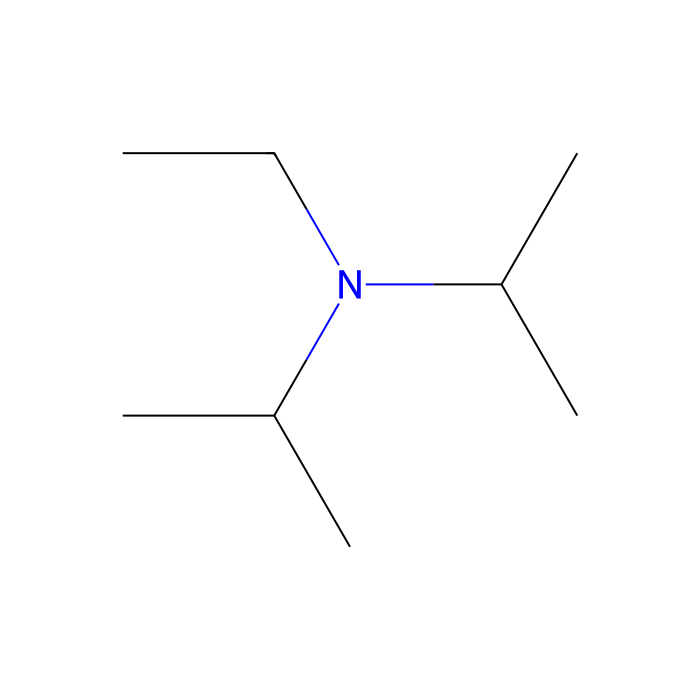
N-乙基二异丙胺 溶液

CAS: 7087-68-5 货号: N433364 分子式: C8H19N 分子量: 129.24 Beilstein号: 4124745 EC号: 230-392-0
有货
级别和纯度: 适用于多肽合成 ? 适用于多肽合成 —— 供固相/液相多肽合成的高纯度试剂。适用于注重偶联效率和低副反应的场合。 ~2 M in 1-methyl-2-pyrrolidinone
别名
DIPEA,N,N-二异丙基乙胺, Hünig 碱
储存条件
避光,室温,充氩
运输条件
DG运输
★
规格
库存
价格
数量
250ml
N433364-250ml
现货 Stock Image
¥715.90
请输入您要添加的产品数量
🧪
为什么选择此级别

适用于多肽合成 级 ,适用于对基线干扰要求严格的色谱和分析工作流程。

🌡

储存与运输

避光,室温,充氩。DG运输 。请查阅批次 COA 获取详细规格。

📋

质量文档

SDS、COA、产品数据表及规格说明书均可下载。可通过批号查询获取批次 COA。

📚

文献证明

在色谱分析、有机合成和交叉偶联反应领域已被 446 篇同行评审文献引用。

概述

应用:

N,N-二异丙基乙胺(DIPEA),也称为Hünig′碱,是一种空间位阻胺。它常被用作多肽合成中的碱。此外,DIPEA还被用于Pd-催化的交叉偶联反应,包括Heck偶联和Sonagashira偶联反应。

N -Ethyldiisopropylamine (EDIA) reacts with monoactivated Michael acceptors to afford symmetrical sulfones.


Application:

N,N-Diisopropylethylamine (DIPEA), also known as Hünig′s base, is a sterically hindered amine. It is commonly employed as a base in peptide synthesis. Additionally, DIPEA is also used in the Pd-catalyzed cross-coupling reactions, which include Heck coupling and Sonagashira coupling reactions.

规格

别名
DIPEA,N,N-二异丙基乙胺, Hünig 碱
英文别名
diisopropylethylarnine | diisoproplyethylamine | EtNiPr2 | i-Pr2EtN | N-(4-chlorobenzyl)piperazine | N-ethyidiisopropylamine | N-ethyl-N-isopropyl-propan-2-amine | N-ethyl-N-isopropylpropan-2-amine | 1H-Imidazol-2-amine xsulfate | (S)-2-((S)-2-Amino-3-phe
规格或纯度
适用于多肽合成, ~2 M in 1-methyl-2-pyrrolidinone
英文名称
N-Ethyldiisopropylamine solution
储存条件
避光,室温,充氩
运输条件
DG运输
名称和识别符
PubChem SID
EC号
230-392-0
分子类型
小分子
IUPAC Name
N-ethyl-N-propan-2-ylpropan-2-amine
INCHI
1S/C8H19N/c1-6-9(7(2)3)8(4)5/h7-8H,6H2,1-5H3
InChi Key
JGFZNNIVVJXRND-UHFFFAOYSA-N
Smiles
CCN(C(C)C)C(C)C
Isomeric SMILES
CCN(C(C)C)C(C)C
UN Number
Packing Group
I
分子量
129.24
Beilstein号
4124745
Reaxy-Rn
605301
Reaxys-RN link address
https://www.reaxys.com/reaxys/secured/hopinto.do?context=S&query=IDE.XRN=605301&ln=

技术文档

📋 安全数据表 (SDS)

全面的危险、操作、储存及法规合规文件。

下载 SDS →

✅ 分析证书 (COA)

批次质量数据。输入批号以获取对应 COA。

查询 COA →

📊 产品数据表

产品规格和应用的快速参考摘要。

查看数据表 →

🔬 规格说明书

该级别的完整质量属性和验收标准。

查看规格说明 →

高级数据

系统学分类

分类树(Taxonomy Tree)

界(kingdom) 有机化合物
超类(Superclass) 有机氮化合物
类(Class) 有机氮化合物
亚类(Subclass) 胺类
中间层级节点(Intermediate Tree Nodes) 叔胺
直接上位类(Direct Parent) 三烷基胺
其他上位类(Alternative Parents) 有机光子化合物  碳氢化合物衍生物  
分子骨架(Molecular Framework) 脂肪族无环化合物
取代基(Substituents) 脂肪族非环化合物 - 烃衍生物 - 有机氮化合物 - 三元脂肪胺
描述(Description) 该化合物属于有机化合物中的三烷基胺类。这类化合物含有三烷基胺基团,其特征在于三个烷基基团精确地与氨基氮原子相连。
外部描述符(External Descriptors) 暂无
三维结构
交互式化学结构模型


化学和物理性质
敏感性
对光线敏感;对空气敏感;易吸潮
折光率
1.414
闪点(℉)
51.08 ℉
闪点(℃)
10.6°C
沸点
127°C
熔点
-45 °C
分子量
129.240 g/mol
XLogP3
2.200
氢键供体数Hydrogen Bond Donor Count
0
氢键受体数Hydrogen Bond Acceptor Count
1
可旋转键计数Rotatable Bond Count
3
精确质量Exact Mass
129.152 Da
单同位素质量Monoisotopic Mass
129.152 Da
拓扑极表面积Topological Polar Surface Area
3.200 Ų
重原子数Heavy Atom Count
9
形式电荷Formal Charge
0
复杂度Complexity
59.000
同位素原子数Isotope Atom Count
0
定义的原子立体中心计数Defined Atom Stereocenter Count
0
未定义的原子立体中心计数Undefined Atom Stereocenter Count
0
定义的键立体中心计数Defined Bond Stereocenter Count
0
未定义的键立体中心计数Undefined Bond Stereocenter Count
0
所有立体化学键的总数The total count of all stereochemical bonds
0
共价键合单元计数Covalently-Bonded Unit Count
1
安全和危险性(GHS)
一般危化品
一般危化品
象形图
GHS02,   GHS05,   GHS06,   GHS08,   GHS09
信号词
危险
危险声明

H226: 易燃液体和蒸气

H302: 吞食有害

H314: 造成严重的皮肤灼伤和眼睛损伤

H331: 吸入会中毒

H335: 可能引起呼吸道刺激

H360: 可能损害生育力或未出生的孩子

H402: 对水生生物有害

H411: 对水生生物有毒并具有长期持续影响

预防措施声明

P201: 使用前获取特殊说明

P210: 远离热源,热表面,火花,明火和其他点火源。 - 禁止抽烟。

P202: 在阅读并理解所有安全预防措施之前,不要进行操作。

P233: 保持容器密闭。

P240: 地面/粘结容器和接收设备

P241: 使用防爆的[电气/通风/照明/.../]设备。

P242: 仅使用无火花的工具。

P243: 采取防静电措施

P261: 避免吸入灰尘/烟雾/气体/雾/蒸汽/喷雾

P264: 处理后要彻底洗手。

P270: 使用本产品时,请勿进食、饮水或吸烟。

P271: 仅在室外或通风良好的地方使用。

P273: 避免释放到环境中。

P280: 戴防护手套/穿防护服/戴防护眼罩/戴防护面具。

P363: 再次使用之前,请清洗受污染的衣物。

P391: 收集溢出物

P301+P330+P331: 如误吞咽:漱口。不要诱导呕吐。

P303+P361+P353: 如皮肤(或头发)沾染:立即脱掉所有沾染的衣服。用水清洗皮肤/淋浴。

P305+P351+P338: 如进入眼睛:用水小心冲洗几分钟。如戴隐形眼镜并可方便地取出,取出隐形眼镜。继续冲洗。

P308+P313: 如接触到或有疑虑:求医/就诊。

P370+P378: 火灾时:使用干砂、干粉或抗醇泡沫灭火。

P403+P233: 存放在通风良好的地方。保持容器密闭。

P403+P235: 存放在通风良好的地方。保持低温。

P501: 将内容物/容器处理到。。。

P301+P312+P330: 如误吞咽:如感觉不适,呼叫急救中心/医生。漱口

WGK Germany
2
Class
6.1 (3)
个人防护装备
Faceshields,full-face respirator (US),Gloves,Goggles,multi-purpose combination respirator cartridge (US),type ABEK (EN14387) respirator filter
质检证书(CoA,COO,BSE/TSE 和分析图谱)
C of A & Other Certificates(BSE/TSE, COO):
输入批号以搜索分析图谱:

通过匹配包装上的批号来查找并下载产品的 COA,每批产品都进行了严格的验证,您可放心使用!

找到2个结果

批号(Lot Number) 证书类型 货号
D2423347 分析证书 N433364
D2423348 分析证书 N433364
技术文档和文章
适用于多肽合成试剂
Suitable for peptide synthesis
新型酯化方法——NDTP缩合剂介导的快速酯化
A New Esterification Method — Rapid Esterification Mediated by the Coupling Reagent NDTP
SPPS 多肽固相合成树脂选型全指南:Fmoc/Boc 路线、C 端酸/酰胺与关键参数导航
A Complete Guide to Choosing Resins for SPPS (Solid-Phase Peptide Synthesis): Fmoc/Boc Routes, C-Terminal Acid/Amide, and a Key-Parameter Navigator
小分子化学探针实用指南:概念纠偏、因果验证与实验选型(含产品导航与表A–D)
A Practical Guide to Small-Molecule Chemical Probes: Concept Clarification, Causal Validation, and Experimental Selection (with Product Navigation and Tables A–D)
OSF/ASF 双通道工具箱:四元小环磺酰氟的分流反应、条件旋钮与选型导航
OSF/ASF Dual-Channel Toolbox: Divergent Reactions of Four-Membered Ring Sulfonyl Fluorides, Condition “Knobs,” and Selection Navigation
从哌啶到吡啶:2013–2023 FDA 小分子新药里“最常见含氮杂环”更替与选型导航(表1–4)
From Piperidine to Pyridine: The “Most Common N-Heterocycle” Shift in FDA Small-Molecule New Drugs (2013–2023) and a Selection Guide (Tables 1–4)
把“芳基氯 + 低Pd + 放大复现”做稳:Pd–NHC(钯-N-杂环卡宾)交叉偶联的启动与耐久逻辑(含选型导航与产品表)
Make “Aryl Chlorides + Low Pd Loading + Scale-Up Reproducibility” Reliable: The Initiation and Durability Logic of Pd–NHC (Palladium–N-Heterocyclic Carbene) Cross-Coupling (with Selection Navigation and Product Tables)
β-酰氧基烯基酰胺(AAAs):一种值得关注的酰胺键与肽键构建新思路
β-Acyloxy Alkenyl Amides (AAAs): A New Approach to Amide Bond and Peptide Bond Construction Worth Attention
从分析仪器到合成装置:常规分析型 HPLC 重构自动化流动固相多肽合成的新思路
From Analytical Instrument to Synthetic Platform: A New Strategy for Reconstructing Automated Flow Solid-Phase Peptide Synthesis with Standard Analytical HPLC
认识 ATD-DMAP:从试剂设计到成酯、成酰胺与手性保持
Understanding ATD-DMAP: From Reagent Design to Esterification, Amidation, and Stereochemical Integrity
空间大位阻多肽固相合成的新进展:RMMR 策略的背景、核心突破与自动化兼容性启示
New Progress in the Solid-Phase Synthesis of Sterically Hindered Peptides: Background, Core Breakthroughs, and Implications for Automation Compatibility of the RMMR Strategy
缩合试剂的新平衡:DMT-TU 如何平衡反应活性、消旋控制与热危险性
A New Balance in Coupling Reagents: How DMT-TU Balances Reactivity, Racemization Control, and Thermal Hazard
重新认识 N-酰基型氨基保护基:Ac、Bz 与 Tfa 的脱保护差异、路线分工与实验选用思路
Reconsidering N-Acyl Amino Protecting Groups: Deprotection Differences, Strategic Roles, and Experimental Selection of Ac, Bz, and Tfa
TfOH(三氟甲磺酸)介导 N-芳基磺酰胺的选择性脱保护与磺酰基迁移:反应规律及合成启发
Selective Deprotection and Sulfonyl Group Migration of N-Aryl Sulfonamides Mediated by TfOH (Trifluoromethanesulfonic Acid): Reaction Patterns and Synthetic Implications
TBTU 的应用定位:消旋风险、延伸用途与选用判断
The Positioning of TBTU in Practice: Racemization Risk, Extended Uses, and Selection Criteria
从“高收率”到“保构型”:缩合体系的活化阶段风险、路线差异与选用思路
From “High Yield” to “Configuration Retention”: Activation-Stage Risks, Route Differences, and Selection Principles for Coupling Systems
HATU 在困难偶联中的方法学价值:活性优势、手性保持与条件管理
The Methodological Value of HATU in Difficult Couplings: Reactivity Advantages, Stereochemical Retention, and Condition Management
Boc-Oxyma 的方法学价值:低消旋偶联、路线衔接与延伸用途
The Methodological Value of Boc-Oxyma: Low-Racemization Coupling, Route Continuity, and Extended Applications
多肽合成中的低消旋,不只是试剂选择:活化阶段的构型风险与实验控制思路
Low Racemization in Peptide Synthesis Is Not Just About Reagent Choice: Stereochemical Risk During the Activation Stage and Practical Strategies for Experimental Control
DSC 的方法学价值:NHS 型活化中间体的构建与选用判断
The Methodological Value of DSC: Building NHS-Type Activated Intermediates and Deciding When to Use Them
TCFH 的方法学价值:困难酰胺化中的应用优势与羧酸活化路径的切换逻辑
The Methodological Value of TCFH: Advantages in Challenging Amidation and the Switching Logic of Carboxylic Acid Activation Pathways
多肽合成中的低消旋控制:活化 α-氨基酸酯的逆向 N→C 成肽思路
Low-Racemization Control in Peptide Synthesis: An Inverse N→C Peptide Synthesis Strategy via Activated α-Aminoesters
炔酰胺缩合试剂:从低差向异构化活化路径到更接近实用的 N→C 反向成肽
Ynamide Coupling Reagents: From Low-Epimerization Activation Pathways to More Practically Usable N→C Inverse Peptide Synthesis
多肽合成路线的判断逻辑:从 SPPS、LPPS 到重组表达的适用情形与判断依据
Decision Logic for Peptide Synthesis Routes: Applicability and Criteria for Choosing among SPPS, LPPS, and Recombinant Expression
酰胺键形成中缩合剂选型的判断逻辑:活化路径、副反应、差向异构化、后处理与安全性
Decision Logic for Selecting Coupling Reagents in Amide Bond Formation: Activation Pathways, Side Reactions, Epimerization, Workup, and Safety
羧酸预活化路线的实验选型逻辑:经典混合酸酐、CDI、磺酰氯与 Yamaguchi 体系的区别与适用情形
Experimental Selection Logic for Carboxylic Acid Preactivation Pathways: Differences and Suitable Use Cases for Classical Mixed Anhydrides, CDI, Sulfonyl Chloride Systems, and the Yamaguchi System
DBU 在不同体系中的反应角色:强有机碱、亲核催化与反应路径参与的实验判断
Reaction Roles of DBU in Different Systems: Experimental Judgment from a Strong Organic Base to Nucleophilic Catalysis and Participation in the Reaction Pathway
Boc₂O 的选用不能只看保护引入:从底物亲核性、介质效应到脱保护路径的实验判断
Boc₂O Selection Cannot Be Judged by Protection Installation Alone: Experimental Decision-Making from Substrate Nucleophilicity and Medium Effects to Deprotection Pathways
DMAP 不只是有机碱:从亲核酰基转移到酯化与大环内酯化的实验判断
DMAP Is More Than Just an Organic Base: Experimental Judgment from Nucleophilic Acyl Transfer to Esterification and Macrolactonization
HOPO 在碳二亚胺介导酰胺偶联中的实验判断:低消旋控制、适用场景与工艺考量
Experimental Assessment of HOPO in Carbodiimide-Mediated Amide Coupling: Low-Racemization Control, Application Scenarios, and Process Considerations
五氟苯基体系的实验选用逻辑:从活性酯、预活化单体到下游转化的实验判断
Experimental Selection Logic for Pentafluorophenyl-Based Systems: Practical Judgment from Active Esters and Pre-Activated Monomers to Downstream Transformations
SEM-Cl 的实验选用:从 O/N-SEM 保护、杂环定向官能化到受保护 C1 片段引入
Experimental Selection of SEM-Cl: From O/N-SEM Protection and Directed Functionalization of N-Heterocycles to the Introduction of Protected C1 Fragments
Oxyma 偶联体系的实验判断:偶联效率、消旋控制与 DIC 体系的 HCN 风险
Experimental Judgment in Oxyma Coupling Systems: Coupling Efficiency, Racemization Control, and the HCN Risk in DIC-Based Systems
三光气在有机合成中的实验判断:按反应任务理解其选用逻辑
Experimental Evaluation of Triphosgene in Organic Synthesis: Understanding Its Selection Logic Through Reaction Tasks
4-[(叔丁基二甲基硅基)氧基]丁-1-醇:作为单保护 1,4-丁二醇构件和受保护 C4 连接臂的实验选型判断
4-[(tert-Butyldimethylsilyl)oxy]butan-1-ol: Experimental Selection Logic as a Monoprotected 1,4-Butanediol Building Block and a Protected C4 Linker
三苯基膦参与的羧酸活化与酰胺键形成:活化路径、酸酐竞争与适用场景
Triphenylphosphine-Involved Carboxylic Acid Activation and Amide Bond Formation: Activation Pathways, Anhydride Competition, and Applicability Scenarios
CMPI 在羧酸活化中的实验判断:适用任务、碱匹配与后处理负担
Experimental Judgment for CMPI in Carboxylic Acid Activation: Applicable Tasks, Base Matching, and Workup Burden
TFPN 在羧酸活化中的实验判断:适用情形、中间体分布与亲核体适配
Experimental Judgment for TFPN in Carboxylic Acid Activation: Suitable Scenarios, Intermediate Distribution, and Nucleophile Compatibility
可见光催化在有机合成中的实验判断与条件选择
Experimental Judgment and Condition Selection for Visible-Light Catalysis in Organic Synthesis
小分子合成中的反应选择:从转化类型判断到实验路径筛选
Reaction Selection in Small-Molecule Synthesis: From Transformation-Type Assessment to Experimental Route Screening
如何判断一个蛋白是否适合靶向降解:从降解通路、分子设计到机制验证
How to Determine Whether a Protein Is Suitable for Targeted Degradation: From Degradation Pathway and Molecular Design to Mechanism Validation
复杂底物中低活性胺的选择性酰化:N/O 与 N/N 选择性控制思路
Selective Acylation of Less Reactive Amines in Complex Substrates: Strategies for N/O and N/N Selectivity Control This article draws on the work of Li et al. on the TCFH/catalytic Oxyma system and transient imine protection, and summarizes design strateg
多肽合成异常杂质如何排查?从氨基相关副反应看工艺问题定位
How to Troubleshoot Abnormal Impurities in Peptide Synthesis? Locating Process Issues Through Amino-Related Side Reactions
多肽中间体难溶、难分离?标签辅助液相肽合成(TAG-LPPS)的路线设计与后处理策略
Peptide Intermediates Difficult to Dissolve and Separate? Route Design and Workup Strategies for Tag-Assisted Liquid-Phase Peptide Synthesis (TAG-LPPS)
AITF 介导羧酸活化用于酰胺、肽和酯合成:活化机制与适用场景
AITF-Mediated Carboxylic Acid Activation for the Synthesis of Amides, Peptides, and Esters: Activation Mechanism and Applicable Scenarios
多肽合成中羧基与羟基相关杂质的形成与控制——以 Asp/Glu 和 Ser/Thr 残基副反应为例
Formation and Control of Carboxyl- and Hydroxyl-Related Impurities in Peptide Synthesis — Using Asp/Glu and Ser/Thr Residue Side Reactions as Examples
桥头位 α-氟胺的稳定化设计及其药物化学砌块价值
Stabilization Design of Bridgehead α-Fluoroamines and Their Value as Medicinal Chemistry Building Blocks
CTSOBt 苯并三氮唑-磺酸酯缩合试剂:羧酸活化与合成应用价值
CTSOBt Benzotriazole–Sulfonate Coupling Reagent: Carboxylic Acid Activation and Synthetic Application Value
氮杂三环烷烃的张力释放:三维氮杂桥环的桥位模块化官能团化与立体控制
Strain Release of Azatricycloalkanes: Modular Bridge-Position Functionalization and Stereochemical Control of Three-Dimensional Bridged Aza Scaffolds
从光催化开环到骨架重构:氧杂环丁烷氧原子置换的反应逻辑与合成应用
From Photocatalytic Ring Opening to Skeletal Reconstruction: Reaction Logic and Synthetic Applications of Oxygen-Atom Replacement in Oxetanes
乙酰基四肽-2与弹性纤维形成:Fibulin-5、LOXL1及皮肤紧致相关研究
Acetyl Tetrapeptide-2 and Elastic Fiber Formation: Research on Fibulin-5, LOXL1, and Skin Firmness
棕榈酰五肽-4如何作用于皮肤:从KTTKS序列、皮肤递送到胶原基质响应
How Palmitoyl Pentapeptide-4 Acts on the Skin: From the KTTKS Sequence and Skin Delivery to Collagen Matrix Responses
环化如何改变多肽行为:以Cyclopeptide-5为例解析构象预组织、皮肤递送与整合素结合
How Cyclization Changes Peptide Behavior: Conformational Preorganization, Skin Delivery, and Integrin Binding, Using Cyclopeptide-5 as an Example
1,8-萘啶型醛糖还原酶抑制剂:骨架构建、体外抑制活性与结构优化方向
1,8-Naphthyridine-Based Aldose Reductase Inhibitors: Scaffold Construction, In Vitro Inhibitory Activity, and Directions for Structural Optimization
一级、二级胺为何难以直接参与经典Mitsunobu反应:BEHT介导醇胺化的机理、构型翻转与反应范围
Why Primary and Secondary Amines Have Difficulty Participating Directly in the Classical Mitsunobu Reaction: Mechanism, Inversion of Configuration, and Reaction Scope of BEHT-Mediated Alcohol Amination
乙酰基六肽-8在表情纹管理中的作用基础:SNARE复合体干预、经皮递送限制与复配思路
Mechanistic Basis of Acetyl Hexapeptide-8 in the Management of Expression Lines: SNARE Complex Interference, Constraints on Percutaneous Delivery, and Combination Strategies
ImCl[H₂F₃]的储存稳定性与脱氧氟化反应性——H₂F₃⁻氟源反应性调控与2-氯咪唑鎓底物活化
Storage Stability and Deoxyfluorination Reactivity of ImCl[H₂F₃]—Reactivity Modulation of the H₂F₃⁻ Fluoride Source and Substrate Activation by 2-Chloroimidazolium
蓝铜胜肽 GHK-Cu 与皮肤修复:从铜配位化学到细胞外基质重塑
Copper Tripeptide GHK-Cu and Skin Repair: From Copper Coordination Chemistry to Extracellular Matrix Remodeling
从 DENV-2 筛选命中到四血清型覆盖:JNJ-1802 的泛血清型构效关系优化
From a DENV-2 Screening Hit to Coverage of All Four Serotypes: Pan-Serotype Structure–Activity Relationship Optimization of JNJ-1802
此产品的引用文献
溶液计算器
