
乙腈(ACN)

CAS: 75-05-8 货号: A104445 分子式: C2H3N 分子量: 41.05 Beilstein号: 741857 EC号: 200-835-2
有货
级别和纯度: 用于DNA合成 ? DNA 合成级 —— 供寡核苷酸合成的高纯度试剂。适用于纯度决定产率的亚磷酰胺 DNA 合成。 ≥99.9%(GC)
别名
色谱乙腈
储存条件
室温,充氩
运输条件
DG运输
★
规格
库存
价格
数量
100ml
A104445-100ml
现货 Stock Image
¥227.90
2.5L
A104445-2.5L
现货 Stock Image
¥561.90
4×2.5L
A104445-4×2.5L
现货 Stock Image
¥1,999.90
请输入您要添加的产品数量
🧪
为什么选择此级别

用于DNA合成 级 提供 ≥99.9%(GC) 纯度,适用于对基线干扰要求严格的色谱和分析工作流程。

🌡

储存与运输

室温,充氩。DG运输 。请查阅批次 COA 获取详细规格。

📋

质量文档

SDS、COA、产品数据表及规格说明书均可下载。可通过批号查询获取批次 COA。

📚

文献证明

在色谱分析、有机合成和交叉偶联反应领域已被 3344 篇同行评审文献引用。

概述

有轻微醚气味。有毒。燃烧时发光火焰。能与水、乙醚、甲醇、丙酮、氯仿、四氯化碳、氯化乙烯、乙酸甲酯、乙酸乙酯、乙酰胺溶液和许多不饱和烃混溶,不能与饱和烃混溶。能溶解一些无机盐类,如硝酸银、硝酸锂和溴化镁等。能与水形成共沸混合物(含水16%) 乙腈最主要的用途是作溶剂。在石油工业中用于从石油烃中除去焦油、酚等物质的溶剂。在油脂工业中用作从动植物油中抽提脂肪酸的溶剂,在医药上用于甾族类药物的再结晶的反应介质。乙腈是医药(维生素B1),香料的中间体,是制造均三嗪氮肥增效剂的原料。也用作酒精的变性剂。此外,还可以用于合成乙胺、乙酸等,并在织物染色、照明工业中也有许多用途。


规格

别名
色谱乙腈
英文别名
ACN | Acetonitril (GERMAN, DUTCH) | ACETONITRILE | ace-tonitrile | aceto-nitrile | acetonitrile- | DTXCID909 | acetonitnle | Acetonitrile 1000 microg/mL in Methanol | Acetonitrile, puriss., 95% | Acetonitrile, Environmental Grade | Acetonitrile, for DNA s
规格或纯度
用于DNA合成, ≥99.9%(GC)
英文名称
Acetonitrile(ACN)
应用
乙腈最主要的用途是作溶剂。在石油工业中用于从石油烃中除去焦油、酚等物质的溶剂。在油脂工业中用作从动植物油中抽提脂肪酸的溶剂,在医药上用于甾族类药物的再结晶的反应介质。乙腈是医药(维生素B1),香料的中间体,是制造均三嗪氮肥增效剂的原料。也用作酒精的变性剂。此外,还可以用于合成乙胺、乙酸等,并在织物染色、照明工业中也有许多用途。
储存条件
室温,充氩
运输条件
DG运输
纯度
≥99.9%(GC)
名称和识别符
PubChem SID
EC号
200-835-2
分子类型
小分子
IUPAC Name
acetonitrile
INCHI
1S/C2H3N/c1-2-3/h1H3
InChi Key
WEVYAHXRMPXWCK-UHFFFAOYSA-N
Smiles
CC#N
Isomeric SMILES
CC#N
UN Number
Packing Group
II
分子量
41.05
Beilstein号
741857

技术文档

📋 安全数据表 (SDS)

全面的危险、操作、储存及法规合规文件。

下载 SDS →

✅ 分析证书 (COA)

批次质量数据。输入批号以获取对应 COA。

查询 COA →

📊 产品数据表

产品规格和应用的快速参考摘要。

查看数据表 →

🔬 规格说明书

该级别的完整质量属性和验收标准。

查看规格说明 →

高级数据

系统学分类

分类树(Taxonomy Tree)

界(kingdom) 有机化合物
超类(Superclass) 有机氮化合物
类(Class) 有机氮化合物
亚类(Subclass) 有机氰化物
中间层级节点(Intermediate Tree Nodes) 暂无
直接上位类(Direct Parent) 腈类
其他上位类(Alternative Parents) 有机光子化合物  碳氢化合物衍生物  
分子骨架(Molecular Framework) 脂肪族无环化合物
取代基(Substituents) 脂肪族非环化合物 - 碳腈 - 烃衍生物 - 氰基化合物 - 有机氮化合物
描述(Description) 该化合物属于有机化合物类别中的氰基化合物。这类化合物具有RC#N结构,即氰化氢(HC#N)的C位取代衍生物。
外部描述符(External Descriptors) aliphatic nitrile
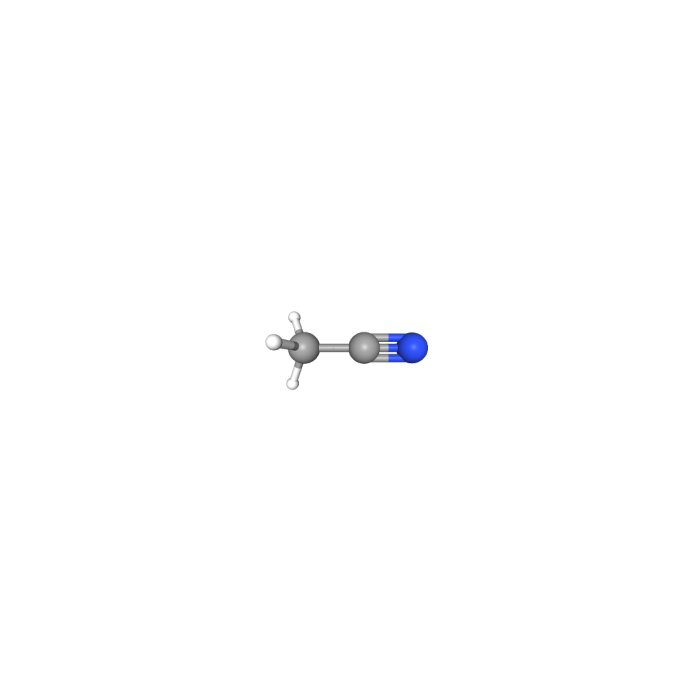
三维结构
交互式化学结构模型


关联靶点(其它种属)
Nfe2l2 Nuclear factor erythroid 2-related factor 2 (214 活性数据)
活性类型 Relation Activity value Units Action Type 期刊 PubMed Id doi Assay Aladdin ID
Nr1i2 Nuclear receptor subfamily 1 group I member 2 (14 活性数据)
活性类型 Relation Activity value Units Action Type 期刊 PubMed Id doi Assay Aladdin ID
作用机制
作用机制 Action Type target ID Target Name Target Type Target Organism Binding Site Name 参考文献
化学和物理性质
密度
0.786
敏感性
对空气敏感;易吸潮
折光率
1.343-1.345
闪点(℃)
2 °C
沸点
81-82°C
熔点
-46°C
分子量
41.050 g/mol
XLogP3
0.000
氢键供体数Hydrogen Bond Donor Count
0
氢键受体数Hydrogen Bond Acceptor Count
1
可旋转键计数Rotatable Bond Count
0
精确质量Exact Mass
41.0265 Da
单同位素质量Monoisotopic Mass
41.0265 Da
拓扑极表面积Topological Polar Surface Area
23.800 Ų
重原子数Heavy Atom Count
3
形式电荷Formal Charge
0
复杂度Complexity
29.300
同位素原子数Isotope Atom Count
0
定义的原子立体中心计数Defined Atom Stereocenter Count
0
未定义的原子立体中心计数Undefined Atom Stereocenter Count
0
定义的键立体中心计数Defined Bond Stereocenter Count
0
未定义的键立体中心计数Undefined Bond Stereocenter Count
0
所有立体化学键的总数The total count of all stereochemical bonds
0
共价键合单元计数Covalently-Bonded Unit Count
1
安全和危险性(GHS)
一般危化品
一般危化品
象形图
GHS02,   GHS07
信号词
危险
危险声明

H225: 高度易燃的液体和蒸气

H319: 引起严重眼睛刺激

H302+H312+H332: 吞咽,皮肤接触或吸入有害。

预防措施声明

P210: 远离热源,热表面,火花,明火和其他点火源。 - 禁止抽烟。

P233: 保持容器密闭。

P240: 地面/粘结容器和接收设备

P241: 使用防爆的[电气/通风/照明/.../]设备。

P242: 仅使用无火花的工具。

P243: 采取防静电措施

P261: 避免吸入灰尘/烟雾/气体/雾/蒸汽/喷雾

P264: 处理后要彻底洗手。

P270: 使用本产品时,请勿进食、饮水或吸烟。

P271: 仅在室外或通风良好的地方使用。

P280: 戴防护手套/穿防护服/戴防护眼罩/戴防护面具。

P321: 特殊处理(请参阅此标签上的...)。

P330: 漱口

P302+P352: 如皮肤沾染:用水充分清洗。

P303+P361+P353: 如皮肤(或头发)沾染:立即脱掉所有沾染的衣服。用水清洗皮肤/淋浴。

P304+P340: 如误吸入:将人转移到空气新鲜处,保持呼吸舒适体位。

P305+P351+P338: 如进入眼睛:用水小心冲洗几分钟。如戴隐形眼镜并可方便地取出,取出隐形眼镜。继续冲洗。

P362+P364: 脱掉沾污的衣服,清洗后方可重新使用。

P370+P378: 火灾时:使用干砂、干粉或抗醇泡沫灭火。

P403+P235: 存放在通风良好的地方。保持低温。

P501: 将内容物/容器处理到。。。

P264+P265: 处理后彻底洗手[和…]。不要触摸眼睛。

P301+P317: 如果被吞咽:请寻求医疗帮助。

P317: 寻求紧急医疗救助。

P337+P317: 如果眼睛刺激持续:寻求医疗帮助。

WGK Germany
2
Class
3
Merck Index
70
质检证书(CoA,COO,BSE/TSE 和分析图谱)
C of A & Other Certificates(BSE/TSE, COO):
输入批号以搜索分析图谱:

通过匹配包装上的批号来查找并下载产品的 COA,每批产品都进行了严格的验证,您可放心使用!

找到15个结果

批号(Lot Number) 证书类型 货号
D2615174 分析证书 A104445
D2615176 分析证书 A104445
F2526025 分析证书 A104445
I2512068 分析证书 A104445
L2405288 分析证书 A104445
L2405289 分析证书 A104445
F2404256 分析证书 A104445
F2404257 分析证书 A104445
B2426267 分析证书 A104445
B2426268 分析证书 A104445
E2310741 分析证书 A104445
I1828056 分析证书 A104445
G1820002 分析证书 A104445
D1819024 分析证书 A104445
I2315113 分析证书 A104445
技术文档和文章
用于DNA合成
For DNA Synthesis
肽图检查法鉴定蛋白质结构
Peptide Mapping for Protein Structure Identification
如何将疏水性药物装载到脂质体中?
How do I load a hydrophobic drug into liposomes?
新型酯化方法——NDTP缩合剂介导的快速酯化
A New Esterification Method — Rapid Esterification Mediated by the Coupling Reagent NDTP
用于DNA合成(for DNA synthesis)试剂等级详解及关键试剂清单
“For DNA Synthesis” Reagent Grade — Detailed Explanation & Rationale
精馏级(Distillation Grade)试剂指南:定义、质量控制与阿拉丁代表产品
Distillation Grade Reagents: Definition, Quality Control and Representative Aladdin Products
橙皮苷:藏在柑橘果皮里的多功能黄酮
Hesperidin: A Multifunctional Flavonoid Hidden in Citrus Peels
钯催化反应一站式手册:催化循环、失活排查、配体/预催化剂选型与阿拉丁清单
One-Stop Handbook for Palladium-Catalyzed Reactions: Catalytic Cycles, Deactivation Troubleshooting, Ligand/Precatalyst Selection, and an Aladdin Reference List
分钟级构建氟代含氮桥环:Pd(II)/Pd(IV) 串联反应与 Pd(IV)“成对迁移(dyotropic)”重排驱动的应力释放环扩张
Minute-Scale Construction of Fluorinated Nitrogen-Bridged Bicycles: Pd(II)/Pd(IV) Cascade Chemistry and a Pd(IV) “Dyotropic (Paired-Migration)” Rearrangement Driving Strain-Release Ring Expansion
TEMPO 催化氧化速查(醇氧化主线):三条再生路线(NaOCl / Cu–O₂ / PIDA)与选型排故
TEMPO-Catalyzed Oxidation Quick Reference (Alcohol Oxidation Focus): Three Regeneration Routes (NaOCl / Cu–O₂ / PIDA) + Selection & Troubleshooting
植物可溶性糖检测技术研究进展
Research Progress in Detection Technologies for Soluble Sugars in Plants
芍药苷(Paeoniflorin):结构特征、理化性质与分析质控要点
Paeoniflorin: Structural Features, Physicochemical Properties, and Key Considerations for Analytical Quality Control
SPPS 多肽固相合成树脂选型全指南:Fmoc/Boc 路线、C 端酸/酰胺与关键参数导航
A Complete Guide to Choosing Resins for SPPS (Solid-Phase Peptide Synthesis): Fmoc/Boc Routes, C-Terminal Acid/Amide, and a Key-Parameter Navigator
把生物分子装上红氧开关:ATTO MB2 NHS ester 的原理、偶联要点与应用导航
Installing a Redox Switch on Biomolecules: Principles, Conjugation Essentials, and an Application Guide for ATTO MB2 NHS ester
小分子化学探针实用指南:概念纠偏、因果验证与实验选型(含产品导航与表A–D)
A Practical Guide to Small-Molecule Chemical Probes: Concept Clarification, Causal Validation, and Experimental Selection (with Product Navigation and Tables A–D)
后期氟化工具箱:给候选分子做“微创升级”:四类“氟旋钮”→ 亲电/亲核两大路线 → ¹⁸F-PET 示踪分线 → 选型导航与代表产品清单
Late-Stage Fluorination Toolbox: “Minimally Invasive Upgrades” for Lead Candidates: Four “Fluorine Knobs” → Two major routes (electrophilic vs nucleophilic) → An ¹⁸F-PET tracer branch → Selection navigation & representative product list
OSF/ASF 双通道工具箱:四元小环磺酰氟的分流反应、条件旋钮与选型导航
OSF/ASF Dual-Channel Toolbox: Divergent Reactions of Four-Membered Ring Sulfonyl Fluorides, Condition “Knobs,” and Selection Navigation
从哌啶到吡啶:2013–2023 FDA 小分子新药里“最常见含氮杂环”更替与选型导航(表1–4)
From Piperidine to Pyridine: The “Most Common N-Heterocycle” Shift in FDA Small-Molecule New Drugs (2013–2023) and a Selection Guide (Tables 1–4)
甲氧基(–OCH₃)在已上市小分子药物中的结构功能解析:作用机制、证据链与产品选型导航(附相关产品表)
Structural–Functional Analysis of the Methoxy Group (–OCH₃) in Approved Small-Molecule Drugs: Mechanisms, Evidence Chains, and Product-Selection Navigation (with Related Product Tables)
合成锌试剂(Organozinc Reagents)实用指南:结构特性、关键反应与实用选型导航(含阿拉丁产品表)
A Practical Guide to Organozinc Reagents for Synthesis (Organozinc Reagents): Structural Features, Key Reactions, and a Practical Selection Navigation (Including Aladdin Product Tables)
吖啶为何能把“微量分子”变成“可测的光信号”:吖啶鎓酯化学发光免疫分析的机制、选型与排错指南(含产品表1–表4)
Why Acridine Can Turn “Trace Molecules” into a Measurable Light Signal: A Mechanistic, Selection, and Troubleshooting Guide to Acridinium Ester Chemiluminescent Immunoassays (Including Product Tables 1–4)
关于诺丝菌素的16个常见问题
16 Frequently Asked Questions About Nourseothricin
植物组学技术全景:基因组—转录组—蛋白质组—代谢组的流程框架与多组学整合应用
Plant Omics Panorama: Workflow Frameworks and Multi-Omics Integration from Genomics to Transcriptomics, Proteomics, and Metabolomics
氨基酸氧化酶:氧依赖性氧化脱氨反应体系及其分析与应用
Amino Acid Oxidases: Oxygen-Dependent Oxidative Deamination Systems and Their Analytical and Applied Uses
Suzuki–Miyaura 反应怎么做稳:定位瓶颈,锁定可复现窗口(含选型导航及产品表1–表5)
How to Make the Suzuki–Miyaura Reaction Robust: Pinpoint the Bottleneck and Lock in a Reproducible Operating Window (with Selection Navigation and Product Tables 1–5)
血管紧张素转换酶(ACE):分子特征、催化功能与科研及转化应用综述
Angiotensin-Converting Enzyme (ACE): A Review of Molecular Features, Catalytic Functions, and Research and Translational Applications
凝乳酶:分子特征、凝乳动力学与活力评价的研究综述
Chymosin: A Review of Molecular Features, Coagulation Kinetics, and Activity Evaluation
植酸酶:酶学特性、作用机理与饲料及食品领域应用
Phytase: Enzymological Properties, Mechanism of Action, and Applications in Feed and Food
叶绿素:结构特征、理化性质与科研及产业应用要点
Chlorophyll: Structural Features, Physicochemical Properties, and Key Points for Research and Industrial Applications
阿奇霉素:理化特征、作用机制与科研应用要点
Azithromycin: Physicochemical Features, Mechanism of Action, and Key Points for Research Applications
阿魏酸:结构特征、制备获取与科研应用要点
Ferulic Acid: Structural Features, Preparation Routes, and Key Points for Research Applications
丹皮酚:理化特征、用途与科研应用要点
Paeonol: Physicochemical Features, Uses, and Key Points for Research Applications
法莫替丁:理化特征、作用机制与科研应用要点
Famotidine: Physicochemical Features, Mechanism of Action, and Key Points for Research Applications
黄酮:结构特征、理化性质与科研及应用要点
Flavones: Structural Features, Physicochemical Properties, and Key Points for Research and Applications
糖蛋白结构表征与质量属性分析的方法学研究
Methodological Studies on Glycoprotein Structural Characterization and Quality Attribute Analysis
从分析仪器到合成装置:常规分析型 HPLC 重构自动化流动固相多肽合成的新思路
From Analytical Instrument to Synthetic Platform: A New Strategy for Reconstructing Automated Flow Solid-Phase Peptide Synthesis with Standard Analytical HPLC
TCFH–NMI 在高含水体系中的酰胺化:研究价值、方法认识与实验启示
TCFH–NMI Amidation in Highly Aqueous Media: Research Value, Methodological Understanding, and Experimental Insights
从“先还原再酰化”到“直接成酰胺”:硝基及亚硝基底物与 α-酮羧酸的非常规酰胺键构建路线
From “Reduction First, Then Acylation” to “Direct Amidation”: An Unconventional Route to Amide Bond Formation from Nitro and Nitroso Substrates with α-Keto Carboxylic Acids
重新认识三甲基铝:未保护氨基酸一锅法肽链延长的方法设计与实验价值
Reassessing Trimethylaluminum: Method Design and Experimental Value of One-Pot Peptide Elongation from Unprotected Amino Acids
DSC 的方法学价值:NHS 型活化中间体的构建与选用判断
The Methodological Value of DSC: Building NHS-Type Activated Intermediates and Deciding When to Use Them
多酶消化策略与蛋白质组学覆盖度优化研究框架
Research Framework for Multi-Enzyme Digestion Strategies and Optimization of Proteomic Coverage
TCFH 的方法学价值:困难酰胺化中的应用优势与羧酸活化路径的切换逻辑
The Methodological Value of TCFH: Advantages in Challenging Amidation and the Switching Logic of Carboxylic Acid Activation Pathways
多肽合成路线的判断逻辑:从 SPPS、LPPS 到重组表达的适用情形与判断依据
Decision Logic for Peptide Synthesis Routes: Applicability and Criteria for Choosing among SPPS, LPPS, and Recombinant Expression
二溴三苯基膦(PPh₃Br₂)不只是溴化剂:从醇转溴代物到羧酸活化与一锅酯化、烯基溴与腈构建的实验选型逻辑
Triphenylphosphine Dibromide (PPh₃Br₂) Is More Than Just a Brominating Reagent: Experimental Selection Logic from Alcohol-to-Alkyl Bromide Conversion to Carboxylic Acid Activation and One-Pot Esterification, Vinyl Bromide Formation, and Nitrile Constructi
DMAP 不只是有机碱:从亲核酰基转移到酯化与大环内酯化的实验判断
DMAP Is More Than Just an Organic Base: Experimental Judgment from Nucleophilic Acyl Transfer to Esterification and Macrolactonization
双 Boc 及相关 N-Boc 差异化脱保护的实验判断:底物类型、位点响应差与初始条件选择
Experimental Judgment for Differential Deprotection of Double Boc and Related N-Boc Systems: Substrate Type, Site-Response Differences, and Initial Condition Selection
Burgess 试剂实验选型:醇脱水、一级酰胺/醛肟脱水与氧唑啉/噻唑啉环化的判断框架
Experimental Selection of Burgess Reagent: A Decision Framework for Alcohol Dehydration, Primary Amide/Aldoxime Dehydration, and Oxazoline/Thiazoline Cyclization
ADMP 用于伯胺转有机叠氮化物的实验判断:底物亲核性、碱匹配与介质选择
Experimental Considerations for the Use of ADMP in the Conversion of Primary Amines to Organic Azides: Substrate Nucleophilicity, Base Matching, and Medium Selection
Fmoc 引入路线的实验判断:杂质谱差异、原料带入与质量控制
Experimental Assessment of Fmoc Introduction Routes: Impurity Profile Differences, Raw Material Carryover, and Quality Control
TFPN 在羧酸活化中的实验判断:适用情形、中间体分布与亲核体适配
Experimental Judgment for TFPN in Carboxylic Acid Activation: Suitable Scenarios, Intermediate Distribution, and Nucleophile Compatibility
硅烷偶联剂底涂液的配制方法与注意事项
Preparation Methods and Precautions for Silane Coupling Agent Primer Solutions
寡核苷酸化学合成中的偶联活化剂、核苷砌块与修饰设计:对合成效率、纯度和性质的影响
Coupling Activators, Nucleoside Building Blocks, and Modification Design in Oligonucleotide Chemical Synthesis: Their Effects on Synthetic Efficiency, Purity, and Product Properties
多孔石墨化碳(PGC)色谱柱:用分子形状和石墨表面 π 电子云建立困难分离的新选择性
Porous Graphitic Carbon (PGC) Chromatography Columns: Creating New Selectivity for Challenging Separations through Molecular Shape and the π-Electron Cloud on the Graphitic Surface
复杂底物中低活性胺的选择性酰化:N/O 与 N/N 选择性控制思路
Selective Acylation of Less Reactive Amines in Complex Substrates: Strategies for N/O and N/N Selectivity Control This article draws on the work of Li et al. on the TCFH/catalytic Oxyma system and transient imine protection, and summarizes design strateg
多肽合成异常杂质如何排查?从氨基相关副反应看工艺问题定位
How to Troubleshoot Abnormal Impurities in Peptide Synthesis? Locating Process Issues Through Amino-Related Side Reactions
多肽中间体难溶、难分离?标签辅助液相肽合成(TAG-LPPS)的路线设计与后处理策略
Peptide Intermediates Difficult to Dissolve and Separate? Route Design and Workup Strategies for Tag-Assisted Liquid-Phase Peptide Synthesis (TAG-LPPS)
AITF 介导羧酸活化用于酰胺、肽和酯合成:活化机制与适用场景
AITF-Mediated Carboxylic Acid Activation for the Synthesis of Amides, Peptides, and Esters: Activation Mechanism and Applicable Scenarios
多肽合成中羧基与羟基相关杂质的形成与控制——以 Asp/Glu 和 Ser/Thr 残基副反应为例
Formation and Control of Carboxyl- and Hydroxyl-Related Impurities in Peptide Synthesis — Using Asp/Glu and Ser/Thr Residue Side Reactions as Examples
β-羟丁酸检测方法与代谢意义:酶法、血酮仪与LC-MS检测的应用比较
β-Hydroxybutyrate Detection Methods and Metabolic Significance: Comparative Applications of Enzymatic Assays, Blood Ketone Meters, and LC-MS
还原糖检测方法比较:斐林试剂、Benedict法、 DNS法与HPLC法的应用选择
Comparison of Reducing Sugar Detection Methods: Selection of Fehling’s Reagent, Benedict’s Method, DNS Method, and HPLC
CTSOBt 苯并三氮唑-磺酸酯缩合试剂:羧酸活化与合成应用价值
CTSOBt Benzotriazole–Sulfonate Coupling Reagent: Carboxylic Acid Activation and Synthetic Application Value
从硝基芳烃到药物相关吡啶:光诱导芳基氮宾介导的骨架编辑策略
From Nitroarenes to Pharmaceutically Relevant Pyridines: A Photochemically Induced Aryl Nitrene-Mediated Skeletal Editing Strategy
含水介质中酰胺化试剂的选择逻辑:竞争反应、活化中间体与底物效应
Logic for Selecting Amidation Reagents in Aqueous Media: Competing Reactions, Activated Intermediates, and Substrate Effects
非共价3CL蛋白酶抑制剂S-217622的发现与结构优化
Discovery and Structural Optimization of the Noncovalent 3CL Protease Inhibitor S-217622
环化如何改变多肽行为:以Cyclopeptide-5为例解析构象预组织、皮肤递送与整合素结合
How Cyclization Changes Peptide Behavior: Conformational Preorganization, Skin Delivery, and Integrin Binding, Using Cyclopeptide-5 as an Example
生物模拟肽的皮肤作用逻辑:序列与构象、皮肤递送、稳定性及靶点匹配
The Logic of Biomimetic Peptide Action in Skin: Sequence and Conformation, Skin Delivery, Stability, and Target Matching
辅酶Q10如何作用于皮肤:线粒体电子传递、膜脂抗氧化与脂质载体递送
How Coenzyme Q10 Acts on the Skin: Mitochondrial Electron Transfer, Antioxidant Protection of Membrane Lipids, and Lipid-Carrier Delivery
先构建三元环,还是先形成碳—氮键?——环丙胺合成的逆合成策略、路线选择与立体控制
Build the Three-Membered Ring First, or Form the Carbon–Nitrogen Bond First?—Retrosynthetic Strategies, Route Selection, and Stereochemical Control in Cyclopropylamine Synthesis
一级、二级胺为何难以直接参与经典Mitsunobu反应:BEHT介导醇胺化的机理、构型翻转与反应范围
Why Primary and Secondary Amines Have Difficulty Participating Directly in the Classical Mitsunobu Reaction: Mechanism, Inversion of Configuration, and Reaction Scope of BEHT-Mediated Alcohol Amination
乙酰基六肽-8在表情纹管理中的作用基础:SNARE复合体干预、经皮递送限制与复配思路
Mechanistic Basis of Acetyl Hexapeptide-8 in the Management of Expression Lines: SNARE Complex Interference, Constraints on Percutaneous Delivery, and Combination Strategies
ImCl[H₂F₃]的储存稳定性与脱氧氟化反应性——H₂F₃⁻氟源反应性调控与2-氯咪唑鎓底物活化
Storage Stability and Deoxyfluorination Reactivity of ImCl[H₂F₃]—Reactivity Modulation of the H₂F₃⁻ Fluoride Source and Substrate Activation by 2-Chloroimidazolium
芳炔–四嗪三重串联反应的选择性机制:反应路径切换与中间体转化
Selectivity Mechanism of the Triple Aryne–Tetrazine Cascade Reaction: Reaction-Pathway Switching and Intermediate Transformations
含甲基磺酰基杂环的直接构建:预功能化三碳脒鎓盐的合成与应用
Direct Construction of Methylsulfonyl-Containing Heterocycles: Synthesis and Applications of Prefunctionalized Three-Carbon Vinamidinium Salts
氮杂环膦酸酯的合成路线设计:C–P键形成时机与三类路线策略
Synthetic Route Design for Azaheterocyclic Phosphonates: Timing of C–P Bond Formation and Three Route Strategies
未知黄酮类O-糖苷的结构鉴定——分子式、苷元与糖组成、连接位置及端基构型
Structural Elucidation of Unknown Flavonoid O-Glycosides—Molecular Formula, Aglycone and Sugar Composition, Linkage Positions, and Anomeric Configurations
光/镍 C(sp²)–C(sp³) 偶联的动力学匹配:自由基生成、镍物种稳定性与光子通量
Kinetic Matching in Photoredox/Nickel C(sp²)–C(sp³) Coupling: Radical Generation, Nickel-Species Stability, and Photon Flux
LY3509754关键α-溴代酮的构建:β-氧代酯策略与酶促酯水解后的伴随脱羧
Construction of the Key α-Bromoketone Intermediate for LY3509754: A β-Keto Ester Strategy and Concomitant Decarboxylation Following Enzymatic Ester Hydrolysis
分子内 [2+2] 光环加成的连接链效应:直向型与交叉型区域选择性及逐步 C–C 成键
Tether Effects in Intramolecular [2+2] Photocycloadditions: Straight and Crossed Regioselectivity and Stepwise C–C Bond Formation
脱饱和胺化合成氨基杂芳烃:羰基位点预设C–N成键位置与后续脱饱和芳构化
Desaturative Amination for the Synthesis of Amino Heteroarenes: Carbonyl-Site Predefinition of the C–N Bond-Forming Position and Subsequent Desaturative Aromatization
无外加光催化剂条件下的烷烃 C(sp³)–H 光诱导官能化:痕量铁效应
Photoinduced Alkane C(sp³)–H Functionalization in the Absence of an Added Photocatalyst: Trace-Iron Effects
9,10-菲醌及其衍生物的反应性基础:邻二羰基电子结构、电子转移与光化学反应
Fundamentals of the Reactivity of 9,10-Phenanthrenequinone and Its Derivatives: Vicinal Dicarbonyl Electronic Structure, Electron Transfer, and Photochemical Reactions
氨基化 Suzuki–Miyaura 偶联:从 Ar–Ar′ 到 Ar–NH–Ar′ 的成键顺序与化学选择性控制
Aminative Suzuki–Miyaura Coupling: Bond-Formation Order and Chemoselectivity Control in the Transformation from Ar–Ar′ to Ar–NH–Ar′
LY3509754关键α-溴代酮的构建:β-氧代酯策略与酶促酯水解后的伴随脱羧
Construction of the Key α-Bromoketone Intermediate for LY3509754: A β-Keto Ester Strategy and Concomitant Decarboxylation Following Enzymatic Ester Hydrolysis
此产品的引用文献
溶液计算器

常见问题

本产品的纯度是多少?如何测定?
本产品的纯度为 ≥99.9%,采用气相色谱(GC)测定。批次的具体数值以分析证书(COA)为准。
什么是「用于DNA合成」?
「用于DNA合成」表示该产品经过加工和检测,适用于PCR、测序和核酸扩增。典型规格包括:低或不可检测的核酸酶/蛋白酶活性、低内毒素、受控的微生物限度,以及高批间重现性。
本产品应如何储存?
请于室温、氩气保护条件下保存。本品在氩气保护下供应,每次取用后请在惰性气体下重新密封。
本产品如何运输?
本产品属危险品,通过 FedEx DG Service 运输。不提供陆运及其他经济型服务,部分目的地或地址类型可能受限。
本产品的 CAS 号、分子式和分子量是多少?
本产品的 CAS 号为 75-05-8,分子式为 C2H3N,分子量为 41.05 g/mol。InChIKey WEVYAHXRMPXWCK-UHFFFAOYSA-N。
如何获取批次专用COA?
每个订单都会随附分析证书(COA),您也可以从账户订单历史中下载。如需订购前的COA,请联系您的客户代表,或使用PDP上的"申请COA"按钮——我们将提供代表性批次的COA。
